
Does the prestige of a top-tier secondary school ranking actually guarantee your child’s long-term academic success? It’s a question that keeps many Singaporean parents awake as the PSLE results approach. You likely feel the weight of this decision, balancing the desire for an elite environment against the practical reality of whether your child can cope with the intense pressure. With the full implementation of Subject-Based Banding (Full SBB), the old labels have vanished, replaced by a more flexible but admittedly complex system of G1, G2, and G3 levels. Choosing a school shouldn’t be a guessing game.
We understand that you want a clear path forward that prioritizes your child’s well-being alongside their grades. This guide provides the most current AL cut-off points for the 2026 intake and explains how to evaluate the new Posting Groups effectively. You’ll gain the clarity needed to make an informed choice that fits your child’s unique learning pace. We will examine the latest rankings for Integrated Programme (IP) schools, clarify the differences between academic tracks, and share a strategic plan for securing 1-to-1 academic support to ensure a smooth transition into secondary school life.
Key Takeaways
- Access the most current secondary school ranking data based on 2025 PSLE results to set realistic targets for your child’s 2026 admission.
- Navigate the transition from traditional streaming to Full Subject-Based Banding (Full SBB) and understand how it affects subject choices.
- Evaluate strategic factors beyond cut-off points, such as school culture, affiliation benefits, and the logistical impact of travel time.
- Distinguish between the Integrated Programme (IP) and standard tracks to determine which academic pathway best suits your child’s learning style.
- Build a proactive academic support plan to help your child manage the jump from four primary subjects to the rigorous secondary curriculum.
Understanding the 2026 Secondary School Ranking Landscape
The secondary school ranking for 2026 isn’t a static list of “best” schools. It’s a dynamic reflection of how the 2025 PSLE cohort performed and where those students chose to apply. The Ministry of Education (MOE) acts as the central facilitator, ensuring that every school admission follows a standardized process based on merit. This system ensures that rankings are determined by student demand and performance, rather than arbitrary government labels. Understanding this framework helps you look past raw numbers to find the right academic fit for your child.
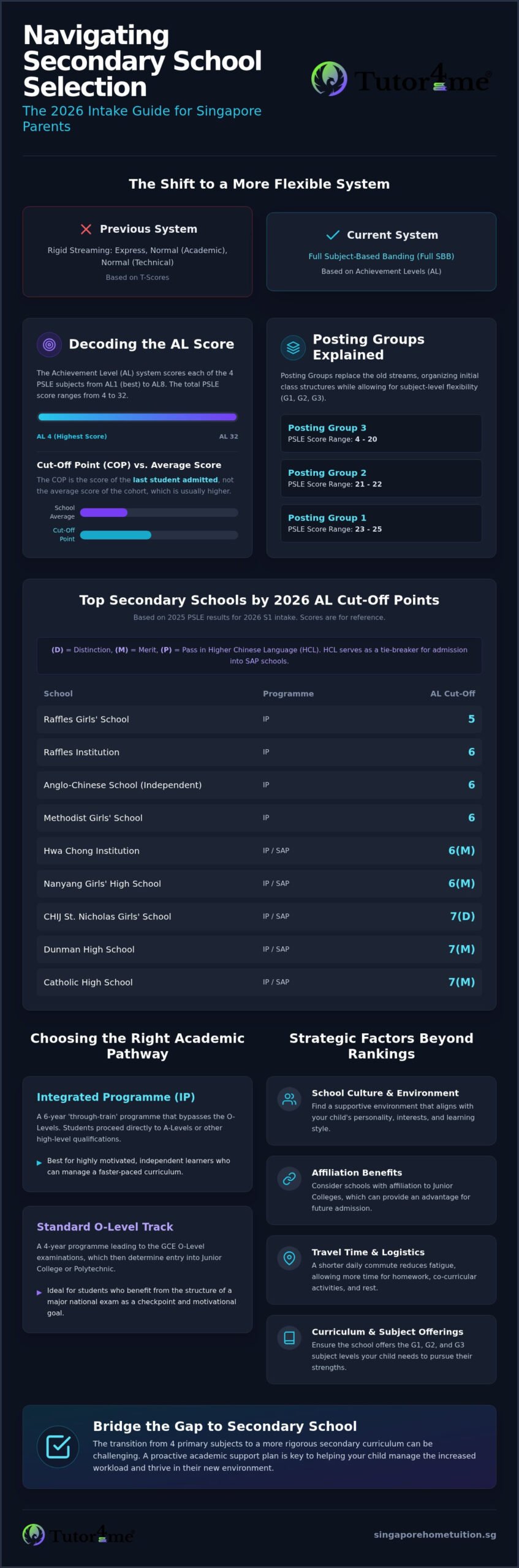
You should distinguish between the “lowest score admitted” and the average score of the cohort. The cut-off point (COP) is specifically the PSLE score of the last student admitted to a school for that year. It represents the entry threshold. If a school has a COP of 8, it means every student who entered had an 8 or better. However, the average score of the students in that school might be significantly higher, perhaps closer to a 5 or 6. Focusing solely on the COP tells you only about the barrier to entry, not the overall academic environment.
The Shift to Achievement Levels (AL)
The move from T-scores to the Achievement Level (AL) system was designed to reduce fine-grained differentiation between students. Each subject is now scored from AL1 to AL8, with a total score ranging from 4 to 32. This shift changed the Education in Singapore by grouping students into broader bands. It makes competition less about decimal points and more about consistent performance across all four subjects. Many parents find that PSLE home tuition provides the necessary stability to navigate these broader scoring bands. An AL Cut-Off Point is the score of the last student admitted to a school.
Posting Groups 1, 2, and 3 Explained
In the 2026 landscape, traditional labels like Express, Normal (Academic), and Normal (Technical) have been retired. They are replaced by Posting Groups 1, 2, and 3. Posting Group 3 represents the highest academic tier in the 2026 rankings, generally requiring an AL score of 4 to 20. Posting Group 2 typically covers scores 21 to 22, while Posting Group 1 includes scores 23 to 25. These groups help schools organize initial class structures while maintaining academic standards.
Full Subject-Based Banding (Full SBB) introduces flexibility that the old streaming system lacked. Students aren’t locked into a single rigid track. They can take specific subjects at G1, G2, or G3 levels based on their individual strengths. For instance, a student in Posting Group 2 who excels in Mathematics can take that subject at the G3 level. This personalized approach ensures that the secondary school ranking is merely a starting point, not a ceiling on a student’s potential.
Top Singapore Secondary Schools by 2026 AL Cut-Off Points
Securing a spot in a premier institution remains a significant milestone for many families. The 2026 secondary school ranking reveals that the “AL 6” threshold continues to be the definitive benchmark for Singapore’s most elite schools. This score represents the top tier of the PSLE cohort, where competition is exceptionally high. Schools like Raffles Institution and Nanyang Girls’ High School maintain their positions at the summit because they offer specialized environments that cater to high-ability learners. Their consistently low cut-off points (COPs) are a direct result of high demand during the Secondary 1 Posting Process.
When reviewing the 2026 COPs, you’ll notice suffixes like (D), (M), or (P) next to certain scores. These stand for Distinction, Merit, and Pass in Higher Chinese Language (HCL). For example, a COP of 6(M) means the last student admitted had an AL score of 6 and at least a Merit in HCL. This is a critical distinction for parents aiming for Special Assistance Plan (SAP) schools, as HCL results often serve as the tie-breaker for students with identical AL scores.
- Raffles Girls’ School (IP): 5
- Hwa Chong Institution (IP/SAP): 6(M)
- Nanyang Girls’ High School (IP/SAP): 6(M)
- Raffles Institution (IP): 6
- Anglo-Chinese School (Independent) (IP): 6
- Methodist Girls’ School (IP): 6
- CHIJ St. Nicholas Girls’ School (IP/SAP): 7(D)
- Dunman High School (IP/SAP): 7(M)
- Catholic High School (IP/SAP): 7(M)
- National Junior College (IP): 7
Top Integrated Programme (IP) Schools
IP schools consistently dominate the secondary school ranking because they offer a seamless six-year journey. Students bypass the O-Level examinations, moving directly to the A-Levels or the International Baccalaureate (IB) diploma. This track allows for a broader, more enriched curriculum that focuses on critical thinking and leadership. Because the academic pace is rigorous, many parents engage a top home tutor Singapore to help their children manage the transition from primary school to the more independent learning style required in IP tracks.
Special Assistance Plan (SAP) Schools
SAP schools like Hwa Chong and St. Nicholas Girls’ focus heavily on bilingualism and Chinese cultural heritage. In the 2026 rankings, these schools remain highly sought after by families who value strong linguistic foundations. Beyond the top five, schools like Anglican High and Chung Cheng High (Main) provide excellent SAP environments with slightly more accessible COPs. If your child is aiming for these institutions, ensuring they excel in Higher Chinese is vital for their admission chances. Finding the right academic support through PSLE home tuition can provide the competitive edge needed for these specialized schools.
Full SBB and the Integrated Programme: Beyond the Numbers
While the secondary school ranking provides a numerical baseline, the implementation of Full Subject-Based Banding has fundamentally shifted the academic environment for the 2026 intake. Traditional streaming labels are gone. Instead of being locked into a single track, students now operate within Posting Groups that allow for significant customization. This means a school’s overall rank is no longer a rigid predictor of your child’s specific curriculum. A student’s experience is now defined by their individual subject levels rather than a collective label.
This shift means that the prestige of a school is becoming secondary to its ability to support a student’s unique learning profile. The 2026 academic landscape treats a school’s ranking as merely one part of a larger equation. Parents are looking for environments that offer a balance of G2 and G3 subjects tailored to their child’s strengths. This personalized approach reduces the “all or nothing” pressure of the PSLE, as students can still access higher-tier content even if they didn’t qualify for Posting Group 3 across all subjects.
Subject-Level Customization in 2026
Students can now leverage their strengths in specific areas like Math or Science. For example, a student in Posting Group 2 who excels in logic can take Mathematics at the PG3 level. This flexibility makes “mid-tier” schools increasingly attractive to families who value a balanced pace. They often provide a less pressurized environment while still offering access to the most rigorous academic content. To manage this transition, many families utilize Secondary School Home Tuition to help students bridge the gap to higher subject levels. It ensures that the jump from G2 to G3 content is manageable and successful.
The Integrated Programme (IP) vs. O-Levels
The academic rigor of the IP track differs significantly from the O-Level track in dual-track schools. IP students focus on a six-year journey that emphasizes independent research and critical analysis. It’s designed for those who thrive without the constant pressure of national examinations. However, this independence requires a high level of maturity. Students must manage their own schedules and engage with complex topics that often go beyond the standard syllabus. This academic maturity is a prerequisite for success in the IP track, as the curriculum often moves faster than the standard national pace. For those looking at international curriculum comparisons, IGCSE Home Tuition Singapore can provide insights into how these tracks prepare students for global university standards. Choosing between IP and O-Levels should depend on your child’s learning style rather than the school’s rank alone.
Strategic Selection: Factors to Consider Beyond Rankings
While the secondary school ranking provides a clear benchmark, relying solely on numbers can lead to a mismatch between a student and their environment. Strategic selection involves looking at logistical and cultural factors that will impact your child’s daily life for the next four to six years. The “Distance Rule” is one of the most overlooked factors. A long commute can drain a student’s energy, leaving them with less time for revision and rest. Choosing a school within a 30 to 45-minute commute often yields better long-term academic results than a higher-ranked school that requires two hours of travel daily. This physical stamina is essential for managing the increased workload of secondary education.
Co-Curricular Activities (CCA) also play a vital role in the Direct School Admission (DSA) process. If your child has a specific talent in sports, arts, or leadership, the DSA path allows them to secure a spot in a school before the PSLE results are even released. This effectively bypasses the standard AL ranking system. You should research schools that offer niche programs, such as Applied Learning Programmes (ALP) or Learning for Life Programmes (LLP), which align with your child’s passions. These programs provide a more holistic education and can be a significant factor in a student’s overall engagement with their school.
The Affiliation Advantage
Students from affiliated primary schools often enjoy a safety net through lower cut-off points. This is a significant strategic advantage when the secondary school ranking for an institution is highly competitive. Choosing an affiliated school can reduce the stress of the posting process; it provides a clearer path to admission even if the AL score is slightly higher than the general COP. If you’re currently managing this transition, seeking PSLE Home Tuition Singapore can help you finalize your choices and ensure your child meets the necessary thresholds for their preferred affiliated school.
Holistic Development and Niche Programs
It’s vital to look at a school’s “Value-Added” performance. This metric shows how much a school improves its students’ grades from their entry point to their final examinations. A school ranked in the Top 20 might offer a better personality fit and more specialized niche programs than a Top 5 school. Matching your child’s personality to the school’s culture ensures they remain motivated throughout their secondary journey. To support your child through these critical years, consider engaging Home Tutors Singapore to provide personalized guidance tailored to their new school’s curriculum and academic track.
Bridging the Gap: Academic Success in Your Chosen School
Entering a high-status institution is a significant victory; however, the real work begins on day one. The “Secondary 1 Shock” is a documented reality for many students in Singapore. They move from managing four subjects to juggling eight or more. This isn’t just about quantity. The nature of the work changes, requiring better time management and a more sophisticated approach to study habits. Even if a school holds a prestigious position in the secondary school ranking, the internal pressure to perform remains high. Students must adapt quickly to maintain their momentum.
Many parents assume that a high AL score guarantees a smooth transition. This is rarely the case. The depth of Secondary Math and Science often surprises even top-tier students. Concepts become more abstract and rote memorization no longer suffices. Early intervention is the most effective way to prevent subject gaps that can snowball by the end of the first year. Addressing these challenges immediately keeps your child’s confidence intact and ensures they don’t fall behind their peers.
Mastering New Subjects
Science transitions from a general topic into specialized branches. Students must now navigate Biology, Chemistry, and Physics as distinct disciplines. Each carries its own terminology and logic. Building a strong foundation through Chemistry Tuition Singapore can prevent the common struggle with molecular theory and chemical equations later on. Similarly, the Humanities and English Literature demand a level of critical thinking that PSLE English didn’t require. Students must learn to analyze themes and authorial intent rather than just identifying facts.
Personalized Matching with Singapore Home Tuition
Large classroom settings often leave specific questions unanswered. 1-to-1 home tuition provides the personalized attention your child needs to master these new complexities. We match your child with MOE-trained teachers or subject specialists who are deeply familiar with the 2026 syllabus requirements. This customized approach ensures that the tutor addresses your child’s specific weak points immediately. Home-based learning also saves precious travel time for busy secondary students. It allows them to focus their energy on rest and revision rather than commuting. Our agency provides fast tutor matching to support academic goals in high-stakes environments.
Securing Your Child’s Future in a New Academic Era
Choosing the right environment involves more than just analyzing the latest secondary school ranking data. While AL cut-off points provide a necessary starting line, your child’s ultimate success depends on how they navigate the flexibility of Full SBB and the increased rigor of eight or more subjects. Strategic factors like school culture and travel logistics are just as vital for long-term well-being as the academic prestige of the institution. A well-rounded choice balances academic aspiration with practical daily realities.
The transition from primary to secondary school is a significant milestone that often requires specialized guidance to bridge the gap. We provide access to MOE-trained teachers and subject specialists available islandwide to ensure your child remains confident as they face new challenges. Our personalized 1-to-1 matching is designed to suit your child’s unique learning style and your specific budget. Find the Perfect Home Tutor for Secondary School Success today and give your child the dedicated support they need to thrive. With a clear plan and the right partner, your child can turn the academic demands of 2026 into a foundation for lifelong achievement.
Frequently Asked Questions
What is the secondary school cut-off point for 2026?
The 2026 cut-off points are determined by the 2025 PSLE results of the cohort applying for admission. These scores aren’t fixed by the Ministry of Education but reflect the score of the last student admitted to a specific school. For elite schools, the cut-off often sits between AL 5 and AL 7. You should use the previous year’s data as a guide while allowing for slight fluctuations based on student demand.
How are secondary school rankings determined in Singapore?
The secondary school ranking in Singapore is primarily based on the Achievement Level (AL) cut-off points from the previous year’s intake. Schools with the lowest scores are considered the most competitive and are often ranked higher by parents. However, rankings can also be influenced by a school’s niche programs and historical academic performance in national examinations. It’s important to view these rankings as a measure of popularity rather than a definitive quality score.
What is the difference between IP and O-Level tracks in terms of ranking?
Integrated Programme (IP) tracks consistently feature lower cut-off points compared to O-Level tracks within the same school. This is because the IP allows students to bypass the O-Level examinations and proceed directly to A-Levels or the International Baccalaureate. Academically strong students often prefer this six-year fast-track, which increases competition for spots. Consequently, IP tracks usually sit at the top of any secondary school ranking list due to this high barrier to entry.
How does Full Subject-Based Banding (Full SBB) affect school rankings?
Full Subject-Based Banding (Full SBB) makes entry thresholds more fluid by removing rigid streaming labels like Express or Normal Academic. Students now take subjects at different levels (G1, G2, or G3) based on their individual strengths. While the entry cut-off point remains a key indicator of a school’s academic tier, the focus is shifting toward how well a school supports diverse learning paces. This change encourages parents to look at subject-level flexibility.
Can my child enter a top-ranked school if they missed the cut-off point?
Admission is generally strict, but you can appeal if your child missed the cut-off point by a small margin. Success is rare and usually depends on available vacancies and specific school criteria. Alternatively, the Direct School Admission (DSA) exercise allows students to secure spots based on talents in sports, arts, or leadership before the PSLE results are released. If your child didn’t qualify through the standard posting, they may need to consider other schools.
Is it better to choose a school further away if it is ranked higher?
Choosing a school closer to home is often more beneficial for a student’s long-term academic health than picking a higher-ranked school with a long commute. A daily travel time exceeding 45 minutes can lead to physical exhaustion and reduced focus during evening revision. Students in Secondary 1 face a significant increase in subjects; having more time for rest and extracurricular activities is often more valuable than the marginal prestige of a slightly higher-ranked institution.
How do affiliations affect the 2026 secondary school rankings?
Affiliations provide a significant advantage by offering lower cut-off points for students from affiliated primary schools. This safety net allows these students to enter competitive schools with an AL score that might be several points higher than the general public requirement. It provides peace of mind for families during the posting process. However, spots for affiliated students are limited, and meeting the minimum requirement doesn’t always guarantee admission if demand is exceptionally high.
Why should I consider home tuition for my child in Secondary 1?
Secondary 1 introduces a drastic jump in academic depth and the number of subjects. Home tuition provides the 1-to-1 personalized attention necessary to master new topics like Biology, Chemistry, or Literature. Our agency matches your child with MOE teachers or subject specialists who provide customized support islandwide. This early intervention prevents subject gaps from forming and helps students manage the transition into high-stakes secondary environments without feeling overwhelmed by the increased workload.