

What if the reason your child is struggling with Chemistry isn’t a lack of effort, but a reliance on memorisation techniques that no longer work? It’s a common frustration for many parents in Singapore. You watch your child spend hours highlighting notes, only to see them freeze when faced with the application-heavy questions of the new H2 or O-Level papers. The jump from Lower Secondary Science to Pure Chemistry is notoriously steep. With the 2026 syllabus updates placing even less emphasis on factual recall and more on scientific inquiry, the old ways of studying are simply falling short.
We understand that you want a reliable partner to help navigate these high-stakes academic milestones. This guide explains how the right chemistry tuition singapore can transform your child’s results. You’ll discover how inquiry-based learning and personalised 1-to-1 home tuition move beyond rote learning to foster genuine conceptual mastery. We’ll preview the specific shifts in the 2026 curriculum, such as the revised H2 Chemistry 9729 framework, and show you how a dedicated specialist can simplify abstract concepts. This approach gives your child the confidence to tackle even the most challenging unseen questions and secure a distinction.
Key Takeaways
- Understand why the 2026 MOE syllabus updates render rote memorisation ineffective for modern, application-heavy examination questions.
- Discover how Inquiry-Based Learning mirrors professional scientific methods to bridge the gap between abstract theory and exam performance.
- Evaluate the advantages of personalised 1-to-1 chemistry tuition singapore compared to the standardised approach of group learning centres.
- Learn specific strategies to satisfy SEAB markers, including high-impact keywords and active recall techniques for complex topics.
- Identify how a professional tutor matching process ensures your child finds a specialist who understands their unique learning needs.
The Evolution of Chemistry Tuition in Singapore: Why Rote Learning is Failing
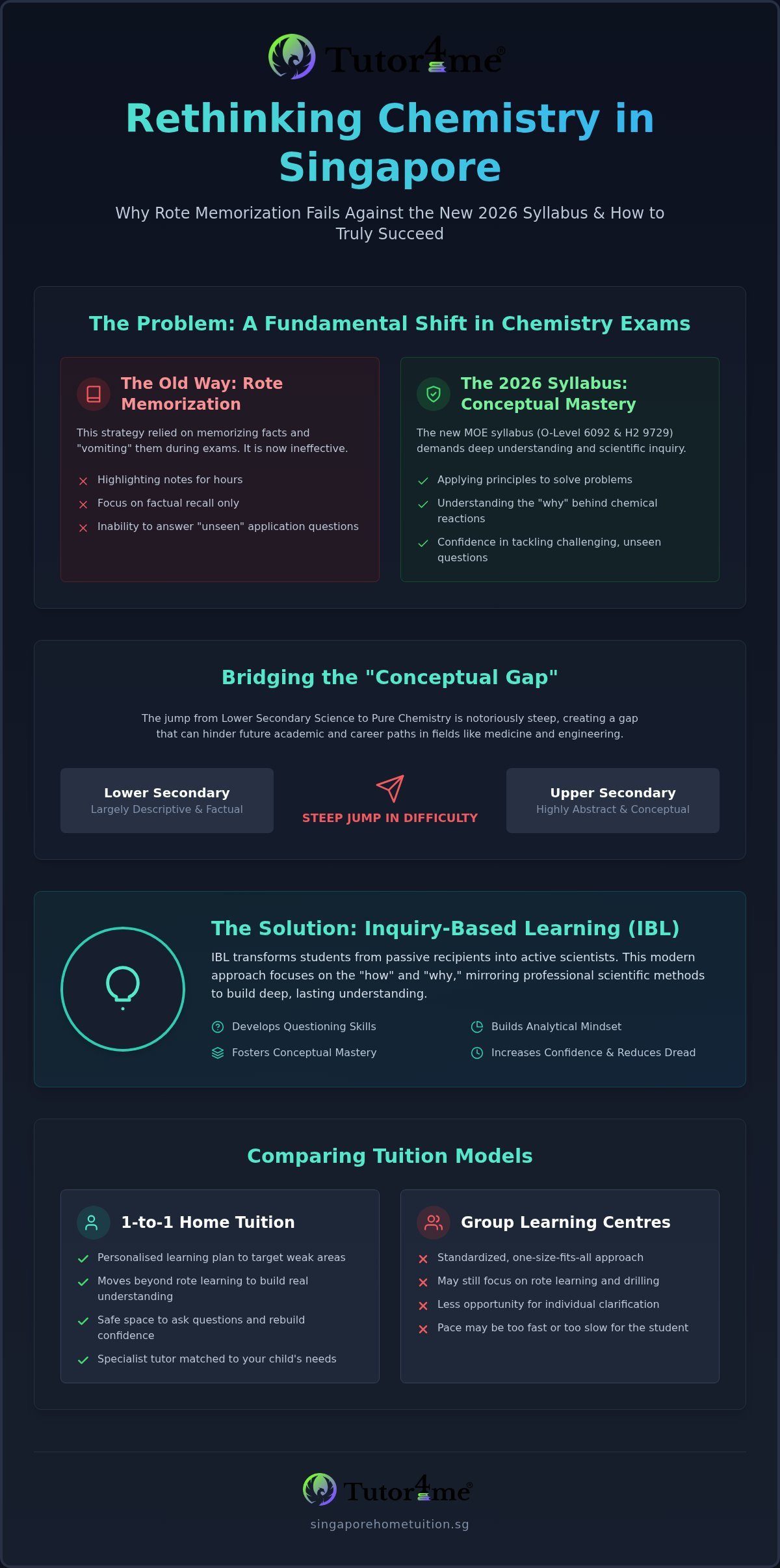
The academic landscape for Chemistry in Singapore has undergone a significant transformation. For decades, many students relied on a “memorise and vomit” strategy to clear their national examinations. However, the latest MOE Chemistry syllabuses, specifically 6092 for O-Levels and the revised 9729 for H2 Chemistry, have effectively closed that loophole. SEAB examiners now prioritise application over factual recall. This shift is most evident in topics like Qualitative Analysis, where students can no longer simply memorise a table of observations. They must now explain the underlying chemical principles behind every precipitate and colour change. If a student doesn’t understand the “why,” they often find themselves unable to answer even basic descriptive questions in the 2026 papers.
This evolution makes choosing the right chemistry tuition singapore more critical than ever. Traditional group tuition that focuses on rote learning often fails to address the “Conceptual Gap” that emerges between Secondary 2 and Secondary 3. In Lower Secondary, Science is largely descriptive. By the time a student reaches Pure Chemistry, the subject becomes highly abstract, requiring a firm grasp of atomic theory and bonding to explain macroscopic properties. Chemistry acts as a rigorous gatekeeper for prestigious university tracks like medicine and engineering. Failing to master these foundations early doesn’t just impact a single grade; it can limit future career pathways. This is why many parents are moving toward Inquiry-Based Learning, an approach that encourages students to ask questions and explore concepts rather than just accepting them as facts.
Understanding the 2026 Chemistry Syllabus Requirements
The 2026 syllabus requirements demand a higher level of intellectual rigour. O-Level students must move beyond basic atomic structure to master complex Organic Chemistry pathways and stoichiometry. For JC students, the H2 Chemistry 9729 framework introduces updated data booklets and a heavy focus on Energetics, Kinetics, and Equilibria. These topics require students to apply mathematical precision to chemical theories. Examiners are looking for deep understanding, meaning that “unseen” application questions now carry more weight than ever before. Success requires a mentor who can bridge the gap between O-Level foundations and the intense demands of A-Level content.
The Emotional Toll of Academic Struggle
Falling behind in Chemistry often leads to a significant drop in a student’s overall academic confidence. Because the subject is so cumulative, missing a single concept in Secondary 3 can make the entire Secondary 4 year feel overwhelming. The pressure of the O-Level and A-Level milestones in Singapore’s competitive environment can be taxing for both the student and the family. Seeking chemistry tuition singapore as an early intervention is far more effective than enrolling in last-minute “crash courses.” A stable, 1-to-1 learning environment provides the peace of mind needed to rebuild that confidence, allowing students to approach their examinations with a sense of empowerment rather than dread.
Inquiry Based Learning Singapore: A Modern Approach to Chemistry
Traditional education often treats Chemistry as a collection of facts to be stored and retrieved. Inquiry-based learning (IBL) flips this script by positioning the student as a scientist rather than a passive recipient of information. This student-centered pedagogy focuses on the power of questioning, encouraging learners to explore the “how” and “why” behind chemical phenomena. By mirroring the scientific method used in professional Chemistry research, IBL helps students develop the analytical mindset required for high-level academic success. Inquiry-based learning in the context of Singaporean Chemistry tuition is a pedagogical framework where students build deep conceptual understanding by investigating scientific questions and developing evidence-based arguments under the guidance of a specialist.
Implementing IBL effectively requires an understanding of its four distinct levels. These stages guide a student from high levels of tutor support to complete independence. The first level is Structured Inquiry, where the tutor provides the question and the procedure to help the student reach a known conclusion. This evolves into Triangulated Inquiry, where students cross-reference multiple data points and concepts to form a cohesive argument. As the student gains confidence, they move into Guided Inquiry, where the tutor provides only the research question, leaving the methodology to the student. Finally, Open Inquiry allows the student to formulate both the question and the solution, a skill that is invaluable for the independent learning requirements of the chemistry tuition singapore landscape.
How Inquiry-Based Learning Solves the “Why” in Chemistry
Most students can tell you that a reaction occurs, but few can explain why it happens. IBL pushes students to move beyond “what” by using first principles like electronegativity and atomic radius to predict outcomes. Instead of memorising the reactivity series, a student might be asked to investigate why the position of an element on the Periodic Table dictates its behaviour. When a student hits a logical wall, a tutor uses the Socratic method to ask probing questions that help the student “debug” their own fallacies. This process ensures that the knowledge is constructed by the student, making it far more resilient than anything learned through rote memorisation.
The Role of the Tutor as a Facilitator
A private tutor is uniquely positioned to lead IBL because they have the luxury of time that a school teacher often lacks. In a 1-to-1 setting, the tutor acts as a facilitator, creating a safe environment where “wrong answers” aren’t failures but useful data points for further investigation. This personalised attention is crucial for mastering the rigorous requirements of the 2026 Chemistry Syllabus, especially the Practical Exams which demand high-level critical thinking. If you’re looking for a mentor who can guide your child through this process, Singapore Home Tuition can match you with an experienced specialist who understands these modern teaching methodologies. This approach doesn’t just prepare students for exams; it builds the critical thinking skills they’ll need for life.
Comparing Chemistry Tuition: Home Tuition vs. Learning Centres
When searching for chemistry tuition singapore, parents often weigh the benefits of established learning centres against the privacy of 1-to-1 home-based sessions. Learning centres offer a structured, school-like environment and the opportunity for peer interaction. However, these group settings often rely on a standardised curriculum that follows a fixed timeline. In a subject as cumulative as Chemistry, a student who misses a foundational concept in week three may struggle for the rest of the term because the class must move forward. Home tuition provides a necessary alternative by prioritising the individual’s specific learning gaps over a rigid schedule.
The Ministry of Education actively promotes Inquiry-based Learning in the Singapore Chemistry curriculum, a methodology that flourishes in a 1-to-1 setting. In a private session, the tutor has the flexibility to pause and explore a student’s question in depth, whereas a centre must balance the needs of ten or more students. This level of customisation ensures that the student isn’t just another face in a crowd, but an active participant in their own education. It’s a shift from standardised instruction to personalised mentorship.
Travel time and physical fatigue are also significant factors in Singapore’s high-pressure academic environment. A student who finishes school at 4:00 PM and travels 45 minutes to a tuition centre arrives with a heavy cognitive load. This fatigue reduces their ability to absorb complex information like organic synthesis or chemical energetics. Home tuition eliminates this commute, allowing the student to learn in a familiar, comfortable space. While the hourly rate for private chemistry tuition singapore may be higher than group rates, the return on investment is often superior. Every minute is dedicated to the student’s specific needs, making the learning process far more efficient.
The Benefits of 1-to-1 Personalisation
One of the greatest advantages of 1-to-1 tuition is the immediate feedback loop. If a student misapplies the Mole Concept during a practice question, the tutor can correct the misconception instantly before it becomes a deep-seated habit. This real-time debugging is nearly impossible in a group setting. Tutors can also pace the curriculum perfectly. For those approaching their final secondary years, a structured O Level Home Tuition plan ensures that challenging topics are given the time they deserve, rather than being rushed to meet a centre’s deadline.
Resource Availability in Home Tuition
There’s a common misconception that home tuition lacks the resources of a dedicated lab. In reality, modern home tutors use digital simulations and molecular modelling apps to visualise reactions that are difficult to see even in a school laboratory. Additionally, home tutors work directly with the student’s own school notes and materials. This alignment is vital because it ensures the student is prepared for their specific school’s prelim patterns and teacher expectations, providing a tailored path to distinction.
Practical Strategies to Score Distinctions in Chemistry
Success in national examinations requires more than just understanding; it requires a strategic approach to the assessment itself. Markers from the Singapore Examinations and Assessment Board (SEAB) look for specific “keywords” that signal a student’s technical proficiency. For instance, when discussing reaction rates, using the phrase “increased frequency of effective collisions” is mandatory for full marks. Simply describing the process in layman’s terms often results in lost credit. High-quality chemistry tuition singapore trains students to identify these marking requirements early, ensuring their answers are both accurate and concise. This level of precision is what separates a B grade from an A.
Another powerful strategy is the “Active Recall” technique. Instead of passively reading through the Reactivity Series or Periodic Table trends, students should practice reproducing this information from a blank page. This method forces the brain to retrieve data, which significantly improves long-term retention compared to re-reading notes. For Paper 2, time management is equally vital. A practical rule of thumb is to allocate approximately one minute per mark. This allows for a final ten-minute buffer to check for common mistakes, such as missing state symbols or unbalanced chemical equations, which are frequent pitfalls for even the strongest students.
Tackling Application Questions with Confidence
Complex Organic Chemistry synthesis problems often overwhelm students because of their length. We recommend the “Chunking” method, where the student breaks the reaction pathway into smaller, manageable steps. By identifying “clue words” in the question stem, such as “decolourises bromine water” or “effervescence with carbonates,” students can deduce the functional groups involved. Accuracy in drawing chemical structures and energy profile diagrams is also essential. A clear, well-labelled diagram can often secure marks even if the accompanying written explanation is brief, as it demonstrates a clear grasp of the concept.
Preparing for the Chemistry Practical Exam
The practical component is often where distinctions are won or lost. Since students cannot take lab equipment home, mental rehearsal becomes a key tool for success. Walking through the specific steps of a titration or salt analysis in one’s mind helps solidify the procedure before stepping into the lab. Students must also understand common sources of error, such as heat loss to the surroundings or parallax error, and be able to suggest valid improvements. Developing these rigorous habits early, as discussed in our PSLE Home Tuition guide, creates a strong foundation for the sciences. If your child is struggling to bridge the gap between theory and practical work, you can request a specialist tutor to provide the targeted support they need to excel in their next assessment.
Finding the Perfect Chemistry Mentor with Singapore Home Tuition
Selecting the right chemistry tuition singapore involves more than just finding someone with a degree in the subject. It requires a mentor who understands the nuances of the 2026 MOE syllabus and possesses the pedagogical skills to implement inquiry-based learning. Our agency maintains a rigorous tutor verification process to ensure every specialist in our pool is qualified to guide students through high-stakes examinations. We verify academic credentials and teaching experience, focusing on those who are MOE-trained or have a proven track record of helping students achieve distinctions. This meticulous screening provides parents with the confidence that their child is learning from a stable, professional pillar in the local educational landscape.
Beyond technical expertise, we prioritise the interpersonal “chemistry” between the tutor and the student. A student who feels overwhelmed by the jump to H2 Chemistry needs a supportive environment where they feel safe to ask difficult questions. We match tutors based on their ability to act as facilitators, specifically looking for mentors who can move a student through the four levels of inquiry discussed earlier. If a student is struggling with the Mole Concept or Organic Synthesis, they don’t need a lecturer; they need a dedicated specialist who can identify their specific logical fallacies. Our fast matching service ensures that you can find this perfect fit quickly, preventing your child from falling further behind as the academic year progresses.
Why 1-to-1 Home Tuition is the Logical Conclusion
The unique advantage of a dedicated mentor is the ability to focus entirely on the student’s unique requirements. In a 1-to-1 setting, the curriculum is paced to the learner’s speed, ensuring that foundational concepts are mastered before moving to complex application questions. This personalised attention is a significant benefit for a high-stakes subject like Chemistry, where one misunderstood topic can derail an entire paper. We offer islandwide coverage, bringing these specialists directly to your home. This convenience allows your child to learn in a familiar environment, free from the distractions of a crowded classroom. The process is simple: you provide us with your requirements, and we match you with a qualified specialist who meets your child’s academic and personality needs.
Take the Next Step Toward Academic Excellence
Academic success is often a matter of timing. Many parents wait until the mid-year assessment slump to seek help, but early intervention is far more effective for building long-term confidence. Providing your child with professional academic support now ensures they have the tools to tackle “unseen” questions with ease. It’s about providing peace of mind for the family and empowerment for the student. If you’re ready to transform your child’s understanding from rote memorisation to genuine conceptual mastery, we invite you to Request a Chemistry Home Tutor Today and secure the professional mentorship your child deserves.
Empowering Your Child for Success in the 2026 Chemistry Syllabus
Mastering Chemistry in Singapore’s competitive landscape now requires a shift away from outdated rote learning. The 2026 syllabus demands a deep, inquiry-based understanding that allows students to apply complex concepts to unfamiliar exam scenarios. By choosing 1-to-1 home-based mentorship, you provide your child with the dedicated attention needed to bridge conceptual gaps and build lasting academic confidence. This personalised approach ensures that specific weaknesses are addressed immediately, moving beyond simple memorisation toward true mastery.
Finding the right chemistry tuition singapore is the most effective way to ensure your child remains prepared for their O-Level or A-Level milestones. Singapore Home Tuition offers a fast and reliable service that matches your child with MOE-trained teachers and subject specialists. We provide personalised 1-to-1 matching for all academic levels, ensuring a perfect fit for your child’s unique learning requirements. Find your ideal Chemistry tutor today with Singapore Home Tuition and give your child the academic advantage they deserve. It doesn’t just improve grades; it provides the peace of mind that comes with professional support.
Frequently Asked Questions
Is 1-to-1 Chemistry tuition more effective than group classes in Singapore?
Personalised 1-to-1 sessions are generally more effective for students who have specific conceptual gaps or struggle with the fast pace of school lectures. Unlike group classes that follow a rigid schedule, a private tutor can pause to ensure mastery of foundational topics like the Mole Concept before moving forward. This level of attention is particularly beneficial in the high-stakes environment of Singaporean national examinations where every mark counts.
How much does Chemistry home tuition cost for O-Level and JC students?
Rates for chemistry tuition singapore vary depending on the tutor’s qualifications and the student’s academic level. Generally, MOE-trained teachers and subject specialists are positioned at a different rate tier compared to full-time tutors or undergraduates. We recommend contacting us directly to find a mentor who fits your specific budget and academic requirements while maintaining the high standards necessary for the 2026 syllabus.
Can a home tutor help with the Chemistry Practical Exam (Paper 3)?
A home tutor provides critical support for Paper 3 through mental rehearsal and rigorous error analysis. They guide students through the logic of salt analysis and titration procedures, helping them identify common sources of error and suggest valid improvements. This theoretical mastery of practical procedures is often what secures the distinction in the actual lab assessment where time management and precision are vital.
What is the best time to start Chemistry tuition for a Secondary 3 student?
The ideal time to start is at the beginning of the Secondary 3 academic year. This is when the “Conceptual Gap” between Lower Secondary Science and Pure Chemistry is most pronounced. Early intervention allows the student to build a strong foundation in atomic structure and bonding. These concepts are essential for understanding more complex topics like Organic Chemistry that appear later in the curriculum.
How does inquiry-based learning help with the H2 Chemistry syllabus?
Inquiry-based learning helps students master the H2 Chemistry syllabus by focusing on first principles like electronegativity and thermodynamics rather than rote learning. Instead of memorising reaction pathways, students learn to predict outcomes based on chemical theory. This analytical mindset is crucial for tackling the application-heavy questions that now dominate the revised 9729 framework used in JC examinations.
Are your Chemistry tutors familiar with the latest 2026 MOE syllabus changes?
Yes, our specialists stay fully updated on the 2026 syllabus changes for both O-Level (6092) and H2 Chemistry (9729). They understand the increased emphasis on application-based questions and the revised weighting for practical components. This ensures that the chemistry tuition singapore we provide remains aligned with the specific requirements set by SEAB examiners for the upcoming national papers.
Can I choose between an MOE teacher and a full-time private Chemistry tutor?
You have the flexibility to choose the tutor profile that best suits your child’s learning style. Our pool includes current or former MOE-trained teachers and highly experienced full-time subject specialists. Whether you require a mentor with deep classroom experience or one who offers a more flexible and modern approach to inquiry-based learning, we facilitate a match that meets your specific criteria.
How long does it take to find a Chemistry tutor through your agency?
Our matching process is designed to be fast and efficient to ensure your child doesn’t fall further behind in school. We typically provide suitable tutor profiles for your consideration within 24 to 48 hours of receiving your request. This quick turnaround allows you to start the first session promptly, providing your child with the academic support they need to regain their confidence.