
On 25 November 2025 at 11:00 am, thousands of families across Singapore will receive the PSLE results that define the next four to six years of their child’s academic journey. It’s a high-stakes moment that often brings a mix of pride and intense pressure as you begin scanning the latest secondary school ranking to find the best possible fit. You’re likely feeling the weight of the competitive AL scoring system, especially with the transition to Full Subject-Based Banding (SBB) adding new layers of complexity to your decision.
We understand that you want more than just a spot in a top-tier institution; you want a school environment where your child can truly excel. This guide provides the essential data you need to make an informed choice, including the 2026 AL cut-off points for Integrated Programme (IP) and O-Level tracks. We’ll explain how Posting Groups work and how targeted 1-to-1 home tuition can help your child bridge the gap to their dream school.
Key Takeaways
- Learn how to interpret the latest secondary school ranking data to navigate the 2026 intake with clarity and confidence.
- Identify the projected AL cut-off points for elite Integrated Programme (IP) schools and the benefits of a six-year academic trajectory.
- Discover how school affiliations provide a strategic advantage through lower cut-off points for students from specific primary schools.
- Evaluate schools based on holistic factors like culture and niche programmes to ensure a sustainable and productive environment for your child.
- Understand how personalized 1-to-1 home tuition can target specific subject gaps to help your child reach the necessary AL bracket for their top-choice school.
Decoding the 2026 Secondary School Ranking System
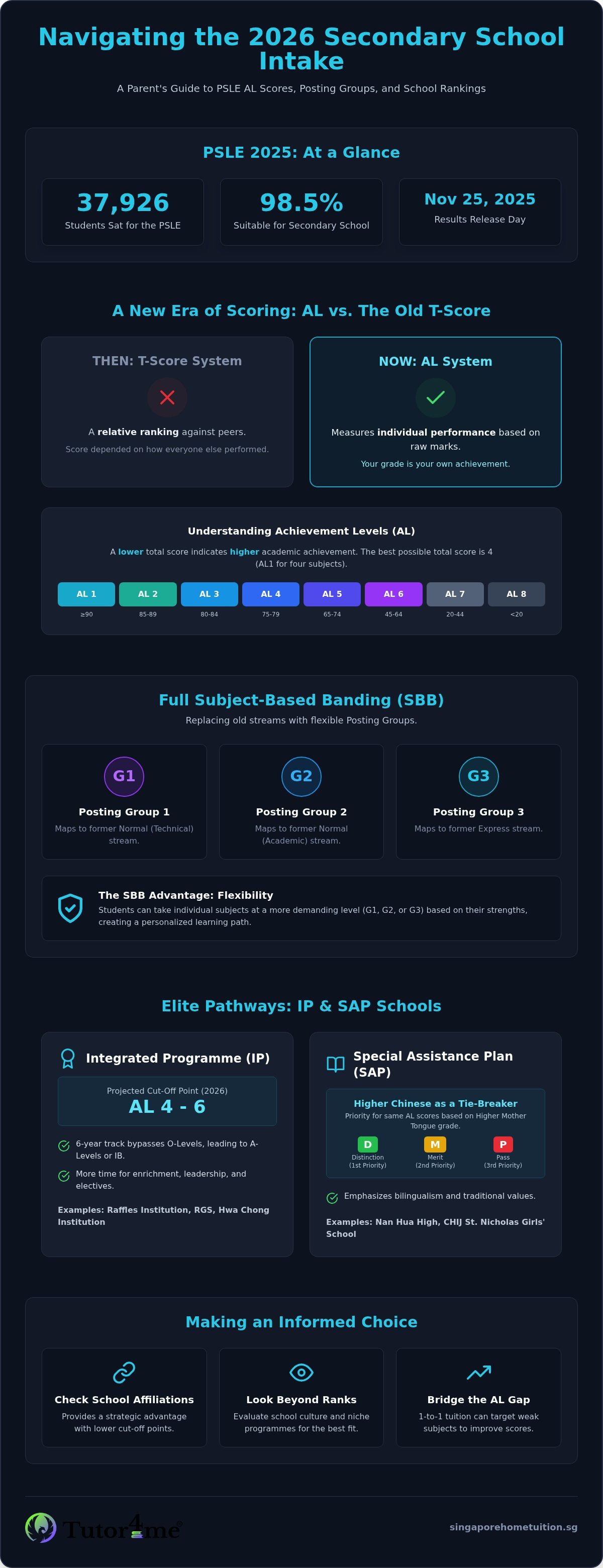
The secondary school ranking for the 2026 intake is a direct reflection of the Achievement Level (AL) scores from the 2025 PSLE cohort. Understanding these rankings requires looking at the Cut-Off Point (COP), which represents the score of the final student posted to a specific school. If a school has a COP of 8, it means every student admitted had a score of 8 or better. Because the performance of each cohort varies, these points fluctuate slightly every year. They serve as a reliable guide for parents rather than a fixed rule for admission.
The 2026 rankings are grounded in the results of the 37,926 students who sat for the PSLE in 2025. With 98.5% of these students assessed as suitable for secondary school, the competition for specific posting groups remains high. Parents should use the previous year’s indicative score ranges to gauge the likelihood of admission, while remaining aware that the final COP is only determined after the posting exercise is complete.
Achievement Levels (AL) vs. The Old T-Score
The AL system marks a significant shift from the old T-score method used years ago. While the T-score was a relative ranking against peers, the AL system measures a student’s individual performance based on raw marks. Scores range from AL1, representing 90 marks and above, to AL8, which is below 20 marks. In this system, a lower total score indicates higher academic achievement. For example, a student with a total score of AL4 is ranked significantly higher than one with AL20. The choice order tie-breaker rule for 2026 admissions ensures that if two students share the same AL score, the student who placed the school higher in their six choices receives priority.
Understanding Posting Groups 1, 2, and 3
The landscape of Singapore’s secondary education system has evolved with the implementation of Full Subject-Based Banding (Full SBB). The traditional Express, Normal (Academic), and Normal (Technical) streams have been replaced by Posting Groups 1, 2, and 3. Posting Group 3 generally maps to the former Express track, requiring the most demanding AL scores. However, the new system offers much more flexibility than the old streaming model.
Students now have the opportunity to take specific subjects at a more demanding level, known as G1, G2, or G3, based on their individual strengths. This shift means that a secondary school ranking list may now feature multiple COPs for a single school to account for different entry requirements across the three posting groups. For parents aiming to secure a spot in a specific posting group, PSLE home tuition provides the targeted support needed to improve specific subject grades and lower the overall AL score before the final examinations.
Elite Pathways: Integrated Programme (IP) and SAP School Rankings
Securing a spot in one of Singapore’s premier institutions remains a primary goal for many high-achieving families. Schools like Raffles Institution (RI), Raffles Girls’ School (RGS), Nanyang Girls’ High School (NYGH), and Hwa Chong Institution (HCI) consistently occupy the top tier of any secondary school ranking. For the 2026 intake, the projected cut-off points for these schools typically range between AL4 and AL6. These scores reflect the intense competition for the Integrated Programme (IP), which offers a unique six-year academic journey.
The IP track is highly sought after because it allows students to bypass the GCE O-Level examinations. Instead, students progress directly toward the GCE A-Levels or the International Baccalaureate (IB) diploma. This pathway provides more time for enrichment, leadership development, and elective subjects. According to the Ministry of Education (MOE), these programmes are tailored for students who thrive in a less structured, more independent learning environment. This flexibility, combined with a history of academic excellence, ensures these schools maintain their prestige in the local landscape.
The Role of Higher Chinese in SAP Rankings
Special Assistance Plan (SAP) schools represent another elite category within the secondary school ranking hierarchy. These schools, such as Nan Hua High and CHIJ St. Nicholas Girls’ School, emphasize bilingualism and traditional values. When viewing their cut-off points, you’ll notice suffixes like (D), (M), or (P). These represent Distinction, Merit, and Pass in Higher Mother Tongue. These grades serve as a critical tie-breaker during the posting process. A student with an AL8 and a Distinction in Higher Chinese will have priority over a student with an AL8 and a Merit. As students enter these demanding environments, subjects like Science become increasingly complex, leading many to seek specialized Chemistry tuition to maintain their competitive edge.
IP vs. O-Level Tracks within the Same School
It’s vital to recognize that several top schools operate on a dual-track system. Institutions like Catholic High School, Methodist Girls’ School (MGS), and St. Joseph’s Institution offer both the IP and the O-Level track. There’s often a noticeable gap in the cut-off points between these two options. For instance, the IP track might require an AL6, while the O-Level track within the same school might accept an AL8 or AL9. Because the entry window for the IP is exceptionally narrow, many parents find that PSLE home tuition is an essential investment to help their child secure the necessary marks. Engaging a top home tutor in Singapore can provide the personalized guidance needed to navigate these competitive entry requirements and find the perfect academic fit.
Strategic Rankings: Affiliated Schools and Value-Add Institutions
While elite IP schools often dominate the headlines, many parents find success by utilizing the "Affiliation Advantage." This strategy involves choosing secondary schools with established ties to specific primary schools. This connection often results in a significantly lower Cut-Off Point (COP) for affiliated students compared to the general public. For instance, a student from an affiliated primary school might enter a secondary school with an AL13, while a non-affiliated student would require an AL8 for the same institution. This "points discount" provides a valuable safety net, allowing students to access high-quality environments even if their PSLE performance wasn’t at the very top of the cohort.
According to the official MOE S1 Posting guide, at least 20% of places in these schools are reserved for students without affiliation. This ensures that these institutions remain accessible to the wider community while still honoring their historical ties. If you’re considering an affiliated track, it’s wise to look ahead; reading an O Level Home Tuition guide can help you plan for the academic rigor your child will face once they’ve secured their spot.
The Affiliation Safety Net
Key clusters with strong affiliations include the Anglo-Chinese School (ACS) family, St. Andrew’s, and the CHIJ network. These schools often prioritize their own primary students, which can lead to a more stable transition into secondary education. However, it’s vital to remember that a school’s position in the secondary school ranking is not the only indicator of a student’s future success. Some "value-add" schools may have a more moderate ranking at entry but consistently produce students who exceed expectations at the O-Levels or within the Full SBB framework. These institutions often have specialized teaching methodologies that help students jump multiple grade levels over four years.
Autonomous and Independent Schools
Parents should also distinguish between Autonomous and Independent schools when evaluating options. Autonomous schools follow the national curriculum but offer a wider range of programmes and CCAs, usually with slightly higher fees than standard government schools. Independent schools have the greatest autonomy over their curriculum, staff, and fees. Being "Independent" doesn’t necessarily mean a school is out of reach for middle-AL students, as many offer diverse entry points across different posting groups. Financial assistance schemes, such as the Independent School Bursary (ISB) and the MOE Financial Assistance Scheme (FAS), are available to ensure that talented students can access top-ranked education regardless of their financial background.
Choosing Beyond the Rank: Factors That Outweigh the AL Score
While the secondary school ranking provides a useful benchmark for academic selectivity, it shouldn’t be the only metric you use. A school’s position on a list doesn’t account for your child’s unique temperament, interests, or learning pace. Choosing a school solely based on its secondary school ranking can lead to a mismatch between the institution’s pace and the student’s learning style. It’s often more productive to prioritize a "best fit" philosophy, ensuring the school’s culture aligns with what your child needs to feel confident and motivated. A student who feels socially and emotionally supported is far more likely to achieve their academic potential than one who is struggling to keep up in an environment that doesn’t suit them.
Niche Programmes and ALP/LLP
Every secondary school in Singapore offers Applied Learning Programmes (ALP) and Learning for Life Programmes (LLP). These initiatives focus on real-world applications and character development. You might find a mid-tier school that ranks lower in academic cut-off points but boasts a world-class Robotics ALP or a renowned Art elective. These specialized domains allow students to develop skills that are increasingly relevant in the modern economy. If your child shows an early interest in social sciences or humanities, considering a school with a strong track record in these areas might lead them toward Economics Home Tuition later in their academic journey.
School Culture and Environment
The ethos of a school can vary significantly between single-sex and co-educational environments. Some students thrive in the focused atmosphere of a single-sex school, while others benefit from the social diversity of a co-ed setting. Similarly, religious schools offer a specific values-based education that may or may not align with your family’s preferences. Secular schools, on the other hand, often focus on a broad, inclusive community ethos. Understanding these nuances is essential for long-term success and your child’s happiness. To ensure your child receives support tailored to their specific school’s curriculum and culture, you can find a top home tutor in Singapore who understands the unique demands of these diverse environments.
Securing the Rank: How to Reach Your Target Secondary School
Closing the distance between your child’s current grades and the cut-off points found in the latest secondary school ranking requires a methodical approach. It’s not just about increasing study hours; it’s about higher quality, targeted intervention. To help your child secure a place in their preferred institution, we recommend a clear four-step strategy:
- Audit Performance: Compare your child’s current AL scores against the indicative COPs in the secondary school ranking to identify the necessary "jump" in points.
- Isolate Weaknesses: Pinpoint specific conceptual gaps, such as Math problem sums or English synthesis, that are preventing a move into the next AL bracket.
- Refine Techniques: Master exam-specific skills, including time allocation and precise keyword usage in Science open-ended questions.
- Consistent Practice: Utilize past-year papers under timed conditions to build exam stamina and reduce anxiety.
By treating the rankings as a practical target rather than a source of pressure, you can provide your child with a clear roadmap. Success in the PSLE is often a matter of fine-tuning these specific areas to ensure every mark is secured.
Identifying Subject Gaps Early
Primary 5 is widely regarded as the "warning year" because the academic workload increases significantly. If a student begins to struggle with new concepts at this stage, the gap can become difficult to bridge by the time they reach Primary 6. In a standard classroom of 30 to 40 students, it’s difficult for a teacher to address every individual misunderstanding. This is where a top home tutor provides a critical advantage. They offer the personalized attention needed to resolve specific subject gaps before they impact the final score. For students aiming for schools with strong Science backgrounds, building a firm foundation now is essential for future success in subjects like Biology and Chemistry. It’s also worth planning ahead for the academic transition that follows, as many students who excelled in PSLE Mathematics find themselves challenged by the abstract rigour of Secondary 1 — a shift that dedicated sec 1 math tuition can help bridge effectively.
The Final Push: PSLE Intensive Support
The six months leading up to the PSLE are the most critical for consolidating knowledge and mastering exam nuances. During this period, the focus should shift from learning new content to perfecting execution. Understanding how a single mark can shift a student into a better AL bracket can be a powerful motivator when framed correctly. Singapore Home Tuition acts as a dedicated specialist in this journey, matching students with experienced tutors who understand the AL scoring system’s complexities. To give your child the best possible chance at their dream school, consider engaging PSLE home tuition to provide the expert guidance and confidence they need for the final push.
Empowering Your Child’s Academic Future
Choosing a secondary school is a significant milestone that requires balancing academic data with your child’s personal needs. While the latest secondary school ranking offers a necessary guide to cut-off points and competitive pathways like the Integrated Programme, it’s the environment and culture that will ultimately sustain their growth. By understanding the nuances of Posting Groups and the "affiliation advantage", you can navigate the 2026 intake with a clear and confident strategy.
Achieving the necessary AL score for a top-tier school is well within reach with the right support. Singapore Home Tuition provides access to expert MOE teachers and full-time tutors with a proven track record of helping students jump multiple AL levels. With our fast 24-hour tutor matching, you can begin targeted revision immediately to secure your child’s place in their ideal environment. Find the Perfect Home Tutor to Secure Your Child’s Secondary School Rank and take the first step toward a successful transition to Secondary 1. You have the tools and the information to make the best decision for your child’s future.
Frequently Asked Questions
What is the lowest AL score needed for a top secondary school in 2026?
Top-tier schools like Raffles Institution or Hwa Chong typically require an AL score between 4 and 6. This represents the most competitive tier in the secondary school ranking for the 2026 intake. These scores vary slightly each year based on the performance of the 37,926 students in the cohort. If your child is aiming for these elite institutions, it’s essential to monitor the indicative cut-off points released by the Ministry of Education to gauge their chances.
How do affiliations affect secondary school rankings?
Affiliations provide a strategic advantage by offering a lower cut-off point for students from specific primary schools. An affiliated student might enter with an AL13 while a non-affiliated student needs an AL8 for the same school. To maintain fairness, at least 20% of places in these schools are reserved for students without any primary school affiliation. This balance ensures that the school remains accessible to the wider community while still honoring its historical and cultural ties.
Can my child still enter an IP school if they missed the cut-off point?
Admission through the standard S1 Posting exercise is strictly based on merit and the school’s final cut-off point. If a student misses this score, they won’t be posted to that school through the general exercise. However, the Direct School Admission (DSA) exercise allows students to secure a place earlier based on talents in sports, arts, or leadership. It’s a vital alternative for children whose specific strengths aren’t fully reflected in their PSLE results.
What is the difference between Posting Group 3 and the old Express stream?
Posting Group 3 effectively replaces the Express stream but offers significantly more flexibility under the Full Subject-Based Banding system. While it remains the most academically demanding group, students can now take specific subjects at G1 or G2 levels if they have different learning strengths. This change ensures that a student’s secondary school ranking isn’t a rigid label but a starting point for a customized academic journey that respects their individual pace.
How does Higher Chinese help in secondary school admission?
Higher Chinese serves as a critical tie-breaker for admission into Special Assistance Plan (SAP) schools. Students receive a suffix of Distinction (D), Merit (M), or Pass (P) based on their performance in the subject. If two students have the same total AL score, the one with the better Higher Chinese grade receives priority for the spot. This advantage is unique to SAP institutions and doesn’t apply to non-SAP schools in the general ranking list.
Is a school’s ranking the most important factor for O-Level success?
A school’s rank is a measure of entry-level selectivity, not a guarantee of future O-Level results. Many mid-tier schools are recognized as "value-added" institutions because they help students improve significantly beyond their initial PSLE scores. Factors like Co-Curricular Activities, school culture, and a supportive environment often play a larger role in a student’s long-term academic success and overall well-being than the school’s initial position in the cut-off point tables.
How can I improve my child’s AL score for a better secondary school rank?
Improving an AL score requires identifying specific subject weaknesses as early as Primary 5. Targeted 1-to-1 tuition is the most efficient way to resolve conceptual gaps that large classrooms might miss. By focusing on exam techniques and time management, students can often jump two to three AL levels. This improvement directly impacts their position in the secondary school ranking and opens doors to a wider range of academic options for their future.
What happens if two students with the same AL score apply for the same school?
When two students with identical AL scores apply for the same final spot, the Ministry of Education uses three tie-breakers. First, Singapore Citizens receive priority over Permanent Residents and International Students. Second, the "choice order" matters; the student who ranked the school higher on their list of six choices gets the spot. If a tie still exists after these two steps, computerized balloting is used to determine the final placement for that year’s intake.