
What if the reason your child is struggling with Biology isn’t a lack of effort, but a syllabus that now values high-level application over simple memorization? For many students, the transition to the 2026 O-Level, IP, or IGCSE requirements feels like an uphill battle against dense textbooks and complex data-based questions. It’s frustrating to watch a hardworking student spend hours memorizing facts only to struggle when faced with an unfamiliar application scenario in an exam.
We understand that every learner processes abstract topics like molecular genetics or homeostasis at a different pace. When group classes move too quickly or too slowly, critical gaps in understanding begin to form. This guide shows you how personalized 1-to-1 secondary biology tuition bridges those gaps by providing the undivided attention your child deserves. You’ll discover how a tailored matching process connects your student with a specialist who can simplify the most difficult topics. We also preview the specific strategies used by dedicated tutors to improve exam time management and boost grades in both Pure and Combined Biology. By the end of this article, you’ll have a clear roadmap for supporting your child’s path to academic success in 2026.
Key Takeaways
- Understand the critical shift from rote memorization to application-based learning in the 2026 O-Level and IP Biology syllabuses.
- Evaluate the structural differences between Pure Biology (6093) and Combined Science to ensure your child’s subject combination aligns with their Junior College goals.
- Discover how personalized secondary biology tuition provides customized pacing and a low-stress environment that traditional group centers cannot match.
- Learn essential exam techniques, including the precise use of biological keywords and drawing skills, to meet strict SEAB marking requirements.
- Identify the most suitable educator for your child’s needs by utilizing a professional matching service that considers both syllabus expertise and personality fit.
Understanding the Challenges of Secondary Biology in 2026
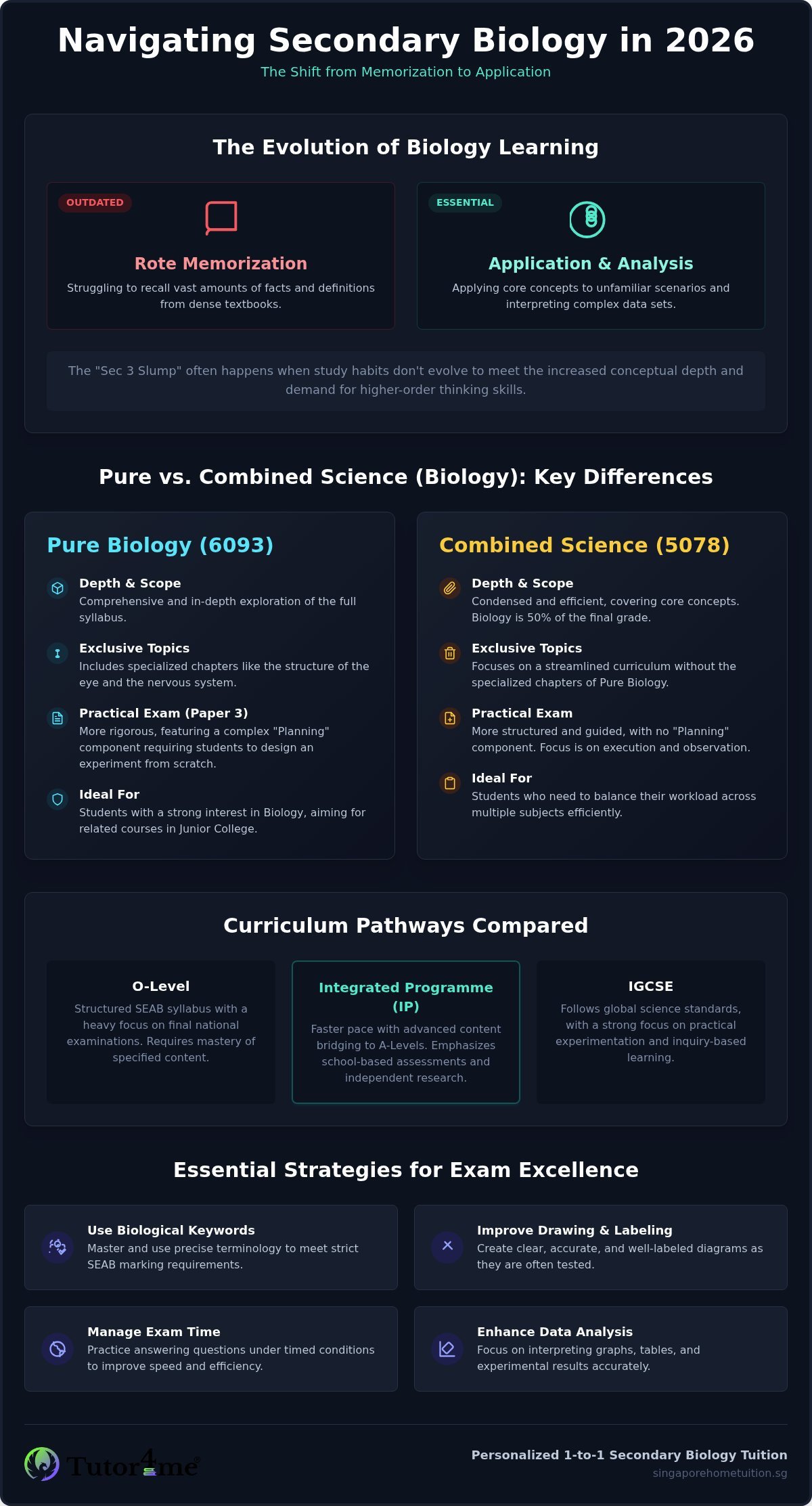
The transition into Upper Secondary Biology marks a significant turning point in a student’s academic journey. In 2026, the SEAB continues to emphasize higher-order thinking skills, which means students can’t simply rely on the rote memorization techniques that served them well in lower secondary. While Biology has a reputation for being content-heavy, the real challenge lies in applying that knowledge to complex data sets. Students often make the mistake of focusing on recall rather than understanding the underlying mechanisms of life. Modern exams now prioritize data analysis and the ability to predict biological outcomes in unfamiliar scenarios.
The Jump from Lower Secondary Science
Many students who achieved high marks in Secondary 1 and 2 find themselves struggling as they enter Secondary 3. Lower secondary science provides a broad survey of various disciplines, but Upper Secondary Biology requires a deep dive into intricate, invisible systems. Students are introduced to complex topics such as molecular genetics and cellular metabolism, which require a level of abstract thinking not previously demanded. The “Sec 3 slump” is a direct result of the sudden increase in conceptual depth that outpaces a student’s existing study habits. Without the targeted support of secondary biology tuition, these gaps in understanding can quickly become overwhelming as the syllabus moves forward.
O-Level vs. IP Biology: Which Path is Your Child On?
The educational landscape in Singapore offers different tracks, each with its own set of challenges. The standard O-Level track follows a structured syllabus with a heavy focus on final national examinations. In contrast, the Integrated Programme (IP) often moves at a faster pace and includes advanced content that bridges the gap toward A-Levels. IP students frequently encounter school-based assessments that prioritize independent research and sophisticated data interpretation. Because IP schools have the autonomy to design their own modules, these students require tutors who possess a deep familiarity with their specific school’s curriculum and assessment criteria.
For families in the international school system, IGCSE Biology presents another variation, focusing on global Science education standards that emphasize practical experimentation and inquiry-based learning. Whether a student is navigating the national curriculum or an international track, the demand for analytical skills remains consistent. Expert secondary biology tuition provides the necessary framework to help students transition from passive learning to active, critical analysis of biological concepts.
Pure vs. Combined Biology: Navigating Syllabus Requirements
Choosing between Pure Biology and Combined Science (Biology) is a pivotal decision that impacts a student’s workload and future academic options. Many students face significant challenges in biology learning due to technical vocabulary and the high volume of content. Pure Biology (Syllabus 6093) offers a comprehensive exploration of the subject, while Combined Science (Syllabus 5078) provides a condensed version. It’s not just about the number of chapters; it’s about the depth of understanding required for each biological process.
Pure Biology: Mastering the Full Syllabus
Pure Biology students delve into specialized topics like the structure and function of the eye and the central nervous system. These chapters are exclusive to the 6093 syllabus and demand a high level of detail. The assessment is naturally more rigorous, particularly regarding Paper 3, the practical exam. This paper includes a complex “Planning” component where students must design an entire experiment from scratch, identifying variables and ensuring accuracy. It’s a test of logical thinking and procedural knowledge. Managing this heavier workload requires disciplined study habits. Engaging secondary biology tuition on a 1-to-1 basis allows students to focus specifically on these advanced modules. This ensures they don’t fall behind in the more technical chapters while maintaining their other subjects.
Combined Science (Biology): Precision and Efficiency
The Combined Science track requires a different tactical approach. Since Biology only contributes 50% to the final grade, students must be highly efficient with their revision. They need to prioritize high-yield topics like nutrition in humans and inheritance to maximize their scores within a limited timeframe. A common struggle is balancing Biology with their other science component. For those paired with Chemistry, seeking Chemistry Tuition Singapore can provide the necessary balance to excel in both disciplines. Combined Science students often find the “Science Practical” component challenging. They have less lab time dedicated to a single subject, making precision in experimental techniques even more critical for success.
This choice also dictates Junior College pathways. While Combined Science students can still take H2 Biology in JC, they often face a steeper learning curve compared to Pure Biology peers who have already mastered foundational concepts. A qualified home tutor can help bridge this gap, providing the personalized guidance needed to transition smoothly into higher-level studies. By focusing on the specific requirements of each syllabus, students can navigate their secondary school years with greater confidence and clarity.
Why 1-to-1 Home Tuition Outperforms Traditional Learning Centers
While group tuition centers are a common choice in Singapore, they often lack the flexibility required to master a subject as nuanced as Biology. The primary advantage of 1-to-1 secondary biology tuition lies in its ability to adapt to the student’s specific cognitive load. In a group setting, the teacher must adhere to a fixed schedule to cover the official O-Level Biology syllabus within a set number of weeks. This often leaves some students behind while others wait for the next topic. Private tutoring eliminates this friction by allowing for a completely customized learning journey.
Learning in a familiar, low-stress environment also provides a significant “home advantage.” Students are more likely to ask questions and admit when they don’t understand a concept when they aren’t in front of their peers. This safe space allows for an immediate feedback loop. Tutors can identify and correct misconceptions in real-time, preventing small errors from becoming ingrained habits that affect exam performance.
Personalized Pacing vs. Group Schedules
Traditional centers operate on a model that prioritizes the group’s average speed. If your child finds molecular genetics particularly challenging but has already mastered cell structure, a group class won’t pause the curriculum to accommodate their needs. A 1-to-1 tutor can pivot the entire lesson plan based on a student’s latest school results. They provide on-demand clarification that simply isn’t possible in a larger classroom. This targeted approach ensures that the student spends their time where it matters most, focusing on their specific learning gaps rather than repeating content they already know.
Cost-Benefit Analysis: Value Beyond the Hourly Rate
Parents often compare options based only on the hourly rate. However, a comprehensive cost-benefit analysis should factor in travel time and transportation expenses. Attending a physical center often involves significant travel, which contributes to student fatigue after a long school day. 1-to-1 home tuition is remarkably efficient. Because the session is entirely focused on one individual, a tutor can often achieve in one hour what a group class takes two to cover. This higher intensity means fewer total hours of tuition might be needed to reach the same goal. Finding a Top Home Tutor Singapore through a specialized agency ensures that every minute of secondary biology tuition is a direct investment in your child’s academic success. Tutors can also create personalized resources, such as summary notes and worksheets, that are tailored to the specific assessment style of the student’s school.
Key Strategies for Excelling in Secondary Biology Exams
Achieving an A1 in Biology involves mastering the art of precision. Many students understand the concepts but lose marks because they don’t use the specific keywords required by the SEAB marking schemes. In Biology, “near enough” isn’t good enough. For instance, explaining osmosis without mentioning a “selectively permeable membrane” or “water potential gradient” will often result in zero marks for that point. Targeted secondary biology tuition addresses these gaps by training students to think like examiners and use non-negotiable terms to verify their technical accuracy.
Effective secondary biology tuition also focuses on connecting the dots between seemingly unrelated topics. A student shouldn’t study Transport in Plants in isolation from Photosynthesis. Understanding how the xylem and phloem support the leaf’s metabolic needs is crucial for answering higher-order application questions. Tutors use active recall and spaced repetition to help students memorize complex sequences like the Menstrual Cycle or the stages of mitosis. These techniques move information from short-term to long-term memory, which is vital for the heavy content load of the 2026 syllabus.
Decoding Question Phrasing
Students must distinguish between directive verbs to avoid wasting time. A “Describe” question asks for what is happening, often based on a graph or diagram. An “Explain” question requires the biological reason behind the observation. Identifying “clue words” in data-based questions, such as “limiting factor” or “optimum temperature,” allows a student to tailor their answer to what the marker is actually seeking. Using SEAB-approved terminology is the only way to ensure full marks in these sections.
The Role of Practical Work in Theory Success
The Practical Exam (Paper 3) isn’t just a standalone assessment. Understanding the “why” behind lab procedures, such as why we boil a leaf in alcohol during a starch test, helps students answer theory questions in Paper 2. Common pitfalls in the practical paper include messy biological drawings or failing to include magnification scales. Building these foundational science skills should start early. Many parents find that PSLE Home Tuition Singapore provides the necessary early exposure to scientific inquiry that makes secondary level transitions smoother.
If your child is struggling to translate their knowledge into high exam marks, book a session with a specialist Biology tutor to master these critical techniques today.
Finding Your Perfect Match with Singapore Home Tuition
Finding the right secondary biology tuition is a strategic decision that requires balancing academic expertise with personal suitability. At Singapore Home Tuition, we believe that the most effective learning happens when a student feels understood and supported. Our agency serves as a professional facilitator, connecting families with a diverse pool of educators tailored to the specific needs of the 2026 syllabus. We provide islandwide coverage, ensuring that high-quality biological instruction is accessible to every household in Singapore, regardless of location.
Our pool of educators includes MOE teachers who bring deep classroom experience, full-time tutors who specialize in exam techniques, and high-achieving undergraduates who offer recent, relatable insights into the curriculum. This spectrum allows us to offer flexible options for every budget without compromising on the standard of instruction. By focusing on a personalized matching process, we help students regain their confidence and navigate the complexities of O-Level, IP, or IGCSE Biology with a clear path forward. We act as a stable partner in this high-stakes environment, providing peace of mind for parents and empowerment for students.
The Matching Process: Quality and Suitability
We take the guesswork out of finding a tutor by implementing a rigorous verification process. Every educator’s credentials and past performance in Secondary Biology are carefully vetted before they’re recommended to you. We don’t just look for subject mastery; we look for the ability to communicate complex ideas simply. We understand that the student-tutor bond is critical for long-term success, which is why we encourage a first-lesson trial to ensure the right chemistry is present. Our matching service is designed to be fast and efficient, recognizing that students often need support quickly when faced with difficult topics like molecular genetics or homeostasis before an upcoming exam.
Home vs. Online Tuition: Choosing the Right Format
Parents can choose between traditional home-based sessions or the modern flexibility of online learning. Face-to-face secondary biology tuition is highly effective for subjects requiring visual aids and detailed biological drawings, as the tutor can provide immediate feedback on a student’s work. Alternatively, online tuition is an excellent choice for busy students who need to save travel time or those seeking access to a specific specialist who may not be in their immediate vicinity. For those in the international school system, we offer dedicated IGCSE Home Tuition Singapore to match students with tutors who are experts in that specific curriculum. Both formats provide the same dedication to your child’s academic excellence and personalized matching standards.
Empowering Your Child for Biology Excellence in 2026
Navigating the complexities of the 2026 Biology syllabus doesn’t have to be a source of stress for your family. Success in this subject now hinges on a student’s ability to apply deep conceptual knowledge to data-driven exam questions. By choosing specialized secondary biology tuition, you provide your child with a dedicated partner who can bridge the gap between classroom theory and exam-day application. Whether it’s mastering the nuances of molecular genetics or perfecting biological drawings, the right 1-to-1 support makes all the difference.
This personalized approach ensures that your child isn’t just memorizing facts but is actually developing the analytical skills required for long-term academic success. Singapore Home Tuition is trusted by thousands of parents for O-Level and IP success. We offer a fast matching service that connects you with qualified MOE teachers and subject specialists within 24 hours. Don’t let your child fall behind in a fast-paced classroom environment when tailored help is readily available.
Find the Perfect 1-to-1 Secondary Biology Tutor Today
With the right guidance and a perfect tutor match, your child can approach their upcoming exams with quiet confidence and achieve the results they’ve worked so hard for.
Frequently Asked Questions
Is Secondary Biology harder than Physics or Chemistry?
Difficulty depends entirely on a student’s natural learning style and cognitive strengths. Biology is often perceived as content-heavy because it requires the mastery of complex systems and a large volume of technical vocabulary. While Physics is more mathematical and Chemistry focuses on abstract bonding, Biology demands high-level application and the precise use of keywords. Scoring an A1 in Biology is challenging because examiners look for specific SEAB-approved terminology in every answer.
What is the difference between Pure Biology and Combined Science Biology?
The primary difference lies in the breadth of the curriculum and the depth of the assessment. Pure Biology (Syllabus 6093) includes exclusive topics such as the structure of the eye and the brain. It also features a dedicated practical paper with a complex planning component. Combined Science Biology (Syllabus 5078) covers approximately 75% of the Pure syllabus and shares its practical assessment with another science subject, making it less intensive but still rigorous.
How many hours of Biology tuition does my child need per week?
Most students find that one session of 1.5 to 2 hours per week is sufficient for consistent progress. This duration allows enough time to clarify school-based misconceptions, practice application questions, and preview upcoming topics. During the lead-up to major examinations like the O-Levels or IP finals, some parents opt for twice-weekly sessions to accommodate intensive topical revision and timed mock papers for better time management.
Can a private tutor help with the Biology Practical Exam at home?
Yes, a private tutor is invaluable for mastering the theoretical and analytical aspects of the practical paper. While they don’t provide a full laboratory setup, they focus on high-weightage skills like biological drawing, magnification calculations, and experimental planning. Secondary biology tuition at home allows students to practice the logic behind variables and control setups, which are critical for scoring well in the Paper 3 planning question.
Are your tutors familiar with the latest 2026 MOE Biology syllabus?
Our educators stay strictly updated with the latest SEAB requirements and MOE curriculum changes for 2026. We match students with specialists who understand the shift toward inquiry-based learning and data-based questions. Whether your child is following the O-Level, IP, or IGCSE track, our tutors use current specimen papers and marking reports to ensure the teaching remains relevant to what will actually appear in the national examinations.
How much does 1-to-1 secondary biology tuition cost in Singapore?
The investment for 1-to-1 secondary biology tuition varies depending on the qualifications and experience of the educator you choose. We offer a spectrum of options to fit different household budgets, ranging from high-achieving university undergraduates to experienced full-time tutors and MOE-trained teachers. Rates are generally higher for current or ex-school teachers due to their deep familiarity with national marking standards and classroom pedagogy.
What happens if my child doesn’t click with the assigned tutor?
We understand that a strong student-tutor bond is essential for effective learning. If your child doesn’t feel comfortable after the first lesson, we provide a fast and efficient replacement service. Our goal is to act as a professional facilitator to find the perfect personality fit. This ensures your child feels empowered to ask questions and admit gaps in their understanding without any hesitation or stress.
Is it too late to start Biology tuition in Secondary 4?
It’s never too late to seek help, even in the final year of secondary school. Many students begin tuition in Secondary 4 to address specific content gaps or to refine their exam techniques. A dedicated specialist can provide a structured “crash course” environment that focuses on high-yield topics and past-year paper analysis. This targeted support can significantly boost a student’s confidence and grade trajectory in the months before the final exams.