
What if your child knows the science facts but still loses marks because answers do not explain the evidence clearly? For many families considering psle science tuition singapore, the challenge is not simply learning more content. It is helping a student understand what an open-ended question asks and express the answer using precise scientific terms.
That concern is especially relevant in 2026: the PSLE Science paper’s open-ended section, Booklet B, is worth 40 marks. Students need to apply concepts and explain observations, not rely on memorisation alone. One-to-one support can help identify specific gaps that may be missed in a larger class.
This guide explains how to assess a tutor’s experience with the primary science syllabus, MOE expectations and open-ended answering techniques. You will also learn how a student can structure responses using Claim, Evidence, Reasoning (CER), and what to consider when arranging private home instruction. Singapore Home Tuition matches students with educators suited to their academic needs and learning styles. The aim is to find support that fits your child.
Key Takeaways
- Use your child’s recent science exam scripts to pinpoint whether they need help with concepts, deduction or explaining answers.
- When comparing psle science tuition singapore options, check a tutor’s familiarity with the current primary science syllabus and experience teaching the subject.
- Consider whether one-to-one private home instruction suits your child’s learning style and gives the tutor room to address specific gaps.
- Define your child’s academic needs and preferred tutor background before requesting suitable educator profiles.
- Ask about tutor matching, lesson arrangements and what options are available if the fit is not right.
Understanding the 2026 PSLE Science Examination Format
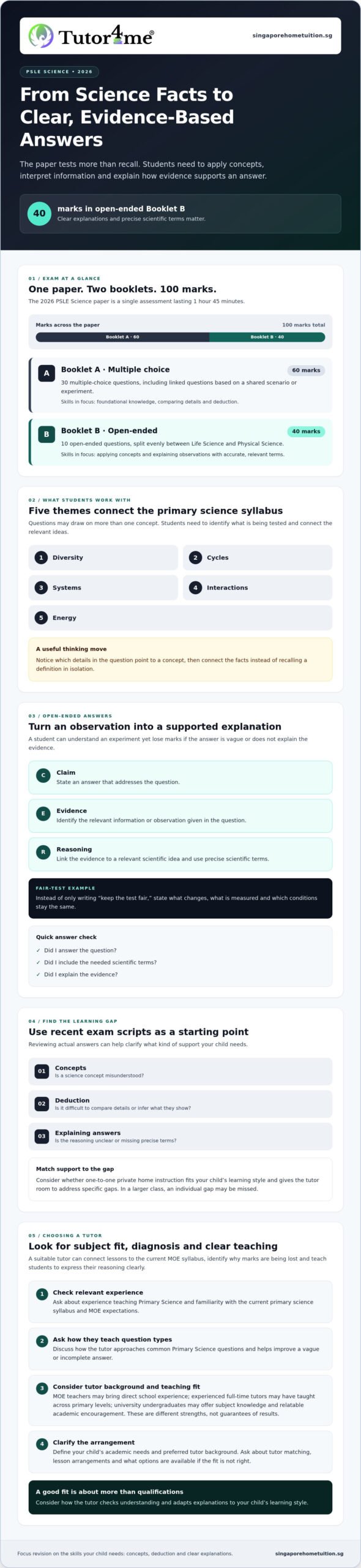
The 2026 PSLE Science paper is a single 1 hour 45 minute assessment worth 100 marks. It tests more than factual recall: students must also apply concepts, interpret information and explain how evidence supports an answer. The Primary School Leaving Examination (PSLE) is a key national assessment, and understanding its paper structure helps you focus revision on the skills your child needs.
The paper has two booklets. Booklet A is worth 60 marks and contains 30 multiple-choice questions, including linked questions based on a shared scenario or experiment. Students need sound foundational knowledge, but they must also compare details and use deduction to select the best answer. Booklet B is worth 40 marks and contains 10 open-ended questions, split evenly between Life Science and Physical Science. Here, clear explanations matter as much as knowing the underlying science.
Core Syllabus Themes Tested in Primary Science
Primary Science is organised around five themes: Diversity, Cycles, Systems, Interactions and Energy. Students meet these ideas across primary levels, building from core observations and concepts towards questions that ask them to analyse relationships or apply learning in a new situation. A question about how a plant grows, for example, may ask a student to connect life processes with the conditions needed for growth.
Questions can draw on more than one concept at a time. Encourage your child to identify what the question is testing, then connect relevant facts instead of recalling a definition in isolation. For practice, ask them to explain which details in a question point to a particular concept. This supports both MCQ deduction and written explanations.
Why Section B Open-Ended Questions Cause Grade Drop
A student may understand an experiment but lose marks by describing it imprecisely. If asked how to make a fair comparison, they should state what changes, what is measured and which conditions stay the same. Saying “keep the test fair” is too general; naming the controlled conditions shows how the student would make the comparison meaningful.
Open-ended marking rewards relevant, accurate explanations. A response such as “the plant grew better” may not explain the observation. The student should identify the evidence given, then link it to a scientific idea using the terms that fit the question. Practise checking each answer: Did I answer the question, include the needed scientific terms and explain the evidence?
Targeted PSLE home tuition can help students review errors and practise expressing ideas precisely, rather than only repeating facts. If you are considering psle science tuition singapore, look for support that addresses your child’s specific gaps in both Booklet A reasoning and Booklet B written answers.
Evaluating Key Qualities in a PSLE Science Tutor
A suitable tutor should do more than explain science facts. Look for someone who can connect lessons to the current MOE syllabus, spot why your child is losing marks and teach them how to express their reasoning clearly. Ask how they approach common Primary Science question types. You could also share an example of a vague or incomplete answer and ask how they would help your child improve it.
Qualifications provide useful context, but they do not prove teaching fit on their own. The National Library Board’s account of the history of the PSLE shows how the examination has evolved. For current support, ask tutors to explain how they keep their teaching aligned with the syllabus and what experience they have with Primary Science learners.
Tutor Backgrounds: MOE Teachers, Full-Time Tutors and Graduates
MOE teachers may bring direct school experience, while experienced full-time tutors may have worked with students across several primary levels. University undergraduates can offer subject knowledge and relatable academic encouragement. These are different strengths, not automatic guarantees of results. Ask about relevant teaching experience, how the tutor checks understanding and whether they can adapt explanations to your child’s learning style.
Diagnostic Skills That Improve Answering
A skilled educator identifies whether an incorrect answer comes from a science misconception, missing information in the question or difficulty explaining an idea. During a guided problem-solving task, notice whether the tutor asks your child to explain their thinking before supplying the answer. That discussion can reveal whether the student understands the concept or has guessed correctly.
For open-ended responses, ask how the tutor teaches a structure such as Claim, Evidence and Reasoning (CER). The student states a conclusion, points to relevant evidence and explains the scientific link between them. For example, instead of writing that a plant “grew better,” they should refer to the observation provided and connect it to the tested condition. Tutors should also reinforce accurate scientific terms, so everyday wording does not blur the meaning.
- Ask for a diagnostic approach: How will the tutor identify gaps from your child’s work?
- Check practice methods: Does practice include relevant school papers and careful review of errors?
- Discuss fit: Can the tutor adjust explanations to your child’s pace and learning style?
As you compare options for psle science tuition singapore, focus on teaching methods and relevant experience, not titles alone. You can review PSLE home tuition options and ask about educator profiles matched to your child’s academic needs. For a tailored match, contact Singapore Home Tuition.
Comparing Private Home Instruction with Group Science Classes
Both one-to-one tuition and group lessons can support learning, but they offer different kinds of attention. In private home instruction, the tutor can focus the session on your child’s questions, pace and current science gaps. In a group, the lesson needs to serve several students, so the tutor may not be able to pause for every individual misunderstanding.
That difference matters if your child understands a topic in class but repeatedly loses marks on a particular question type. A tutor can review school worksheets and test papers line by line, ask how the student reached each answer, and use those errors to guide the next lesson. A group lesson may follow a planned topic sequence, leaving less room to revisit one student’s specific misconception.
Addressing Specific Topic Weaknesses Immediately
If Forces or Electricity remains difficult, individual sessions can return to the relevant concepts and practise applying them to different questions. The tutor can check understanding as the student works, then correct an inaccurate explanation before it becomes a habit. Practice can also focus on recurring problem areas, such as identifying variables in an experiment or explaining what a result shows.
Ask how the tutor will use your child’s own work to plan practice. The aim is not simply to complete more questions. It is to understand why an answer went wrong and what the student should do differently next time. For example, if an answer misses a comparison in a data question, practise identifying the values first and then writing what they show.
Building Confidence and Exam Readiness
A quieter student may feel more comfortable asking questions one-to-one than speaking in front of peers. At home, they can explain their thinking without worrying about keeping pace with a group. This gives the tutor a clearer view of where the student feels unsure and a chance to encourage questions as part of learning.
One-to-one practice can also help students build a personal exam routine. The tutor can guide your child in allocating time across Booklet A and Booklet B, then review whether they left enough time to complete and check written responses. Timed practice can help a student get used to working steadily under exam conditions, while feedback afterwards keeps practice focused on accuracy as well as pace.
Home lessons also remove the need to travel to a lesson location, which may help your child begin study time with less travel fatigue. The right format depends on your child’s academic needs, confidence and learning style. If you are considering psle science tuition singapore, compare how each option handles individual questions, correction and follow-up practice. You can explore private home instruction and consider whether one-to-one support fits your child’s current needs.
Steps to Select the Right Science Tutor for Your Child
A good tutor match starts with a clear picture of what your child needs. Before comparing profiles, review recent science work and note where marks were lost. Was the concept misunderstood, was information in a graph overlooked, or was the explanation too vague? This helps you look for support that targets the cause rather than simply adding more revision.
Start with the Learning Gap
Separate content gaps from answering difficulties. A child may know what an experiment shows but struggle to describe the evidence in clear written English. Check whether they also find it hard to interpret data, read graphs or compare information in classification tables. Share these examples when discussing a tutor match, so the educator can explain how they would address the specific weakness.
Use These Steps to Compare Tutors
- Identify academic needs: Review recent test scripts and list recurring errors, such as confusing a concept or missing key details in an open-ended response.
- Choose a suitable background: Consider whether your child may respond best to an MOE teacher, a full-time tutor or a university undergraduate. Match the choice to your child’s confidence, pace and learning style, not credentials alone.
- Request a focused match: A home tuition agency can help identify educators whose experience suits your child’s needs. Ask how tutor profiles are matched and whether the educator has relevant Primary Science teaching experience.
- Review the profile carefully: Check stated qualifications and ask about experience with current syllabus expectations, experimental questions and open-ended answers. Look for relevant teaching experience rather than relying on broad claims of success.
- Assess the first lesson: Notice whether the tutor listens, checks your child’s thinking and explains ideas in a way they understand. Discuss how you will review progress and whether the communication feels comfortable for both of you.
During your discussion, ask the tutor to work through a sample question and explain how they would guide your child. For example, if a student misreads a graph, will the tutor check how they identify the axes and compare results? If an answer lacks precision, will they help the child use scientific terms and structure the explanation? Clear examples make it easier to judge subject knowledge and teaching approach.
For psle science tuition singapore, prioritise a tutor who can explain their methods and adapt them to your child, rather than promising a particular score. Singapore Home Tuition matches families with educators suited to students’ academic needs and learning styles. Request a PSLE Science tutor match based on your child’s learning needs.
Finding Verified PSLE Science Educators with Singapore Home Tuition
Once you have identified your child’s learning gaps and preferred tutor background, the next step is finding a suitable educator. Singapore Home Tuition matches students with a range of educators, including MOE teachers, experienced full-time tutors and university undergraduates. Share your child’s academic needs and learning style so the match can reflect the support they need.
Hand-Picked Profiles Delivered Within 24 Hours
Share the areas your child finds difficult, such as interpreting experiment results, identifying variables or writing precise open-ended answers. This gives the matching process useful context. When reviewing proposed profiles, consider each tutor’s qualifications, relevant teaching experience and availability before deciding whether to proceed.
Profile details can help you make an informed choice, but you should still check that a tutor’s experience fits your child’s needs. Ask how they approach the current Primary Science syllabus and how they would help your child practise a specific question type. A clear explanation of their teaching approach is more useful than a broad promise of results.
Clear Arrangements and Dedicated Support
Before lessons begin, confirm practical details directly, including the schedule, format and tutor’s approach to reviewing your child’s work. A shared understanding of these arrangements helps both sides start smoothly. You can also ask about the support available during tutor matching if you have questions about suitability or next steps.
If you are unsure whether a proposed match is suitable, explain what your child needs and discuss the available options with the agency. Specific feedback, such as the pace of explanations or how your child responds to the teaching approach, can help clarify what to look for in an educator.
Finding the right psle science tuition singapore support is about matching a tutor’s subject experience and communication style to your child, then checking that the arrangement works in practice. Explore PSLE home tuition to learn how tailored support can contribute to your child’s exam preparation.
Build Your Child’s Science Confidence with the Right Support
PSLE Science success depends on more than remembering facts. Students need to apply concepts, interpret questions and explain answers with precise scientific language, especially in open-ended questions. Start by reviewing your child’s work to identify whether the main gap is subject knowledge, question interpretation or answer technique. Then look for a tutor whose experience and teaching approach fit your child’s academic needs and learning style.
With psle science tuition singapore, focused one-to-one support can help your child practise specific skills and learn from mistakes. Singapore Home Tuition matches students with educators including MOE teachers, experienced full-time tutors and university undergraduates. Consider the tutor’s relevant experience and approach when deciding whether a profile is a good fit.
When you are ready, request a PSLE Science tutor match and share the areas your child wants to work on. With focused guidance and steady practice, your child can approach science learning with greater confidence.
Frequently Asked Questions
How does private PSLE Science tuition differ from attending group tuition classes?
Private tuition gives the tutor time to focus on your child’s questions, pace and specific science gaps. In a group class, the lesson is shared among students, so the tutor may need to follow a set plan rather than pause for one learner’s misunderstanding. One-to-one support can be useful if your child needs detailed feedback on particular topics or open-ended answers. The right format depends on your child’s needs and learning style.
What qualifications should I look for when selecting a primary science tutor?
Look for relevant teaching experience, familiarity with the Primary Science syllabus and the ability to explain how they teach answering techniques. Tutors may include MOE teachers, experienced full-time tutors and university undergraduates, each with different experience. Ask about their background, how they check a student’s understanding and how they address recurring mistakes. Review the tutor’s profile and discuss whether their approach suits your child before confirming lessons.
Can a home tutor help my child master Section B open-ended questions?
A suitable tutor can help your child practise interpreting what each question requires, selecting precise scientific terms and explaining evidence clearly. For example, they can review an answer about an experiment and check whether the student identifies the relevant variables and explains what the results show. Regular feedback helps your child understand where an answer is unclear and how to improve it. Progress depends on the student’s needs and practice.
How quickly can Singapore Home Tuition match a suitable science tutor to our home?
Singapore Home Tuition matches students with educators based on their academic needs and learning styles. Share your child’s requirements and preferred tutor background so the agency can identify suitable profiles. Ask about the expected matching process and review each tutor’s qualifications, experience and availability before deciding whether to proceed.
Are there agency or administrative fees when requesting a tutor through Singapore Home Tuition?
Before proceeding, ask Singapore Home Tuition to confirm any agency or administrative fees and how lesson payments are arranged. Also confirm practical details with the tutor, including the lesson schedule and format. This helps you understand the arrangement clearly and decide whether it works for your child and family.
What happens if the assigned science tutor does not suit my child’s learning style?
If the tutor does not seem like the right fit, contact Singapore Home Tuition to discuss the available options. Explain what is not working, such as the pace of explanations or how your child responds to the teaching approach. Sharing specific feedback can help clarify what to look for in another educator. The goal is to find someone who suits your child’s academic needs and helps them feel comfortable asking questions.
When is the ideal time to engage a PSLE Science tutor for my child?
Consider arranging support when you notice recurring gaps, rather than waiting until revision feels overwhelming. For example, your child may understand science concepts but regularly lose marks when explaining evidence or interpreting experimental results. Reviewing recent schoolwork can help you decide what support is needed. With psle science tuition singapore, a tutor can focus lessons on those learning needs and help your child build skills through guided practice.