
What if the biggest hurdle for the 2026 PSLE Science exam isn’t what your child needs to learn, but how they apply it? As a parent, you’ve likely noticed that the traditional method of rote memorisation is no longer enough to secure a top AL grade. With the removal of familiar topics like ‘Cells’ and a significant shift toward inquiry-based learning, the updated PSLE science syllabus requires a more strategic approach to revision.
We understand the uncertainty that comes with these curriculum changes. It’s challenging to track which topics are taught at each primary level or to know how to help your child tackle the new 10-question format in Booklet B. Our goal is to provide you with the clarity and professional guidance needed to manage this transition smoothly. You’ll learn how to master the 2026 requirements through an expert breakdown of topic structures and specific skill sets.
This guide offers a clear look at the P3 to P6 distribution, actionable strategies for mastering Section B open-ended questions, and a reliable revision schedule. By focusing on application over memorisation, you can help your child approach their papers with quiet confidence and academic rigour.
Key Takeaways
- Understand how the updated PSLE science syllabus shifts the focus from rote memorisation to deep inquiry and real world application.
- Identify specific content changes, including the removal of ‘Cells’, and how the new fixed level distribution creates a more consistent learning path for students.
- Learn to apply the ‘Claim, Evidence, Reasoning’ (CER) framework to navigate the analytical requirements of open ended questions in Booklet B.
- Adopt a strategic 12 month revision timeline that emphasises mastering core concepts before drilling for specific scientific keywords.
- Explore why 1-to-1 tuition is uniquely suited to addressing the individual gaps created by this more rigorous, inquiry based curriculum.
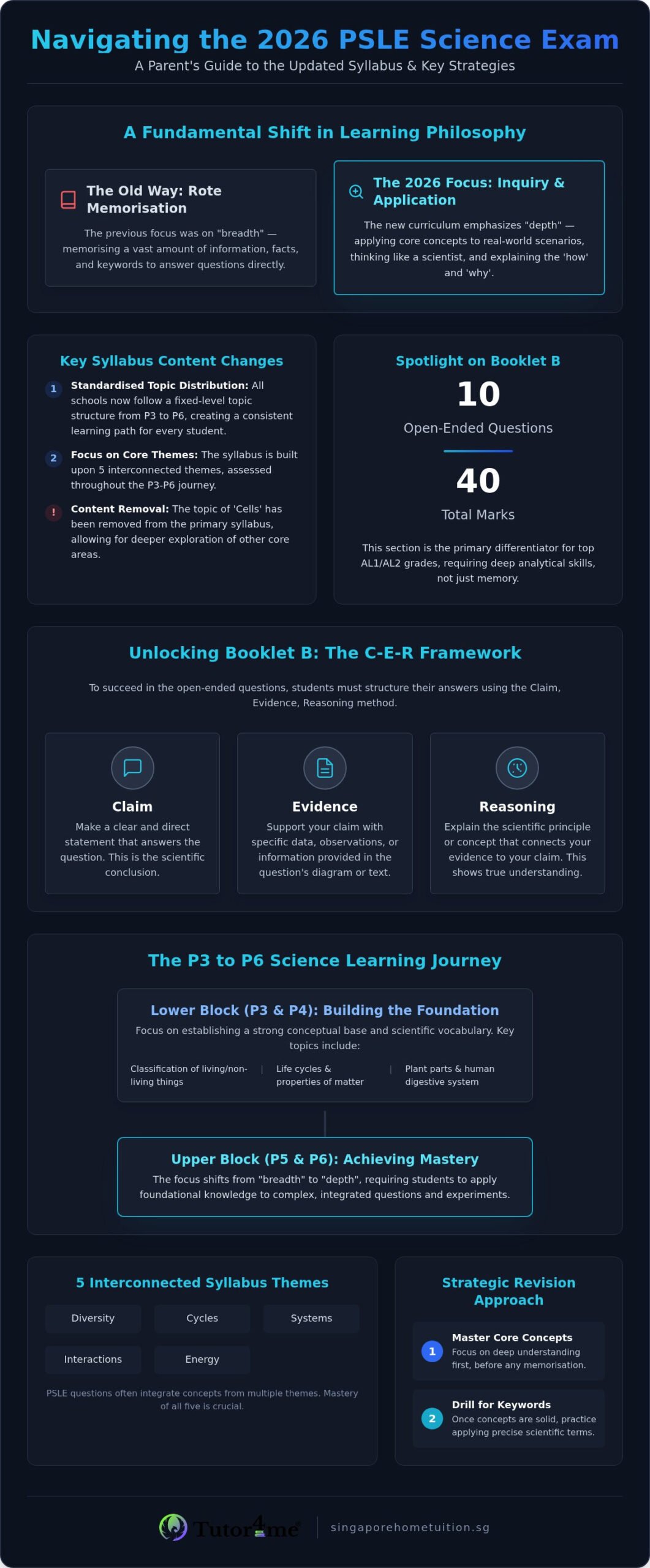
The 2026 cohort marks a significant milestone in Singapore’s primary education. These students are the first to have navigated the entire revamped Primary 3 to Primary 6 journey under the updated curriculum. The Ministry of Education (MOE) has refined the PSLE science syllabus to move away from “breadth” and toward “depth.” This means students spend more time exploring core concepts rather than memorising vast amounts of information. By standardising topic levels, the MOE ensures that every child across the country builds a solid, consistent foundation in science.
The core objective of this change is to equip students with the ability to apply scientific concepts to real-world scenarios. It isn’t enough to state a fact; students must explain how that fact influences a specific situation. This shift prepares them for the complexities of secondary education and beyond, fostering a genuine interest in how the world works. For parents looking for structured support during this transition, PSLE home tuition can provide the necessary 1-to-1 guidance to bridge any conceptual gaps.
The Inquiry-Based Learning Framework
The 2026 curriculum is built on the “Ways of Thinking and Doing” framework. This approach encourages students to act like young scientists. Instead of passive learning, they engage in active inquiry by asking questions, making predictions, and conducting investigations. The syllabus places a heavy emphasis on scientific ethics and attitudes. Students are taught to value objectivity, integrity, and perseverance when dealing with data and observations. This mindset is crucial because the exam now rewards those who can demonstrate a logical, evidence-based thought process rather than just providing a “correct” keyword.
Key Components of the PSLE Science Paper
The format of the Primary School Leaving Examination (PSLE) Science paper remains divided into two main sections: Booklet A and Booklet B. However, the weightage and focus have subtly shifted to reflect the new goals. Booklet A consists of multiple-choice questions that test foundational knowledge. While these questions might seem straightforward, they often include distractors that require a precise understanding of the PSLE science syllabus to avoid common pitfalls.
Booklet B is where the real challenge lies for many students. It features 10 open-ended questions worth a total of 40 marks. These questions are the primary differentiator for students aiming for AL1 or AL2 grades. To succeed in Section B, students must use the “Claim, Evidence, Reasoning” (CER) framework to structure their answers. They need to identify the scientific principle involved, cite evidence from the question’s diagram or text, and explain the reasoning behind their conclusion. This analytical depth is what separates top performers from the rest of the cohort.
Mapping the Themes: P3 to P6 Topic Distribution
The PSLE science syllabus is built upon five interconnected themes: Diversity, Cycles, Systems, Interactions, and Energy. Under the 2026 framework, the Ministry of Education has moved toward a more rigid, fixed-level distribution of these topics. This change ensures that every student, regardless of their school, encounters the same complexity of content at the same stage of their development. It provides a level playing field but also means that the pace of learning is consistent across the nation.
While students often focus on the new topics introduced in Primary 6, the final paper assesses knowledge from the entire four-year journey. Foundational topics from the lower block are not just introductory; they are the essential building blocks for higher-order questions. A student who hasn’t mastered the properties of matter in P4 will likely struggle with more advanced heat energy experiments in P6.
Lower Block Foundation (Primary 3 & 4)
In the initial years, the official MOE curriculum focuses on establishing a strong conceptual base. The theme of Diversity introduces the classification of living and non-living things, helping students understand the characteristics of different groups. Under Cycles, they explore the life cycles of various organisms and the fundamental properties of matter. The Systems theme begins with a study of plant parts and the human digestive system. These topics form the “breadth” of the syllabus, providing the vocabulary and basic principles that students will use to explain more complex phenomena later on. Consistency is key here; skipping over these basics can lead to confusion when they reappear in integrated PSLE questions.
Upper Block Mastery (Primary 5 & 6)
As students progress to the upper block, the focus shifts toward “depth” and intricate interactions. The Systems theme expands to include the respiratory and circulatory systems, along with the study of electrical circuits. Energy becomes a major focal point, covering forms of energy, energy conversion, and the vital process of photosynthesis. Finally, the Interactions theme introduces forces and the relationship between organisms and their environment. These topics are often the “heavyweights” in the final exam, carrying significant mark allocations in Booklet B. Because these concepts require high-level reasoning, many parents find that PSLE home tuition is a practical way to ensure their child can navigate the leap in difficulty. A dedicated tutor can help a student map these themes and identify specific gaps created by the new fixed-level structure.
Major Changes in 2026: What Parents Need to Know
The 2026 update represents a fundamental pivot in how students are assessed. For years, the PSLE science syllabus required students to recall specific parts of a cell, such as the nucleus or cytoplasm. Starting in 2026, this topic has been removed from the examinable content. This change signals a broader move away from memorisation-heavy curricula toward a framework that values inquiry and process skills. The Singapore Science Curriculum Framework prioritises the ability to think like a scientist over the ability to recite a textbook. Learning outcomes are now more specific, requiring students to demonstrate how they can apply knowledge to novel situations.
The Impact of Removing ‘Cells’
Removing the ‘Cells’ topic isn’t just about reducing the workload. It allows schools to reallocate critical teaching hours to more complex themes like ‘Energy’ and ‘Interactions’. Previously, students spent weeks mastering microscopic biological structures. Now, they can dive deeper into how systems function as a whole. While students don’t need to identify cell parts, they must still understand how biological systems interact to support life. This transition from microscopic details to systemic functions is essential for mastering the PSLE science syllabus in its current form. It’s a move toward “depth over breadth” that helps students handle integrated questions in Booklet B.
New Emphasis on Application Skills
The 2026 syllabus places a premium on experimental design and data analysis. Students are expected to identify variables with precision. They must distinguish between the independent variable (what is changed), the dependent variable (what is measured), and constant variables (what is kept the same). This is the foundation of the ‘Fair Test’ concept, which is now a cornerstone of both theory and practical assessments.
Beyond just identifying variables, students must formulate hypotheses based on experimental data. They need to look at a set of results and predict a trend or explain a relationship. For instance, instead of just stating that a plant needs light, they might be asked to design an experiment that proves how different light intensities affect the rate of photosynthesis. This level of application is where many students struggle. At Singapore Home Tuition, we match students with tutors who specialise in these process skills, ensuring they can handle the higher-order thinking required for the 2026 exam.
Revision Strategy: Preparing for the 2026 Science Paper
Success in the 2026 exam requires a structured 12-month roadmap. We recommend breaking the year into three distinct phases: concept consolidation, application practice, and final refinement. The first four months should focus on the “Golden Rule” of the PSLE science syllabus: master the concept first, then the keywords. Many students make the mistake of memorising model answers without understanding the underlying science. This approach often fails when they encounter the novel scenarios common in the updated paper.
When using past-year papers, you’ll need to be selective. Papers from 2025 and earlier contain the “Cells” topic and follow a different question distribution in Booklet B. Use these older resources for topical practice, but rely on 2026 specimen papers for realistic exam simulation. For students struggling to adapt to this new format, PSLE Home Tuition provides targeted practice that focuses specifically on the analytical demands of the 2026 paper.
Mastering the ‘Keywords’ and ‘Clues’
Spotting “clue words” is a vital skill for the 2026 exam. Questions often include phrases like “based on the results,” which signal that the answer must directly reference the provided data. Precision in vocabulary is non-negotiable. Using general terms like “air” when “oxygen” or “carbon dioxide” is required can cost marks. Common phrasing errors, such as confusing “heat” with “temperature,” often prevent students from achieving an AL1. Our tutors help students identify these traps and refine their scientific expression.
The CER Framework for Open-Ended Questions
The most effective way to tackle Section B is the CER (Claim, Evidence, Reasoning) framework. A student must first make a clear claim, then provide specific evidence from the experimental setup, and finally explain the scientific reasoning that connects them. This logical structure ensures no part of the answer is left to chance. It’s exactly why top home tutors in Singapore prioritise this method. By analysing experimental setups systematically, students learn to derive logical conclusions even from unfamiliar data sets.
If your child is finding Section B challenging, you can find the right support by booking a Science Home Tutor in Singapore to bridge these application gaps today.
Maximizing Success with Professional Science Tuition
The shift toward inquiry-based learning in the 2026 PSLE science syllabus makes 1-to-1 guidance a strategic asset. In a classroom setting, it’s often difficult for a single teacher to address the specific conceptual hurdles each student faces. Professional PSLE Home Tuition allows for a deep dive into the “why” behind scientific phenomena. This personalized attention is especially valuable for mastering the CER framework discussed earlier. Tutors can engage students in mock practical discussions, helping them articulate their reasoning clearly before they ever put pen to paper.
Preparing for the PSLE is also about looking ahead. The skills developed now, such as analytical thinking, evidence-based reasoning, and systematic inquiry, are the same ones required for success in Secondary School Science. By mastering the 2026 syllabus today, students build a bridge to more advanced scientific disciplines. It’s about fostering a mindset of excellence that lasts beyond a single examination.
Identifying Individual Learning Gaps
Every student has a unique learning profile when facing the PSLE science syllabus. Some might excel in the theme of Diversity but struggle with the abstract concepts found in Energy or Interactions. Experienced tutors use diagnostic tests to pinpoint these “weak” themes early in the revision cycle. This data-driven approach allows for a tailored pace of revision. Instead of rushing through a generic curriculum, the tutor can spend extra time on the specific P3 to P6 topics where the student lacks confidence. Regular, constructive feedback helps transform these weaknesses into strengths, providing a sense of empowerment as the exam date approaches.
Strategic Final Sprint Preparation
The August to September countdown is a high-stakes period for any P6 student. Intensive tuition during these final months focuses on exam technique and stress management. Familiarity with the 2026 paper format is the best antidote to exam anxiety. Tutors help students run through a final checklist for the Written Science Paper week, which includes:
- Reviewing “clue words” in recent specimen papers to ensure no data point is missed.
- Practicing time management for the 10 open-ended questions in Booklet B.
- Re-visiting the “Fair Test” principles for experimental setups.
- Ensuring all scientific vocabulary is precise and context-heavy.
This methodical preparation ensures that students enter the examination hall feeling like prepared specialists. By addressing individual gaps and refining exam skills, professional tuition provides the peace of mind parents need and the confidence students deserve.
Empowering Your Child for the 2026 PSLE Science Exam
The transition to the 2026 PSLE science syllabus marks a definitive shift toward scientific inquiry and real-world application. By focusing on depth rather than breadth, the Ministry of Education is preparing students to think critically and solve complex problems. Success now depends on mastering the CER framework and understanding how core themes like Energy and Interactions connect across the primary levels. Moving away from rote memorisation allows your child to develop a more profound understanding of the natural world.
If you’re looking for specialized support during this transition, our team is ready to help. We provide specialized MOE Science tutors who are specifically briefed on these curriculum changes. With our fast 24-hour matching service, you can quickly secure a dedicated tutor to provide a tailored 1-to-1 focus on the new syllabus requirements. This personalized guidance helps bridge individual learning gaps and builds the confidence needed for the final paper week.
With a clear revision roadmap and the right professional support, your child can navigate these changes with quiet confidence. We’re dedicated to helping every student reach their full potential in this new academic landscape.
Frequently Asked Questions
What are the biggest changes in the 2026 PSLE Science syllabus?
The biggest changes include a shift from rote memorisation to inquiry-based learning and the removal of the ‘Cells’ topic. The curriculum now focuses on depth over breadth, requiring students to apply scientific concepts to real-world scenarios. There is also a standardisation of topics across Primary 3 to Primary 6 to ensure national consistency. This means students must demonstrate a higher level of analytical thinking than in previous years.
Is the topic of ‘Cells’ completely gone from the 2026 exam?
Yes, the topic of ‘Cells’, including identifying parts like the nucleus and cytoplasm, has been officially removed from the examinable content for the 2026 exam. While students don’t need to recall microscopic details, they still need to understand how biological systems function at a broader level. This change allows more time for students to master complex themes such as Interactions and Energy, which are now more central to the upper primary curriculum.
How can I help my child improve their Section B Science marks?
You can help your child by teaching them to use the ‘Claim, Evidence, Reasoning’ (CER) framework for their open-ended answers. They must identify the scientific concept, cite specific evidence from the question’s diagram, and explain the reasoning behind their conclusion. Practising with 2026 specimen papers is also vital. Specialized PSLE science syllabus tutors can provide the 1-to-1 feedback necessary to refine their scientific vocabulary and avoid common phrasing errors that cost marks.
Does the 2026 syllabus require more practical science knowledge?
The syllabus places a much greater emphasis on the application of experimental skills and process skills. Students are expected to understand the ‘Fair Test’ concept and correctly identify independent, dependent, and constant variables. They must be able to formulate hypotheses and analyse data from experimental setups. While the written paper remains the primary assessment, the questions often describe experiments that require students to think like young scientists to derive logical conclusions.
Which Science themes are most heavily weighted in the PSLE?
All five themes-Diversity, Cycles, Systems, Interactions, and Energy-are tested, but Energy and Interactions often carry significant weight in Booklet B. These themes require high-level application and reasoning skills. In the 2026 paper, Booklet B features 10 open-ended questions worth 40 marks, split equally between Life Science and Physical Science. Mastery of these ‘heavyweight’ topics is essential for students aiming for top AL grades, as they test integrated knowledge across multiple years.
When is the best time to start intensive Science tuition for P6?
The best time to start is usually at the beginning of the Primary 6 year to allow for a structured 12-month revision roadmap. This provides enough time to consolidate concepts before moving into intensive practice for Section B. For students with significant gaps, starting even earlier in P5 can be beneficial. Singapore Home Tuition offers fast 24-hour matching to help you find a tutor who can provide a strategic final sprint during the August-September countdown.
Are the 2026 Science exam formats different from previous years?
The format has been subtly adjusted to reflect the new PSLE science syllabus goals. Booklet A now features more multiple-choice questions, increasing its overall weight. Conversely, Booklet B has been reduced to 10 open-ended questions instead of the previous 12 or 13. This change means each open-ended question carries more significance. The focus has moved away from recall to assessing inquiry skills, making the quality of the student’s reasoning more important than ever.
How does the AL scoring system apply to the 2026 Science paper?
The Achievement Level (AL) system remains the standard for grading, where students are placed into bands based on their raw scores. To achieve an AL1 or AL2, a student must score highly in both Booklet A and Booklet B. Because the 2026 paper emphasizes depth and application, the differentiator often lies in Section B. Consistent performance and precise scientific communication are required to secure the top bands in this more rigorous inquiry-based assessment.