
Imagine your child, who comfortably scored high marks in Primary 2, suddenly coming home with a math paper that feels like it is written in a different language. In 2026, the transition to the upper primary track begins earlier than most parents expect. This is the year many families realize that primary 3 math tuition isn’t just about extra practice; it’s a strategic move to address the “Primary 3 Jump.” With the full implementation of the updated MOE syllabus, students are now tackling complex topics like the 24-hour clock and advanced heuristics that require a higher level of logic and visualization.
It’s completely normal to feel overwhelmed when the “model method” becomes too intricate to teach at the kitchen table. We understand that seeing your child feel demoralized by lower marks is heartbreaking for any parent. This article explains why Primary 3 is the most pivotal year for your child’s mathematical development and how targeted home tuition builds a resilient foundation for PSLE success. You’ll learn about the specific syllabus shifts occurring this year, how specialized 1-to-1 support restores a student’s confidence, and why early intervention is the most effective way to prevent knowledge debt before the high-stakes upper primary years.
Key Takeaways
- Understand why the shift from simple arithmetic to multi-step logic creates the “Primary 3 Jump” and how it impacts long-term academic performance.
- Discover how primary 3 math tuition serves as a strategic bridge to secure the essential concepts needed for future PSLE success.
- Learn the critical difference between rote memorization and the heuristics-based approach required by the current MOE Mathematics syllabus.
- Identify the subtle behavioral signs and academic indicators that suggest a child is struggling with increasingly complex word problems.
- Explore the advantages of a 1-to-1 learning environment in building a student’s confidence and addressing specific knowledge gaps at a personalized pace.
Understanding the “Primary 3 Jump” in Mathematics
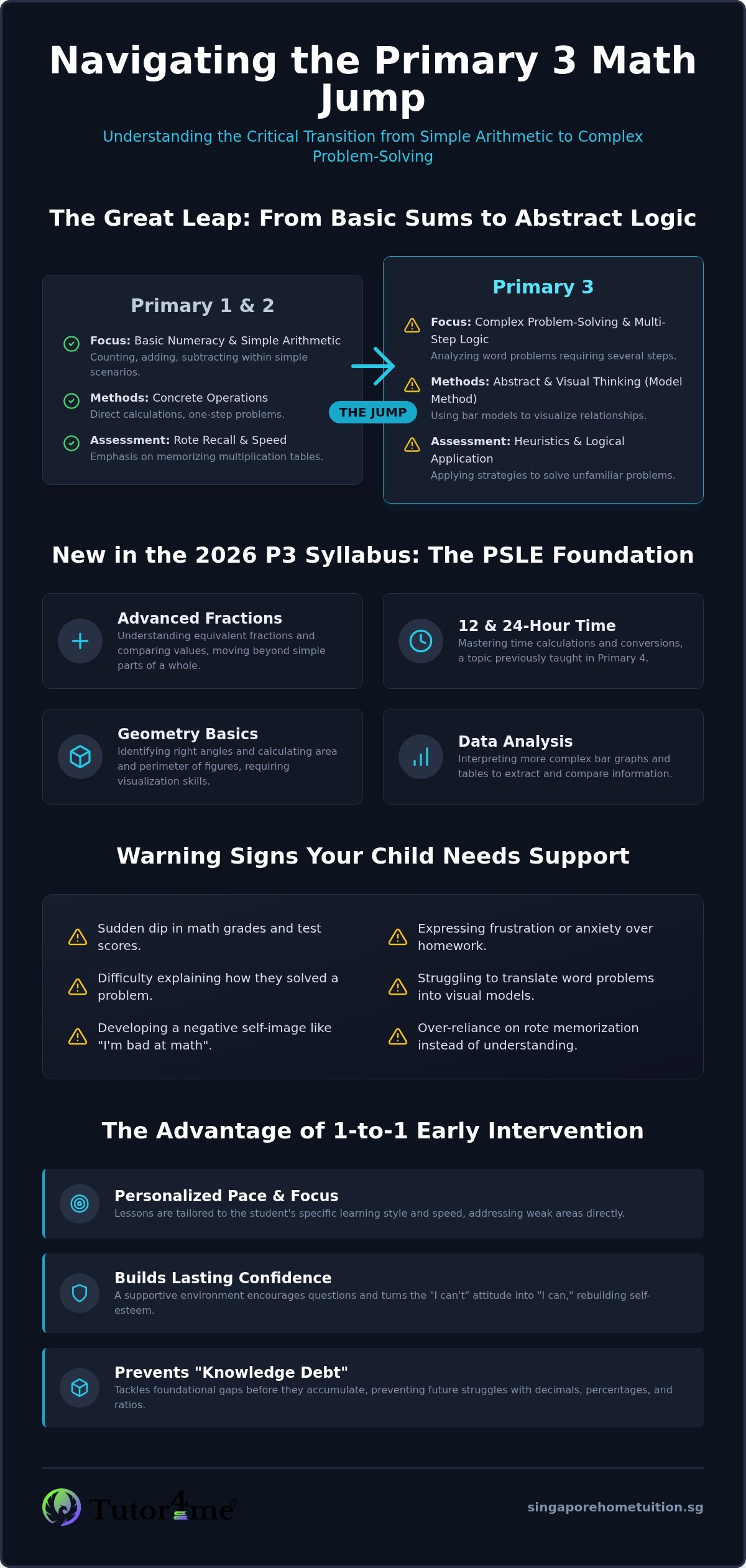
The term “Primary 3 Jump” describes the significant shift in academic rigor students experience at age nine. In Primary 1 and 2, mathematics focuses on basic numeracy and simple arithmetic. By Primary 3, the curriculum demands complex problem-solving and multi-step logic. It’s common to see grades dip during this transition. This isn’t necessarily a reflection of a child’s ability, but rather a sign that the mental tools they used previously are no longer sufficient. Identifying these challenges early through primary 3 math tuition allows students to bridge this gap before frustration sets in. When a child faces their first major academic hurdle, the psychological impact can be lasting. If they begin to view themselves as “bad at math,” it can take years to rebuild that lost confidence.
From Arithmetic to Abstract Thinking
Students move from concrete “plus-minus” operations to conceptual understanding. The introduction of the Model Method marks a major turning point. This technique requires students to visualize mathematical relationships rather than just memorizing steps. The Singapore math methodology emphasizes this “Concrete, Pictorial, Abstract” approach. Without proper guidance, a child might struggle to translate a word problem into a visual bar model. This visualization is essential for solving the increasingly abstract questions found in the upper primary years. Professional primary 3 math tuition focuses on this transition, helping students move past rote counting toward logical visualization.
The 2026 MOE Syllabus: What is New in P3?
The 2026 syllabus introduces several sophisticated topics earlier to better prepare students for the future. Key additions and focuses include:
- Fractions: Understanding equivalent fractions and comparing different values.
- Time: The introduction of the 12-hour and 24-hour clock, which was previously taught in Primary 4.
- Geometry: Identifying right angles and calculating the area and perimeter of figures.
- Data Analysis: Interpreting more complex bar graphs and tables to extract information.
The 2026 P3 Math syllabus serves as the critical baseline for all future PSLE heuristics. These topics require a high level of precision. For instance, the 12-hour and 24-hour clock conversion is a practical skill that demands meticulous attention to detail. If a child enters Primary 4 with unresolved gaps in these areas, the “knowledge debt” can become difficult to manage. Securing a strong start with PSLE Home Tuition fundamentals at the P3 level ensures these new concepts are mastered rather than just memorized. Addressing these hurdles early prevents the development of poor study habits, such as over-reliance on rote learning, which often fails in high-stakes examinations.
Why Early Intervention with Primary 3 Math Tuition Matters
Many parents view Primary 3 as just another year of school. However, the logic taught at this level forms the skeletal structure for the entire upper primary curriculum. According to the official MOE Primary Mathematics syllabus, the complexity of topics increases significantly between P2 and P3. Engaging in primary 3 math tuition early helps students manage this transition before a “cumulative knowledge debt” begins to accrue. In mathematics, every new concept relies on the mastery of the previous one. If a child doesn’t fully grasp P3 fractions, they’ll likely struggle with P4 decimals and P5 percentages. This debt grows over time, making it much harder to “catch up” once the high-stakes years of P5 and P6 arrive.
Building the PSLE Foundation Three Years Early
Mastering the P3 syllabus is essentially a three-year head start on the PSLE. For example, the way a student learns to handle large “Whole Numbers” and basic word problem structures in P3 directly influences their ability to solve “Ratio and Percentage” problems in P6. By establishing a strong PSLE Home Tuition Singapore strategy now, you ensure that future Primary 6 Math tuition sessions focus on refinement rather than basic remediation. This early intervention transforms heuristics from a source of stress into a familiar toolset. When students understand the “why” behind the models early on, they don’t have to relearn fundamentals during their busiest academic year.
Restoring Academic Confidence
P3 is often the first time a child faces academic setbacks. A sudden drop in marks during a topical test can be demoralizing for a nine-year-old. This is where primary 3 math tuition proves its worth beyond just grades. It provides a safe, one-to-one environment where a child can admit they’re confused without the fear of judgment from peers. Tutors help students see that mistakes are part of the learning process, which prevents the development of “Math anxiety.” When a child feels capable, their entire attitude toward school shifts. They become active participants in their education rather than passive observers. Securing a top home tutor in Singapore ensures your child has a dedicated specialist to guide them through these first academic hurdles.
Establishing structured study habits in P3 sets the tone for the rest of their primary school journey. It’s about more than just the subject matter; it’s about learning how to learn. Early intervention builds a child’s interest in the subject before they decide they “aren’t a math person.” By providing the right support now, you’re investing in their long-term academic peace of mind. Students who build strong heuristic skills at this stage are far better positioned when they eventually need primary 5 maths tuition to navigate the even greater logical demands of the upper primary curriculum.
Heuristics vs. Rote Learning: The P3 Math Battleground
In Primary 1 and 2, many students succeed through rote memorization. They memorize addition tables and basic multiplication facts, which allows them to solve straightforward arithmetic quickly. However, Primary 3 introduces “Heuristics,” which are specialized problem-solving strategies designed to tackle non-routine questions. Relying on memory alone often leads to a sharp decline in results during this year. This is why primary 3 math tuition focuses on shifting a child’s mindset from “calculation” to “strategy.” Without this shift, students often feel lost when a question doesn’t fit a familiar pattern. Citing research on early math learning, educators emphasize that mastering these logical frameworks early is a strong predictor of long-term academic success.
Most parents find it challenging to teach these methods at home because the techniques differ significantly from the algebra-heavy approach adults use. Common heuristics introduced in the P3 syllabus include:
- Act it out: Using physical objects or movements to visualize a scenario.
- Draw a diagram (The Model Method): Representing quantities as rectangular bars to see relationships.
- Guess and Check: A systematic way to test possibilities when multiple variables are unknown.
- Look for a pattern: Identifying sequences in numbers or shapes to predict the next value.
Mastering the Model Method
The “Bar Model” is the most critical tool in a P3 student’s arsenal. It transforms abstract word problems into a visual map that makes the solution obvious. Many students make mistakes when drawing models for multiplication and division, often failing to scale the bars correctly or misplacing the “total” bracket. A private tutor ensures the child draws to understand the underlying logic, not just to copy a template from a textbook. This distinction is vital; if a child doesn’t understand why a bar is divided into four units, they won’t be able to apply the concept to more complex P4 questions. Securing help from Home Tutors in Singapore allows for the immediate correction of these drawing errors before they become ingrained habits.
Identifying “Keyword” Traps in Word Problems
Word problems in Primary 3 often use linguistic tricks to hide the required mathematical operation. A student might see the word “more” and automatically add, even if the context requires subtraction. Reading comprehension becomes a major factor in math performance at this level. Effective primary 3 math tuition teaches students how to annotate long paragraphs and break them down into solvable equations. By identifying these “keyword traps” early, students learn to read for context rather than just hunting for numbers. This skill is essential for the PSLE Home Tuition journey, where multi-step problems become the standard for scoring high marks. Parents who want to understand the broader picture of how to score well in PSLE will find that these early heuristic habits are among the most impactful factors in achieving a top Achievement Level score.
Signs Your Child Needs Primary 3 Math Tuition
Identifying the need for extra support often happens too late, usually after a major examination. While grades provide a clear signal, they’re lagging indicators. Parents should instead look for leading indicators that appear during daily study sessions. One common behavioral sign is sudden procrastination. If your child previously enjoyed school but now vocalizes phrases like “I hate Math,” it’s rarely about the subject itself. It’s usually a defense mechanism against a lack of understanding. This is where primary 3 math tuition can step in to identify specific conceptual gaps, though it is also wise to ensure that no physical barriers like hearing difficulties are hindering their classroom experience; you can learn more about Amazing Hearing Centre for expert guidance on auditory wellness.
Another subtle sign is the “Incomplete Paper” syndrome. In Primary 2, time is rarely a significant issue. In Primary 3, the introduction of multi-step word problems consumes much more of the time limit. If your child consistently fails to finish their practice papers, they likely lack the heuristic fluency needed to solve problems efficiently. Similarly, if you see frequent “careless mistakes,” don’t assume it’s just a lack of focus. Often, these errors are a symptom of weak conceptual understanding; the child is guessing because they don’t have a reliable method to verify their logic.
The “P2 to P3 Grade Drop” Benchmark
A slight dip in marks is expected as academic difficulty increases. However, a decline of more than 15 percent often signals a deeper issue. It’s helpful to compare their performance in topical tests versus holistic assessments. If they do well in simple calculation tests but struggle with holistic papers, they’re likely struggling with the application of heuristics. When consulting with the school teacher, ask specific questions about your child’s participation. Are they “blanking out” during class discussions? Teachers can often tell if a student is mentally lost when the model method is being introduced.
The Homework Struggle
The most immediate sign is the time spent on assignments. If a simple 15-minute worksheet now takes 2 hours of frustration, it’s time for intervention. Many parents try to help by “teaching the way we were taught,” but this often causes conflict. Modern MOE methods differ from the algebraic approaches used decades ago. Choosing the right Math Tuition Singapore provides can help bridge this gap. A professional tutor acts as a neutral party, removing the emotional friction from the learning process. This allows the child to focus on the numbers rather than the stress of the situation.
If these signs sound familiar, don’t wait for the end-of-year results to take action. You can find a dedicated specialist today to help your child regain their confidence and master the P3 syllabus before the year concludes.
The Advantage of 1-to-1 Home Tuition for P3 Math
While group tuition centers offer a structured environment, they often follow a rigid syllabus that doesn’t account for individual learning gaps. For a nine-year-old navigating the complexities of the new MOE syllabus, the “Customized Pace” of 1-to-1 instruction is a significant advantage. In a home setting, the tutor can address a child’s specific weak topics immediately rather than moving on with a group. This personalized attention also eliminates the “shame” factor. At this age, students often feel self-conscious about admitting they’re confused in front of peers. A private setting encourages them to ask “silly” questions, ensuring that no misunderstanding goes unaddressed. Furthermore, primary 3 math tuition conducted at home removes the fatigue of traveling to a center after a long school day, allowing the child to learn in a familiar, low-stress environment.
Finding the right personality match is essential for a student’s long-term engagement. A professional facilitator like Singapore Home Tuition plays a critical role here. By understanding a child’s temperament and learning style, the agency can match them with a tutor who serves as both an educator and a mentor. This connection is often the catalyst that transforms a child’s attitude toward mathematics from one of avoidance to one of quiet confidence.
Targeted Remediation for Specific Topics
One of the greatest benefits of home tuition is the ability to pivot lessons based on immediate needs. If a child has mastered Whole Numbers but consistently fails Fractions, a group center will still move the entire class to the next topic. A home tutor, however, will stay on Fractions until the concept is fully secured. This flexibility is vital for preparing for school-based assessments like the Weighted Assessment 2 (WA2). For families considering international academic tracks early, exploring IGCSE Home Tuition options can also provide a broader perspective on mathematical logic. This targeted approach ensures that the “knowledge debt” mentioned in previous sections never has a chance to accumulate.
Professional Matching: MOE Teachers vs. Full-Time Tutors
Parents can choose between MOE-trained teachers and experienced full-time tutors based on their child’s needs and the family’s budget. MOE teachers bring a deep familiarity with the latest marking schemes and pedagogical shifts. Full-time tutors often offer greater scheduling flexibility and can build a strong rapport with younger students. Both groups of specialists are well-versed in the requirements of the PSLE 2026 exam dates and can align their P3 coaching with these long-term milestones. To start the process, using a reputable tuition agency allows you to filter for the best primary 3 math tuition specialists. You can find a top home tutor in Singapore who understands the specific pressures of the P3 year and can provide the 1-to-1 support your child needs to excel.
Securing Your Child’s Mathematical Future
Primary 3 is more than just another school year; it’s the definitive bridge between basic numeracy and the complex logic required for the PSLE. By addressing the “Primary 3 Jump” early, you ensure your child masters the essential heuristics and model drawing techniques that form the foundation of the upper primary curriculum. Early intervention through primary 3 math tuition prevents the accumulation of knowledge debt and protects your child’s academic confidence during their first major transition.
Finding the right support shouldn’t be a stressful process. Singapore Home Tuition acts as a dedicated partner to match your child with the most suitable educator for their learning style. You gain access to qualified MOE teachers and experienced specialists with the benefit of fast tutor matching within 24 hours. This personalized 1-to-1 attention is designed for maximum grade improvement and provides the peace of mind that comes from knowing your child is well-prepared for the challenges ahead.
Find the Perfect Primary 3 Math Tutor for Your Child Today and give them the tools they need to navigate the 2026 syllabus with ease. A strong start today is the best investment for a confident and successful academic journey.
Frequently Asked Questions
Is Primary 3 too early to start Math tuition in Singapore?
Starting early is a strategic decision rather than a premature one. Primary 3 marks the introduction of heuristics and complex logic that differs significantly from lower primary work. By securing primary 3 math tuition now, you prevent the accumulation of knowledge debt that often becomes overwhelming by Primary 5. It’s about building a stable foundation before the academic stakes increase in the upper primary years.
What are the main topics covered in the Primary 3 Math syllabus for 2026?
The 2026 syllabus covers Whole Numbers up to 10,000, Fractions, and Geometry topics like Angles, Area, and Perimeter. A significant update includes the 12-hour and 24-hour clock systems, which are now taught at this level. Students also begin interpreting more complex data through graphs, requiring a higher level of analytical thinking and precision than they needed in Primary 2.
How much does Primary 3 Math home tuition cost in Singapore?
Rates for home tuition are generally determined by the tutor’s specific qualifications and years of teaching experience. Factors such as whether the tutor is a university student, a full-time specialist, or an MOE-trained teacher will influence the hourly rate. These costs reflect the level of personalized attention and the depth of syllabus expertise the tutor provides during each 1-to-1 session.
My child is good at mental sums but fails word problems. Why?
Mental sums rely on arithmetic speed, but word problems require visualization and reading comprehension. Many students struggle because they can’t translate text into mathematical models. They often fall into keyword traps where they add instead of subtract based on a single word. Success in this area requires learning how to break down long paragraphs into manageable, solvable visual units through heuristics.
Can online tuition be as effective as home tuition for a P3 student?
While online tuition is a viable option, 1-to-1 home tuition offers unique advantages for a Primary 3 student. At this age, children are still refining their bar-model drawing techniques. Having a tutor physically present allows for immediate, hands-on corrections to their pencil-and-paper work. This real-time feedback is crucial for ensuring they don’t develop incorrect habits that could persist into the PSLE years.
How many hours of Math tuition does a Primary 3 student typically need?
Most Primary 3 students find that one session of 1.5 to 2 hours per week is sufficient. This timeframe allows the tutor to review school work, address new concepts, and practice heuristics without causing cognitive overload. The focus should be on a purposeful and steady rhythm that builds confidence and mastery without adding unnecessary stress to the child’s weekly schedule.
What is the difference between a tuition center and a home tutor for P3 Math?
Tuition centers follow a fixed curriculum and a group pace, which can leave some students behind if they don’t understand a specific concept. In contrast, primary 3 math tuition at home offers a customized approach. The tutor can pivot immediately to address your child’s specific weak topics, such as fractions or time, ensuring they achieve full mastery before moving on.
How can I help my child with the P3 Model Method at home?
You can help by encouraging the use of the “Concrete, Pictorial, Abstract” approach. Start with physical objects to represent numbers before moving to bar models on paper. Ensure your child annotates the word problem by underlining key information. Focus on the logic of the drawing itself rather than just the final answer, as the model is the bridge to understanding.