
What if the secret to a top Achievement Level score isn’t adding more hours to your child’s study schedule, but actually subtracting the wrong habits? Many parents find the transition to Primary 6 daunting. You’ve likely watched your child grapple with an overwhelming volume of content, inconsistent Math problem-solving, or the technical phrasing required for Science Open-Ended Questions. It’s natural to feel the pressure of the 2026 season, especially when your goal is to help them secure a spot in a preferred secondary school. Understanding how to score well in psle requires more than just hard work; it demands a diagnostic-led strategy that targets specific component weaknesses.
In this guide, we’ll share the exact revision frameworks and subject-specific techniques needed to excel under the AL scoring system. We’ll move past generic advice to provide a clear, manageable roadmap that builds genuine exam confidence. You’ll discover how to refine answering techniques for English, bridge the gap in Math logic, and master the precision needed for Science. This article provides the strategic clarity your child needs to approach their final primary year with peace of mind and a focused path toward academic excellence.
Key Takeaways
- Understand how the AL scoring system rewards consistency across all subjects and why addressing a single weak area is more critical than under the previous T-score system.
- Implement a 5-step diagnostic framework to categorize errors and learn exactly how to score well in psle by focusing on high-priority ‘Red Zone’ topics.
- Apply subject-specific mastery techniques, such as using the Model Method for Math heuristics and the ‘Show, Don’t Tell’ strategy for English compositions.
- Shift from passive reading to active recall and timed exam simulations to build the mental stamina and precision required for actual sitting conditions.
- Discover the advantages of 1-to-1 home tuition in providing personalized pacing and the dedicated mentorship needed to navigate the pressures of the P6 year.
Navigating the PSLE Achievement Level (AL) System in 2026
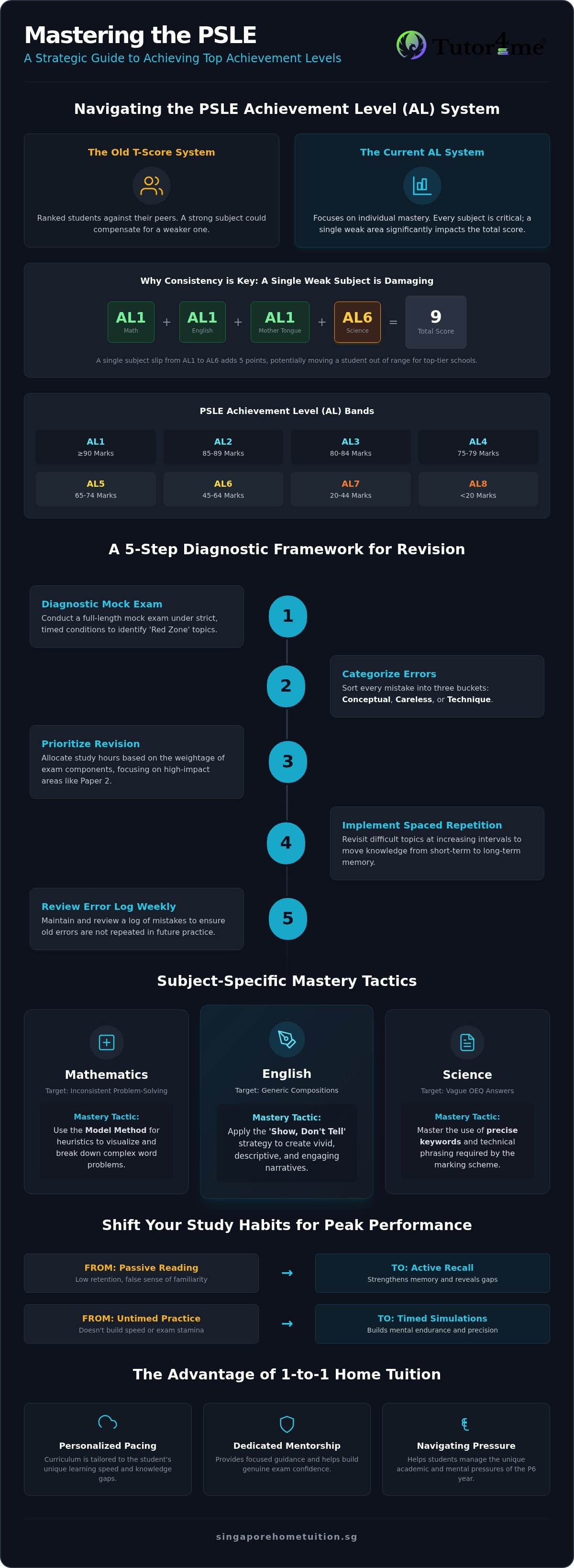
The Primary School Leaving Examination (PSLE) underwent a significant transformation with the introduction of Achievement Levels (AL). Unlike the previous T-score system, which ranked students against their peers, the AL system focuses on individual mastery. Your child receives a score from AL1 (the highest) to AL8 based on their raw marks in each subject. To understand how to score well in psle, you first need to recognize that this system rewards consistent performance across all four pillars: English, Mathematics, Science, and Mother Tongue. Because the scores are added together, the goal is to achieve the lowest total possible.
In the past, a stellar score in Mathematics could compensate for a weaker language grade. Today, a single “weak” subject is far more damaging. For example, if a student scores AL1 in three subjects but slips to an AL7 (45 to 64 marks) in one, their total score becomes 10. This could potentially move them out of the range for top-tier Integrated Programme (IP) schools, which typically require a total score between 6 and 9. Achieving a balanced profile is now the most reliable way to secure a spot in a preferred secondary school, often necessitating specialized PSLE home tuition to bridge specific gaps.
The Shift from T-Score to AL Bands
The 2026 scoring environment prioritizes reaching specific mark brackets rather than just doing better than the national average. Every mark counts, but some marks carry more strategic weight. For instance, moving from 74 marks to 75 marks shifts a student from AL4 to AL3. This single mark reduces the overall score by one point, which is a significant advantage during the S1 Posting Exercise. If your child is taking Foundation level subjects, they’re scored from AL A to AL C. These are mapped to AL6, AL7, and AL8 respectively for secondary school posting, which essentially places a cap on the total score achievable.
Strategic Goal Setting for Secondary School Choice
Effective preparation starts with realistic targets. Use your child’s Primary 5 end-of-year and Primary 6 mid-year results as a baseline. If they’re currently at an AL14 total, aiming for an AL8 requires a clear plan to jump two bands in at least three subjects. You should also anchor your revision timeline using the PSLE 2026 Exam Dates to ensure your child doesn’t burn out before the written papers. Remember that Higher Mother Tongue (HMT) serves as a critical tie-breaker for Special Assistance Plan (SAP) schools. If two students have the same AL score, the one with a better HMT grade gets priority. Planning for these nuances is a core part of learning how to score well in psle and navigating the competitive landscape of Singapore’s education system.
A 5-Step Diagnostic Framework for PSLE Revision
Broad revision often leads to burnout without producing significant results. If you want to understand how to score well in psle, you must adopt a diagnostic approach rather than just rereading textbooks. Start by conducting a full-length diagnostic mock exam under strict timing. This identifies ‘Red Zone’ topics where your child consistently loses marks. Once finished, categorize every error into three buckets: Conceptual, Careless, or Technique. A conceptual error means they don’t understand the logic, while a technique error suggests they know the answer but can’t phrase it to satisfy the marking scheme.
The next steps involve strategic allocation and retention. You should prioritize revision hours based on the weightage of exam components. For example, Paper 2 in most subjects carries a heavier weight and often requires more intensive practice. To ensure this knowledge sticks, implement a spaced repetition schedule. This involves revisiting difficult topics at increasing intervals. Finally, review an ‘Error Log’ every week. This simple habit ensures that old mistakes aren’t repeated in subsequent practice sessions, building a foundation of accuracy.
Identifying Knowledge Gaps Early
Benchmarking against past-year papers from top schools provides a realistic view of the current competitive standard. It’s common to find that P6 struggles actually stem from weak foundations in earlier years. Gaps in Primary 3 Math Tuition topics, such as basic fractions or model drawing, often resurface as complex Paper 2 problems. You should also analyze your child’s ‘marks per minute’ ratio. If they spend too long on low-weightage MCQ questions, they’ll lack the time needed for demanding open-ended sections.
Building a High-Efficiency Study Schedule
Efficiency always beats sheer volume. We recommend the ’50-10′ rule: 50 minutes of deep work followed by a 10-minute rest. This keeps the mind sharp and prevents the cognitive fatigue that leads to careless mistakes. Focus your child’s energy on high-weightage topics, such as Geometry in Math or the Diversity cycle in Science. Integrating expert tips for PSLE success can help you balance school homework with independent revision. If the schedule feels overwhelming, personalized PSLE home tuition offers a way to outsource the diagnostic work, allowing the student to focus entirely on improvement.
Subject-Specific Mastery: Tactics for the Four Core Pillars
Each subject in the PSLE requires a unique cognitive approach. While the diagnostic framework identifies where to focus, subject-specific mastery defines how to execute. Given the mechanics of Navigating the PSLE Achievement Level (AL) System, precision in answering is the differentiator between an AL2 and an AL1. Learning how to score well in psle isn’t about rote memorization; it’s about understanding the specific marking rubrics for each of the four core pillars.
Conquering PSLE Mathematics and Science
In Mathematics, Paper 2 is often the deciding factor for top scores. Students must move beyond basic arithmetic to master the Model Method for complex heuristic problems. Our Primary 6 Math Tuition guide emphasizes the ‘Big 5’ heuristic types, including ‘Supposition’ and ‘Working Backwards,’ which frequently appear in high-weightage questions. Developing the stamina to solve these multi-step problems without careless errors is essential for reaching the AL1 bracket.
Science requires a similar level of technicality. For Open-Ended Questions (OEQs), especially those involving the Transfer of Heat or the Water Cycle, simply being “correct” isn’t enough. Markers look for specific scientific vocabulary and the CER (Claim, Evidence, Reasoning) structure. A common pitfall is providing a conceptually sound answer that lacks the necessary keywords, resulting in zero marks despite the student’s understanding. To make these concepts more intuitive, some parents find that fostering a child’s technical curiosity at an enrichment centre like Cyberland helps them grasp the underlying logic more effectively. Practicing with a focus on ‘keywords-based’ answering ensures that your child’s knowledge translates into actual marks.
Excelling in English and Mother Tongue
English mastery is split between technical accuracy and creative flair. For Paper 1, the ‘Show, Don’t Tell’ technique allows compositions to stand out from generic, canned essays. Instead of writing “He was angry,” a student might describe the “clenched fists and furrowed brow,” signaling a higher level of linguistic sophistication. In Situational Writing, students should focus on the purpose, audience, and tone to secure full marks for task fulfillment. Grammar MCQ can be mastered through a consistent process of elimination, reducing the risk of falling for common distractors.
Mother Tongue success often hinges on the Oral and Cloze Passage components. To secure a 20/20 Oral score, students should engage examiners with relevant personal anecdotes rather than rehearsed responses. This demonstrates genuine language fluency and confidence. For Cloze Passages, building a robust vocabulary through consistent reading is the most effective way to improve accuracy in picking the right contextual words. Understanding these subject nuances is vital for anyone looking for how to score well in psle and secure their preferred school placement.
The Science of Exam Performance: Beyond the Textbooks
Academic knowledge is only half the battle. To truly understand how to score well in psle, students must master the science of performance. This involves transitioning from passive consumption of information to active retrieval and mental conditioning. Even the most prepared student can underperform if they haven’t practiced the physical and psychological rigors of a full-length paper. Success in the 2026 season requires a shift in how your child interacts with their study materials.
Active Recall vs. Passive Reading
Rereading notes or highlighting textbooks is often the least effective way to prepare. These methods create an “illusion of competence” where a student recognizes the text but cannot retrieve the information during a test. Active recall is a superior alternative. Use flashcards for Science cycles or Math formulas to force the brain to retrieve information from scratch. Another powerful technique is having the child teach a concept back to you. If they can explain the “Transfer of Heat” in simple terms, they’ve achieved true mastery.
Simulating the Exam Environment
Careless mistakes often happen because students aren’t used to the pressure of a ticking clock. When practicing at home, simulate exam conditions by removing all distractions and enforcing strict timing. There should be no “checking the back” for answers until the entire paper is finished. As students move from the foundational work of Primary 5 Maths Tuition to the high-stakes P6 mock papers, mental stamina becomes crucial.
Teach your child the “Final 15 Minutes” strategy. This dedicated block isn’t for solving new problems but for a technical audit. They should check for OMR shading errors, ensure all units like cm² or kg are present, and verify that they’ve answered every part of a multi-part question. This simple habit can save several marks that are often lost to oversight.
Managing anxiety is equally important. Simple box-breathing techniques can lower a child’s heart rate during the paper, while positive self-talk prevents the “mental block” common in difficult Math papers. Finally, prioritize sleep and nutrition during the PSLE week. A brain deprived of rest cannot function at peak cognitive capacity, regardless of how much revision was done. To help your child build these essential exam-taking habits, consider the support of specialized PSLE home tuition to provide expert guidance during this final stretch.
Personalized Support: Why 1-to-1 Home Tuition is the Final Piece
While diagnostic frameworks and subject mastery are foundational, the way a student receives this knowledge is often the deciding factor in their final results. Group tuition centers often move at a median pace that accommodates the average student, but this can leave your child behind in their weak areas or bored in their strengths. To truly understand how to score well in psle, a student needs a learning environment that adapts to them, not the other way around. 1-to-1 tuition allows for customized pacing, where 100% of the session is spent on the ‘Red Zone’ topics identified during the diagnostic phase. This ensures that no time is spent on concepts they’ve already mastered.
Beyond the academic benefits, a dedicated mentor provides a significant psychological advantage. The P6 year is a high-stakes environment that can take a toll on a child’s confidence. Having a tutor who understands these unique stressors and provides consistent encouragement can transform a student’s outlook. If a student doesn’t understand a concept, the tutor can pause and re-explain it immediately. This level of precision isn’t possible in a classroom of thirty. Also, home-based learning offers flexible scheduling. By eliminating the ‘tuition commute,’ you save hours of travel time every week. This time is better spent on rest or targeted revision, both of which are essential for peak cognitive performance.
Matching with the Right PSLE Specialist
An MOE-trained teacher or a top home tutor makes a tangible difference in the final sprint toward the exams. These specialists bring years of experience in identifying the subtle traps examiners set in Paper 2. Utilizing PSLE Home Tuition is a strategic move for students aiming for targeted grade jumping. It allows the tutor to uncover ‘blind spots’, those small, recurring errors in logic or phrasing, that group teachers often miss. This personalized attention is how to score well in psle when the margin for error between AL bands is so slim.
The Convenience of Home-Based Learning
Maximizing efficiency is paramount during the final months of P6. Home-based learning creates a safe, quiet environment free from the social distractions of a physical tuition center. It allows the student to focus entirely on the task at hand. You can request a tutor match that fits your family’s specific budget and academic goals via Singapore Home Tuition. This bespoke approach ensures that the tutor’s expertise perfectly aligns with your child’s personality and learning style, providing the stable pillar they need to excel in their first major academic milestone.
Empowering Your Child for PSLE Success
Transitioning from passive learning to a diagnostic-led strategy is the most effective way to navigate the 2026 AL scoring system. By focusing on high-weightage components and mastering active recall techniques, your child can build the mental stamina needed for the final papers. Understanding how to score well in psle isn’t just about the volume of work; it’s about the precision of the preparation and the quality of the support they receive during the final sprint.
If you’re ready to bridge the gap between current performance and your child’s target secondary school, personalized guidance is the next step. Our team offers fast tutor matching within 24 hours, connecting you with MOE-trained teachers and subject specialists. We provide 100% personalized 1-to-1 attention that has helped many students achieve AL1 to AL3 grade improvements. Find the Perfect PSLE Home Tutor to Boost Your Child’s AL Score Today and give them the confidence to excel. With the right strategy and a dedicated partner, your child’s academic goals are well within reach.
Frequently Asked Questions
How many hours a day should a Primary 6 student study for PSLE?
A Primary 6 student should aim for two to three hours of focused revision on weekdays and four to five hours on weekends. It’s more effective to prioritize quality over quantity. Using the 50-10 rule ensures that the brain remains sharp and prevents the cognitive fatigue that leads to careless mistakes. Consistency in daily practice is far more beneficial than marathon sessions that cause burnout.
Is it too late to start intensive tuition in the middle of Primary 6?
It is not too late to start intensive tuition in the middle of the year. While starting early is ideal, a dedicated specialist can help bridge significant gaps quickly by focusing entirely on high-weightage ‘Red Zone’ topics. The key is to shift from broad revision to a diagnostic approach that targets specific component weaknesses. This targeted support often leads to rapid grade jumps before the written papers begin.
How can I help my child reduce careless mistakes in the Math paper?
Reducing careless mistakes requires a systematic approach to checking and a disciplined habit of showing all working steps. Encourage your child to underline key information in word problems and verify units like cm² or liters. Implementing a technical audit during the final fifteen minutes of the paper is essential. This dedicated time should be used to check OMR shading and ensure no parts of a question were missed.
What is the best way to prepare for the PSLE Science Open-Ended Questions?
The most effective way to master Science OEQs is through the CER (Claim, Evidence, Reasoning) framework combined with precise scientific vocabulary. Students often lose marks not because they don’t understand the concept, but because they lack the required keywords. Practicing with top school papers helps them recognize the specific phrasing markers look for in topics like the Water Cycle or Transfer of Heat.
Should my child take Higher Mother Tongue if they are already struggling with core subjects?
The decision to take Higher Mother Tongue (HMT) should be strategic and based on your child’s target secondary school. HMT serves as a critical tie-breaker for Special Assistance Plan (SAP) schools. However, if your child is currently scoring below AL4 in core subjects, it’s often better to stabilize those grades first. A balanced profile across all four subjects is usually more beneficial under the AL scoring system.
How does the AL system affect the choice of secondary schools in 2026?
In 2026, the AL system continues to prioritize consistent performance as scores from AL1 to AL8 are summed across all four subjects. Since secondary schools have specific cut-off points, understanding how to score well in psle is crucial for navigating these boundaries. A single weak subject can disproportionately affect the total score, making it vital to maintain a high standard across English, Math, Science, and Mother Tongue.
Can 1-to-1 home tuition really improve a child’s AL score in a few months?
Yes, 1-to-1 home tuition is highly effective for rapid improvement because it addresses a student’s unique blind spots immediately. Unlike group settings, a private tutor can adapt the pace to the child’s needs and provide instant feedback on conceptual errors. This personalized guidance is a proven method for those wondering how to score well in psle when time is limited during the final months of Primary 6.
What should we do if my child feels burnt out before the actual exam dates?
If your child shows signs of burnout, it’s essential to adjust their schedule immediately by prioritizing rest over additional assessment papers. Ensure they are getting at least eight hours of sleep and maintaining a balanced diet. Sometimes, a short break from the books can reset their cognitive capacity. Mental well-being is a cornerstone of exam performance, as a rested mind processes information much more efficiently than a fatigued one.