
The most expensive tutor isn’t automatically the right choice for your child. When comparing home tuition rates Singapore, look at how a tutor’s experience and subject expertise fit your child’s needs, whether they’re preparing for the PSLE, O-Levels, A-Levels, IB or IGCSE.
It’s understandable to wonder what distinguishes an undergraduate, a full-time tutor and an MOE teacher. Their backgrounds and teaching experience differ, and the right fit depends on your child’s learning gaps, goals and preferred way of learning. Credentials matter, but they’re only one part of choosing suitable support.
This guide explains tutor categories and academic levels to consider, then offers practical ways to assess experience, subject knowledge and teaching approach. Use it to compare quotes in context and choose one-to-one home tuition that fits your child’s needs and your budget.
Key Takeaways
- Compare tutor categories and academic levels before deciding what kind of support suits your child.
- Match tutor experience to your child’s next milestone, from PSLE preparation to O-Level, IB or IGCSE support.
- Assess value beyond credentials by considering subject expertise, learning style and the support your child needs.
- Before choosing a tutor, clarify the matching process and any terms that could affect your tuition arrangement.
- Share your child’s level, subject and budget when exploring tutor profiles, so you can compare options relevant to your needs.
2026 Home Tuition Rates in Singapore: A Market Overview
Families can compare tutors with different backgrounds, subject strengths and teaching experience. The right option depends on your child’s academic level, curriculum and learning goals. Support may focus on milestones such as the PSLE and A-Levels, or international programmes such as IB and IGCSE. These pathways call for different subject knowledge and exam preparation, so compare quotes for tutors with relevant experience rather than treating every tutor as interchangeable.
Singapore’s education system includes varied learning pathways and assessment stages. You can read more about Singapore’s education system and the context for private tuition. Online lessons offer a different setting from one-to-one home tuition, where the tutor and student work together in person. Consider your child’s learning style, ability to stay focused and comfort with each format. When requesting a quote, specify the format you want so you can compare arrangements consistently.
The Tutor Category Comparison
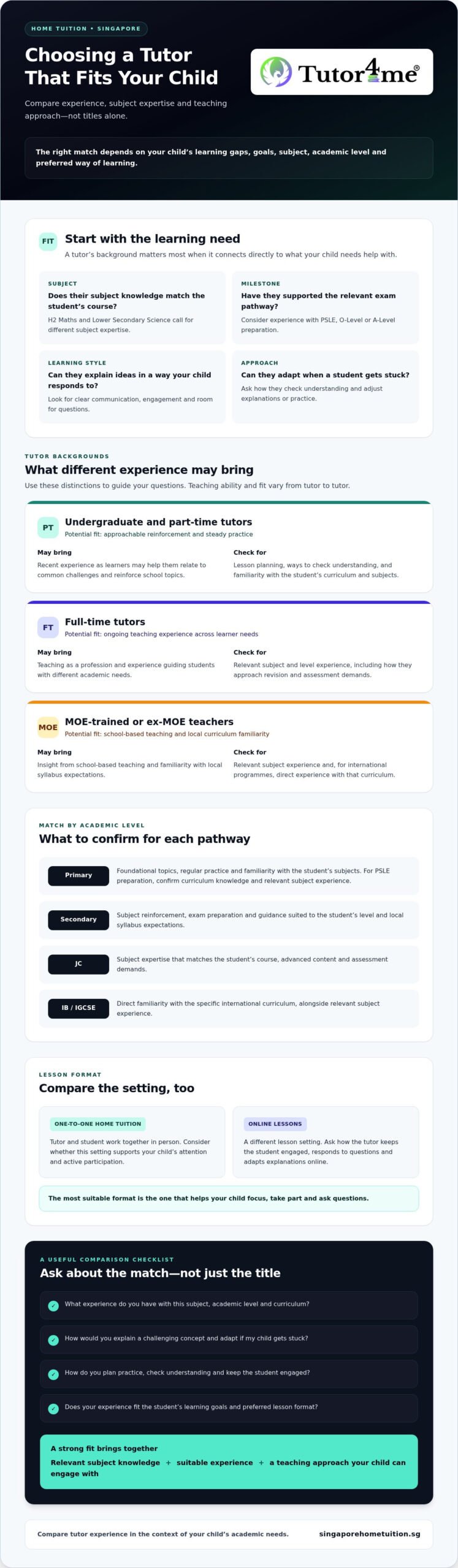
Tutor categories are best understood through the experience and support each may bring. Use this guide to identify what to ask about a tutor’s background:
| Level | Part-time tutors | Full-time tutors | MOE-trained or ex-MOE teachers |
|---|---|---|---|
| Primary | May offer approachable support with foundational topics and regular practice. | May bring ongoing teaching experience across different learner needs. | May offer insight from school-based teaching and familiarity with the local curriculum. |
| Secondary | Can help reinforce subject learning and exam preparation. | May have experience supporting students through secondary-level work. | May be suited to students seeking guidance on local syllabus expectations. |
| JC | Check for subject expertise that matches the student’s course. | Look for experience with advanced subject content and assessment demands. | Ask about relevant subject and curriculum experience. |
| IB and IGCSE | Confirm familiarity with the specific international curriculum. | Prioritise direct experience with the subject and programme. | Check international-curriculum experience alongside local teaching background. |
Online and home lessons differ in format, not simply in how a tutor teaches. For families open to remote sessions, platforms like TheTuitionE show how one-to-one online tuition can be tailored to individual academic needs. Ask how the tutor keeps the student engaged, responds to questions and adapts explanations in the chosen setting. The best format is the one that supports your child’s attention and active participation.
Why Tutor Needs Differ
Subject complexity shapes the expertise a student may need. H2 Maths calls for different subject knowledge from Lower Secondary Science. A tutor’s experience with PSLE, O-Level or A-Level preparation may also be useful when a student needs focused exam guidance. Ask for examples of how the tutor explains challenging concepts and adapts lessons to the student, rather than relying only on broad claims about experience.
Explore Singapore home tutor profiles to compare relevant teaching backgrounds and subject experience for your child’s level and academic needs.
Defining Tutor Categories: Who Are You Paying For?
A tutor’s background can shape how they explain a topic, structure practice and respond when a student gets stuck. The useful question is not which title sounds most impressive, but which experience fits your child’s subject, level and learning style. Ask each prospective tutor how they would approach a specific challenge, such as building confidence in Primary English or strengthening exam technique in Secondary Maths.
The Ministry of Education statistics provide official context on Singapore’s education sector. For an individual tutor, check qualifications and teaching experience directly, then consider how clearly they explain their approach. A strong match combines relevant subject knowledge with communication that helps your child stay engaged and ask questions.
Undergraduate and Part-Time Tutors
Undergraduates and other part-time tutors may suit younger students who benefit from an approachable mentor and steady reinforcement of school topics. Their recent experience as learners may help them relate to common challenges, but teaching ability varies from person to person. Ask how they plan lessons, check understanding and adapt explanations when a child needs more support. For PSLE preparation, confirm their familiarity with the curriculum and the student’s specific subjects.
Full-Time Tutors and MOE Professionals
Full-time tutors have made teaching their profession and may have experience guiding students with different academic needs. For PSLE, O-Level and A-Level preparation, ask how they help students interpret questions, organise revision and practise exam techniques. Request examples of their approach rather than relying on broad claims about experience.
Current or former MOE teachers may bring school-based teaching experience and knowledge of the local curriculum. If professional training is relevant to your decision, ask about the tutor’s qualifications, including any NIE training. For IB or IGCSE, check for direct experience with the specific programme, since local syllabus knowledge alone may not cover its requirements.
Choose for Your Child, Not Just the Credential
Notice how your child learns best. A student who needs time to build confidence may respond to patient explanations and regular checks for understanding. Someone who knows the material but struggles to apply it may benefit from guided problem-solving and exam-style practice. Discuss these preferences before lessons begin, then observe whether your child feels comfortable asking questions and following the tutor’s pace. The importance of matching teaching style to a student’s personal learning rhythm extends beyond academics to creative pursuits as well, such as private instrument study with Rising Tones Music.
To compare relevant experience and teaching backgrounds, review top home tutor Singapore profiles and consider which profile best fits your child’s subject, level and learning style.
Budgeting for Milestones: PSLE, O-Levels, and IB/IGCSE
Exam preparation can change how much support your child needs, even if the tutor’s hourly rate stays the same. To plan a realistic budget, estimate lesson frequency and the number of subjects that need attention, then review the plan as your child’s needs change. The Straits Times report on household spending on private tuition offers wider context for families planning education spending.
PSLE Home Tuition Budgeting
Primary 6 preparation can feel like a spending spike when families add lessons or focus support on several core subjects: English, Maths, Science and Mother Tongue. That doesn’t necessarily mean the hourly rate itself has risen. The total may change because of more frequent lessons or a short-term focus on specific learning gaps as the exam approaches.
To keep the plan manageable, identify the subjects where your child needs the most help, set a lesson schedule you can sustain, and review progress regularly. If you’re considering a short, intensive period of support in the final months, agree on the goals and schedule in advance rather than assuming a “crash course” is the right fit. Explore PSLE Home Tuition options that match your child’s subjects and academic needs.
Secondary School and O-Level Planning
Secondary budgeting can become more complex as a student’s subject combination grows. The change from supporting four subjects to as many as eight isn’t the same for every student, so avoid planning around a fixed number. List each subject, note where extra help is most needed, and prioritise lessons according to upcoming assessments and persistent gaps. You can then decide whether to focus on one subject at a time or arrange support across more than one.
IB and IGCSE Subject Support
IB and IGCSE require tutors who understand the relevant curriculum and subject expectations. Specialist experience may affect the quotes families receive, so compare tutors on curriculum familiarity as well as qualifications. For an IB Diploma student, Economics and Physics may call for different expertise. Confirm that a prospective tutor has experience with the specific subject and level, and ask how lessons will address the student’s current challenges before deciding how much support to schedule.
To compare IGCSE home tuition profiles, consider curriculum experience alongside your child’s learning goals. For any milestone, set your subject priorities first, then discuss tutor background, lesson frequency and expectations. This makes it easier to assess home tuition rates Singapore in context and choose support that fits your family’s plan.
Maximizing ROI: How to Get the Best Value for Your Tuition Fees
Value isn’t simply a question of choosing the tutor with the highest credentials. A tutor is a stronger fit if their subject expertise and teaching approach address your child’s specific gaps. Before comparing home tuition rates Singapore, define what progress should look like: clearer understanding of a topic, more confident problem-solving, or better preparation for a particular exam.
Compare Attention and Fit
Group lessons and one-to-one home tuition offer different learning experiences. In a group, the tutor’s attention is shared. In a one-to-one lesson, the tutor can focus on your child’s questions and adjust the pace. That individual attention may be useful when a student has specific gaps in a subject such as Maths, but it isn’t automatically the best fit for every learner. Consider how your child learns and what support they need.
Rather than comparing only the hourly rate, weigh the lesson format against its usefulness for your child. Ask how much of each session is likely to focus on their questions, whether lesson goals can be tailored, and how progress will be reviewed. For Maths support, you can also explore home tutor profiles and check for relevant subject experience.
Assess the Tutor Beyond Credentials
A higher-priced tutor may bring relevant experience, but that alone doesn’t guarantee faster progress. Use an initial conversation to understand how the tutor would approach your child’s academic needs. Ask which topics they would prioritise, how they explain difficult concepts, and how they adapt when a student is struggling. You can also ask how they’ll communicate progress and what they would want to know about your child before starting.
If you’re considering a trial lesson, first check whether one is available and clarify its terms. Use it to observe whether your child feels comfortable asking questions and whether the lesson has a clear focus. A good match should be able to explain how the teaching approach connects to your child’s goals, not promise a particular result.
Clarify the Arrangement Before You Commit
Share your budget and priorities with a home tuition agency, then ask what tutor options may suit both. Before confirming lessons, request a clear explanation of the arrangement, including any separate charges or expectations related to travel, learning materials or agency commission. Don’t assume these details; check what applies to the specific match.
For a tutor match based on your child’s subject, level and budget, explore Singapore Home Tuition’s matching options.
Securing the Right Tutor with Singapore Home Tuition
A suitable match starts with a clear brief, not just a preferred tutor title. Share your child’s level, subject, learning goals and budget so the tutor search can focus on relevant experience. Whether you’re looking for PSLE Maths, O-Level English, A-Level Economics, IB Physics or IGCSE support, these details help narrow the options to tutors whose backgrounds fit the academic need.
Singapore Home Tuition provides one-to-one home and online tutor matching for students from Preschool to University. Its pool includes MOE teachers, experienced full-time tutors and university undergraduates, with options matched to students’ needs and budgets. Share your requirements so the matching process can focus on relevant tutor profiles.
A Clear Matching Process
Prepare a short brief before starting your search. Include the student’s level and curriculum, subject, current challenges, preferred lesson format and budget. Then review the proposed tutor profiles for relevant subject experience, qualifications and fit with your child’s learning style.
- Share your requirements. Explain the level, subject, goals and budget you have in mind.
- Review suitable profiles. Compare tutor backgrounds and qualifications against your child’s needs.
- Agree on the arrangement. Discuss lesson timing, expectations and any relevant terms directly before confirming the first session.
As you compare profiles, ask how a tutor would approach a specific challenge. For instance, a student who understands Chemistry concepts but struggles to apply them may need a different teaching approach from one who needs help with foundational knowledge. A focused question gives you a clearer sense of whether the tutor’s experience and communication style are suitable.
Support Across Subjects and Levels
Families can consider different tutor backgrounds, including undergraduates, experienced full-time tutors and MOE teachers, according to the child’s level, subject and learning goals. Tutor qualifications and ability verification can also help inform your decision. For specialised subject support, explore Chemistry tuition in Singapore. Ask about any terms you want clarified before confirming lessons, and make sure you understand the arrangement from the outset.
Good matching is a practical way to bring your budget and your child’s needs into the same decision. If your child needs help with Chemistry, ask about Chemistry tutor support.
Choose Support That Fits Your Child’s Next Step
Choosing a tutor is about more than comparing home tuition rates Singapore. Match your budget to your child’s academic needs, subject and upcoming milestone, then weigh tutor experience against the kind of guidance that will help them learn. For PSLE, O-Level, A-Level, IB or IGCSE support, start with a clear picture of the areas where your child needs help.
Before confirming a tutor, review their relevant qualifications and experience, discuss how they approach lessons, and clarify the terms of the arrangement. Singapore Home Tuition matches families with tutors from a pool that includes MOE teachers, full-time tutors and undergraduates. Share your child’s needs and budget to explore potential fits.
Share your child’s level, subject and budget to begin exploring suitable options. Contact Singapore Home Tuition to discuss a tutor match. With a thoughtful match and clear learning goals, you can help your child build confidence and make steady progress.
Frequently Asked Questions
How much does a private tutor cost in Singapore per hour in 2026?
Hourly quotes vary by the student’s level, subject and tutor category. Part-time tutors, full-time tutors and current or former MOE teachers may have different rates, while specialist curricula such as IB and IGCSE can call for specific experience. Singapore Home Tuition does not publish a single rate for every match, so request a quote based on your child’s level, subject, preferred format and requirements.
Is there a difference in rates between home tuition and online tuition?
Rates can differ between home and online lessons, but there isn’t one fixed difference that applies to every tutor. The subject, academic level, tutor background and lesson arrangement all affect the quote. Compare profiles with similar qualifications and experience, then ask whether travel or other arrangements affect the terms. Choose the format that best supports your child’s focus, learning style and access to individual guidance.
Do I have to pay a commission or matching fee to the tuition agency?
Agency policies vary, so confirm the arrangement directly before accepting a tutor. Ask whether parents pay registration or matching charges, whether any commission applies, and whether payments are made to the tutor or agency. Request clear terms before lessons begin, so you understand what you’re agreeing to and can plan with confidence.
Why are MOE teachers significantly more expensive than full-time tutors?
MOE teachers may bring school-based teaching experience, familiarity with the local syllabus and professional training, which can affect their rates. Full-time tutors may also have substantial teaching experience, but their backgrounds and specialities differ. Neither category is automatically the right choice for every student. Compare relevant subject knowledge, experience with your child’s level and teaching approach, then decide which profile best fits your child’s academic needs.
What happens if the tutor is not a good fit after the first lesson?
Tell the agency what felt unsuitable, such as the tutor’s pace, communication style or subject approach, and explain what your child needs instead. Ask what options are available if the match isn’t suitable, and confirm the process with the agency. Clarify any lesson arrangements already agreed. A clear explanation can help guide the next match more closely to your child’s needs.
Can I negotiate the tuition rates listed on the agency website?
Ask whether there’s flexibility, but don’t assume a quoted rate is negotiable or that every tutor will accept the same terms. If the quote is outside your budget, explain your spending limit and the subject or experience you need. The agency may be able to suggest profiles from different tutor categories for comparison. Check that any revised arrangement still meets your child’s learning requirements before you decide.
Are there additional costs for materials or travel for home tutors?
Additional charges depend on the tutor and the agreed lesson arrangement. Before confirming, ask whether the quoted terms include travel, learning materials or other items, and whether you’re expected to provide anything for the lesson. Don’t rely on assumptions or leave details until later. Getting the arrangement in writing helps you understand what’s included and avoid surprises as your child’s lessons continue.
How many hours of tuition per week is considered standard for PSLE or O-Levels?
There isn’t one weekly schedule that suits every PSLE or O-Level student. Consider the subjects needing support, current gaps, school workload and time remaining before exams. A student working on one specific topic may need a different plan from someone seeking support in several subjects. Discuss priorities with your tutor, agree on a manageable schedule and review whether the sessions are helping your child progress.