

In 2026, simply memorizing the textbook is no longer enough to secure an A1 in O-Level Biology. Many students find that while they understand the concepts, they struggle to apply that knowledge to the complex, structured questions found in syllabus 6093. If your child feels overwhelmed by the volume of content, specialized secondary biology home tuition can provide the targeted support they need. It’s common for students to lose marks because they haven’t mastered the specific keywords or experimental techniques that examiners look for, especially in large classes where personalized feedback is rare.
We understand the pressure of the O-Level journey and believe that the right support can make all the difference. This guide shows you how 1-to-1 tutoring bridges the gap between basic theory and the high-level application required for excellence. You’ll learn how a customized study plan can address your child’s unique weaknesses in areas like molecular biology, providing them with the answering techniques and confidence needed for success. We will break down the essential steps to finding a dedicated specialist who can help your child navigate this high-stakes environment with ease and quiet confidence.
Key Takeaways
- Understand the transition from General Science to the specialized 2026 O-Level syllabus and how to manage the “content shock” students face in Secondary 3.
- Learn the structural differences between Pure and Combined Biology to help your child choose the track that aligns with their strengths and future goals.
- Discover how personalized 1-to-1 secondary biology home tuition creates a safe environment for students to ask questions and bridge the gap between theory and application.
- Master the precise use of biological terminology and data interpretation techniques that are essential for scoring well in structured and experimental questions.
- Identify the key criteria for selecting the right subject-matter expert, whether you’re looking for an MOE-trained teacher or a dedicated full-time specialist.
The Jump to Upper Secondary Biology: Why Students Struggle
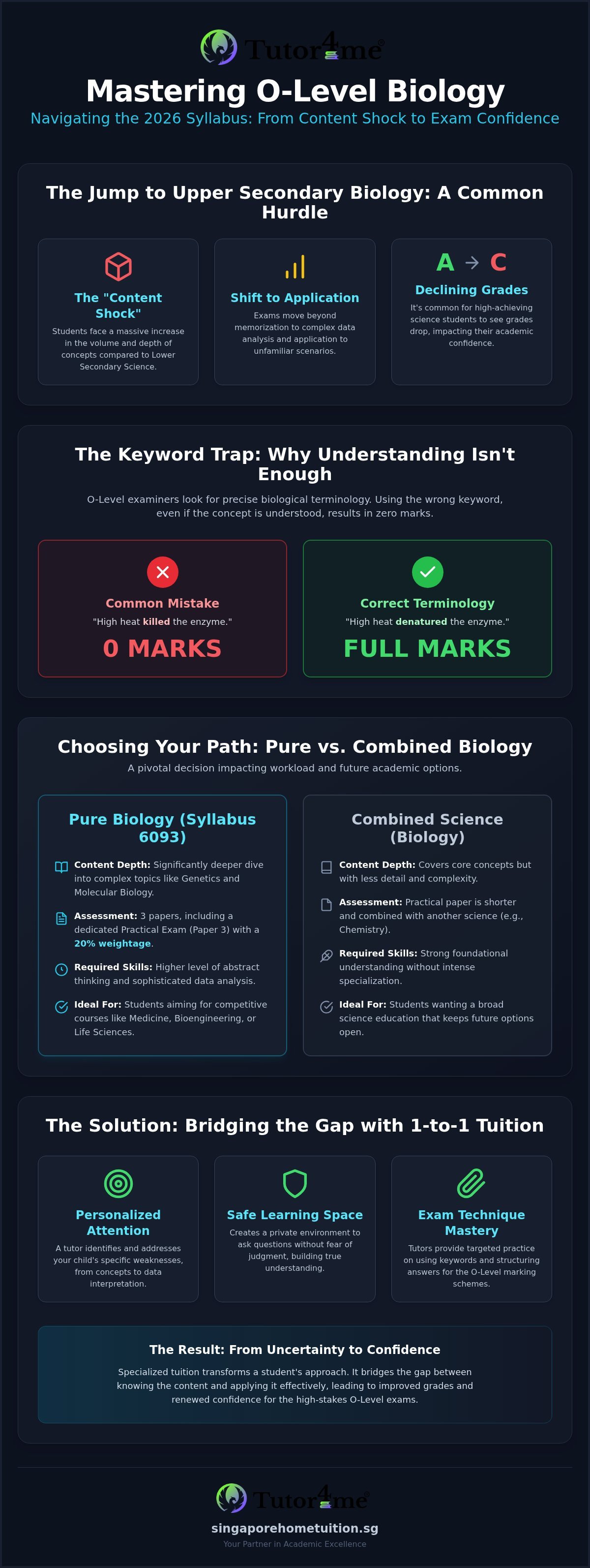
The transition from Lower Secondary Science to specialized Biology disciplines is often the first significant academic hurdle for Singaporean students. In the earlier years, Science is taught as an integrated subject where concepts are broad but relatively accessible. However, as students enter Secondary 3, they encounter a “content shock.” The volume of information in the Singapore-Cambridge GCE O-Level Biology syllabus is significantly higher than anything they’ve faced previously. This sudden increase in curriculum depth can be overwhelming, leading to a noticeable decline in grades during the transition year.
This shift isn’t just about the quantity of information. It’s a fundamental change in how students are assessed. The O-Level syllabus moves away from simple factual recall toward data analysis and the application of concepts to unfamiliar experimental setups. For many students, this results in a heavy emotional toll. Seeing “C” or “D” grades after years of scoring “A”s in Science can damage their confidence. Engaging secondary biology home tuition early in this transition helps students regain their footing by providing the personalized attention needed to navigate these new requirements with quiet confidence.
The Content-Application Gap
In the 2026 academic landscape, memorizing the textbook no longer guarantees a pass. The SEAB marking schemes are precise and unforgiving. Students often understand a concept but fail to use the exact “keywords” required to secure marks. For instance, describing an enzyme as being “killed” by high heat rather than “denatured” will result in zero marks for that section. These nuances are difficult to master in a crowded classroom. This is where 1-to-1 secondary biology home tuition proves invaluable. A dedicated tutor identifies specific conceptual gaps and trains the student to use precise biological terminology, ensuring their answers meet the rigorous standards of the O-Level examiners.
Foundational Knowledge from Lower Secondary
Upper Secondary success is built on the foundations laid during the primary and lower secondary years. Advanced topics like molecular genetics or homeostasis rely on a deep understanding of cell structure and transport mechanisms. Students who benefited from PSLE Home Tuition often have a smoother start, but the jump to O-Levels still requires a shift in mindset. They must often unlearn “simplified” primary school concepts that are no longer scientifically accurate at a higher level. A professional tutor acts as a bridge, helping students connect their prior knowledge to the complex requirements of the 2026 syllabus while correcting misconceptions before they become deep-seated habits.
Pure vs. Combined Biology: Navigating the 2026 MOE Syllabus
Choosing between Pure and Combined Biology is a pivotal decision at the end of Secondary 2. The 2026 MOE Biology Syllabus outlines distinct paths that impact both daily workload and future academic options. While both tracks cover core concepts, Pure Biology (Syllabus 6093) dives significantly deeper into complex topics like Genetics and Molecular Biology. This added depth requires a higher level of abstract thinking and a more robust grasp of scientific inquiry. Students in the Pure track are expected to master more content and demonstrate a sophisticated understanding of how biological systems interact.
The assessment structures also differ. Pure Biology students sit for three papers, including a dedicated Practical Examination (Paper 3) that carries 20% weightage. Combined Science students also take a practical paper, but it is shorter and covers two different sciences. The expectations for Pure Biology are naturally higher; students must demonstrate independent experimental design and advanced data analysis. For those finding these requirements daunting, specialized secondary biology home tuition provides a structured environment to practice these high-stakes laboratory skills and theoretical applications.
Is Pure Biology Right for Your Child?
Assessing interest versus academic capability is essential before committing to the Pure track. Pure Biology is ideal for students eyeing competitive careers in Medicine, Bioengineering, or Life Sciences. However, it demands a significant time commitment that can be taxing when combined with other subjects. If a student is already struggling with the heavy workload of three sciences, the pressure can lead to burnout. We recommend parents look at their child’s Secondary 2 Science performance as a baseline. If they enjoy the “why” behind biological processes and can handle rigorous content, Pure is likely the right fit.
Combined Biology: Managing Multiple Disciplines
Combined Biology is not necessarily “easier” when it comes to schedule management. It requires balancing Biology with another science, often necessitating Chemistry Tuition to ensure both halves of the grade remain strong. A common pitfall for combined students is neglecting the Biology component because it feels more descriptive than Physics or Chemistry. To score well, students must strategically focus on high-yield topics like Human Physiology and Ecology. Finding a specialized tutor who understands these syllabus nuances can make managing these multiple disciplines much smoother.
Your choice also impacts post-secondary eligibility. Scoring well in Pure Biology typically opens more doors for H2 Biology in Junior College. While some JCs allow Combined Science students to take H2 Biology, they often require a distinction to bridge the foundational gap. Similarly, popular Polytechnic courses like Biomedical Science favor students with the rigorous background provided by the Pure Biology track. Understanding the secondary school ranking and 2026 PSLE AL cut-off points can also help families plan ahead, as the school your child attends often influences which Biology track is available to them.
Comparing Learning Environments: Why 1-to-1 Home Tuition for Biology?
Choosing between a tuition center and home-based learning is a significant decision for many families. While centers offer a structured group environment, they often follow a rigid curriculum that may not align with a student’s specific pace or school schedule. Secondary biology home tuition delivered 1-to-1 provides a level of customization that group settings simply cannot match. In a private setting, students feel the psychological safety to ask “silly” questions without the fear of judgment from peers. This open dialogue is crucial for mastering complex biological processes that require more than just surface-level understanding.
Efficiency is another critical factor for busy Secondary 4 candidates. Home-based learning eliminates travel time, allowing students to focus their energy entirely on their studies. It also enables the tutor to concentrate on specific weak chapters, such as molecular genetics or nutrient cycles, rather than following a fixed center schedule. This targeted approach ensures that every hour spent in tuition directly contributes to improving the student’s performance. It’s a methodical way to identify a specific requirement and provide a clear path forward without the distractions of a large classroom.
Immediate Feedback and Error Correction
One of the most significant advantages of 1-to-1 instruction is the ability to receive real-time correction. When practicing structured questions, a top home tutor in Singapore can spot conceptual errors the moment they appear on the page. This immediate loop is supported by research on one-on-one tutoring, which highlights how personalized feedback accelerates the learning process. Tutors can also help bridge the gap for students who understand the science but struggle with English expression. They ensure the student uses the precise terminology required by SEAB examiners to avoid losing unnecessary marks.
Customized Materials vs. Generic Notes
Generic notes from tuition centers often include excess information that may not be relevant to a student’s specific school curriculum. In contrast, 1-to-1 secondary biology tuition focuses on creating personalized mind maps and summary sheets tailored to the student’s learning style. These materials are often designed around the specific internal exam trends and past papers of the student’s school. For students in international systems, tutors can seamlessly integrate IGCSE Home Tuition techniques to meet different assessment criteria, ensuring the curriculum remains relevant to their specific academic goals.
Core Skills and Exam Techniques for O-Level Biology Success
Success in O-Level Biology is as much about strategy as it is about science. While previous sections discussed the significant jump in content, this section focuses on the tactical skills required to translate that knowledge into marks. Mastering precise biological terminology is the first step. For example, examiners strictly require the term “denature” when referring to enzymes at high temperatures. Using “kill” or “break down” often results in lost marks. Specialized secondary biology tuition helps students internalize these distinctions through repetitive practice and guided feedback, ensuring they don’t lose easy marks to imprecise language.
Interpreting complex data is another major hurdle in the 2026 syllabus. Students must analyze graphs, tables, and experimental setups to draw valid conclusions. The “Planning” question in the Practical Paper is particularly challenging for many. It requires a clear understanding of independent, dependent, and controlled variables. A methodical approach to this section can secure a significant portion of the 20% weightage assigned to Paper 3. Effective time management is also vital. We teach students to allocate their minutes based on a mark-to-minute ratio, ensuring they don’t spend too long on 1-mark questions at the expense of mark-heavy sections.
Decoding the Question Keywords
Many students lose marks by failing to recognize what a question actually asks. “Describe” requires a factual account of what is seen, while “Explain” demands the underlying biological reasoning. “Suggest” involves applying known concepts to a novel situation. In the “Free Response” section, structuring answers with clear, logical points is essential for maximum marks. Careless mistakes in MCQ often stem from misreading qualifiers like “except” or “incorrect.” Tutors address these habits by reviewing past paper trends and highlighting common examiner traps. If your child struggles with these nuances, you can find a dedicated biology specialist to provide the targeted practice they need.
Active Recall and Spaced Repetition for Content
Retaining the vast syllabus requires more than just reading notes repeatedly. Tutors help students use active recall and spaced repetition to keep information fresh in their minds. Flashcards and summary tables are particularly effective for memorizing the intricate details of Human Physiology. By linking different chapters, such as Nutrition in Plants and Photosynthesis, students develop a holistic understanding of the subject. This interconnected approach makes it easier to tackle cross-topical questions that are common in the current O-Level format. It’s about building a stable pillar of knowledge that remains accessible under exam pressure.
Choosing Your Biology Tutor: The Singapore Home Tuition Advantage
Selecting the right mentor is the final, crucial step in securing O-Level excellence. While previous sections detailed the technical demands of the syllabus, the human element of secondary biology tuition is what truly transforms a student’s attitude toward the subject. A subject-matter expert does more than teach; they act as a stable pillar during the high-pressure exam season. At Singapore Home Tuition, we prioritize a methodical matching process to ensure the tutor’s teaching style aligns with the student’s specific learning requirements and personality.
Parents can choose from three main categories of educators. Ex or current MOE teachers offer unparalleled insight into the latest SEAB marking standards and examiner expectations. Full-time tutors are dedicated specialists who often possess years of experience in one-to-one instruction, providing a consistent and reliable feedback loop. Undergraduates from top local universities offer a relatable perspective and are often highly effective at simplifying complex concepts for younger students. We verify all credentials and track performance to maintain the professional standards our clients expect.
Flexible Arrangements for the O-Level Year
The academic year is not a steady climb but a series of peaks. Our secondary biology tuition services offer the flexibility to scale up lesson frequency before critical milestones like mid-year exams or prelims. You can also choose between the convenience of online sessions or the traditional focus of physical home tuition. For a truly holistic approach to the sciences, many parents find synergy in combining Biology support with A Maths Tuition. This ensures the student develops the quantitative skills necessary for data analysis across all STEM subjects.
Getting Started with Your Biology Specialist
Requesting a tutor is a straightforward and frictionless process. Once you identify your requirements, we match you with a specialist who fits your budget and schedule. To make the most of the first diagnostic session, it’s helpful to prepare your child’s recent exam papers and school worksheets. This allows the tutor to identify conceptual gaps immediately and begin crafting a customized study plan. Together, we will set realistic academic milestones for the 2026 exam season, ensuring your child moves forward with a sense of empowerment and professional support.
Securing a Bright Future in the Life Sciences
Navigating the complexities of the 2026 syllabus code 6093 doesn’t have to be a source of stress for your family. By focusing on precise terminology and mastering experimental design, your child can move beyond rote memorization to achieve true academic excellence. We’ve explored how identifying conceptual gaps early and choosing the right academic track are essential steps in this journey. It’s about transforming overwhelming content into manageable, actionable knowledge that sticks.
Quality secondary biology tuition provides the personalized 1-to-1 attention necessary to build this foundation with quiet confidence. Our agency offers islandwide coverage and a fast matching service to connect you with qualified MOE teachers or full-time subject specialists tailored to your specific requirements. This dedicated support ensures your child has the tools and techniques needed to excel in both their structured and practical papers.
Ready to take the next step? Find Your Specialist Secondary Biology Tutor Today and give your child the empowerment they deserve. With the right partner by their side, O-Level success is well within reach.
Frequently Asked Questions
How much does secondary biology tuition cost in Singapore for 2026?
Rates for secondary biology tuition are tiered based on the tutor’s qualifications and experience level. Generally, fees vary depending on whether you choose a part-time tutor, a full-time specialist, or an ex-MOE teacher. Factors such as the duration of the lessons and the specific track, whether Pure or Combined Biology, also play a role in determining the final cost. We recommend consulting with our matching specialists to find a tutor who fits your family’s specific budget.
Is it better to have an MOE teacher or a full-time tutor for Biology?
The choice depends on your child’s learning requirements and the specific areas they find challenging. MOE teachers bring a deep understanding of the SEAB marking schemes and current school curriculum trends, which is excellent for mastering exam strategies. Full-time tutors often offer more flexible scheduling and a dedicated focus on 1-to-1 mentorship. Both are professional options that provide the stable pillar of support needed for O-Level success.
Can my child switch from Combined to Pure Biology with the help of a tutor?
A specialist tutor can help bridge the significant content gap between the two tracks, though the final approval depends on your child’s school. Pure Biology requires mastering additional topics like molecular genetics and more complex physiology chapters. A dedicated specialist will create a customized study plan to help your child catch up on these advanced concepts while ensuring they can handle the increased workload of the Pure track.
How many hours of biology tuition per week is recommended for Sec 4 students?
Most Secondary 4 students benefit from one session of 1.5 to 2 hours per week to maintain a steady pace with the syllabus. During the lead-up to prelims and the O-Level exams, some families choose to increase this to two sessions a week. This additional time allows for more intensive practice with past-year papers and a deeper focus on refining precise answering techniques for structured questions.
Does home tuition cover the practical/lab component of the O-Level Biology exam?
While home tuition doesn’t provide a physical laboratory, it is highly effective for mastering the “Planning” and “Data Analysis” components of Paper 3. Tutors guide students through the logic of experimental design, including how to identify variables and evaluate experimental errors. Since many students lose marks on the theoretical aspects of the practical paper, this focused 1-to-1 practice is a vital supplement to their school lab sessions.
What is the best time to start secondary biology tuition?
Starting at the beginning of Secondary 3 is ideal to help students manage the sudden increase in content depth and complexity. This early start prevents the “content shock” that many face during their first year of specialized science. By building a strong foundation in core topics early on, students can approach the more abstract Secondary 4 chapters with greater confidence and less academic pressure.
Is online biology tuition as effective as face-to-face home tuition?
Online tuition is a highly effective and flexible option, provided the student is comfortable with digital learning tools. It allows for seamless sessions regardless of location and fits easily into the busy schedules of Secondary 4 students. Face-to-face tuition remains a popular choice for those who prefer a more traditional, physical presence to stay focused. Both formats deliver the same high-quality, personalized instruction required for O-Level excellence.
How does the 2026 Biology syllabus differ from previous years?
The 2026 syllabus, under code 6093, places a much heavier emphasis on the high-level application of knowledge rather than factual recall. Examiners now look for a student’s ability to analyze complex data sets and use precise biological terminology in their explanations. Secondary biology tuition focuses on these specific skills, helping students navigate the shift toward more analytical and experimental assessment styles found in the current SEAB standards.