
Imagine it’s a Tuesday evening in May 2026 and your child is staring at a stack of Science and Mathematics revision notes, unsure where to begin. This feeling of being overwhelmed is a common experience for many Singaporean families as the national exams approach. You likely feel that the volume of the syllabus is daunting and balancing daily school work with a structured psle preparation timeline is a constant struggle.
It’s understandable to worry about whether you’re doing enough or if you’ve missed a critical topic. Our comprehensive roadmap is designed to replace that anxiety with a sense of quiet confidence. By following a phased, month-by-month plan, you can ensure your child masters the material systematically while maintaining their well-being.
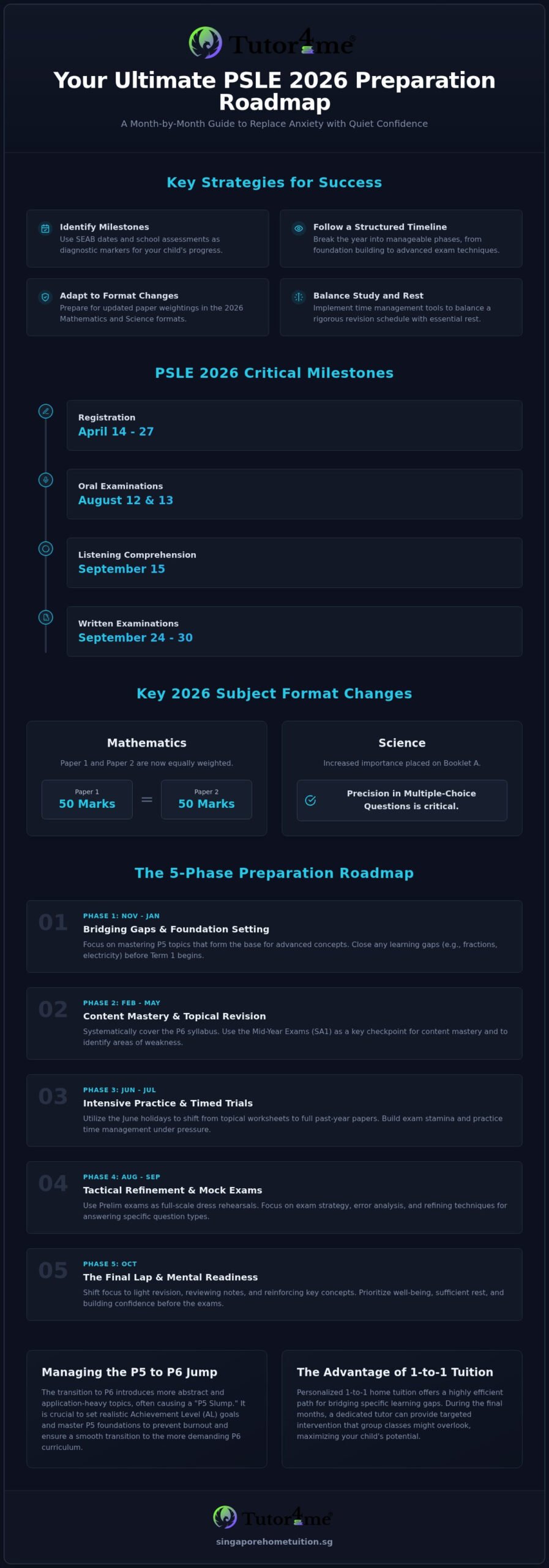
In this guide, we provide a clear monthly checklist that aligns with the 2026 academic calendar. We’ll cover everything from the initial foundation building in Term 1 to the final tactical refinements before the written examinations begin on September 24. You’ll discover how to manage time effectively and adapt to syllabus changes, such as the equal weighting of Mathematics Paper 1 and 2, giving your child the best opportunity to reach their full academic potential.
Key Takeaways
- Identify critical SEAB 2026 milestones and learn how to use school-based assessments as diagnostic markers for your child’s progress.
- Follow a structured psle preparation timeline that breaks the year into manageable phases, moving from foundation building to advanced exam techniques.
- Discover specific strategies for the 2026 Mathematics and Science format changes to ensure your child is prepared for updated paper weightings.
- Implement practical time management tools to help your child balance a rigorous revision schedule with essential rest and extracurricular activities.
- Learn why personalized 1-to-1 home tuition offers a more efficient path for bridging specific learning gaps during the final months of preparation.
Understanding the PSLE 2026 Academic Calendar
The Primary School Leaving Examination (PSLE) serves as a pivotal milestone in a Singaporean student’s academic journey. For the 2026 cohort, the schedule is already defined by the Singapore Examinations and Assessment Board (SEAB). Success isn’t just about the final week in October; it’s about understanding how the entire year is structured to test different competencies. A well-constructed psle preparation timeline accounts for the increasing depth of the syllabus and ensures students aren’t cramming during the final months. Parents should view the academic calendar as a strategic roadmap rather than a series of isolated deadlines.
Key Examination Milestones to Note
The 2026 calendar officially begins with registration between April 14 and April 27. However, the academic pressure builds much earlier. Term 1 focuses on diagnostic assessments to identify foundation gaps, while Term 2 culminates in the Mid-Year Examinations (SA1). This is a critical period for content mastery before the June intensive revision month. The high-stakes phases are clearly partitioned:
- Oral Examinations: Scheduled for August 12 and 13, 2026.
- Listening Comprehension: Taking place on September 15, 2026.
- Written Examinations: Running from September 24 to September 30, 2026.
Each phase requires a specific tactical focus. School-based assessments like the Prelims in Term 3 act as vital diagnostic markers. They reveal whether a student is struggling with the revised 2026 Mathematics format, where Paper 1 and Paper 2 are now equally weighted at 50 marks each. Identifying these weaknesses early allows for targeted intervention before the final papers are marked in mid-October.
The Shift from Primary 5 to Primary 6
Many parents notice a “P5 Slump” where grades dip as topics become more abstract and application-heavy. Moving into P6, the complexity intensifies significantly. Students must adapt to the Achievement Level (AL) scoring system, where every point affects secondary school placement. Setting realistic AL goals based on early year performance prevents burnout and keeps the child motivated throughout the marathon. It’s often helpful to engage PSLE home tuition during this transition to bridge conceptual gaps that group classes might overlook. The 2026 Science format also places more weight on Booklet A, requiring students to be incredibly precise with multiple-choice questions. Starting the psle preparation timeline in November of the preceding year gives students the breathing room they need to master complex heuristics and scientific inquiry without the stress of a last-minute rush.
The 12-Month PSLE Preparation Roadmap
Preparing for the national exams is a marathon, not a sprint. A successful psle preparation timeline starts long before the Primary 6 year actually begins. Looking back at the history of the PSLE, we see how the exam has evolved from simple testing to a sophisticated assessment of critical thinking and application. Today’s students need a structured, phased approach to manage the increased syllabus depth effectively. This roadmap is divided into five distinct phases:
- Phase 1 (Nov – Jan): Bridging Gaps and Foundation Setting
- Phase 2 (Feb – May): Content Mastery and Topical Revision
- Phase 3 (Jun – Jul): Intensive Practice and Timed Trials
- Phase 4 (Aug – Sep): Tactical Refinement and Mock Exams
- Phase 5 (Oct): The Final Lap and Mental Readiness
The Foundation Phase: November to March
The year-end holidays after Primary 5 are vital. This isn’t about starting P6 work early; it’s about mastering P5 topics that form the base for advanced concepts. By January, students should have a consistent daily routine. If a child struggled with fractions or electricity in P5, these gaps must be closed before Term 1 gathers pace. Establishing this rhythm early prevents the panic often seen in later months. It’s about building a stable platform for the challenges ahead.
The Intensive Phase: June Holidays to Prelims
June is the “golden window” for revision. With no new school topics being introduced, it’s the perfect time to transition from topical worksheets to full past-year papers. This phase builds the stamina required for the four-day written exam stretch in late September. Managing stress is crucial here, as the Preliminary examinations in August act as a realistic dress rehearsal. Finding a specialized PSLE home tutor can provide the targeted support needed to navigate this high-pressure period effectively.
The Final Lap: September to October
After Prelims, the focus shifts to tactical refinement. You shouldn’t be learning new concepts in September. Instead, analyze Prelim scripts to identify recurring mistakes in answering techniques. Focus on “low-hanging fruit” marks, such as MCQ precision and situational writing formats. As the October written papers approach, reduce study intensity. Your child’s mental readiness is paramount. Ensuring they are well-rested and sharp is more valuable than one last practice paper. A well-managed psle preparation timeline ensures they peak at exactly the right moment without facing burnout.
Subject-Specific Revision Timelines
Each subject in the PSLE requires a distinct rhythm and approach. While Mathematics demands logical precision, English and Mother Tongue rely on consistent linguistic exposure and conversational confidence. A generic study plan often fails because it doesn’t account for these nuances. Integrating subject-specific goals into your psle preparation timeline ensures that no component, from the August Oral exams to the October written papers, is left to chance.
English and Mother Tongue: The Oral Advantage
Oral examinations are the first major hurdle, yet many students wait until Term 3 to begin serious practice. This is often too late to build the natural fluency required for a high Achievement Level (AL) score. We recommend starting Oral practice as early as Term 1. Focus on reading aloud with expression and engaging in stimulus-based conversations about current affairs or daily life. This early start transforms a high-pressure component into a source of confidence.
For paper 1, weekly composition planning is more effective than writing full essays every week. Spend time brainstorming plots, refining character descriptions, and expanding vocabulary. By Term 3, the focus should pivot toward the Listening Comprehension format. Practicing with audio recordings helps students adapt to the pacing and nuances of the SEAB examiners. Consistent, small-scale practice across the year is far more productive than a last-minute scramble.
Math and Science: The Logic and Application Track
The Primary 6 Mathematics syllabus introduces complex topics like Circles, Speed, and Pie Charts early in the year. Mastery isn’t just about memorizing formulas; it’s about applying heuristics to solve non-routine problem sums. Given the 2026 format change where Paper 1 and Paper 2 are equally weighted, students must be equally proficient in mental calculation and calculator-based problem solving. A specialized PSLE home tutor can help identify which heuristic tools a child is missing, whether it’s “supposition” or “units and parts.”
In Science, the focus during the first half of the year should be on mastering the “Diversity” and “Systems” themes. The key to scoring in Booklet B is the CER (Claim, Evidence, Reasoning) framework. Students often lose marks because they provide the right answer without the necessary scientific keywords. We suggest starting the Ten Year Series (TYS) papers during the June holidays. This allows the child to familiarize themselves with the specific phrasing SEAB examiners look for. By aligning your psle preparation timeline with these subject-specific requirements, you ensure your child is tactically ready for every paper.
Optimizing the Study Schedule: Practical Techniques
A rigid schedule often breaks under the pressure of daily school commitments and unexpected homework. To maintain a sustainable psle preparation timeline, students need a system that balances discipline with flexibility. The first step is conducting a weekly schedule audit. Map out school hours, CCA timings, and essential rest periods to find “pockets” for revision. Rather than planning hour by hour, we recommend using a block-based approach that adapts as the October examinations approach.
Different tasks require different levels of focus. The Pomodoro technique, which involves 25 minutes of work followed by a 5 minute break, is excellent for lighter tasks like English vocabulary drills or Mother Tongue oral practice. For complex Mathematics heuristics or Science open-ended questions, longer “deep work” sessions of 60 to 90 minutes are more effective. These sessions allow the child to enter a state of flow without the interruption of frequent breaks. Always include “buffer time” on Saturday or Sunday afternoons. This acts as a safety valve to catch up on any revision backlog without increasing the family’s stress levels.
Effective Revision Strategies
Active recall and spaced repetition are the most efficient ways to master the vast volume of Science keywords and concepts. Instead of just reading notes, students should test themselves using flashcards or summary sheets. Another vital tool is the “Error Log” method. By tracking and revisiting past mistakes from school worksheets and practice papers, students can identify recurring patterns in their thinking. This prevents them from repeating the same errors during the actual exam. Simulating exam conditions is also essential. Sitting for a full practice paper in a quiet room without distractions builds the mental stamina required for the four-day written exam stretch.
Parental Support and Well-being
Success in the PSLE isn’t just about academic rigor; it’s about emotional resilience. Parents should watch for signs of burnout, such as unusual irritability, changes in sleep patterns, or a sudden drop in motivation. If these appear, it’s often better to pull back and prioritize rest. Encouraging a growth mindset is particularly important during the stressful Prelim season in August. Remind your child that a lower-than-expected grade is a diagnostic marker, not a final verdict. If you find that managing the psle preparation timeline is becoming a source of friction at home, engaging expert PSLE home tutors can help. A professional tutor provides an objective perspective, taking the “teaching” role off the parent’s shoulders and allowing for a more supportive home environment. Finally, ensure your child gets at least eight hours of sleep and balanced nutrition to keep their cognitive functions sharp throughout the year.
Integrating Professional 1-to-1 Tuition for Targeted Progress
While a structured roadmap provides a necessary framework, every student has a unique learning profile. Group tuition centers often follow a rigid syllabus that may not align with your child’s specific pace or immediate needs. In contrast, 1-to-1 home tuition offers the flexibility to pivot the focus instantly. If a child masters “Geometry” faster than expected but struggles with the nuances of “Situational Writing,” a private tutor can adjust the psle preparation timeline to allocate more hours where they’re truly needed. This personalized approach ensures that no time is wasted on concepts the student has already mastered.
Immediate feedback is a cornerstone of effective learning, especially during the final lap of the Primary 6 year. In a group setting, a student might wait a week for a marked composition or a corrected Math paper. A home tutor provides real-time corrections, explaining the logic behind a complex problem sum or suggesting better vocabulary choices on the spot. This prevents the “cementing” of incorrect habits and allows for the rapid bridging of concept gaps that a school teacher, managing forty students, might naturally overlook. It’s this efficiency that helps a student move from understanding a topic to achieving mastery in a shorter period.
The Role of an Experienced PSLE Home Tutor
An experienced tutor acts as a stable pillar during a high-stakes environment. They provide personalized matching, whether you require the pedagogical expertise of an MOE-trained teacher or the fresh perspective of a subject specialist. These professionals adapt the revision pace based on diagnostic markers, such as the Term 2 SA1 or the August Preliminary results. Beyond academic coaching, they offer mentorship and confidence-building. This emotional support is vital for helping students maintain a growth mindset when facing the inevitable pressures of the national exam season.
Finding the Right Fit with Singapore Home Tuition
We understand that time is a precious commodity in the P6 year. Our service prioritizes fast tutor matching across Singapore to ensure your child starts their psle preparation timeline without delay. We maintain a diverse pool of qualified full-time tutors and school teachers, making it easier to find a perfect fit for your child’s learning style and your family’s requirements. By focusing on a dedicated 1-to-1 environment, we help students identify and bridge specific gaps faster than group centers. Secure your child’s PSLE success with a professional home tutor today and provide them with the organized, efficient support they need to excel.
Securing Your Child’s Academic Future in 2026
Success in the PSLE isn’t defined by the final week of exams but by the deliberate steps taken throughout the year. By following a structured psle preparation timeline, you transition from the stress of a massive syllabus to a manageable, phased journey. We’ve explored how identifying foundation gaps early and mastering subject-specific techniques like the CER framework can significantly reduce academic pressure and prevent last-minute burnout.
Every child’s path is unique; sometimes the standard school pace doesn’t align with their specific needs. This is where personalized support makes a difference. Our platform connects you with qualified MOE teachers and full-time tutors who possess a proven track record in PSLE subject mastery. Through personalized 1-to-1 matching, we ensure your child receives the focused attention required for maximum efficiency and academic confidence.
Don’t leave the final lap to chance. Find an Expert PSLE Home Tutor in Singapore today to provide your child with the stability and expertise they deserve. With the right roadmap and a dedicated partner, your child can approach the 2026 exams with quiet confidence and reach their full potential.
Frequently Asked Questions
When is the best time to start PSLE preparation in 2026?
The ideal time to begin your psle preparation timeline is the November holidays at the end of Primary 5. This period allows students to bridge foundation gaps from P5 topics before the P6 syllabus introduces more abstract concepts. Starting early prevents intensive cramming in Term 3. It also gives your child enough time to establish a consistent daily routine, which is vital for maintaining stamina throughout the entire exam year.
Is it too late to hire a PSLE home tutor in the middle of Primary 6?
It is never too late to engage professional help, even during the high-pressure period between SA1 and Prelims. While starting in Term 1 is ideal for foundation building, a home tutor hired mid-year can provide immediate, targeted intervention for specific weaknesses. They focus on exam techniques and high-weightage topics to maximize efficiency. This late-stage support is often exactly what a student needs to regain confidence before the final papers.
How many hours a day should a Primary 6 student study for PSLE?
Quality of revision is more important than the total number of hours spent at a desk. Most educators suggest 1.5 to 2 hours of focused study on weekdays, with slightly longer blocks on weekends. Forcing a child to sit for four or five hours often leads to diminishing returns and mental fatigue. Using techniques like the Pomodoro method ensures the time spent is productive and helps prevent burnout during the long academic year.
How can I help my child improve their English Oral score?
Daily conversational practice is the most effective way to boost Oral scores. Encourage your child to read news articles aloud to improve expression and fluency. You can also use pictures or short videos to simulate the stimulus-based conversation component. Focus on helping them develop a structured response using specific examples. This systematic approach ensures they provide the depth and personal insights that SEAB examiners look for in top-tier candidates.
What is the difference between school Prelims and the actual PSLE?
Preliminary examinations are school-based assessments designed to be slightly more challenging than the actual national papers. Schools use these as a stress test to identify remaining gaps in a student’s knowledge. While the format and timing are identical to national standards, the grading is often stricter. Use the Prelim results as a diagnostic marker to fine-tune your child’s psle preparation timeline rather than viewing them as a final prediction of results.
How do I manage my child’s stress during the PSLE month?
Maintaining a calm home environment is crucial during the examination month. Ensure your child gets at least eight hours of sleep and continues to engage in light physical activity to manage cortisol levels. Avoid introducing new, complex topics in the final week; instead, focus on reinforcing what they already know. Providing emotional reassurance helps them stay grounded. Remind them that their effort is more important than a specific score to keep anxiety manageable.
Should my child focus on their weakest subject or all subjects equally?
You should allocate approximately 40% of revision time to the weakest subject while dividing the remaining time among the others. Neglecting strong subjects can lead to a drop in those Achievement Level scores, which impacts the overall total. However, the weakest subject often has the most “low-hanging fruit” marks that can be gained with targeted practice. A balanced approach ensures foundation skills remain sharp across the board while addressing difficult areas.
Is the 2026 PSLE syllabus different from previous years?
The 2026 syllabus includes specific format changes for Mathematics and Science. In Mathematics, Paper 1 and Paper 2 are now equally weighted at 50 marks each, requiring better mental calculation skills. Science examinations now place more emphasis on Booklet A, with an increased weight given to multiple-choice questions. These changes mean students must be more precise with their basic concepts. Understanding these updates is essential for aligning your revision strategy with current SEAB assessment objectives.