

Moving from Primary 6 to Secondary 1 is an important milestone in a student’s academic journey. The transition introduces new mathematical concepts, different problem-solving methods, and greater expectations for independent learning.
For many students in Singapore, Secondary 1 Mathematics can feel different from PSLE Mathematics. Students gradually move beyond familiar arithmetic and model-drawing methods towards more formal mathematical notation, algebraic expressions, numerical reasoning and problem-solving.
In 2027, Singapore’s education system will also enter an important examination milestone with the introduction of the Singapore-Cambridge Secondary Education Certificate (SEC). Under Full Subject-Based Banding (Full SBB), students study subjects at different levels: G1, G2 and G3.
Parents should understand that the SEC examination syllabus and the Secondary 1 teaching syllabus serve different purposes. The SEC G3 Mathematics syllabus describes the content assessed at the national examination level, while the MOE Mathematics syllabus outlines the learning progression across the secondary years.
This guide explains the Secondary 1 Mathematics curriculum, G1, G2 and G3 subject levels, the 2027 SEC examination framework, common learning challenges and how personalised 1-to-1 Mathematics home tuition can support your child.
Key Takeaways: Secondary 1 Mathematics 2027
- Secondary 1 Mathematics builds on the mathematical foundations developed in primary school.
- Under Full Subject-Based Banding, students study Mathematics at G1, G2 or G3 subject levels.
- The lower-secondary Mathematics curriculum covers Number and Algebra, Geometry and Measurement, and Statistics and Probability.
- G1, G2 and G3 have different syllabus requirements and learning expectations.
- The Singapore-Cambridge SEC examination begins in 2027, replacing the previous N(T)-, N(A)- and O-Level examinations.
- G3 Mathematics is listed as subject code K310 in the 2027 SEC syllabus.
- Additional Mathematics is a separate subject, listed as K341 for the 2027 G3 SEC examination.
- Individual tuition can help students strengthen their understanding and develop confidence in Mathematics.
1. Understanding the Transition from Primary 6 to Secondary 1 Mathematics
Primary Mathematics develops essential numerical skills, mathematical reasoning and problem-solving strategies.
In Secondary 1, students build on these foundations and gradually learn more formal mathematical methods.
Some important changes include:
Moving from Arithmetic to Algebra
- Primary students commonly use models, diagrams and arithmetic operations to solve mathematical problems.
In Secondary 1, they begin using letters to represent unknown numbers and learn to interpret and evaluate algebraic expressions.
Developing Numerical Understanding
- Students extend their understanding of negative numbers, integers, rational numbers and mathematical operations.
- They also develop greater confidence in using calculators, number lines, approximation and estimation.
Applying Mathematical Concepts
- Secondary Mathematics increasingly requires students to select appropriate methods and explain their reasoning.
- They learn to connect different mathematical concepts and apply them to practical situations.
- The transition is not simply about learning more difficult calculations. It involves developing a deeper understanding of how mathematical ideas work.
2. Understanding G1, G2 and G3 Mathematics Under Full Subject-Based Banding
Singapore’s Full Subject-Based Banding system provides students with greater flexibility to study subjects at different academic levels.
The previous Express, Normal (Academic) and Normal (Technical) stream labels have been phased out for the new system.
Students can take individual subjects at G1, G2 or G3 levels according to their learning needs, strengths and school arrangements.
G1 Mathematics
G1 Mathematics focuses on developing essential mathematical knowledge, practical applications and problem-solving skills.
The Secondary 1 syllabus includes:
Number and Algebra
- Negative numbers and primes.
- Integers and their four operations.
- Fractions and decimals, including negative values.
- Calculator operations involving squares, cubes and roots.
- Number lines and ordering numbers.
- Approximation and estimation.
- Ratio and proportion.
- Percentages.
- Algebraic expressions and formulae.
Geometry and Measurement
- Relevant introductory geometric concepts and measurement according to the G1 syllabus progression.
Statistics and Probability
- Relevant introductory data-handling and probability concepts according to the G1 syllabus progression.
G1 students develop their mathematical understanding through structured learning and practical applications.
G2 Mathematics
G2 Mathematics develops broader mathematical understanding and more extensive applications.
The Secondary 1 syllabus includes:
Number and Algebra
- Prime numbers and prime factorisation.
- Highest Common Factor (HCF) and Lowest Common Multiple (LCM).
- Squares, cubes, square roots and cube roots.
- Negative numbers, integers and rational numbers.
- Number operations.
- Ratio and proportion.
- Percentages.
- Rate and speed.
- Algebraic notation and expressions.
- Formulae and mathematical applications.
Geometry and Measurement
- Angles and geometric properties.
- Triangles and polygons.
- Measurement and relevant geometric applications.
Statistics and Probability
- Data handling and interpretation.
- Introductory statistical concepts.
- Probability concepts according to the applicable syllabus progression.
G3 Mathematics
G3 Mathematics provides a more extensive level of mathematical study and develops students’ ability to apply mathematical concepts in different situations.
The Secondary 1 learning progression includes:
Number and Algebra
- Prime numbers and prime factorisation.
- HCF and LCM.
- Negative numbers and rational numbers.
- Squares, cubes and roots.
- Number operations and estimation.
- Ratio and proportion.
- Percentages.
- Rate and speed.
- Algebraic expressions and formulae.
Geometry and Measurement
- Angles, triangles and polygons.
- Geometric properties.
- Measurement and mathematical applications.
Statistics and Probability
- Data handling.
- Statistical interpretation.
- Probability and related mathematical concepts.
The exact content and progression should always be checked against the relevant MOE syllabus and the student’s school learning plan.
3. Start Preparing for the 2027 Syllabus Early with the Right Home Tutor
As your child prepares to move into the next academic year, November is a good time to start planning ahead for the 2027 school syllabus. Getting familiar with upcoming subjects and learning expectations early can help your child begin the new academic year with greater confidence.
At Tutor4Me, we help parents find carefully matched home tutors based on their child’s academic level, learning needs, subjects and schedule.
Give Your Child a Confident Start to 2027
Starting early gives your child more time to strengthen foundational concepts, address learning gaps and become familiar with the topics they will encounter in the new academic year.
Whether your child is preparing for Secondary 1 or needs continued academic support at their current level, Tutor4Me can help you find suitable one-to-one home tuition in Singapore.
Planning ahead for 2027? Find the right home tutor for your child and get started with a learning schedule that works for your family.
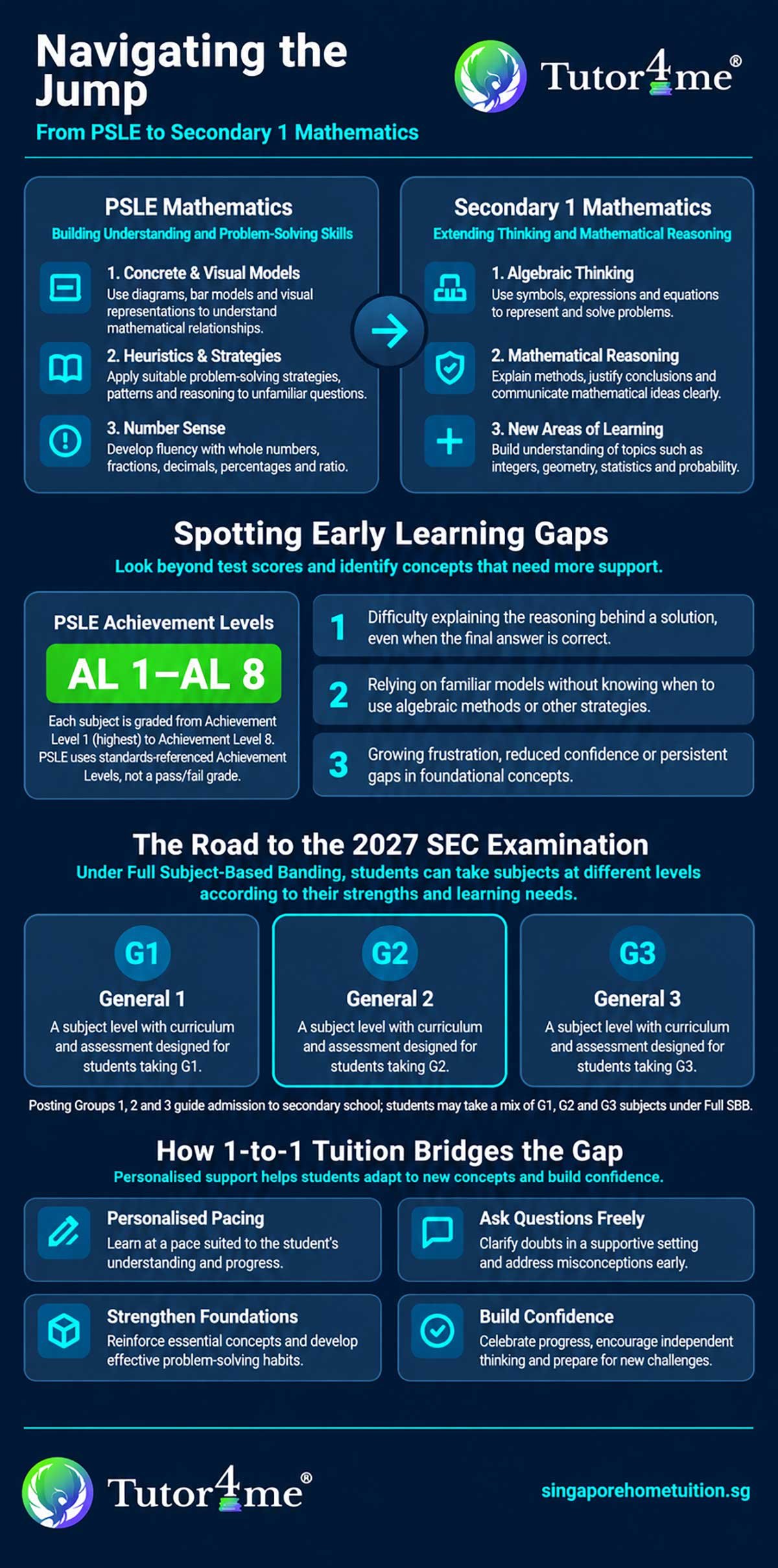
4. What Is the Difference Between the 2026 and 2027 SEC Examination Systems?
The 2027 academic examination framework introduces the Singapore-Cambridge Secondary Education Certificate.
Before 2027, students sat for the Singapore-Cambridge GCE N(T)-Level, N(A)-Level or O-Level examinations.
From 2027, these examinations are brought together under the SEC framework.
Under this system:
- Students sit for subjects at G1, G2 or G3 levels.
- G1, G2 and G3 are subject levels, not separate school streams.
- Students receive a single SEC certificate reflecting the subjects and levels taken.
- The examinations continue to be jointly examined and awarded by SEAB, MOE and Cambridge International Education.
There is no change in the overall examination standards simply because of the introduction of the SEC.
The subject-level grading structures also remain aligned with the previous N(T)-, N(A)- and O-Level grading structures respectively.
Parents can refer to Singapore Examinations and Assessment Board for the official examination information and syllabus requirements.
5. Common Challenges Students Face in Secondary 1 Mathematics
Adjusting to Algebra
- Students who are familiar with primary-school model drawing may initially find algebraic expressions unfamiliar.
- They need time to understand variables, mathematical notation and the relationships between quantities.
Understanding Negative Numbers
- Negative numbers introduce a different way of thinking about numerical values.
- Students must understand how addition, subtraction, multiplication and division work with negative values.
Applying the Correct Mathematical Method
- Secondary Mathematics requires students to identify the relevant concepts and apply appropriate methods to different questions.
- Memorising a formula without understanding its application can lead to mistakes.
Managing a New Academic Routine
- Secondary school introduces more subjects, new responsibilities and Co-Curricular Activities (CCAs).
- Students need to develop consistent revision habits and effective time management.
6. How Can Parents Identify Whether Their Child Needs Mathematics Tuition?
Parents can observe their child’s progress and identify areas that require additional support.
Some common indicators include:
- Difficulty understanding algebraic expressions.
- Repeated calculation mistakes.
- Difficulty working with negative numbers.
- Trouble understanding mathematical word problems.
- Lack of confidence when attempting unfamiliar questions.
- Difficulty completing homework independently.
- Inconsistent performance in school assessments.
Parents can also discuss learning difficulties with school teachers and review the student’s school-based assessment feedback.
It is important to identify specific learning gaps rather than judging a student’s ability based on one assessment result.
7. How 1-to-1 Secondary 1 Mathematics Home Tuition Can Help
Individual home tuition gives students an opportunity to receive personalised academic support.
At Singapore Home Tuition, lessons can be arranged according to the student’s subject level, school syllabus and individual learning requirements.
Personalised Learning Approach
A tutor can identify the concepts a student finds difficult and provide additional explanations and practice.
G1, G2 and G3 Subject-Level Support
Lessons can be matched to the student’s actual Mathematics subject level and applicable syllabus requirements.
Stronger Mathematical Foundations
Students can receive additional guidance in numbers, algebra, geometry, measurement and other relevant topics.
Flexible Learning Pace
Tutors can adjust the lesson pace based on the student’s understanding and school learning schedule.
Improved Problem-Solving Confidence
Regular practice and clear explanations can help students become more confident when approaching unfamiliar questions.
8. How to Choose the Right Secondary 1 Mathematics Tutor in Singapore
Choosing an appropriate tutor is an important decision for parents.
Consider these factors before arranging tuition.
- MOE syllabus knowledge: Check whether the tutor understands the relevant Mathematics syllabus.
- Subject-level experience: Confirm experience teaching the student’s G1, G2 or G3 level.
- Secondary Mathematics experience: Look for experience teaching lower-secondary students.
- Teaching approach: Choose a tutor who explains mathematical concepts clearly.
- Problem-solving guidance: The tutor should encourage students to understand the reasoning behind their answers.
- Progress monitoring: Discuss learning objectives and review progress regularly.
- Student compatibility: Consider communication, teaching style and the student’s comfort with the tutor.
9. Frequently Asked Questions About Secondary 1 Mathematics in Singapore
Is Secondary 1 Mathematics harder than PSLE Mathematics?
Secondary 1 Mathematics introduces new concepts and more formal mathematical methods. Algebra, negative numbers and additional mathematical applications can take time to understand. Students benefit from developing a strong foundation during the transition.
What are G1, G2 and G3 Mathematics?
G1, G2 and G3 are the three subject levels under Full Subject-Based Banding in Singapore. Each level has its own syllabus requirements and learning expectations.
Is the SEC examination starting in 2027?
Yes. The Singapore-Cambridge Secondary Education Certificate begins in 2027, replacing the previous N(T)-, N(A)- and O-Level examinations.
What is the 2027 G3 Mathematics subject code?
According to SEAB, the 2027 G3 SEC Mathematics subject code is K310.
Is G3 Mathematics the same as Additional Mathematics?
No. G3 Mathematics and G3 Additional Mathematics are separate subjects with different syllabuses. SEAB lists them under K310 and K341 respectively for the 2027 examination.
Does every Secondary 1 student follow the G3 Mathematics syllabus?
No. Students study Mathematics at the subject level assigned by their school arrangements. They may take G1, G2 or G3 Mathematics.
Can students study Mathematics at a different level from their other subjects?
Yes. Full Subject-Based Banding allows students to take different subjects at different levels, depending on their strengths, learning needs and school arrangements.
When should a student start Secondary 1 Mathematics tuition?
Students can consider additional tuition when they experience difficulties understanding new mathematical concepts, completing assignments or applying problem-solving methods. Parents do not need to wait until an examination result shows a problem before seeking support.
How does 1-to-1 home tuition help Secondary 1 Mathematics students?
One-to-one home tuition provides individual attention, additional practice and explanations based on the student’s learning needs and subject level.
10. Give Your Child a Strong Start in Secondary 1 Mathematics
Starting secondary school is an important stage in a student’s educational journey.
Developing a strong Mathematics foundation can help students understand new concepts, improve problem-solving abilities and approach their studies with greater confidence.
Singapore Home Tuition provides personalised 1-to-1 home tuition for students across Singapore.
Whether your child studies G1, G2 or G3 Mathematics, we help parents find suitable tutors based on the student’s subject level, academic requirements and learning preferences.
Our tutor-matching service is designed to make finding appropriate home tuition more convenient for parents.