
What if the most difficult transition in your child’s academic career isn’t the PSLE, but the sudden shift they face in Primary 3? For many families, this year marks a significant turning point where math moves beyond simple arithmetic into the realm of complex logic and heuristics. You might notice your child, who previously found math easy, now struggling with multi-step word problems or feeling discouraged by the increased workload. It’s a common experience, yet it remains one of the most stressful periods for young learners in the Singapore education system.
We understand that seeing your child lose confidence is difficult. This article explains why the 2026 curriculum creates this specific “foundation pivot” and how primary 3 math tuition can bridge the gap through personalized 1-to-1 support. You’ll learn how to identify the early signs of struggle and the ways a dedicated tutor helps your child master new heuristic concepts early. We also preview how building a stable foundation now protects your child’s academic interest and prepares them for the rigors of the years ahead. By the end of this guide, you’ll have a clear roadmap to restore your child’s confidence and ensure they stay on track for future success.
Key Takeaways
- Discover why Primary 3 represents the most significant shift in the MOE syllabus, moving from basic arithmetic to conceptual logic and multi-step operations.
- Learn how specialized primary 3 math tuition helps students master new challenges like identifying keywords in word problems and managing mental calculation demands.
- Compare the benefits of 1-to-1 home tuition against group centers, focusing on how a personalized pace reduces anxiety and restores a child’s confidence.
- Understand the direct link between P3 topics and future PSLE requirements, helping you prevent the snowball effect of unaddressed learning gaps.
- Gain practical advice on selecting the ideal tutor profile, whether an MOE teacher or an experienced undergraduate, to match your child’s specific learning style.
Understanding the “Primary 3 Jump” in Mathematics
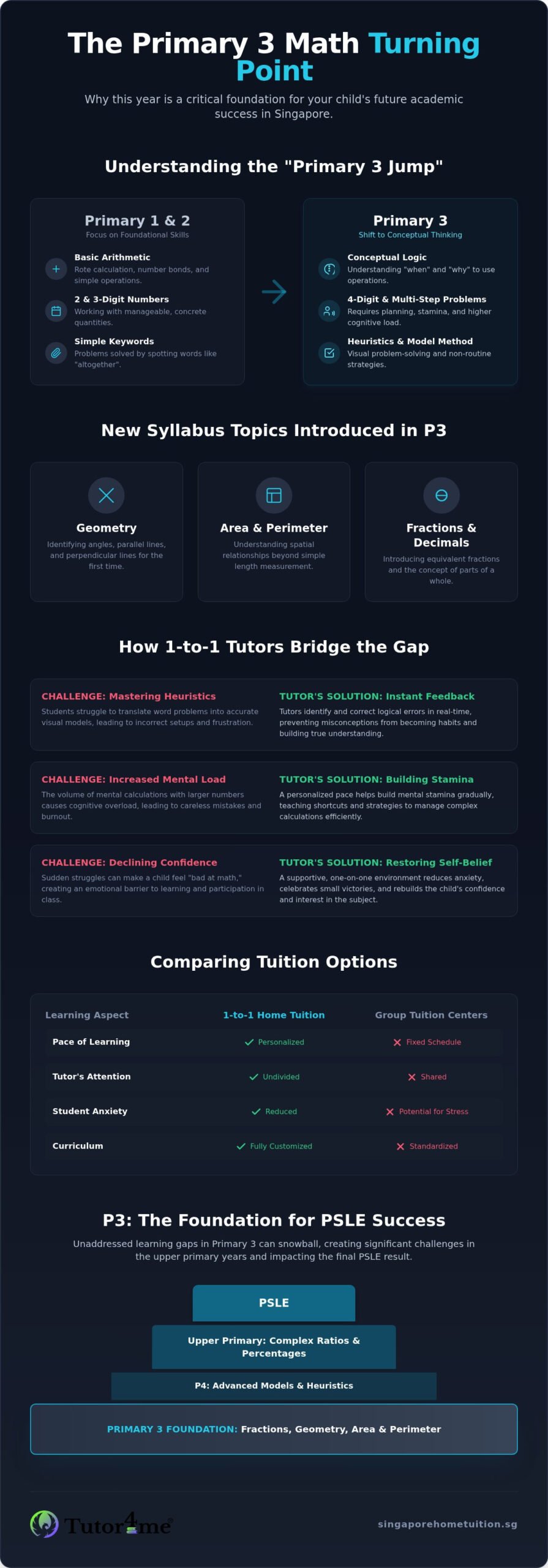
For many students, the transition from Primary 2 to Primary 3 is more than a simple grade promotion. It represents a fundamental shift in how they must process mathematical information. Educators often refer to this as the “Primary 3 Jump.” While the first two years of primary school focus heavily on rote calculation and basic number bonds, Primary 3 introduces conceptual logic. Students move from working with 2-digit and 3-digit numbers to 4-digit operations, which naturally increases the margin for error and requires more stamina.
This shift explains why children who excelled in lower primary may suddenly face declining grades. The challenge isn’t just the larger numbers; it’s the introduction of multi-step operations that require a child to plan their approach before picking up a pencil. Without early intervention, these small gaps in understanding can become permanent habits. Engaging primary 3 math tuition helps identify these misconceptions before they compromise a student’s long-term academic trajectory.
From Calculation to Conceptual Thinking
The core of the Primary 3 curriculum shifts the focus from “how to calculate” to “when to use which operation.” This requires a higher level of cognitive demand. A child must now interpret word problems by identifying specific keywords that signal different mathematical actions. For instance, a problem might require both multiplication and subtraction in a specific sequence, making simple keyword spotting like “altogether” less effective than it was in Primary 2.
The Singapore Math methodology emphasizes the Concrete-Pictorial-Abstract (CPA) approach, which becomes vital at this stage. When a child fails to bridge these steps, their confidence often drops. They may begin to view themselves as “bad at math,” which creates an emotional barrier to learning. A dedicated tutor provides the reassurance and clarity needed to navigate this transition smoothly, ensuring the child feels empowered rather than overwhelmed.
New Topics Introduced in the P3 Syllabus
The syllabus expands significantly in Primary 3, introducing several abstract concepts for the first time. These aren’t just new chapters; they are new ways of thinking about space and numbers. Key additions include:
- Geometry: Students begin identifying angles and distinguishing between parallel and perpendicular lines.
- Measurement: The introduction of Area and Perimeter requires students to understand spatial relationships rather than just memorizing formulas.
- Fractions and Decimals: Equivalent fractions and basic decimal notation in the context of money introduce the idea of parts of a whole.
These topics are not isolated; they form the bedrock for future PSLE Home Tuition success. For example, a solid grasp of fractions in Primary 3 is essential for the complex ratio and percentage problems found in the Primary 6 papers. Securing these foundations through primary 3 math tuition ensures that your child is prepared for the increasing complexity of the upper primary years.
Key Challenges in Primary 3 Math and How Tutors Solve Them
Singapore’s mathematics curriculum is globally recognized for its rigor. The PISA 2022 results for Singapore confirm that students here consistently lead the world in mathematical literacy. However, this high standard often translates into significant pressure during the Primary 3 transition. At this level, the volume of mental calculations increases, and the complexity of word problems requires a more sophisticated approach than simple counting. Students must now manage larger numbers while simultaneously applying logic to abstract scenarios.
Mastering Heuristics and the Model Method
One of the biggest hurdles in Primary 3 is the move toward visual problem-solving. Heuristics are a set of strategies for non-routine problems. The most prominent of these is the Model Method. While drawing bars to represent numbers seems simple, many students struggle to translate text into accurate visual representations. They might draw the bars but fail to label them correctly, or they might struggle to see the relationship between different parts of the model.
A private tutor provides immediate, real-time feedback that a classroom teacher often cannot. When a child makes a mistake in their model, the tutor identifies the specific logical error at that moment. This prevents the child from practicing the wrong technique. By mastering these visual tools early through primary 3 math tuition, students build the confidence needed to tackle the even more complex heuristics introduced in Primary 4 and 5.
Bridging the Gap in Word Problem Interpretation
Word problems in Primary 3 often contain “traps” that capitalize on common reading errors. Phrases like “more than” or “less than” can be particularly confusing. A student might see the word “more” and instinctively add, even if the context requires subtraction. Tutors help students develop a methodical approach to these questions:
- Identifying Keywords: Teaching students to highlight operational triggers within a sentence.
- Sentence Breakdown: Converting long, complex sentences into smaller, manageable mathematical equations.
- Logical Verification: Encouraging students to check if their final answer makes sense within the story of the problem.
Consistent practice is the only way to build true mathematical intuition. Because every child learns at a different speed, primary 3 math tuition allows for a customized pace that focuses on a student’s specific weak points. If your child is finding these word problems particularly daunting, finding a top home tutor in Singapore can provide the targeted support they need to overcome their anxiety and master the syllabus.
1-To-1 Home Tuition vs. Group Tuition Centers
Choosing between a group tuition center and private home tuition is a decision that impacts more than just academic grades. In a group setting, the curriculum is standardized to meet the needs of the average student. This often means the class moves forward regardless of whether every child has mastered a concept. Primary 3 math tuition in a 1-to-1 format allows for a different level of agility. If a child struggles with the logic of equivalent fractions, the tutor can pause and pivot, spending the entire hour on that single hurdle until it’s cleared.
The home environment also plays a significant role in reducing anxiety for young learners. At age nine, many children are hesitant to admit they’re confused in front of their peers. Home tuition provides a safe space where mistakes are viewed as learning opportunities rather than social embarrassments. Additionally, the logistical ease of home sessions removes the stress of commuting. This flexibility helps fit tuition into a busy Singaporean student’s life, ensuring they remain well-rested and ready to learn.
Immediate feedback is another critical advantage of the 1-to-1 model. In a tuition center, a teacher might have a dozen papers to mark, meaning a student might not realize they’ve used the wrong model-drawing technique until the following week. A private tutor corrects errors in real-time, preventing the reinforcement of incorrect habits.
Why Personalization Matters at Age Nine
Primary 3 students have vastly different “click” moments for different topics. One child might intuitively understand geometry but struggle with the multi-step logic of word problems. A top home tutor recognizes these individual patterns and adapts their teaching style to match the child’s personality. Whether your child is a visual learner who needs more model-drawing practice or a kinesthetic learner who benefits from physical manipulatives, personalization ensures no time is wasted. This focused attention allows students to address their weak areas without the peer pressure found in larger classrooms.
The Role of the Tutor as a Mentor
A dedicated tutor acts as more than just an instructor; they become a mentor who builds a rapport with the student. This relationship encourages the child to ask “silly” questions that they might suppress in a school setting. The tutor also serves as a professional bridge between school requirements and parent expectations, providing clear updates on progress. For advanced learners who master the P3 syllabus early, tutors can naturally integrate higher-level logic or IGCSE home tuition concepts to keep the child engaged and challenged. This holistic support system ensures the student feels empowered and motivated throughout their mathematical journey.
Preparing for the Future: P3 as the PSLE Foundation
Primary 3 is often the first time students face the reality of the long-term academic journey in Singapore. While the national exam is years away, the mathematical concepts introduced now serve as the structural framework for the Primary School Leaving Examination (PSLE). Topics aren’t just isolated chapters; they’re the start of a logical progression. For example, the basic understanding of equivalent fractions in P3 evolves directly into complex ratio and percentage problems. Similarly, the introduction of Area and Perimeter forms the basis for solving composite figures in the upper primary years.
A “snowball effect” occurs when these early concepts aren’t fully mastered. Small gaps in understanding 4-digit operations or basic geometry can lead to significant confusion when those topics are revisited with higher complexity. Building stamina is also essential. P3 examination papers are longer and more demanding than those in lower primary. Establishing effective study habits and time management now prevents the stress of playing catch-up later. Securing a strong start with primary 3 math tuition ensures that these foundational blocks are set firmly.
Preventing the Primary 5 “Shock”
Many parents are surprised by the sharp dip in grades during Primary 5. This “shock” is usually the result of foundation cracks that formed back in Primary 3. When a student doesn’t fully grasp the logic of multi-step operations or heuristics at age nine, the increased volume of work in upper primary becomes overwhelming. Early intervention is always more cost-effective than attempting intensive “crash courses” during the high-stakes P6 year. Entering Upper Primary with confidence allows a child to focus on new challenges rather than struggling with old ones.
Developing a Growth Mindset in Mathematics
Success in math requires more than just knowing formulas; it requires a growth mindset. Tutors play a pivotal role in helping students view mistakes as learning opportunities. When a child faces a multi-step logic puzzle that doesn’t yield an answer on the first try, they need the persistence to try a different heuristic. Tutors encourage this persistence by breaking down complex journeys into manageable steps. This builds the psychological resilience needed for the years ahead. If you’re ready to secure your child’s academic future, you can start preparing for the PSLE with a dedicated home tutor today.
Finding the Right Primary 3 Math Tutor for Your Child
Selecting the ideal support for your child requires a clear understanding of their specific academic requirements. Some students grasp the “how” of calculation but struggle with the “why” of logic, making them concept-heavy learners. Others understand the theory but require consistent drilling to reduce careless mistakes, categorizing them as practice-heavy learners. Identifying this distinction early helps you choose the right primary 3 math tuition approach to address their unique learning gaps.
The profile of the tutor also matters significantly. Current or former MOE teachers offer deep expertise in syllabus nuances and marking rubrics, which is invaluable for high-stakes preparation. Full-time tutors often bring years of experience across diverse student profiles, providing a wealth of practical strategies. Meanwhile, undergraduates can offer a relatable and energetic approach that appeals to younger children. Regardless of the profile, you should verify their familiarity with the 2026 MOE syllabus to ensure they’re teaching the correct heuristic methods required today.
Matching Criteria: Beyond Just Grades
Successful primary 3 math tuition depends heavily on the chemistry between the tutor and the student. At age nine, a child’s emotional connection to their teacher often dictates their willingness to engage with difficult topics. You should look for a tutor who possesses a track record of improving lower primary results and who can adapt their personality to suit your child’s temperament. This compatibility ensures that the student feels supported rather than pressured during their sessions.
Singapore Home Tuition acts as a professional facilitator in this process. We don’t just provide a list of names; we prioritize a qualitative match based on your child’s specific needs and your family’s schedule. This personalized approach removes the stress of tutor-hunting and ensures a stable, productive learning environment from the very first lesson. By focusing on suitability, we help build a bridge between current struggles and future excellence.
Getting Started with Singapore Home Tuition
The journey to academic recovery is designed to be frictionless. Our agency provides a structured process for requesting a tutor, whether you prefer home-based sessions or online learning. We maintain a focus on professional reliability and the quiet confidence of a trusted partner, ensuring that every match is made with the goal of long-term success. This organized efficiency allows you to focus on your child’s progress rather than administrative hurdles.
Once a tutor is selected, it’s helpful to set clear expectations and milestones for the first few months. This might include mastering 4-digit addition or improving keyword identification in multi-step word problems. Establishing these goals early creates a transparent path for progress and helps the child see their own improvement. If you’re ready to bridge the gap in your child’s mathematical journey, you can secure a dedicated Primary 3 Math tutor today and provide the foundation they need for the years ahead.
Securing Your Child’s Mathematical Future
Primary 3 is more than just a grade level; it’s the year your child moves from basic numbers to the complex logic of heuristics. By addressing the “Primary 3 Jump” now, you prevent the academic stress often seen in upper primary and ensure a stable path toward the PSLE. Personalized primary 3 math tuition provides the specific, one-to-one attention required to master these new concepts at a comfortable pace. This early intervention ensures that small gaps don’t turn into permanent obstacles.
Singapore Home Tuition acts as a professional facilitator to remove the stress of finding the right support. We offer access to a diverse pool of MOE teachers and subject specialists through a fast, personalized matching service tailored to your budget. With islandwide coverage for convenient 1-to-1 home tuition, we ensure that high-quality academic support is always within reach. Empower your child to face their math challenges with confidence and clarity. Find the Perfect Primary 3 Math Tutor for Your Child and establish a strong foundation today.
Frequently Asked Questions
Is Primary 3 Math tuition necessary if my child did well in Primary 2?
Success in Primary 2 is a strong start, but the transition to Primary 3 involves a significant move from simple arithmetic to logic-based heuristics. Many students find the “Primary 3 Jump” challenging because it introduces multi-step word problems that require a different cognitive approach. Starting primary 3 math tuition early helps ensure these new logical requirements don’t become stumbling blocks as the syllabus complexity increases toward the upper primary years.
What are the main differences between the P2 and P3 Math syllabus?
The primary difference lies in the complexity of operations and the introduction of abstract concepts. Primary 3 introduces 4-digit numbers, equivalent fractions, and basic geometry like angles and perpendicular lines. Unlike Primary 2, which focuses on straightforward calculation, Primary 3 requires students to interpret keywords and apply multi-step logic. This transition marks the beginning of the foundation for the PSLE, shifting the focus from “how to calculate” to “when to use specific operations.”
How many hours of math tuition per week is recommended for a P3 student?
A standard recommendation is one session of 1.5 to 2 hours per week. This duration allows enough time to review school work, address specific misconceptions, and practice new heuristic methods without overwhelming a nine-year-old student. For children who have significant gaps in their foundation or struggle with the increased volume of word problems, two shorter sessions might be more effective to maintain consistency and build confidence gradually over time.
Can a private tutor help my child with the new heuristic methods?
Yes, a private tutor provides the personalized attention needed to master complex heuristics like the Model Method. In a classroom, a teacher may not have time to correct every student’s drawing in real-time. A 1-to-1 tutor identifies logical errors immediately, ensuring your child learns the correct way to translate word problems into visual models. This targeted support is essential for building the problem-solving intuition required for primary 3 math tuition success.
Should I choose an MOE teacher or a full-time tutor for P3 Math?
The choice depends on your child’s specific needs and your budget. MOE-trained teachers offer deep insights into current syllabus requirements and marking rubrics, making them ideal for students struggling with specific curriculum shifts. Full-time tutors often provide a wealth of practical experience across various student profiles and can be more flexible with scheduling. Both profiles are effective facilitators, and Singapore Home Tuition helps you match with the most suitable professional for your child.
How soon can I expect to see improvements in my child’s math results?
Most parents notice an improvement in their child’s confidence within the first month of consistent tuition. While tangible grade improvements usually appear after a full school term, the immediate benefit is often a reduction in anxiety toward complex word problems. As the tutor clarifies foundational gaps, the child becomes more willing to tackle challenging questions. Consistent practice and a stable support system are key to seeing long-term academic progress in the subject.
Does Singapore Home Tuition offer 1-to-1 online math tuition for P3?
Singapore Home Tuition provides both 1-to-1 home and online tuition options for Primary 3 students. Online sessions are particularly useful for busy families who require scheduling flexibility or prefer learning from the comfort of their own digital environment. Our agency uses a personalized matching service to connect you with tutors who are experienced in digital teaching tools, ensuring that the quality of instruction remains high regardless of the delivery format chosen for the lessons.
What happens if my child does not click with the matched tutor?
Finding a perfect fit is essential for a child’s learning journey, so we prioritize suitability in our matching process. If your child doesn’t build a rapport with the initial tutor, you can request a change through our agency. We act as a professional bridge between parents and tutors, facilitating a frictionless transition to a new educator. Our goal is to ensure every student feels empowered and supported by a tutor who matches their personality and learning style.