
A useful mindflex tuition review and platform comparison starts with your child’s needs, not the size of a tutor pool. What matters is how a service turns its pool into suitable tutor recommendations and what support follows once lessons begin.
Parents are right to look beyond claims of tutor quality and rapid matching. Compare how each home tuition agency considers a student’s subject, academic level, learning style and preferred tutor background. The matching process and support after a match should also be easy to understand.
This comparison looks at MindFlex alongside Singapore Home Tuition using practical criteria. You’ll see how to assess tutor fit, compare information about tutor backgrounds and consider support after a match. Use these criteria to weigh each service against your child’s academic needs, whether you’re considering one-to-one home tuition or online lessons, and decide on a sensible next step.
Key Takeaways
- Compare matching speed with tutor suitability: a quick introduction alone doesn’t show whether a tutor fits your child’s subject, level and learning style.
- This mindflex tuition review and platform comparison considers tutor backgrounds, profile information, parent support and reassignment, not just headline tutor-pool size.
- Use your child’s academic needs and goals to assess whether a tutor profile suits exam preparation or ongoing subject support.
- Separate MindFlex’s published claims from the details available about each service to make a fair comparison.
- Singapore Home Tuition offers matching support and home or online one-to-one tuition for families across Singapore.
MindFlex tuition review: what the platform says it offers
Singapore tuition agencies can sound similar when they describe tutor quality, database size and fast matching. This mindflex tuition review and platform comparison looks at what MindFlex says it offers and how parents can use those details when assessing a tutor recommendation. The key is to distinguish the service’s process from promotional claims, then consider whether the proposed profiles suit your child.
What does MindFlex say about its tutor-matching service?
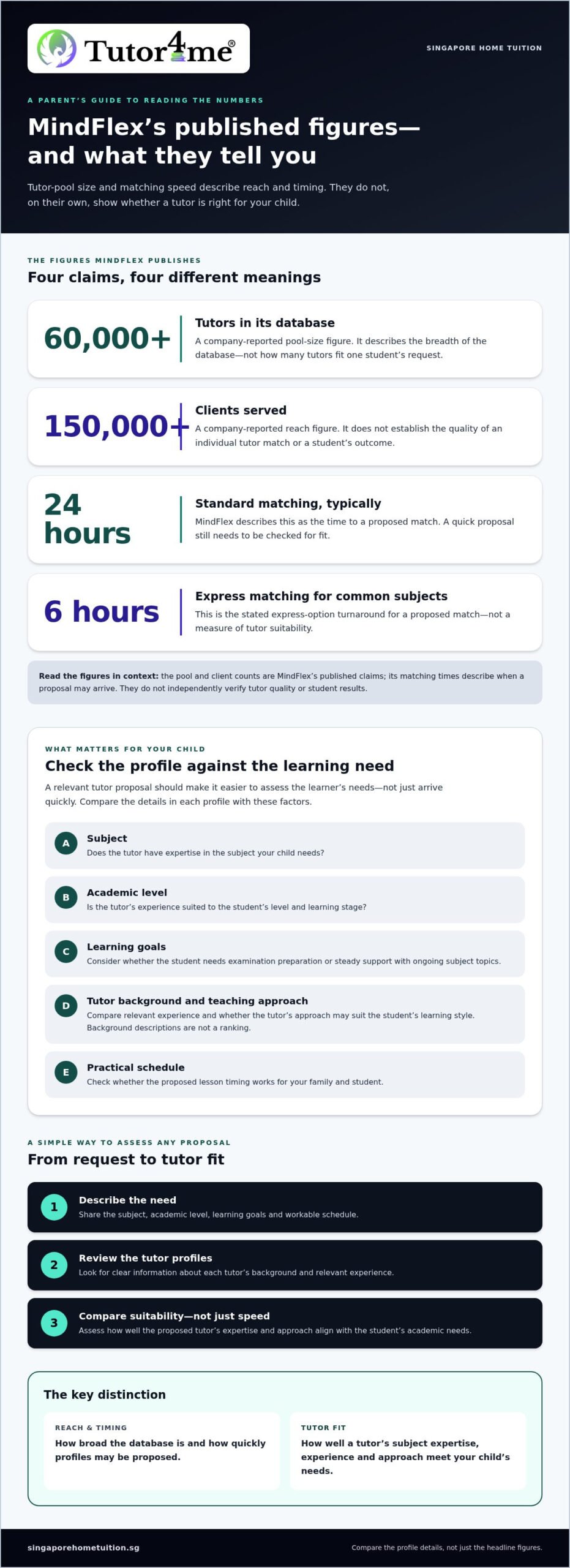
MindFlex describes a request-and-profile approach: parents submit a tuition request and receive tutor profiles to consider. Its website states that its database contains over 60,000 tutors and that it has served over 150,000 clients. These are company-reported figures. They describe the agency’s overall reach, not how many tutors would suit a particular learner or how effective an individual match may be.
MindFlex also describes standard matching as typically taking place within 24 hours and an express option as offering a match within six hours for common subjects. These turnaround claims describe the time to a proposed match, not the suitability of the tutor. A fast proposal can help you move forward, but the tutor’s subject expertise and experience still need to fit your child’s academic needs.
MindFlex’s website uses promotional labels, including superlative descriptions. Treat a phrase such as “number one” as marketing unless it is tied to a clear measure and named source. Database size, client numbers and speed can help describe a service, but they do not establish teaching quality or student outcomes on their own.
Agency, platform, or tuition centre: what is the difference?
A home tuition agency connects learners and parents with private tutors. In this model, the agency receives a request and proposes tutor profiles, while the tutor provides the lessons. A platform may refer to the technology used to manage requests and profiles; the label alone doesn’t explain how a student’s academic needs are assessed or how a suitable tutor is selected.
Families in Singapore seek academic support across different school pathways and learning stages. For broader context on the country’s education system, see Wikipedia’s overview of Education in Singapore. The practical distinction is between matching and teaching: a database or digital process can help organise tutor proposals, but it cannot by itself guarantee that a tutor is the right fit.
Read MindFlex’s description as an account of how it presents its matching service. Then assess the proposed profiles and the information provided about each tutor. Those details are more useful for judging an individual match than promotional labels alone.
How MindFlex’s matching process works, and what its claims mean
A matching service can take a parent’s request and produce tutor profiles, but the steps between those points matter. To assess MindFlex’s model, separate its description of the process from the details you need to judge whether a profile fits your child. A useful request states the subject, academic level, learning goals and practical schedule. This makes it easier to distinguish a relevant proposal from a fast one.
Use a simple sequence to assess any agency’s matching explanation: note what information it asks you to provide, see what the resulting profiles tell you, then compare each tutor’s background with your child’s needs. MindFlex describes a request-and-profile process; the profiles themselves help you consider how a tutor may suit an individual learner.
Rapid matching means proposing potential tutors quickly; it does not, by itself, measure how well a tutor’s expertise and teaching approach fit a student. Speed can be useful when you want to arrange lessons promptly. Suitability depends on what the proposed tutor can teach and how that experience aligns with your child’s requirements.
What a tutor-pool figure can, and cannot, tell parents
MindFlex’s website publishes a tutor-pool figure. A headline number represents the breadth of its database, not the number of profiles suited to one learner. It is a company-reported figure, rather than an independently audited count.
For parents, the useful comparison is between the breadth of a pool and the relevance of profiles proposed for particular academic needs. A large database may include tutors across subjects and levels, but only a smaller group may fit a specific request, such as O Level Chemistry support at a time that works for the student. Focus on profile details and fit, not the headline alone.
Why tutor background and student fit matter
Tutor backgrounds can point to different kinds of experience. An MOE teacher may bring classroom teaching experience; a full-time tutor may have a dedicated private-tuition practice; a university graduate may offer recent subject knowledge. These descriptions aren’t a ranking. Consider each tutor’s expertise in the requested subject, experience with the student’s academic level and ability to support the learner’s preferred learning style.
A student who needs structured preparation for a specific examination may have different requirements from one who needs steady help with weekly Maths or English topics. State the difference in your request, along with a schedule that works for your family. Singapore Home Tuition verifies tutor qualifications and ability as part of its matching process, helping parents assess profiles against the learner’s requirements. You can also explore home tutor selection as you consider what makes a profile relevant.
In a mindflex tuition review and platform comparison, treat matching speed, tutor-pool size and tutor suitability as separate measures. Together, they give a clearer picture than any single claim and help you focus on the profile that may best support your child.
MindFlex vs. Singapore Home Tuition: compare the factors parents experience
Both agencies describe matching services, so compare what parents can see and use: the proposed profiles, the information about tutors and the support available if the arrangement needs attention. The table summarises the services’ stated approaches. MindFlex’s turnaround and tutor-pool figures are its own published claims, not direct measures of teaching quality.
| Factor | MindFlex | Singapore Home Tuition |
|---|---|---|
| Matching | Describes a request-and-profile process and promotes its matching system. Assess the proposed profiles against your child’s needs. | Provides hand-picked profiles matched to a student’s academic needs. |
| Profile turnaround | Its website describes standard matching as typically within 24 hours and an express option claiming a match within six hours for common subjects. | Delivers tutor profiles within 24 hours. |
| Tutor backgrounds | MindFlex says tutors are screened before recommendation. | Profiles may include MOE teachers, experienced full-time tutors and university graduates. |
| Support | Consider the support available during matching and after lessons begin. | Provides dedicated tutor support through the matching process. |
| Reassignment | MindFlex describes instant reassignment. | Offers instant reassignment if the match is unsuitable. |
Compare the process, not just the headline claims
A system name or matching claim doesn’t show how a specific profile was selected. MindFlex describes a request-and-profile process, while Singapore Home Tuition provides hand-picked profiles matched to a student’s academic needs. Consider whether the profile information helps you connect each tutor’s subject expertise and teaching background to your child’s level and goals. Singapore Home Tuition also verifies tutor qualifications and ability as part of its matching process. The table compares service descriptions, not teaching quality or student outcomes.
Matching quality can’t be measured by speed alone; it also depends on how well a tutor’s expertise and approach fit the student. A prompt profile can help you move forward, but its relevance is what lets you judge whether the recommendation aligns with your child’s learning needs.
Compare support and what happens after a match
Support matters beyond the first introduction. Singapore Home Tuition provides dedicated tutor support through the matching journey and offers instant reassignment if the tutor match is unsuitable. This gives parents a clear next step if the original arrangement isn’t right. MindFlex also describes instant reassignment as part of its service.
Use the same criteria for both agencies: how clearly the profiles explain tutor suitability, what support is available and what reassignment means for your family. This gives you a consistent basis for weighing each service and choosing an option that fits your priorities.
Which tuition-matching option fits your child’s academic needs?
The right tutor profile starts with your child, not an agency’s headline claims. Before comparing recommendations, write down four things: the student’s education level, the subject, the immediate learning goal, and a workable schedule and teaching approach. This makes it easier to judge whether a proposed tutor is relevant, whether you’re considering MindFlex or another home tuition agency.
Match the tutor to the subject and education level
Be specific about what your child is studying. A Primary 6 learner preparing for PSLE Maths may need focused practice and help with problem-solving, while a Secondary student seeking English support may need help with comprehension, writing or language foundations. If your child is preparing for O-Level or A-Level Physics, Chemistry or Biology, look for a profile that reflects expertise at that level, not just a general science background. Families seeking exam-focused support can explore PSLE home tuition.
IB and IGCSE learners may have different course content and assessment needs from students in local school programmes. University students may need subject-specific academic support rather than school-level revision. For Humanities, such as Geography, match the tutor’s subject knowledge to the course and the skills the student wants to strengthen. For language tuition, consider the language taught and the student’s current proficiency. A clear request helps an agency identify profiles suited to the actual subject and level.
Choose a tutor profile that suits the student
Tutor background is one part of fit. MOE teachers may bring classroom experience, experienced full-time tutors may have a dedicated private-tuition practice, and university graduates may offer current knowledge in subjects they have studied. None is automatically the right choice for every learner. Compare subject expertise and relevant teaching experience with your child’s goals, then consider whether the tutor’s communication style may help the student feel comfortable asking questions.
Think about learning style and schedule, too. Does your child benefit from step-by-step explanations, guided practice or more independent problem-solving? Can lessons fit the family’s routine? A profile that suits these preferences may be more useful than one selected only because it arrived quickly. For a student needing subject-specific Chemistry support, the tutor’s familiarity with the relevant academic level and topics should guide your comparison.
Separate exam preparation from ongoing support
Exam preparation usually calls for a defined focus, such as reviewing topics, practising exam-style questions or addressing gaps before an assessment. Ongoing support may instead involve reinforcing current classwork and building confidence with regular study. Neither purpose guarantees a particular result, but each helps you describe what the tutor should support. Decide what useful progress would look like in lessons, then use that goal to compare profiles and any reassignment support if the match isn’t suitable.
Use those criteria to make your next step practical: find Chemistry tuition in Singapore and share the student’s level, learning goals and preferred schedule so the tutor profile can be considered against those needs.
A practical next step: find a suitable home or online tutor
The comparison points to different priorities. Parents who value a matching service with published claims about its database and rapid profile proposals may want to consider MindFlex’s stated approach. Families who prefer hand-picked profiles, tutor qualification and ability verification, and continued matching support may find Singapore Home Tuition’s approach relevant. In either case, assess the actual tutor profile against your child’s needs rather than relying on a headline figure or speed claim alone.
What parents can prepare before requesting a tutor
A clear request makes it easier to focus on relevant profiles. Before seeking a tutor, note:
- The student’s academic level, such as Primary, O Level, A Level, IB, IGCSE or university.
- The subject and specific topics requiring support, such as PSLE Maths, English writing, Biology or Geography.
- The goal, whether preparation for an upcoming examination or consistent support with current coursework.
- The student’s learning style, including whether they benefit from step-by-step explanations, discussion or guided practice.
- Preferred lesson format, home or online, and a schedule that works for your family.
Be direct about your priorities. For example, if a Secondary student needs help strengthening Chemistry concepts while keeping up with school topics, include both the subject level and the ongoing goal. Specific details help guide tutor matching to academic needs and make it easier to assess whether a profile is suitable.
How Singapore Home Tuition supports the matching journey
Singapore Home Tuition delivers hand-picked tutor profiles within 24 hours. Its database includes over 1,000 tutors, such as MOE teachers, experienced full-time tutors and university graduates. Tutor qualifications and ability are verified as part of the matching process, giving parents profile details to consider alongside subject expertise, experience and learning style.
Dedicated tutor support is available through the matching journey, and instant reassignment is offered if a match is unsuitable. This gives parents a clear next step if the original tutor arrangement isn’t right. One-to-one home and online tuition are available across Singapore, so families can choose a format that suits their circumstances.
The mindflex tuition review and platform comparison is most useful when it leads to a practical decision: which service’s profiles and support best align with your child’s requirements? Share the student’s subject, level, goals, learning style and schedule with Singapore Home Tuition. Find a suitable home tutor in Singapore with support focused on your child’s learning needs.
Take the next step with your child’s goals in focus
The most useful outcome of a mindflex tuition review and platform comparison is a clearer sense of what your child needs from the next learning arrangement. Before deciding, agree on one or two priorities as a family. That could be building confidence in a challenging subject, keeping pace with classwork or preparing for an upcoming assessment. A focused goal gives you a practical way to discuss tutor fit and notice whether lessons are addressing the student’s needs.
Keep the conversation open after tuition begins. Ask your child which explanations make sense, where they still feel unsure and whether they’re comfortable asking questions. Their feedback can help you decide whether the current approach feels suitable or whether the arrangement needs attention. Progress can take time, so focus on clear communication and a learning plan that responds to the student rather than expecting an instant change in results.
When you’re ready, share your child’s subject, level and priorities to take the next step toward a suitable match. Share your child’s needs and find a suitable tutor. With a clear starting point and the right support, your child can approach learning with greater confidence.
Frequently Asked Questions
Is MindFlex a tuition agency or a tuition platform?
MindFlex is a home tuition agency that describes its matching service through a technology-supported platform. For parents, the practical distinction is who provides the teaching: use the platform to understand the agency’s matching process, then assess the tutor who would teach your child. An online interface is not itself a tutoring programme, and its technology does not determine whether a particular tutor suits your family.
How quickly does MindFlex match students with tutors?
MindFlex publishes turnaround claims for its matching service, but the time to receive a proposed profile isn’t necessarily the time until lessons can start. If timing matters, state your preferred start date in your request and consider whether the proposed tutor’s schedule fits your plans. Keep those milestones separate when comparing agency claims: receiving a profile is one step, and agreeing on lesson arrangements is another.
Can parents request a tutor for a specific subject and academic level?
Yes. Make the request more useful by naming the student’s level, subject, current challenge and immediate goal. For example, rather than asking for Maths tuition generally, explain which topic the student finds difficult and whether the need is exam practice or help following classwork. You can do the same for English, Sciences, Humanities or language tuition across PSLE, O-Level, A-Level, IB and IGCSE studies.
Does Singapore Home Tuition offer online as well as home tuition?
Yes. Singapore Home Tuition provides one-to-one tuition at home and online. Choose the format that best suits the student’s ability to focus and participate. For online lessons, consider whether your child is comfortable learning through a screen; for home lessons, think about a suitable place to study. Include your preferred format in the request so it can inform the matching process.
What tutor backgrounds can parents compare when seeking tuition?
Parents can consider MOE teachers, experienced full-time tutors and university graduates, then look beyond the label to the tutor’s relevant subject experience. A useful profile should help you judge whether the tutor has taught the subject and level your child needs and whether their communication approach may suit the student. If a child hesitates to ask questions, include that preference when assessing a potential tutor.
What can parents do if the tutor match is unsuitable?
Describe the concern clearly and promptly, using examples such as lessons moving too quickly, difficulty communicating or a schedule that no longer works. Singapore Home Tuition offers instant reassignment if a match is unsuitable. MindFlex also describes instant reassignment as part of its service.