
Key Takeaways: The IGCSE syllabus in Singapore provides a flexible international alternative to O-levels, offering biannual exam sittings in June and November for global university pathways.
- IGCSE subjects alone are insufficient for local Singaporean university admission without further A-Level or Diploma qualifications.
- Except when seeking local Junior College entry, IGCSE is better for students planning overseas higher education.
- Choose Cambridge for broader subject variety or Edexcel if specific exam centre timetables better suit you.
- The 4-step registration process for private candidates requires direct payment to approved centres to avoid fees.
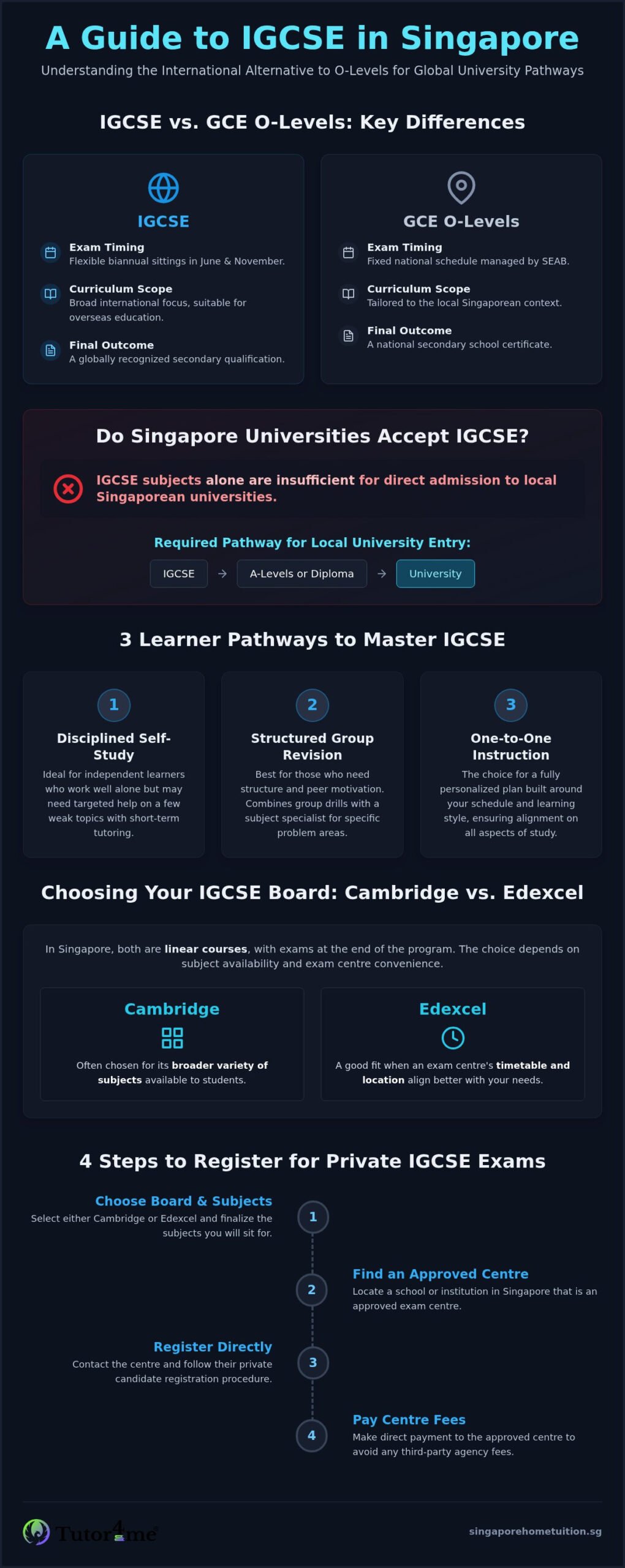
3 Learner Pathways to Master IGCSE in SG
You can master the IGCSE syllabus by picking a pathway that fits how you actually learn, not how a timetable says you should learn.
Three situations we meet often, with a concrete next step for each:
- You work well alone but stall on one or two papers: start with disciplined self-study, then add short tutor blocks only on the weak topics.
- You need structure and peer pace: join group revision for shared drills, and keep a single subject specialist for the papers that still slip.
- You need a plan built around your schedule and learning style: choose one-to-one instruction so explanations, homework load, and exam timing stay aligned.
Self-study demands high discipline; direct help clarifies tough concepts faster. For personalised academic help, a home tuition agency matches your child with university graduates who already have proven track records.
Choosing targeted tuition early locks in structured learning and fee-transparent matching. Dedicated instruction can cover specific IGCSE subjects such as general science or Mandarin language proficiency, with reassignment support if the first fit is wrong.
How is IGCSE different from O-levels?
IGCSE offers international flexibility with flexible exam timing, whereas local O-levels use a fixed syllabus built for Singapore schools.
Local O-levels follow fixed national exam schedules managed by the Singapore Examinations and Assessment Board (2026). IGCSE subjects allow sittings in November or June. Your future study goals decide the path: IGCSE suits plans for overseas education; local O-levels suit staying in Singapore.
| Feature | IGCSE | Local O-Levels |
|---|---|---|
| Exam timing | November and June sittings | Fixed national schedule |
| Curriculum scope | Broad international focus | Local Singapore context |
| Final outcome | Global secondary qualification | National secondary certificate |
Personalised support changes how efficiently you master hard concepts. Read About Us, Tutor4Me to see how experienced tutors are matched to your learning needs without extra agency charges.
Chasing high grades alone can turn studying into a stressful routine. Tuition has long helped students keep pace, yet overemphasis on testing can turn real learning into relentless competition.
Reflecting on a public forum discussion about rethinking tuition’s role in supporting students, one user noted:
"Tuition support has long been seen as a way to help students to keep pace with peers. But this approach can turn learning into an arms race, measuring progress only by exam scores." (source)
That observation shows how exam pressure can pull focus away from subject understanding. Personalised academic support helps you build confidence that lasts beyond a single score sheet.
Do Singapore universities accept IGCSE?
Local Singaporean universities do not accept IGCSE subjects alone for direct undergraduate admission.
You still need further pre-university study (for example A-Levels or an equivalent Diploma pathway) before undergraduate entry. IGCSE works as a secondary-school foundation; universities in the UK typically expect Advanced qualifications alongside those subject results. Academic struggles can bring emotional distress, tiredness, low self-esteem, and severe lack of sleep. Getting support early helps you stay on track for higher education.
Hiring a private home tutor in secondary school can reduce the risk of later academic exhaustion. Matching services pair learners with qualified educators who explain topics in plain steps. Parents pay only for lessons conducted, with transparent fee terms and no separate agency charge on the booking.
Tutors who want flexible part-time hours can also apply through open tutor job listings and receive clear payment terms for lessons taught.
What is the difference between Cambridge and Edexcel IGCSE?
In Singapore, both Cambridge and Edexcel International GCSEs run as linear courses: you sit the exams at the end of the programme rather than in modular stages.
Board choice still depends on your child’s learning style (the characteristic way they engage with material) and on which subject set fits the next school or country plan. Cambridge is often picked for its broad subject list; Edexcel is often picked when the family’s preferred centre and timetable align better with that board’s papers. From local instruction work, students handle pressure more calmly when subject load and revision blocks are paced across the year instead of compressed into one rushed period.
Pick the board that matches how your child revises and which centre can host the papers you need. Matching specialised educators through the platform does not require a separate agency fee.
Exam schedules can overwhelm teenagers. Customised home lessons help balance board preparation with time for other interests, so progress stays steady. If you need support for Humanities or science subjects, Contact Us, Tutor4Me and ask for an experienced tutor profile.
Over-tutoring can strip away curiosity and joy in learning. Writing in response to a public forum piece on rethinking tuition’s role, a reader shared:
"I’ve seen children become weary, their creativity sidelined. We have scaled back our tuition curriculum, allowing tutors to spend more time understanding each child." (source)
That feedback shows how heavy academic pressure can crush creative thinking in secondary school. Tailored guidance keeps structured exam prep beside open-ended exploration so learning stays engaging.
4 Steps to Register for Private IGCSE Exams
Private IGCSE registration is a short set of administrative steps with an authorised exam centre in Singapore.
Starting early stops deadlines from slipping; booking assessment slots on time keeps the candidate on track.
Use this process to finish registration:
- Find an approved exam centre: Locate an official exam board site in Singapore that accepts private candidates for IGCSE subjects.
- Submit personal details and subject choices: Fill out the candidate registration forms with your chosen subjects, target levels, and personal identification.
- Confirm examination timetables: Review your assigned test dates to ensure no scheduling conflicts exist across your papers.
- Pay the centre directly: Finalise booking with the centre so your portal setup carries only the centre’s own charges, not an added agency layer.
Long solo study blocks can leave primary and secondary pupils feeling cut off. Bringing a mentor into the study space closes that gap with regular feedback and clearer weekly goals.
Contact Tutor4Me for a personalised one-to-one tuition quote that fits your timetable.
When Standard IGCSE Schooling Is the Wrong Choice
Standard classrooms fall short when a student needs custom pacing, creative room, or tightly focused exam prep.
Inflexible routines drain energy; back-to-back lessons can leave bright teenagers with little time for personal interests, and weary children lose creativity when every hour is packed.
Switching to private home instruction restores balance while protecting academic goals. Flexible arrangements respect mental well-being and still cover demanding IGCSE subjects such as physics or Humanities without constant burn-out.
Direct support suits self-motivated learners who need tailored pacing. You receive rapid matching with qualified university graduates; hand-picked tutor profiles reflect academic needs and budget, and profiles delivered within 24 hours mean your family can move quickly.
Clients are charged only for lessons that take place, which keeps costs predictable while your child rebuilds drive. Aim for balanced progress week by week.
Tip: Ask for rapid matching with verified educators on your schedule, without an upfront registration cost.
Frequently asked questions
Do Singapore universities accept IGCSE?
Local autonomous universities usually require further qualifications such as A-Levels or the IB Diploma alongside IGCSEs for full admission. If your child follows this syllabus route in Singapore, early targeted tuition helps build the foundation those pre-university courses expect.
Can IGCSE pupils enter UK universities?
UK universities accept IGCSE qualifications as proof of lower-secondary achievement, though degree programmes still require further pre-university study. Personalised tuition across core subjects can prepare you for the A-Level stage that follows.
How much does IGCSE cost in Singapore?
Overall costs vary with exam registration choices, how many subjects you select, and the private tutoring arrangement you use. You only pay for lessons conducted, and hand-picked tutor profiles matched to academic needs arrive within 24 hours.
What subjects are offered in IGCSE?
Students can select IGCSE subjects such as English, Mathematics, Physics, Economics, and Humanities. Specialist tutors are matched to the exact papers and learning goals you name.
When are IGCSE exams in Singapore?
IGCSE written examinations in Singapore take place in two main series: May/June and October/November. Focused one-to-one tutoring helps you organise revision across those windows and sit the papers with a clear plan.
Master the IGCSE Syllabus Singapore in 2026
Qualified tutors can shape lessons around the exact papers your child will sit.
Curated tutor profiles arrive within 24 hours, so you can start while motivation is high. Lessons follow the student’s pace and break dense topics into steps you can rehearse.
Parents value a straightforward private-instruction model: you are billed for lessons that run, and if a tutor is not the right fit, the team arranges a reassignment. Visit our contact page when you want to shortlist a tutor and begin.