

Why do some students spend hundreds of hours memorizing supply and demand curves only to find themselves stuck when asked to evaluate a complex real-world policy? In Singapore’s rigorous academic environment, the leap from understanding theory to applying it with the nuance required for a Grade 7 can feel overwhelming. You’re likely familiar with the anxiety that comes from staring at a blank IA draft or struggling with the quantitative demands of Paper 3. It’s a common challenge, but it doesn’t have to define your IB experience.
This 2026 guide provides a strategic roadmap to mastering the syllabus with confidence. By focusing on ib econ tuition that emphasizes conceptual synthesis over rote memorization, you’ll learn how to bridge the gap between textbook models and high-level evaluative analysis. We’ll examine how to navigate the nine key concepts, secure top marks for your IA portfolio, and master the policy recommendations required for HL success. This overview breaks down the path to academic excellence into manageable, actionable steps for every student.
Key Takeaways
- Understand the nine central concepts of the 2026 syllabus to transition from basic memorization to high-level conceptual synthesis.
- Discover strategic methods for selecting news articles that simplify the Internal Assessment (IA) process and meet top-tier criteria.
- Identify the core differences between HL and SL, focusing on mastering the quantitative demands and policy recommendations in Paper 3.
- Learn why personalized ib econ tuition is the most effective way to develop the evaluative writing skills required for a Grade 7.
- Gain insights into selecting the right specialist, whether you require an MOE-trained teacher or a tutor focused on the latest IB rubric changes.
What is IB Economics? Understanding the 2026 Framework
IB Economics is a conceptual study of how stakeholders allocate scarce resources to satisfy unlimited wants. It moves beyond simple graph drawing to explore the impact of economic decisions on society as a whole. Understanding the IB Economics course structure is the first step toward academic success. For many students in Singapore, engaging in ib econ tuition early in the program helps demystify these high-level expectations and provides a stable foundation for the two-year journey.
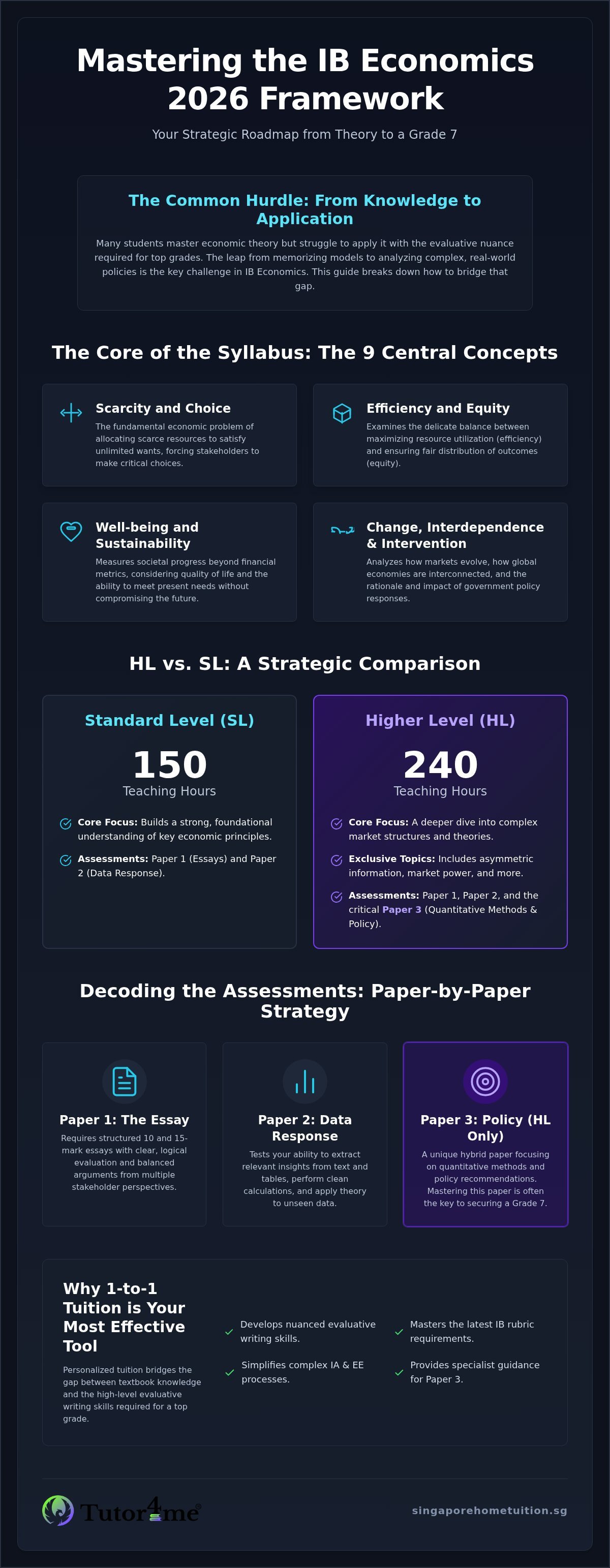
The 2026 framework is built upon nine central pillars that guide every inquiry. These concepts include:
- Scarcity and Choice: The fundamental tension of economics.
- Efficiency and Equity: Balancing optimal resource use with fairness.
- Well-being and Sustainability: Measuring progress beyond mere financial growth.
- Change, Interdependence, and Intervention: How markets evolve and how governments respond.
Unlike traditional A-Level curricula that often prioritize technical mastery of specific models, the IB syllabus requires students to view every economic event through these conceptual lenses. This makes the course inherently more difficult because there’s no single standard answer. You’re expected to justify why a specific government intervention might improve equity but potentially harm market efficiency. Real-World Issues (RWI) are now at the heart of the modern syllabus. Students must apply theoretical frameworks to actual data from recent years to demonstrate a deep understanding of the global economy.
The Shift from Memorization to Conceptual Application
The current IB rubrics specifically reward students who can link economic theory back to the nine core concepts. Traditional rote learning fails here because unseen data response questions require synthesis, not just recall. It’s not enough to define a tariff; you must explain how that tariff shifts the interdependence between domestic producers and foreign exporters. Interdependence serves as a vital bridge between Micro and Macro units by illustrating how the decisions of individual consumers or firms inevitably ripple through the national and global economy.
Managing the Jump from IGCSE or Secondary 4
Transitioning from secondary school requires a significant increase in the depth of evaluative conclusions. You aren’t just identifying a market failure; you’re weighing the long-term sustainability of the proposed solution. The introduction of global trade complexities can be jarring for those used to simpler market models. If you’re currently making this transition, our IGCSE Home Tuition Singapore services can help bridge the gap before the IB curriculum begins in earnest. Specialized ib econ tuition provides the 1-to-1 environment needed to master these international trade nuances and policy complexities before they become overwhelming.
HL vs SL Economics: Strategic Choice and Assessment
Deciding between Standard Level (SL) and Higher Level (HL) is a pivotal moment for any IB student. While both levels share a core foundation, HL dives significantly deeper into complex market structures. Topics like asymmetric information and market power are exclusive to the HL syllabus, requiring a more sophisticated level of analysis. Many students choose HL to meet the entry requirements for competitive university programs such as Philosophy, Politics, and Economics (PPE) or high-ranking Business degrees. Referencing the official IB Economics curriculum confirms that HL requires 240 teaching hours compared to 150 for SL, reflecting this increased breadth.
Assessment structures also vary. Both levels tackle Paper 1 and Paper 2, but HL students must also sit for Paper 3. This third paper focuses on quantitative methods and policy recommendations. It’s often the deciding factor for students aiming for top grades. Engaging in specialized ib econ tuition allows students to practice these distinct assessment formats under the guidance of a subject specialist who knows exactly what examiners look for in a high-level response.
Paper-by-Paper Strategy for Success
Success in Paper 1 hinges on your ability to structure 10-mark and 15-mark essays with clear, logical evaluation. You need to present balanced arguments that consider multiple stakeholder perspectives. Paper 2 requires sharp data response skills. You must extract relevant insights from text or tables and execute calculations cleanly. Finally, Paper 3 is unique. It demands a hybrid policy recommendation question, which is the key to securing a 7. This paper tests an HL student’s ability to use quantitative data to suggest and justify a specific economic course of action.
The Quantitative Demands of Higher Level (HL)
The quantitative hurdle in HL is significant. Students must master the theory of the firm and detailed market structures, which involve complex cost and revenue curves. You’ll need to calculate elasticities, tax incidence, and national income multipliers with precision. If you find these mathematical components challenging, supplemental Maths Home Tuition Singapore can provide the necessary foundation. Specialized ib econ tuition helps students navigate these calculations and the subsequent policy justifications required for top marks. Finding a qualified tutor to guide your progress makes these technical units much more approachable.
Mastering the Internal Assessment (IA) and Extended Essay (EE)
The Internal Assessment (IA) is often underestimated, yet it represents a significant portion of your final grade. For SL students, it accounts for 30%, while for HL students, it’s 20%. Mastering the IA requires more than just summarizing a news article; it demands a “Golden Thread” where your chosen economic concept, diagram, and evaluation align perfectly. According to the official IB Economics curriculum, these commentaries must demonstrate a student’s ability to apply economic theory to real-world situations. This is where specialized ib econ tuition becomes invaluable, as it provides the personalized environment needed to brainstorm and refine individual article choices that a group setting simply cannot offer.
Strategic Roadmap for the IA Portfolio
Your portfolio consists of three commentaries covering Unit 2 (Microeconomics), Unit 3 (Macroeconomics), and Unit 4 (The Global Economy). Picking the right news piece is 50% of the battle. You should avoid “over-explained” articles where a journalist has already done the economic analysis for you. Instead, look for a report that presents a clear problem, such as a specific market failure or a shift in trade policy. This allows you to step in as the economist. With a strict 800-word limit, every sentence must contribute to your economic reasoning. A dedicated tutor helps you trim the “fluff” and focus on the high-level analysis that markers expect.
EE Support: Research and Primary vs Secondary Data
The Extended Essay (EE) is a 4,000-word research project that tests your ability to conduct independent investigation. Success starts with a focused research question (RQ). If your RQ is too broad, your analysis will lack the necessary depth. We recommend a five-step research plan: identifying a local economic issue, selecting a research method, gathering data, analyzing findings, and formulating a conclusion. Whether you’re using primary data from local Singaporean businesses or secondary data from government reports, the process is rigorous. 1-to-1 ib econ tuition provides a critical feedback loop, ensuring your research remains on track and meets the highest academic standards. This personalized support from an experienced economics tutor is essential for navigating the complexities of data collection and evaluative writing.
Why 1-to-1 Home Tuition is Essential for IB Economics
IB Economics is uniquely qualitative compared to other sciences. Reaching the highest level of evaluation requires a student to move beyond “what” is happening to explain “why” it matters for different stakeholders. This is where 1-to-1 ib econ tuition offers a distinct advantage. Unlike group classes where the pace is dictated by the average, private tutoring allows for deep, Socratic discourse. By verbally defending an economic argument before writing it down, students develop the analytical sharpness needed for Paper 1 and Paper 2.
A customized pace is essential for mastering the syllabus. Some students struggle with the intricacies of Market Failure, while others find the Global Economy unit’s trade diagrams challenging. In a 1-to-1 setting, you can spend several sessions on a single difficult concept without the pressure of falling behind a group. Additionally, the individual nature of the IA portfolio makes private tutoring a safer choice. Every student requires a unique news article to avoid plagiarism risks. Brainstorming with a dedicated specialist ensures your work is original and tailored to your specific academic strengths.
Developing the ‘Economist’s Mindset’
The core of economic success is the “so what” factor. You must analyze the long-term impact of a policy on equity, efficiency, and sustainability. Practicing these oral arguments with a mentor builds the confidence to execute them under exam pressure. If you’re looking for an educator who understands these nuances, finding a Top Home Tutor in Singapore ensures you’re learning from a specialist who can cultivate this analytical mindset. This personalized interaction transforms abstract theory into a practical tool for evaluation.
Targeted Revision for Exam Milestones
As exams approach, the focus shifts to precision. Timed essay practice with immediate feedback is the fastest way to improve writing style and structure. Tutors can spot subtle errors in diagram labeling or curve shifting that would otherwise cost valuable marks. For HL students, drilling Paper 3 calculations until they become second nature is a priority. This targeted approach ensures that every hour spent in ib econ tuition directly contributes to a higher final grade. If you’re ready to secure your academic future, request a specialist IB Economics tutor today to begin your personalized learning journey.
Selecting Your IB Econ Tutor with Singapore Home Tuition
Finding the right support for your IB journey is a strategic decision that goes beyond simply searching for a tutor. At Singapore Home Tuition, we understand that every student faces unique hurdles, whether it’s the qualitative evaluation of Paper 1 or the quantitative precision required for Paper 3. Identifying your specific requirements early allows us to facilitate a more effective match. If your primary concern is the Internal Assessment portfolio, we prioritize tutors with a strong history of guiding students through the article selection process discussed earlier. Effective ib econ tuition is built on this personalized alignment between a student’s academic gaps and a tutor’s specialized expertise.
Our matching process is designed to be frictionless and transparent. We connect you with either MOE-trained teachers or subject specialists who have a deep understanding of the Singapore educational landscape. Trial lessons are encouraged to ensure the tutor’s communication style resonates with the student’s learning preferences. Once a match is confirmed, we recommend establishing a consistent long-term schedule. This consistency is vital for managing the heavy workload leading up to the final November or May exam sessions, ensuring that revision is steady rather than rushed.
What to Look for in an IB Specialist
A true specialist must be intimately familiar with the latest rubric changes and the nine central concepts that underpin the current framework. You should look for a professional with a proven track record of helping students secure a Grade 7. Beyond teaching theory, a high-quality specialist provides curated resource materials, including past year papers and model essays that demonstrate Level 4 evaluation. This level of support is what distinguishes professional ib econ tuition from general academic help. The ability to provide immediate, constructive feedback on essay structure is often the deciding factor in a student’s final grade.
Getting Started with Singapore Home Tuition
The journey begins with a consultation where you share your current academic standing and target goals. We then provide tutor profiles tailored to these requirements, allowing you to choose the best fit for your family. For a broader look at how we support families across various subjects, you can read our Parent’s Guide: 1-to-1 Home Tuition in Singapore 2026. When you’re ready to begin, our specialized Economics Home Tuition Singapore service is available to connect you with the expertise needed for IB success. We remain dedicated to finding the perfect match to ensure your child navigates the diploma program with confidence.
Securing Academic Success in the 2026 IB Economics Exams
Mastering the IB Economics curriculum requires a shift from simple memorization to a sophisticated conceptual synthesis. Success in the 2026 syllabus depends on your ability to link real-world data to the nine key concepts while maintaining the “Golden Thread” throughout your IA portfolio. Whether you’re navigating the quantitative demands of Paper 3 or refining your evaluative essay structure, having a dedicated specialist by your side makes a significant difference. Professional ib econ tuition provides the personalized Socratic discourse necessary to develop a true economist’s mindset.
Singapore Home Tuition offers specialist matching with IB-experienced tutors who understand the latest rubric changes. We provide comprehensive support for the IA, EE, and all exam papers through flexible 1-to-1 home and online options. This targeted approach ensures you can manage your heavy CAS and TOK commitments without compromising your academic goals. You don’t have to face these high-stakes assessments alone. Secure your Grade 7 with a specialized IB Economics tutor today and take the first step toward reaching your full potential with confidence.
Frequently Asked Questions
Is IB Economics harder than A-Level Economics?
IB Economics is often viewed as more challenging because it demands conceptual synthesis rather than just rote memorization. While A-Level curricula focus on technical models, the IB framework requires students to apply nine central concepts to real-world issues. The addition of the Internal Assessment (IA) portfolio also introduces a research component that tests your ability to evaluate news articles through an economic lens, adding significant qualitative depth to the course.
What is the difference between HL and SL Economics in IB?
The primary differences involve the depth of extension topics and the final assessment components. Higher Level (HL) students explore advanced areas like market power and asymmetric information, requiring 90 more teaching hours than Standard Level (SL). HL students must also complete Paper 3, which focuses on quantitative analysis and policy advice. Choosing the right level often depends on your university goals, such as pursuing a degree in Business or Economics.
How can a tutor help with my IB Economics Internal Assessment (IA)?
A tutor acts as a professional sounding board during the critical article selection phase. Picking an article that allows for deep evaluation is half the battle, and 1-to-1 ib econ tuition ensures your choice is original. Your tutor helps you link theory to the nine key concepts while maintaining a strict 800-word limit. This personalized feedback is essential for securing top marks in your three commentaries, especially when navigating the latest rubric changes.
What are the 9 key concepts in the new IB Economics syllabus?
The nine key concepts are Scarcity, Choice, Efficiency, Equity, Well-being, Sustainability, Change, Interdependence, and Intervention. These aren’t just definitions to memorize; they are analytical tools you must use to evaluate economic policies. For example, you might analyze how a carbon tax promotes sustainability while potentially impacting equity. Mastering these concepts allows you to transition from basic descriptions to the high-level synthesis required for a Grade 7 in your final examinations.
How do I score a 7 in IB Economics?
Securing a Grade 7 requires a combination of technical accuracy and sophisticated stakeholder analysis. You must be able to draw precise diagrams, execute complex calculations in Paper 3, and write balanced evaluative essays. Success is often found in the “so what” factor, where you explain the long-term implications of economic decisions. Regular practice with a specialist helps you refine your writing style and ensures you meet the specific criteria outlined in the IB mark schemes.
Is Paper 3 only for HL Economics students?
Paper 3 is strictly for Higher Level students and focuses on the quantitative aspects of the syllabus. It requires you to perform calculations related to elasticities, costs, and national income, followed by a policy recommendation based on your findings. While SL students focus on Papers 1 and 2, HL students must master these mathematical demands. Professional tutoring can help you bridge the gap if you find the quantitative requirements of this paper particularly challenging.
How often should I have IB Econ tuition to see results?
A consistent schedule of one 2-hour session per week is generally effective for most students. This rhythm provides enough time to clarify difficult school lessons while making steady progress on your IA portfolio. As final exams approach, increasing the frequency of your ib econ tuition can help with intensive timed essay practice and Paper 3 drills. Maintaining a regular schedule prevents the need for stressful, last-minute cramming during the high-pressure November or May sessions.
Can home tuition help with the Economics Extended Essay (EE)?
Home tuition is highly beneficial for the Extended Essay because it provides a personalized feedback loop for your 4,000-word research project. A specialist tutor helps you narrow down a broad topic into a focused research question and guides your data collection process. This 1-to-1 support is invaluable for ensuring your analysis remains rigorous and meets the high academic standards required for an ‘A’ grade, all while fitting around your school deadlines.