
Families asking how to get into GEP singapore should first check which selection route applies to their child’s cohort. It’s understandable to look for a clear formula, especially when school results and preparation advice can seem to carry so much weight. But grades alone don’t explain the process, and the relevant arrangements depend on your child’s cohort.
For Primary 3 students in 2026, the identification exercise is a single-stage assessment. From 2027, the existing GEP will be replaced by a broader approach that includes school-based support and centre-based advanced modules. This makes it important to distinguish the 2026 cohort’s route from what comes next, using current Ministry of Education (MOE) guidance as your reference.
This article explains what to check for your child’s cohort, what the assessment is intended to identify, and how to support curiosity and reasoning without turning preparation into pressure. It also covers practical next steps, whether your child is identified for advanced modules or benefits from support within their own school.
Key Takeaways
- To understand how to get into GEP singapore, first confirm which selection route applies to your child’s cohort through current MOE guidance and school communications.
- Use reading, discussion and age-appropriate problem-solving to nurture learning, rather than turning preparation into a high-pressure routine.
- Practice may help your child feel more familiar with challenging questions, but it cannot guarantee selection or replace the official criteria.
- If your child isn’t identified for advanced modules, ask the school what learning support and enrichment options may suit them.
- Choose any extra academic support based on a specific learning need, and agree on next steps with your child’s school and family.
What Is the GEP in Singapore, and Who Is It For?
Parents researching GEP entry may find conflicting advice about screening, school results and preparation. Some information describes the earlier selection route, while other guidance refers to changes for later cohorts. Before acting on advice about how to get into GEP singapore, identify your child’s primary level and check the latest Ministry of Education (MOE) guidance and school communications.
What does the Gifted Education Programme provide?
The Gifted Education Programme (GEP) provides an enriched and differentiated curriculum for intellectually gifted students, with greater emphasis on higher-level thinking and self-directed learning. It was designed to offer learning beyond the standard curriculum for students whose abilities and learning needs suit that level of challenge.
You can read a general background to the Gifted Education Programme (GEP), but use MOE information for current selection arrangements. GEP is one form of educational support, not the only way for a child to receive suitable challenge. Ask the school what learning opportunities are available, whether or not your child enters the programme.
Which students and cohorts should parents consider?
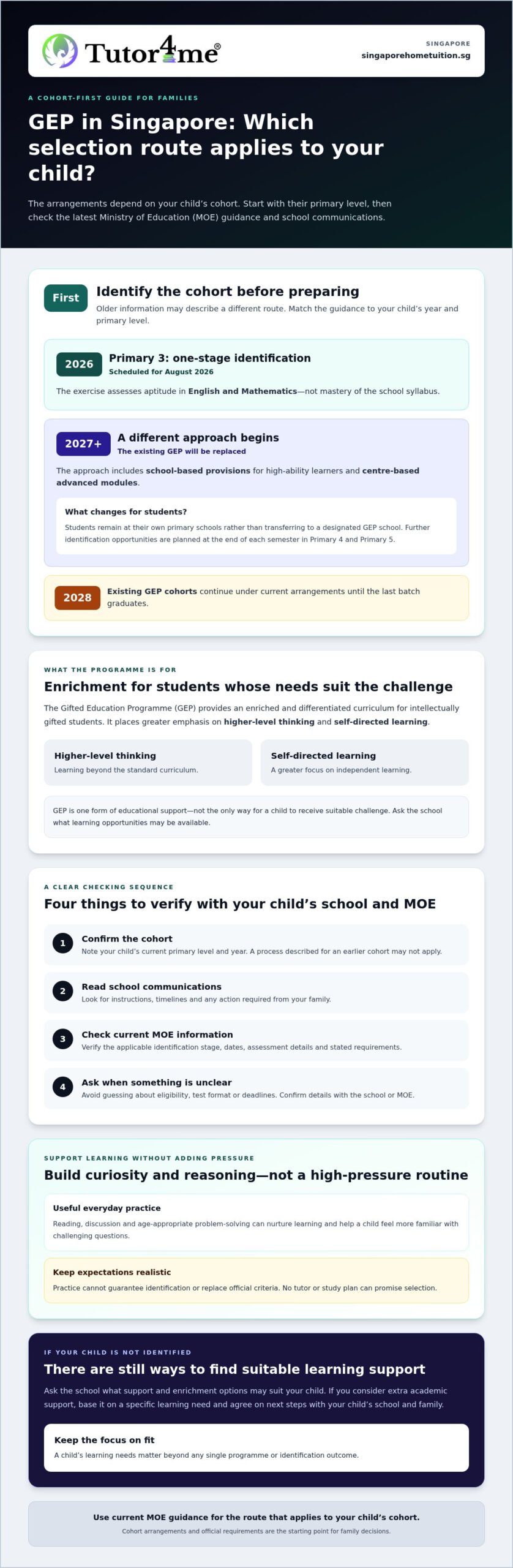
Your child’s current primary level matters because the selection route is changing. Under the current arrangements described by MOE, Primary 3 students in 2026 are the first cohort to take a one-stage identification exercise, scheduled for August 2026. It assesses aptitude in English and Mathematics rather than mastery of the school syllabus.
From 2027, the existing GEP will be replaced by a different approach. It includes school-based provisions for high-ability learners and centre-based advanced modules. Students will remain at their own primary schools rather than transferring to a designated GEP school. Further identification opportunities are also planned at the end of each semester in Primary 4 and Primary 5. Existing GEP cohorts will continue under current arrangements until the last batch graduates in 2028.
These distinctions matter. Information about an earlier two-stage process may not apply to a Primary 3 student in 2026, while arrangements for 2027 onward describe a different system. Check MOE’s latest notices for the applicable cohort, dates and stated requirements, then confirm how the school will communicate with your family. Preparation can support learning, but no tutor or study plan can guarantee identification or replace official criteria.
If your child has a specific subject need, you can review PSLE home tuition as an academic support option. It is not a GEP preparation route or a promise of selection.
How Does GEP Selection Work in Singapore? Check Your Child’s Cohort
Before acting on advice about how to get into GEP singapore, check which process applies to your child. Older articles may describe the earlier two-stage selection route, while the 2026 Primary 3 cohort has a different identification exercise. Start with your child’s current primary level, then compare the school’s communication with the latest MOE guidance.
MOE is the authoritative source for current GEP selection guidance, so check its notices alongside your child’s school communications. The official GEP overview provides programme information, but confirm that any process details you read apply to your child’s cohort.
What should parents check before preparing?
Use this order to avoid relying on outdated details:
- Confirm the cohort. Note your child’s current primary level and year. A process described for an earlier cohort may not apply.
- Read school communications. Look for instructions, timelines and any action required from your family.
- Check current MOE information. Verify the selection or identification stage, official dates, assessment details and stated requirements.
- Flag anything unclear. Don’t guess about eligibility, test format or deadlines. Ask the school or check with MOE before making a preparation plan.
For Primary 3 students in 2026, the stated route is a one-stage identification exercise scheduled for August 2026. It assesses aptitude in English and Mathematics rather than mastery of the school syllabus. The previous two-stage process is historical context, not the route for this cohort.
From 2027, a replacement approach will provide school-based support for high-ability learners and centre-based advanced modules. Further identification opportunities are planned at the end of each semester in Primary 4 and Primary 5. Treat these as later arrangements, and check MOE and school updates for details that affect your child.
Do school results alone determine GEP selection?
No. School results alone should not be treated as a complete selection formula. For the 2026 Primary 3 exercise, the stated focus is aptitude in English and Mathematics, not simply how well a student has mastered classroom content. Grades still matter to your child’s broader learning, but they shouldn’t be mistaken for an official selection rule. MOE does not publish a cut-off or selection probability in the information provided here, so avoid claims that promise a particular outcome.
If your child has a specific primary-school subject need, PSLE home tuition may offer individual academic support. It is separate from the official identification process and cannot guarantee selection.
How Can You Prepare for GEP Without Adding Unnecessary Pressure?
Parents asking how to get into GEP singapore may feel they need to start intensive practice straight away. A steadier approach is to support how your child thinks and learns while keeping preparation in proportion to their age, schoolwork and wellbeing. The aim isn’t to rehearse a supposed selection formula. It’s to nurture curiosity and confidence that matter beyond one assessment.
What learning habits can support a primary-school child?
Make room for questions and conversation in everyday life. If your child wonders why a plant grows towards the light or how to compare two prices at a shop, invite them to explain their thinking. Ask open questions such as, “What makes you think that?” or “Can you find another way?” This gives your child a chance to practise reasoning without turning ordinary moments into tests.
Reading can help too. Let your child explore books and topics that interest them, then talk about a character’s choices, an unfamiliar idea or what might happen next. Keep the discussion suitable for their age and let their interests guide it. These habits support language, reflection and problem-solving as general learning skills, not as a promised advantage in selection.
How can parents keep preparation balanced?
If your child wants to try practice questions, use them in moderation. Practice can make unfamiliar tasks feel less daunting, but it can’t guarantee identification or replace MOE’s stated criteria. Check the Ministry of Education’s Gifted Education Programme information for current guidance, and avoid treating online predictions or a tutor’s claims as official selection advice.
Keep any routine manageable alongside schoolwork, rest and play. Watch how your child responds. If preparation leads to frequent worry, frustration or reluctance to learn, pause and adjust rather than adding more drills. Comparing your child with classmates can create pressure without giving you a reliable picture of their needs.
GEP is one possible form of educational support, not a measure of a child’s full ability or future potential. If your child needs help with a particular subject or learning goal, consider support for that need separately. You can explore this PSLE home tuition guide as one option for broader primary learning support. Any individual tuition should address a specific academic need, not be presented as a route to GEP entry.
What If Your Child Is Not Selected for the GEP?
Not being selected can feel disappointing, especially if your child hoped for the opportunity. But one identification outcome doesn’t define their ability, potential or future path. Children develop at different rates, and a programme decision is only one piece of information, not a complete measure of what your child can learn or achieve.
What learning options can families explore?
Start with your child’s school. Ask what learning support and enrichment options are available, and share what your child finds too easy, challenging or engaging. For cohorts affected by the new approach from 2027, ask how school-based provisions for high-ability learners will apply. Focus on what is actually available to your child rather than assuming one route fits every student.
Then consider your child’s needs as a whole. A useful next step should reflect their academic needs, interests, confidence and workload. For example, if your child finds a particular subject difficult, ask the teacher which skills need attention before adding extra lessons. If they are thriving in a topic outside class, look for suitable ways to keep that interest growing.
One-to-one tuition may be an option when there’s a clear subject-specific need. You can read about primary school home tuition as a form of broader academic support. It doesn’t reproduce the GEP, guarantee an equivalent experience or improve the chance of selection. Choose support for the learning need itself, not as a substitute programme.
How can parents respond supportively?
Give your child room to feel disappointed, if they are. Listen first, and avoid comparing them with classmates or describing the outcome as proof of what they can or can’t do. You might ask, “Which parts of learning have you enjoyed lately?” or “Is there something you’d like more help with?” Their answers can guide a more useful conversation with the school.
Keep the next steps manageable. Agree on one or two priorities, then review them with your child and the school over time. Notice whether the plan is helping your child feel more confident and engaged or adding strain to an already full week. Adjust the support if their needs change.
If a specific primary-school subject need is affecting your child’s confidence, explore suitable primary-school tuition support as one possible option. Keep the focus on helping your child learn well, not on how to get into GEP singapore or treating selection as the only measure of progress.
How to Decide Your Family’s Next Steps for GEP in 2026
You don’t need to map out your child’s entire academic future around one selection outcome. Confirm the information that applies to their cohort, speak with the school, and agree on a learning plan that fits your child. This keeps decisions grounded in current guidance and their actual needs, rather than assumptions about how to get into GEP singapore.
A simple checklist for parents
- Verify the cohort details. Check current MOE guidance and school communications for the applicable process, dates and requirements. Don’t rely on older advice until you’ve confirmed it applies to your child.
- Talk with the school. Ask about your child’s strengths, interests and learning needs, as well as any support or enrichment options available to them.
- Agree on a balanced routine. If your child wants to practise, keep it manageable alongside schoolwork, rest and other interests. Review the plan if it begins to affect their wellbeing.
Keep the conversation open. Your child may enjoy challenging Maths problems, independent reading or exploring a topic in depth. Those interests can guide supportive learning choices without assuming a particular GEP outcome.
When could one-to-one tuition be useful?
One-to-one tuition may be worth considering if you’ve identified a specific subject need, a gap in understanding or a confidence issue that would benefit from individual attention. First, clarify the goal. Is your child struggling with a particular Maths topic, for example, or do they need help strengthening English skills? A clear academic purpose makes it easier to decide whether extra support fits their workload and learning style.
Singapore Home Tuition matches students with tutors for one-to-one home or online tuition. This is general academic support, not a GEP entry programme, and it cannot guarantee identification. Choose tuition only if it addresses a need your family has identified, and continue checking with your child and their school about whether the support is useful.
If you’re considering a tutor, compare options based on your child’s subject needs, learning preferences and schedule. A primary school home tuition guide can help you explore support for primary-level learning. Keep the decision focused on helping your child make steady progress, whether or not they are identified for advanced learning opportunities.
Make Your Child’s Next Step Clear and Balanced
Understanding how to get into GEP singapore starts with checking the route that applies to your child’s cohort, then confirming details through MOE and the school. Avoid relying on older advice or treating grades, practice papers or tuition as a selection formula. A calm routine that supports curiosity and reasoning can help your child learn without making one programme the measure of their ability.
If your child isn’t identified, speak with the school about suitable learning support and enrichment. Their interests, confidence, academic needs and wellbeing can guide what comes next. The goal is to help them keep growing, whatever the outcome.
For a specific subject need, Singapore Home Tuition offers one-to-one home and online tuition for primary-school students, with tutor matching based on a student’s academic needs. It is general learning support, not a GEP entry programme or guarantee. Explore one-to-one home tuition support if it suits your family’s needs.
Keep asking questions, check official guidance, and work with your child’s school. With thoughtful support, your child can move forward with confidence.
Frequently Asked Questions
How do you get into the GEP in Singapore?
To understand how to get into GEP singapore, first confirm your child’s cohort and check current MOE and school guidance. For Primary 3 students in 2026, the stated route is a one-stage identification exercise assessing aptitude in English and Mathematics. Other cohorts may have different arrangements. Preparation can support confidence, but it can’t guarantee entry. Don’t rely on outdated advice, unofficial cut-offs or claims of guaranteed selection.
At what age or primary level can a child enter the GEP?
The relevant primary level depends on the official arrangements for your child’s cohort, so check with MOE and your child’s school rather than relying on a general age rule. For Primary 3 students in 2026, MOE’s stated identification exercise is the applicable route. If your child is in another level or cohort, confirm the relevant process and requirements directly before making plans.
Is there a GEP test in Singapore in 2026?
For Primary 3 students in 2026, the confirmed arrangement is a one-stage identification exercise scheduled for August 2026. It assesses aptitude in English and Mathematics rather than mastery of the school syllabus. Check MOE guidance and school communications for cohort-specific instructions and timing. Don’t assume older two-stage formats still apply, and contact the school if assessment details are unclear rather than relying on tuition advertisements.
Can tuition help a child get into the GEP?
Tuition may help your child address a specific learning need or build confidence, but no tutor or agency can guarantee GEP selection. Singapore Home Tuition offers general one-to-one home and online tuition, with tutor matching based on a student’s academic needs. This isn’t a GEP entry programme. Keep support age-appropriate, focused on your child’s learning, and balanced with rest and other interests.
What should my child study to prepare for GEP selection?
There isn’t a confirmed study formula parents can use to secure selection. Encourage broad, age-appropriate habits such as reading, discussing ideas and explaining how your child reached an answer. These support learning, but aren’t a promised selection advantage. Check official cohort guidance before choosing practice materials or a preparation plan. Avoid excessive drills, which may add pressure without replacing the stated identification criteria.
What happens if my child is not selected for the GEP?
Non-selection doesn’t define your child’s ability or future academic potential. Ask the school what learning support and enrichment options are available, then consider what fits your child’s interests, confidence and workload. If there’s a clear subject need, discuss suitable support with the school. Keep the conversation encouraging, and don’t treat GEP as the only way for your child to experience challenge or make progress.
Has the GEP changed for students entering in 2027?
Yes. MOE’s announced approach replaces the existing GEP from 2027 with school-based provisions for high-ability learners and centre-based advanced modules. Students remain in their own primary schools, and further identification opportunities are planned at the end of each semester in Primary 4 and Primary 5. Check MOE announcements for details affecting your child, and don’t apply these later arrangements to a 2026 cohort without confirmation.