
If you’re researching DSA general ability test preparation singapore, begin with the current selection approach: MOE stopped secondary schools from using general academic ability tests for DSA selection from the 2018 exercise. DSA-Sec selection now focuses on a student’s specific talent, with schools choosing methods suited to the talent area.
It can be difficult to know what to practise when schools assess applicants in different ways. A routine built around reasoning questions may not match your child’s chosen pathway. General problem-solving can still be useful, but preparation should follow the school’s stated requirements and help your child explain and demonstrate their strengths.
This guide covers the kinds of school-specific assessments your child may encounter, how to build a manageable practice routine, and how to keep preparation purposeful without making every session feel like a test. You’ll also learn how one-to-one tuition can provide tailored practice and feedback based on your child’s academic needs and learning style, alongside preparation focused on their chosen DSA talent.
Key Takeaways
- MOE stopped secondary schools from using general academic ability tests for DSA selection from the 2018 exercise. Check each school’s current selection information before planning preparation.
- For DSA general ability test preparation singapore, treat reasoning practice as a way to build transferable skills, not as a guaranteed test syllabus.
- Practise a small mix of verbal, numerical and visual reasoning questions, then review the steps behind incorrect answers.
- Keep reasoning practice separate from talent-specific preparation, such as interviews, auditions, trials or portfolios requested by a school.
- One-to-one tuition can provide focused feedback, with tutor matching shaped around your child’s academic needs, level and learning style.
What Does DSA General Ability Test Preparation in Singapore Involve?
First, clarify what the phrase means. General ability practice develops reasoning and problem-solving skills; it is not a standard DSA-Sec test syllabus or preparation for a confirmed test format. The Ministry of Education stopped secondary schools from using general academic ability tests for DSA selection from the 2018 exercise. So DSA general ability test preparation singapore should focus on useful thinking skills, not assumed test requirements.
DSA-Sec is a school-specific route for students to be considered based on their talents. Schools describe their own talent areas and selection processes. The Direct School Admission (DSA) overview provides background on the scheme, but the chosen school’s current DSA information should guide practical preparation. Review it alongside current MOE guidance before deciding what your child should practise.
How does general ability relate to DSA-Sec?
A school may assess applicants through methods linked to the talent area, such as an interview, audition, trial, portfolio review or subject-specific task. These methods differ, so don’t assume a general ability test is part of every school’s selection process. Review the school’s published requirements and prepare for the activities it actually describes. For subject learning alongside this process, see one-to-one home tutor support.
What skills might general ability practice develop?
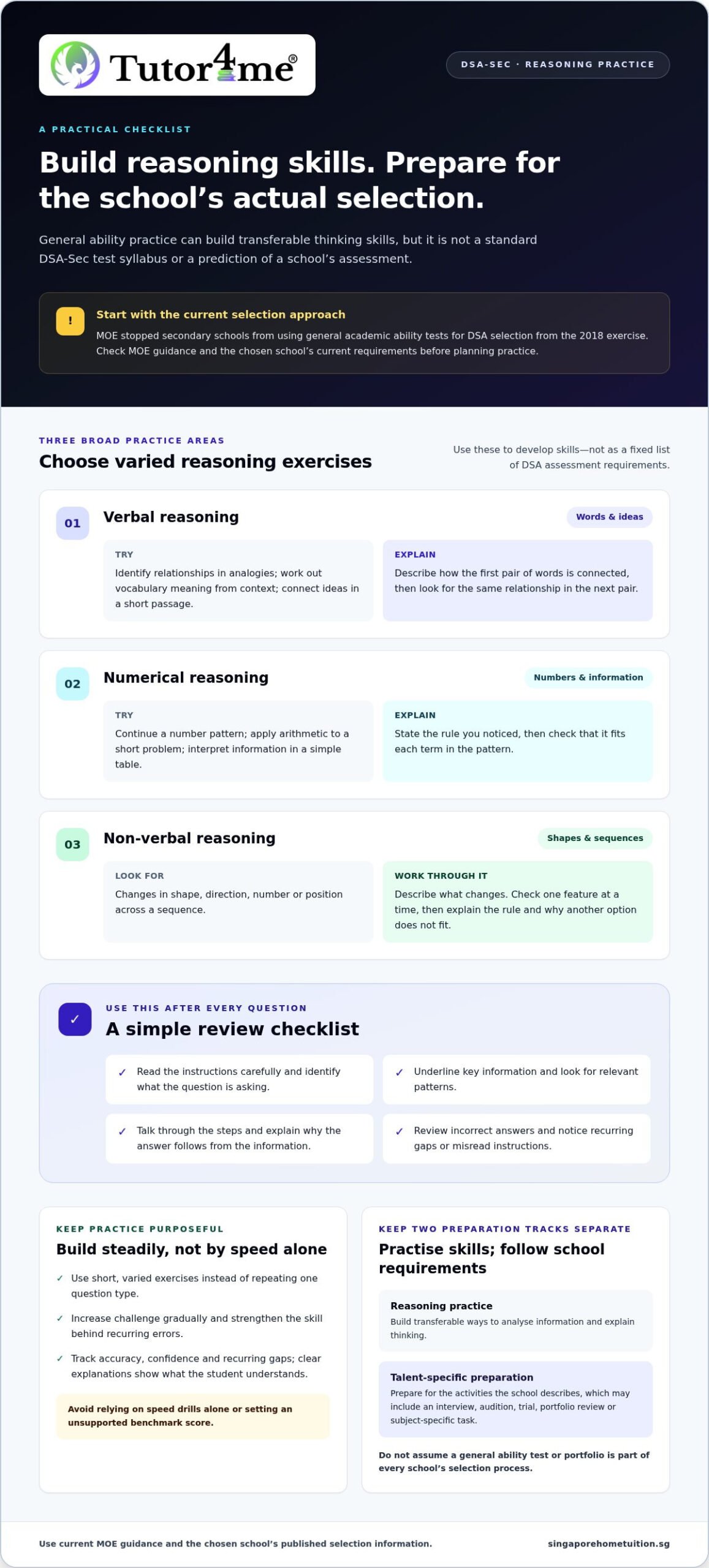
If your child wants to build transferable reasoning skills, practice can include verbal, numerical and non-verbal questions. These are possible areas for skill development, not a fixed DSA syllabus. For example, a student might identify how two words are related, continue a number pattern or work out the rule behind a sequence of shapes.
Use each question to practise a useful habit: read the instructions carefully, identify relevant patterns, explain the steps and check that the answer follows from the information given. If a school publishes a specific assessment format, use that information to guide format-focused preparation. Keep general reasoning exercises separate from confirmed requirements. This helps your child prepare purposefully without mistaking practice questions for a prediction of what the school will ask.
Which Reasoning Skills Should Students Practise for DSA Preparation?
Reasoning practice can help your child organise information, spot relationships and explain a conclusion. These are transferable skills, not a prediction of what a particular school will assess. For DSA general ability test preparation singapore, let the school’s current selection requirements guide any format-specific work. The Ministry of Education (MOE) DSA-Sec guidelines provide official programme information. Review them alongside the chosen school’s published details.
Practice can cover three broad areas:
- Verbal reasoning: Identify relationships in analogies, work out vocabulary meaning from context, and explain how ideas in a short passage connect.
- Numerical reasoning: Continue a number pattern, apply arithmetic to a short problem, or interpret information in a simple table.
- Non-verbal reasoning: Notice changes in shape, direction, number or position across a sequence, then identify the rule that links the images.
How can students practise verbal and numerical reasoning?
Use short, varied exercises rather than repeating a single question type. Ask your child to underline key information, describe what the question is asking and talk through each step before answering. For an analogy, they can explain how the first pair of words is connected, then look for the same relationship in the second pair. For a number pattern, ask them to state the rule they noticed and check whether it fits each term.
Increase the challenge gradually. If your child often misreads instructions, practise careful reading before adding harder questions. If the reasoning is sound but the arithmetic is uncertain, review the relevant calculation. Track accuracy, confidence and recurring gaps, but don’t rely on speed drills alone or set an unsupported benchmark score. Clear explanations tell you more about what the student understands.
How can students approach non-verbal reasoning questions?
Encourage your child to describe what changes before choosing an answer. They can check whether a shape rotates, the number of sides increases or an object moves to a different position. Looking at one feature at a time can make a busy visual sequence easier to analyse.
Use unfamiliar examples so students practise the method instead of memorising questions. After each answer, ask them to explain the pattern and why another option does not fit. If your child benefits from individual feedback on subject learning and reasoning, explore one-to-one home tutor support suited to their academic needs and learning style.
How Is General Ability Practice Different from DSA Portfolio Preparation?
General ability practice and portfolio preparation have different purposes. Reasoning exercises help a student analyse information and explain their thinking. A portfolio, if requested by a school, can provide evidence of a student’s work, experience or development in a particular talent area. Neither should be treated as a universal requirement for every DSA applicant.
Preparation should follow the school’s published selection method, not a one-size-fits-all DSA checklist. For families considering DSA general ability test preparation singapore, keep transferable reasoning practice separate from tasks the school specifically asks applicants to complete. The MOE’s DSA-Sec guidance provides programme information, while each chosen school’s current instructions should shape your child’s next steps.
When might a portfolio or arts evidence matter?
A portfolio may be relevant for an arts talent area if the school requests one. Follow the school’s instructions for that area. A portfolio is different from timed reasoning questions: it relates to a student’s work or experience, while reasoning practice focuses on how they interpret information and reach answers.
Don’t assume a particular format, set of contents or submission deadline. Use the school’s current published requirements as your guide. If a portfolio isn’t requested, preparing one simply because another school asks for it may take time away from more relevant selection preparation.
How should families balance test practice and other preparation?
Start by identifying what the school says it will assess. Give each relevant activity a clear purpose instead of preparing for every possible assessment at once. For example, reasoning practice can focus on explaining thinking; portfolio work can focus on organising requested evidence; and interview preparation can help a student describe their interests and experiences clearly, if an interview is part of the process.
Keep the plan manageable. A short, regular reasoning session may suit a student who wants to maintain those skills, while a school-specific task may need its own preparation time. Review the school’s requirements and adjust the balance if they change or clarify what applicants should do. One-to-one academic support can help students work through reasoning questions and receive focused feedback, while your family keeps preparation aligned with the school’s selection method.
How to Build a Manageable DSA General Ability Practice Plan
A useful practice plan builds steady habits without turning preparation into another source of pressure. Begin with a small mix of verbal, numerical and visual reasoning questions. Use the first attempts to notice which tasks feel clear and where your child hesitates. Treat this as a starting point for choosing practice, not a score target or prediction of a school’s assessment.
For DSA general ability test preparation singapore, keep the routine flexible and separate from school-specific selection preparation. If a school publishes requirements, prioritise those tasks. Reasoning practice can remain a modest way to develop careful thinking alongside regular schoolwork and rest.
What should a weekly practice routine include?
Rotate the reasoning areas so your child doesn’t spend all their time on the most comfortable question type. Keep each session focused, then leave time to discuss answers and reflect on the approach. A simple cycle could look like this:
- Choose: Pick a small set of questions from one or two reasoning areas.
- Explain: Ask your child to talk through the clues or steps they used.
- Review: Look at missed or uncertain answers and identify what caused the difficulty.
- Adjust: Choose the next practice based on the skill that needs attention.
Fit sessions around the student’s school commitments, wellbeing and any DSA-specific tasks. If a busy week leaves little room for practice, reduce the load rather than trying to make up every missed exercise at once. Rest and confidence matter too.
How can parents tell whether practice is helping?
Look beyond the result on a single set of questions. Notice whether your child explains answers more clearly, checks instructions more carefully or can describe a strategy they used. These changes can show that the student is engaging with the reasoning process, even if accuracy varies from one practice session to another.
Keep a brief record of recurring errors and areas of confidence. For example, note whether your child often overlooks a condition in a word problem or can now explain a visual pattern without guessing. Use these observations to choose the next practice step, not to impose an unsupported benchmark or deadline.
If your child benefits from guided feedback, one-to-one tuition gives them space to work through questions and explain their thinking with a tutor. Matching can take account of academic needs, level and learning style. Explore one-to-one tuition support for an approach suited to your child.
How One-to-One Tuition Can Support DSA Preparation
One-to-one tuition gives a student space to explain their thinking, work through questions and receive feedback at a suitable pace. A tutor can help identify whether a student is overlooking details, struggling to explain a reasoning step or needs more practice with a subject concept. This support can complement preparation for a school’s DSA selection process, but it doesn’t replace the school’s stated requirements.
For DSA general ability test preparation singapore, keep the school’s current selection information at the centre of your plan. Tutor matching can take account of your child’s academic needs, level, subject requirements and learning style. Singapore Home Tuition delivers hand-picked tutor profiles within 24 hours and verifies tutor qualifications and ability. Support is provided through student matching. These steps help inform a considered match, not promise a DSA outcome.
What should families look for in learning support?
Look for support that responds to your child’s current understanding. A tutor can adjust question difficulty, invite the student to explain their approach and give focused feedback on areas that need attention. This keeps practice purposeful rather than centred on completing as many questions as possible.
Consider how the tutor’s subject expertise and teaching approach fit your child’s academic needs and learning style. Qualification and ability verification can help inform your decision, while support through matching helps families find a suitable learning fit. No tutor can guarantee admission, selection or a particular score.
What are the next steps for parents?
List the schools and talent areas your child is considering. Then review each school’s latest published DSA requirements and selection information before planning practice. This helps you distinguish general reasoning work from specific tasks the school describes and keeps preparation manageable.
If your child would benefit from individual academic support, share their needs, level and learning style as part of the matching process. One-to-one tuition can offer guided practice and feedback while your family follows school-specific information. Explore home tutor matching in Singapore to find support suited to your child.
Prepare with a Clear, Student-Focused Plan
DSA preparation works best when it follows the selected school’s current requirements. General reasoning practice can build transferable skills, but it isn’t a guaranteed test syllabus. Keep practice manageable, review how your child approaches questions, and prioritise any school-specific tasks, interviews or portfolio requests.
If your child would benefit from individual academic support, tutor matching can take their needs, level and learning style into account. Hand-picked tutor profiles are delivered within 24 hours, with tutor qualifications and ability verified and support provided through student matching. These steps can help you find a suitable learning fit without promising a DSA result.
For DSA general ability test preparation singapore, follow the school’s selection information and choose support that helps your child learn with confidence. Discuss one-to-one support for your child’s academic needs and take the next step with a clear plan. Your child can prepare steadily while keeping their wellbeing and strengths in view.
Frequently Asked Questions
Is there one standard general ability test for DSA in Singapore?
No. There isn’t one standard general ability test used for DSA-Sec selection. MOE stopped secondary schools from using general academic ability tests for DSA selection from the 2018 exercise. Schools select students through stated talent areas and school-specific methods, which can differ. Check current MOE guidance and each chosen school’s latest DSA information before planning preparation. Don’t assume a reasoning test is part of every school’s selection process.
What does a DSA general ability test assess?
There is no standard DSA general ability test with a common syllabus to describe. General ability questions used in other settings may involve verbal, numerical or non-verbal reasoning, but that doesn’t mean a DSA school will use them. You can practise these areas to develop careful reading, pattern recognition and problem-solving. Treat them as transferable skills, not a prediction of a school’s assessment format.
How can my child prepare for a DSA general ability test?
Start with the school’s current selection requirements, since preparation should reflect the talent area and method it describes. A sensible approach to DSA general ability test preparation singapore is to practise reasoning as a supporting skill, not assume there is a standard DSA test. If useful, try a small mix of verbal, numerical and visual questions, then review how your child reached each answer and where they felt unsure.
Can general ability skills be improved with practice?
Practice can help students become more deliberate about reading information, spotting patterns and explaining their reasoning. Discuss the steps behind an answer, including mistakes, rather than simply completing more questions. Progress can show up as clearer explanations or more considered strategies, not only higher accuracy. Practice can support skill development, but it can’t guarantee a particular score or DSA selection outcome.
Is DSA portfolio preparation the same as general ability test preparation?
No. General ability practice involves reasoning exercises, while a portfolio, if requested by a school, relates to evidence of a student’s work or experience in a talent area. Not every school or applicant requires one. Follow the chosen school’s published instructions for its talent area, and don’t assume a particular portfolio format or submission requirement. Keep portfolio preparation separate from reasoning practice so each activity has a clear purpose.
How often should a student practise for DSA general ability assessments?
There is no set practice frequency for DSA general ability assessments. If your child wants to develop reasoning skills, choose short, manageable sessions that fit around schoolwork, rest and any school-specific preparation. Rotate question types and leave time to review answers. Adjust the routine if practice becomes stressful or no longer feels useful. The aim is steady, purposeful learning, not meeting an invented score target or timeline.
Can a private tutor help with DSA general ability preparation?
A private tutor can support individual reasoning practice by asking your child to explain their approach and giving focused feedback on areas of difficulty. Singapore Home Tuition matches students for one-to-one home and online tuition based on academic needs, level and learning style. Tutor qualifications and ability are verified. This support can complement school-specific preparation, but it doesn’t guarantee admission, selection or improved scores.