
What if the strongest preparation for an academic DSA application is deeper subject learning, not rehearsed answers? A private tutor for DSA academic domain can help your child strengthen relevant knowledge and problem-solving while building on interests they genuinely want to pursue.
It’s understandable to wonder whether tuition can support DSA preparation, especially when schools may offer different academic domains and selection activities. General coaching may not match your child’s subject, school level or learning style. The right support should build capability without turning an authentic application into a performance.
This guide explains how one-to-one home or online tuition can support school learning alongside preparation in mathematics, science, languages or humanities. You’ll learn what to look for in a tutor, how subject-focused lessons can help your child describe real learning experiences clearly, and how to keep preparation centred on genuine interests. Singapore Home Tuition matches families with tutors based on a student’s academic needs, subject, level and learning style, with hand-picked tutor profiles delivered within 24 hours.
Key Takeaways
- A private tutor for DSA academic domain can strengthen subject knowledge and problem-solving, while genuine interests and experiences remain at the centre of an application.
- Subject tuition builds capability through focused practice, clear explanations and opportunities for students to discuss their reasoning.
- Compare tutors by subject fit, academic level, teaching background and lesson format, rather than relying on credentials alone.
- Set a clear learning goal and choose home or online tuition that suits your child’s academic needs and learning style.
- Singapore Home Tuition matches students with MOE teachers, experienced full-time tutors and university graduates, with hand-picked profiles delivered within 24 hours.
What a Private Tutor for DSA Academic Domain Can, and Cannot, Support
A private tutor for DSA academic domain is a subject specialist who helps a student develop learning connected to their academic interests. The focus is on building understanding over time, not rehearsing a standard DSA performance. One student may need to strengthen mathematical reasoning; another may want to explore scientific concepts or develop clearer analysis in humanities.
The Direct School Admission scheme is part of Singapore’s wider education system, but each school sets its own DSA domains and selection requirements. Check the latest information published by the Ministry of Education and the school your child is considering. Don’t assume that every academic-domain applicant sits the same test or takes part in the same activities.
What academic-domain DSA preparation may involve
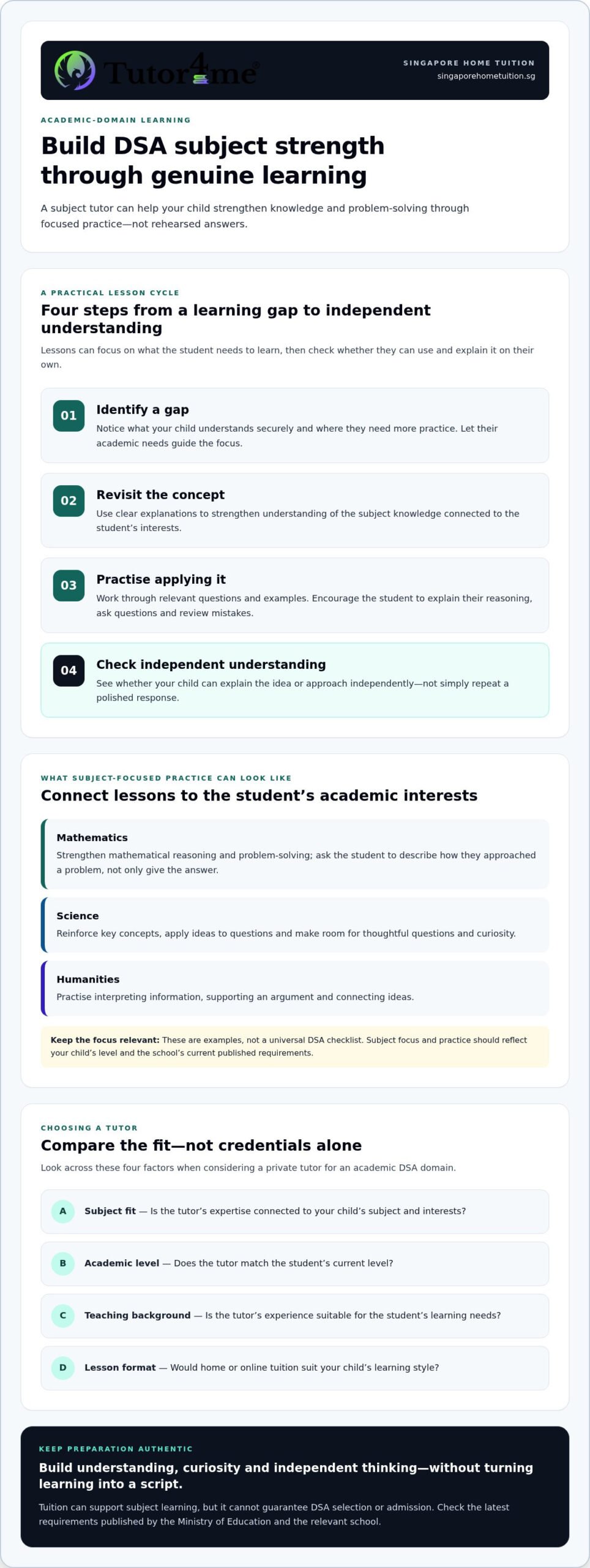
Subject learning can build knowledge, curiosity and confidence gradually. A mathematics tutor might ask a student to explain how they approached a problem, rather than focus only on the answer. In science, lessons could reinforce key concepts and encourage thoughtful questions. Humanities tuition may help a student interpret information, support an argument and connect ideas.
These are examples of learning, not a template for every school’s selection process. The relevant subject, level and practice should reflect your child’s academic needs and the school’s current published requirements. Strong preparation supports genuine development. It doesn’t require a child to claim interests or experiences they don’t have.
How tuition differs from general DSA coaching
Academic tuition develops subject understanding through explanation, practice and student questions. Admissions coaching focuses on preparing for application tasks, such as presenting experiences or practising interview responses, when those are part of a school’s process. The two address different needs, so identify what support your child needs before arranging lessons.
A subject tutor can help your child explain their reasoning, revisit uncertain topics and make connections within the subject. This learning may help them talk about their interests more clearly, but it isn’t a substitute for school-specific application preparation when needed. Any preparation for interviews, tests or other selection activities should follow the current instructions of the relevant school, rather than assumptions about all DSA applications.
Tuition can support your child’s preparation, but it cannot guarantee selection or admission. A suitable tutor helps strengthen learning while keeping the student’s real interests and progress at the centre.
How Subject-Specific Tuition Builds Genuine Academic-Domain Strength
Genuine academic strength develops through steady learning, not a last-minute script. A private tutor for DSA academic domain can help your child identify what they understand securely and where they need more practice, then shape lessons around those academic needs. A practical lesson cycle is to identify a gap, revisit the concept, practise applying it and check whether your child can explain it independently.
Match the tutor’s subject expertise to the student’s academic needs
Start with the subject or foundational skills connected to your child’s interest. A student drawn to chemistry may need to strengthen core concepts and apply them to unfamiliar questions. A student interested in mathematics may benefit from focused work on reasoning and problem-solving. Humanities learning may involve interpreting evidence and explaining ideas. These are examples, not a standard checklist. The right focus depends on the student’s level and the school’s current domain requirements.
For a student whose interest centres on chemistry, chemistry tuition in Singapore can provide subject-focused support alongside school learning. The aim is not to manufacture an application profile. It’s to help the student build knowledge and curiosity through work they can understand and discuss in their own words.
Build understanding rather than rehearsed answers
Good subject practice asks a student to do more than recall a polished response. A tutor can invite them to explain why a method works, ask questions when a step is unclear, apply an idea to a new example and review mistakes without embarrassment. These habits help reveal understanding and give the student room to connect lessons with genuine interests.
For example, economics tuition can involve interpreting a concept, applying it to a question and explaining the reasoning behind an answer. Economics home tuition is one example of how structured practice can support classroom learning without turning discussion into memorised interview lines.
Progress should reflect the student’s own effort and developing interests. Encourage them to talk about what they’ve learned, what they still find challenging and which questions they want to explore. For current DSA information, read the official MOE guidelines and the relevant school’s instructions. Lesson priorities should follow the student’s needs, not assumptions about a universal assessment.
Subject learning supports authentic academic-domain preparation by helping students understand more, think independently and speak honestly about what interests them.
How to Compare Private Tutors for an Academic DSA Domain
The right tutor is not simply the person with the most impressive title. Look for a match with your child’s subject, academic level and learning style. A private tutor for DSA academic domain should be able to explain how lessons will address the student’s learning needs, without suggesting that a particular tutor background guarantees progress or DSA selection.
| What to compare | Questions to consider |
|---|---|
| Subject fit | Does the tutor have relevant expertise in the subject or foundational skills your child wants to develop? |
| Academic level | Can the tutor support the student’s current school level and explain ideas at an appropriate pace? |
| Teaching background | Does the tutor’s experience suit your child’s needs, whether they are an MOE teacher, experienced full-time tutor or university graduate? |
| Lesson format | Would home or online tuition better suit your family’s schedule and your child’s preferred way of learning? |
Which tutor background may suit the learner?
MOE teachers may bring familiarity with school learning and assessment. Experienced full-time tutors may offer substantial one-to-one teaching experience, while university graduates may bring recent subject knowledge. These are possible strengths, not automatic measures of suitability. Consider the student’s academic level, subject and preferred learning approach, then read guidance on finding a top home tutor for broader tutor-fit considerations.
Ask how the tutor would respond if your child struggles with a concept. A suitable match should be able to describe a practical approach, such as breaking a difficult idea into smaller steps, using practice questions or asking the student to explain their reasoning. Clear answers help you assess subject fit beyond a profile or qualification.
What a productive tutor-student match should look like
During lessons, your child should have space to think, ask questions and make mistakes without the tutor simply supplying every answer. Notice whether explanations are clear and practice changes when the student needs another example. The teaching style should encourage independent thinking, not dependence on memorised responses.
Home or online tuition can both support one-to-one learning. Choose the format that fits your family’s schedule and your child’s learning style. Singapore’s public discussion of the education “arms race” is a reminder to base decisions on the child’s needs, not pressure to pursue every possible advantage. A good match supports steady subject learning without promising a particular DSA outcome.
A Practical Process for Finding DSA Academic-Domain Tuition
A clear brief helps you find a tutor who can support your child’s subject learning instead of defaulting to broad DSA coaching. Use this process to define the need, choose a suitable format and assess whether the proposed match fits your child.
- 1. Define the subject need. Note your child’s academic level, subject or foundational skills, current strengths and areas where they need support. Describe their academic-domain interest, but don’t assume every school has the same DSA requirements.
- 2. Set a learning goal. Identify what regular tuition should help your child work on, such as understanding difficult concepts, practising problem-solving or explaining ideas more clearly. Keep this separate from any school-specific application preparation they may need.
- 3. Choose the lesson format. Consider one-to-one home or online tuition in light of your family’s schedule and your child’s learning style. Share practical scheduling preferences so the tutor match can account for them.
- 4. Review the fit. Consider the tutor’s subject expertise, relevant teaching background and approach to the student’s academic level. Look for explanations and practice that respond to your child’s needs, with room for questions and independent thinking.
Prepare a clear brief for the tutor match
Before requesting a match, bring the details together: subject and level, what your child already understands, where they feel less confident, and how they learn best. Include whether you prefer home or online lessons and your practical schedule. If your child has a particular DSA academic interest, share it as context for subject learning, not as an assumed school selection requirement.
Be specific about the help needed. “Build confidence in science” is a starting point. Explaining that your child needs to consolidate concepts or apply them to unfamiliar questions gives a clearer direction. If application preparation is also needed, describe it separately so it isn’t confused with ongoing tuition.
Review the proposed tutor profile and support
Singapore Home Tuition uses rapid matching to provide hand-picked tutor profiles within 24 hours. Tutor qualifications and ability are verified, and dedicated tutor support is available. Parents pay only for lessons conducted, with zero agency fees. Instant reassignment is available if a tutor match is unsuitable.
Review each profile against your original brief: subject, academic level, teaching background, lesson format and fit with your child’s learning style. These details support an informed choice, but no tutor can promise DSA selection or admission. If you’re ready to find a subject-focused match, request a tutor match for your child.
How Singapore Home Tuition Supports Academic-Domain Tutor Matching
Finding a suitable private tutor for DSA academic domain starts with understanding what your child needs from regular subject lessons. Singapore Home Tuition provides one-to-one home or online tuition matched to a student’s subject, academic level and learning style. This keeps lessons focused on subject understanding that supports school learning and the student’s genuine academic interests.
What families can expect from the matching service
Matching takes into account your child’s subject, level, preferred lesson format and learning style. You can share areas of strength, topics they find challenging and the kinds of explanations that help them learn. This gives the matching process a clearer basis than choosing a tutor by title alone.
Families can draw on a global pool of experts, including MOE teachers, experienced full-time tutors and university graduates. Tutor qualifications and ability are verified, and profiles include educators with proven track records. Hand-picked tutor profiles are delivered within 24 hours, while dedicated support is available from registration through student matching. If a tutor match is unsuitable, instant reassignment is available.
This support helps you assess whether a tutor’s subject expertise and teaching approach fit your child. It doesn’t promise academic outcomes or DSA selection. Tuition can build subject skills; school-specific requirements and admission decisions remain separate.
Take the next step toward suitable academic support
Before requesting a match, prepare a short summary of your child’s academic level, subject, strengths, current learning gaps and DSA-related academic interest. Add your preferred lesson format, practical schedule and details about your child’s learning style. If you also need application preparation, describe it separately from ongoing subject tuition.
Parents pay only for lessons conducted, with zero agency fees. A clear picture of your child’s needs makes it easier to review suitable tutor profiles and choose support for your family. Request a suitable private tutor match.
Take the Next Step with Confidence
The right support starts with your child’s real academic needs. A private tutor for DSA academic domain can help strengthen subject understanding and problem-solving, while lessons stay focused on genuine interests rather than rehearsed application answers. Choose a tutor whose subject expertise, teaching approach and lesson format suit your child’s level and learning style.
Singapore Home Tuition provides one-to-one home or online tuition, with hand-picked tutor profiles delivered within 24 hours. Tutor qualifications and ability are verified, and dedicated support is available, including instant reassignment if the match isn’t suitable. There are zero agency fees, and parents pay only for lessons conducted. These supports can help you make a considered choice, without promising a particular DSA outcome.
Prepare a brief about your child’s subject, academic level, strengths, learning goals and preferred lesson format. Then take the next step: Request a suitable private tutor match. With subject support that fits, your child can keep learning with confidence and express their interests in their own words.
Frequently Asked Questions
Can a private tutor help with an academic-domain DSA application?
Yes. A subject tutor can strengthen learning related to your child’s academic interest, such as mathematics, science or humanities. Lessons can build subject knowledge, practise problem-solving and help your child explain their reasoning in their own words. The tutor’s role is to support learning, not determine application requirements or selection outcomes. Check the latest Ministry of Education and individual-school information for the relevant DSA domain and process.
What should I look for in a private tutor for DSA academic domain?
Look for a private tutor for DSA academic domain whose subject expertise matches your child’s interest and current academic level. Consider whether the tutor can explain concepts clearly, adapt practice to your child’s learning style and encourage questions instead of supplying every answer. Teaching background matters, but so does the student-tutor fit. Share your child’s strengths, learning gaps and goals when arranging a match.
Is academic-domain DSA tuition different from interview coaching?
Yes. Academic-domain tuition focuses on subject understanding, practice and the student’s questions. Interview coaching, when relevant to a school’s selection process, focuses on preparing the student to communicate experiences and ideas. One does not automatically replace the other. First identify whether your child needs ongoing subject support, preparation for a specific school activity, or both. Check the school’s current instructions rather than assuming all applicants face the same assessment.
How do I match a tutor to my child’s DSA academic interest?
Start by naming the subject or skills connected to your child’s interest, then note their academic level, what they already understand and where they need help. For example, a student interested in science may need support with particular concepts or applying them to questions. Share your preferred lesson format and your child’s learning style too. Match tuition to the student’s needs, and review the school’s current DSA domain information separately.
Can one-to-one tuition support both school subjects and DSA preparation?
One-to-one tuition can support regular school learning while strengthening subject knowledge relevant to a student’s academic interest. Lessons can revisit a challenging topic, practise applying concepts and build confidence in explaining answers. This can contribute to preparation, but it shouldn’t replace school-specific application guidance if that is needed. Keep subject learning grounded in your child’s real interests and follow the relevant school’s selection requirements.
What tutor backgrounds are suitable for academic-domain tuition?
Suitable tutors may include MOE teachers, experienced full-time tutors and university graduates with relevant subject expertise. Each background can bring a different perspective, but a title alone doesn’t determine whether a tutor is right for your child. Consider the subject, academic level, teaching approach and how well the tutor’s explanations fit your child’s learning style. Singapore Home Tuition verifies tutor qualifications and ability as part of its matching support.
Does a private tutor guarantee DSA selection?
No. A private tutor can support subject learning and help your child develop relevant knowledge and problem-solving, but cannot guarantee DSA selection or admission. Schools set their own domains and selection processes, and outcomes are determined by the relevant school. Choose tuition for its value to your child’s learning, not as a promise of admission. For current requirements, refer to official Ministry of Education guidance and the school’s published information.