
The best GEP tuition Singapore choice may not be a tutor promising to prepare your child for a selection test. If you’re unsure what support should cover or how to judge a tutor’s experience, that’s a reasonable concern.
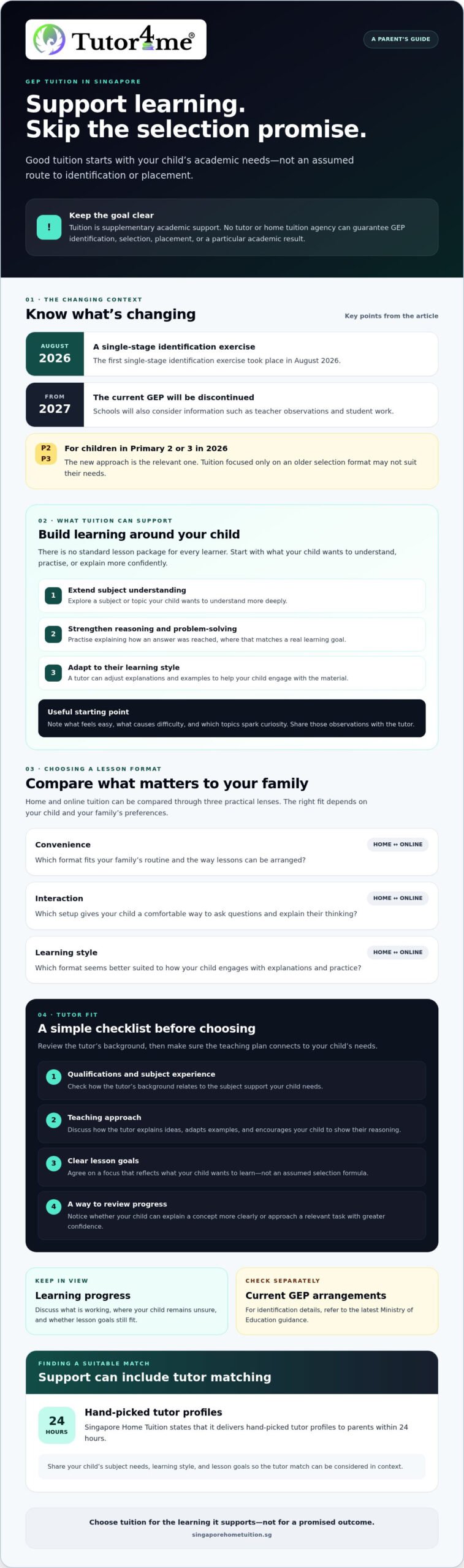
Singapore’s approach is changing. The current GEP will be discontinued from 2027, and a single-stage identification exercise first took place in August 2026. Schools will also consider information such as teacher observations and student work. For children in Primary 2 or 3 in 2026, the new approach is the relevant one, so tuition focused only on an older selection format may not suit their needs. No tutor can guarantee identification or a place in advanced modules.
Tuition can still support learning when it matches your child’s academic needs, whether that means extending subject understanding, building critical thinking and problem-solving, or adapting to their learning style. This guide compares one-to-one home and online tuition, explains what to look for in a tutor, and outlines how to discuss goals, progress and tutor fit with a home tuition agency.
Key Takeaways
- Use GEP tuition Singapore to address your child’s specific academic needs, not as a promise of selection or results.
- Decide what lessons should focus on by identifying the subjects and skills your child would benefit from developing.
- Compare one-to-one home and online tuition based on convenience, interaction, and your child’s learning style.
- Before choosing a tutor, review their qualifications and subject experience, then discuss their teaching approach and how you’ll track progress.
- A home tuition agency can help match your child with a suitable tutor; Singapore Home Tuition states that hand-picked tutor profiles are delivered within 24 hours.
What GEP tuition in Singapore can support, and what it cannot promise
GEP tuition in Singapore is supplementary academic support tailored to a child’s learning needs; it is not an official programme and cannot guarantee identification, selection or placement. A tutor may help a student strengthen subject understanding or practise particular skills, but the support should be chosen for its learning value, not as a shortcut to a GEP outcome.
The programme and identification approach are changing. The current GEP will be discontinued from 2027, so parents should check the latest Ministry of Education (MOE) information for details relevant to their child. For historical background, see the Gifted Education Programme in Singapore, and use MOE sources to confirm current arrangements. If you’re also considering broader primary-level subject support, you can review PSLE home tuition options.
When might one-to-one GEP-related tuition be worth considering?
Start with what you observe, not a label or assumption about your child’s abilities. They may grasp classroom concepts quickly but want more challenging questions, need another explanation to make a topic click, or find it hard to explain how they reached an answer. These are useful details to discuss with a tutor, not a diagnosis or evidence of likely selection.
Be clear about the goal before you contact a tutor. For example, you might want your child to build confidence explaining their reasoning in mathematics, or to deepen their understanding of a subject they enjoy. This keeps lessons focused on your child’s academic needs and learning style rather than on an assumed selection formula.
What can tuition realistically change?
With a suitable tutor, one-to-one support can offer explanations at a pace that works for your child, targeted practice and time to ask questions. Whether that helps depends on the student, the teaching approach and the learning goal. A tutor may support stronger understanding or more confident problem-solving, but no tutor or home tuition agency can promise GEP selection or a particular academic result.
Agree on a practical way to review progress, such as checking whether your child can explain a concept more clearly or approach a relevant task with greater confidence. Keep communication with the tutor regular and focused: discuss what’s working, where your child remains unsure, and whether the lesson goals still fit. If selection is a concern, treat it separately from tuition progress and refer to current MOE guidance.
What should GEP-related tuition cover for your child?
There’s no standard lesson package that will suit every learner. Plan GEP-related tuition around your child’s academic needs, rather than an assumed set of topics or activities. Depending on the student, lessons might strengthen understanding of a school subject, practise explaining ideas, or build reasoning and problem-solving. Include these skills only where they match a genuine learning goal.
Keep lesson planning grounded in current information. The Ministry of Education (MOE) describes the aims and approach of Singapore’s Gifted Education Programme. Check its latest guidance before treating any particular activity, format or selection detail as current. GEP tuition Singapore should support learning, not present practice exercises as an official selection method.
How should subject focus reflect a child’s academic needs?
Before lessons begin, note where your child feels confident, where they get stuck and which topics spark curiosity. A Primary student might understand a maths concept but struggle to explain their reasoning, or enjoy reading yet need support organising written responses. Share these observations with the tutor so lessons can address a specific need rather than cover material without a clear purpose.
A tutor can adjust examples and explanations to your child’s learning style. One learner may benefit from talking through a worked example; another may need to try a question independently and then discuss the steps. This is distinct from general primary-school subject tuition: if you’re seeking standard curriculum support, define that clearly instead of assuming every lesson needs to be GEP-focused.
How can parents assess teaching approach and progress?
Ask the tutor how they introduce an unfamiliar idea and check whether your child understands it. You could discuss how the tutor would respond if your child gives an answer without explaining their thinking, or finds a topic too easy or difficult. Confirm the tutor’s subject expertise and ask directly about relevant experience, including any experience supporting GEP learners. Don’t assume every suitable tutor has GEP-specific credentials.
Set a practical goal together, such as explaining a concept in the child’s own words or showing each step in a solution. Agree on a simple review routine with the tutor: what the child is working on, what seems clearer and what still needs attention. Use these observations to decide whether the lesson approach remains a good fit. Avoid relying on predicted scores, selection claims or guaranteed improvement.
If you’re starting to compare tutor backgrounds and teaching approaches, explore this guide to choosing a home tutor.
Home or online GEP tuition: which format may suit your family?
Both one-to-one home and online tuition can provide focused support, but the right choice depends on your child, your household routine and the tutor match. Consider where your child participates comfortably, how they prefer to ask questions, and what will make lessons practical to attend. The Singapore Ministry of Education’s Gifted Education Programme page is a useful source for official programme information; it doesn’t determine which tuition format will suit your family.
| Format | Possible benefit | Questions to consider |
|---|---|---|
| One-to-one home tuition | In-person discussion may suit a student who prefers face-to-face explanations. | Can your household provide a comfortable, reasonably quiet place and a workable lesson routine? |
| One-to-one online tuition | Remote lessons can fit families looking for support without an in-person visit. | Is your child comfortable communicating through a screen, and what tools will the tutor use to explain ideas? |
When could one-to-one home tuition be a suitable format?
Home lessons may suit a student who finds it easier to talk through a difficult idea face to face, ask questions as they arise or work through written examples alongside a tutor. Think about the practical setup too: a regular time, a suitable space and a routine that allows your child to focus. Home tuition isn’t automatically more effective; the tutor’s approach and your child’s learning style matter just as much.
When could online tuition work well?
Online tuition may be worth considering if remote support fits your family’s routine. Before deciding, ask whether your child can stay engaged in screen-based discussion and communicate when something is unclear. Discuss how the tutor will share explanations, invite your child to participate and update you on progress. A clear plan for interaction can help you judge whether the format is working for your child.
For GEP tuition Singapore, compare the formats against your child’s academic needs rather than assuming one is best for every learner. Ask your child which setting feels comfortable, then discuss the lesson structure and communication with the tutor before settling into a routine. If you’d like help considering a suitable one-to-one match, you can discuss home or online tuition options.
How to assess a GEP tutor before choosing one
A suitable tutor should match your child’s academic needs, subject level and learning style. Use a simple sequence: define what support you want, review the tutor’s background, discuss how they teach, then agree on how you’ll communicate about progress. This gives you a clearer basis for judging fit than a broad claim of GEP expertise.
Check qualifications and relevant subject experience, but don’t assume every capable tutor has GEP-specific credentials. If direct experience with GEP learners matters to your family, ask about it and clarify what that experience involved. A tutor should also be able to explain how their subject knowledge relates to the support your child needs.
Which questions reveal a tutor’s suitability?
Ask focused questions before lessons begin. For example:
- What experience do you have teaching this subject and academic level?
- How would you adapt an explanation if my child didn’t understand it the first time?
- How do you account for different learning styles and academic needs?
- How will you check understanding and share updates with us?
- How should we raise concerns if the lesson approach or tutor match doesn’t feel right?
Notice how the tutor responds, not just what they say. Do they listen to your child’s questions, explain ideas clearly and invite the student to share their thinking? During an initial discussion, your child should have room to speak too. A respectful, patient exchange can help you assess rapport, though a friendly manner alone doesn’t show whether the teaching approach is suitable.
What signs suggest the match needs review?
After lessons start, ask your child whether they can raise questions and describe what they’ve learned. They may not explain every concept perfectly, but persistent confusion, reluctance to participate or unclear lesson goals are reasons to check in with the tutor. Share specific observations and ask what adjustments could help. If communication or goals remain unclear, raise the concern promptly rather than letting uncertainty build.
Some families use a home tuition agency to support tutor matching. Instant reassignment is listed as an agency support option, but confirm the current process and what steps to take if a match isn’t working. If you’re comparing support providers, the article “How to Choose a Tuition Agency in Singapore” may also help you organise your questions.
To discuss your child’s needs and tutor fit, explore one-to-one tuition support for GEP-related learning.
How Singapore Home Tuition can help you find GEP-related support
Singapore Home Tuition arranges one-to-one home and online tuition for students whose families are seeking tailored academic support. It isn’t a GEP-specific class or an official selection programme. Instead, you can share your child’s academic needs and learning style so the home tuition agency can help identify a suitable tutor for the subject and lesson format you have in mind.
The agency states that it sends hand-picked tutor profiles within 24 hours and has over 1,000 tutors in its database. Its tutor pool includes MOE teachers, experienced full-time tutors and university undergraduates. Tutor qualification and ability verification are listed as trust signals. These details can help you start your search, but check each proposed tutor’s background and relevant experience directly. A profile proposal isn’t a promise that a tutor will accept the assignment or that tuition will lead to selection or a particular result.
What information should parents share when requesting a tutor?
Give the matching team a clear starting point. Share your child’s academic level, subject needs and preferred format, then describe how they learn best. For example, explain whether they benefit from step-by-step explanations, discussion or time to work through questions independently. State your learning goals and include any questions about a tutor’s subject background, teaching approach or experience with GEP learners.
Keep the request specific. “Help my child explain their reasoning in mathematics” gives a tutor a clearer direction than “prepare for GEP.” If your child also needs support with the PSLE curriculum, you can review the PSLE Home Tuition Singapore page and distinguish those subject goals from any additional learning you’re considering.
What happens after a tutor profile is proposed?
Review the profile and discuss whether the tutor’s subject experience, approach and availability fit your request before arranging lessons. Ask follow-up questions if details are unclear, and include your child in the conversation where appropriate. The agency states that families can access dedicated tutor support; confirm how to get help and raise concerns if the match needs review. It also states that parents pay only for lessons conducted.
If you’re exploring GEP tuition Singapore, share your child’s academic needs and ask about a suitable one-to-one home or online tutor match. Contact Singapore Home Tuition to discuss your child’s support needs. A thoughtful match can make lessons more focused, while selection decisions and academic outcomes remain outside any tutor’s control.
Choose support that fits your child’s needs
The right GEP tuition Singapore arrangement starts with a clear purpose: identify what your child wants help with, then choose a tutor and lesson format that suit their subject needs and learning style. One-to-one home or online tuition can support focused learning, but it can’t guarantee selection or a particular academic result.
As you compare options, ask about subject experience, teaching approach and how you’ll review progress together. Singapore Home Tuition states that it delivers hand-picked tutor profiles within 24 hours and has a database of over 1,000 tutors. Tutor qualification and ability verification are listed as trust signals. Dedicated tutor support and instant reassignment are also listed features, so confirm the current processes when you enquire.
Share your child’s academic needs and preferred lesson format to start a conversation about tutor fit. Discuss your child’s academic needs with Singapore Home Tuition. A considered match can give your child supportive space to learn and grow, one lesson at a time.
Frequently Asked Questions
What is GEP tuition in Singapore?
GEP tuition in Singapore is supplementary one-to-one academic support, not an official GEP programme. A tutor can work with your child on relevant subject learning or skills based on their academic needs, level and learning style. Lesson content should be agreed with the tutor rather than assumed to follow a standard GEP package. Check current programme information with Singapore’s Ministry of Education (MOE), especially if you’re asking about identification or selection.
Can tuition guarantee that a child will enter the GEP?
No. Tuition cannot guarantee GEP entry, identification, placement or a particular academic result. A tutor can provide explanations and practice tailored to a student’s learning goals, but selection decisions are outside the tutor’s control. Be cautious of claims that lessons ensure a place or predict a result. Set goals around learning and understanding, and refer to current MOE guidance for official programme information.
How do I choose a suitable GEP tutor for my child?
Start by identifying your child’s subject needs, learning preferences and goals. Review the tutor’s qualifications and experience at the relevant academic level, then ask how they explain unfamiliar ideas and check understanding. If GEP-specific experience matters to you, ask about it directly rather than assuming every suitable tutor has it. Consider whether your child can ask questions comfortably, and agree on how you’ll discuss progress and concerns.
Is online tuition suitable for GEP-related academic support?
Online tuition can suit a child who is comfortable learning and asking questions through a screen. Before choosing it, consider whether your child can stay engaged in remote discussion and whether the household has a workable setup for lessons. Ask the tutor how they’ll explain ideas, involve your child and share progress updates. Online and home tuition are both options to assess against your child’s learning style and family routine.
What subjects can a tutor support for a child preparing for GEP-related learning?
A tutor may support subjects such as Mathematics, English, Science, Humanities or languages, depending on the child’s academic needs and the tutor’s subject expertise. This doesn’t mean every subject is required for GEP-related learning or that tuition follows an official GEP syllabus. Tell the tutor where your child needs support, what they’re curious about and what goals you have. Confirm the tutor’s experience with the relevant subject and academic level.
How quickly can Singapore Home Tuition provide tutor profiles?
Singapore Home Tuition states that it delivers hand-picked tutor profiles to parents within 24 hours. The profiles are proposals for you to review, not a guarantee that a tutor will accept the assignment or that a particular learning outcome will follow. The agency says its database contains over 1,000 tutors. Ask about the proposed tutor’s qualifications, subject experience and fit for your child before arranging lessons.
What should I ask a tutor before starting lessons?
Ask about the tutor’s experience teaching your child’s subject and academic level, and how they adapt explanations to different learning styles. Discuss what lessons will focus on, how the tutor will check understanding and how you’ll receive progress updates. You can also ask whether they have direct experience supporting GEP learners, if relevant. Agree on practical learning goals and a clear way to raise concerns if the match or approach needs review.