
A stellar O-Level score gets you through the school gate, but raw aggregate numbers won’t guarantee success once lectures begin. When planning your tertiary pathway around the official jc cut off points 2026, looking only at historical entry scores leaves out the most critical factor: how well you can manage the demanding leap into H2 syllabuses.
Waiting for your Joint Admissions Exercise (JAE) posting results is naturally stressful. It’s completely normal to feel uncertain about tie-breakers, computerised balloting, and whether your net L1R5 meets the mark for your top-choice institution.
You can take control of the process with the right approach. This guide helps you master the 2026 JC cut off points, decode JAE posting rules, and implement a risk-managed strategy to rank your 12 choices. Along the way, we outline the latest Arts and Science entry scores, examine the shift to a 70-point University Admission Score, and share practical steps to tackle the fast-paced A-Level curriculum from your very first week.
Key Takeaways
- Understand how the official jc cut off points 2026 represent the net L1R5 score of the last student posted to each Arts and Science stream rather than a fixed entry mark.
- Structure your 12 JAE choices using a balanced three-tier strategy to safeguard your placement against computerised tie-breakers and balloting.
- Prepare for the steep step up from O-Levels by adapting quickly to independent lecture-tutorial systems and demanding H2 subject syllabuses.
- Navigate the revised 70-point University Admission Score framework by focusing your revision on essential core subjects and consistent daily work.
- Bridge conceptual gaps early with targeted private home instruction tailored to your specific academic needs and learning style.
Understanding JC Cut Off Points and JAE Admissions
Every year, the Joint Admissions Exercise (JAE) manages postings for secondary school graduates seeking pre-university education. Understanding how this system operates is essential before shortlisting colleges. In simple terms, a cut off point represents the net L1R5 aggregate score of the very last student admitted to a specific course during that posting year. These scores aren’t pre-set targets decided by schools. Instead, the published jc cut off points 2026 reflect actual student demand, cohort size, and course vacancies for each intake.
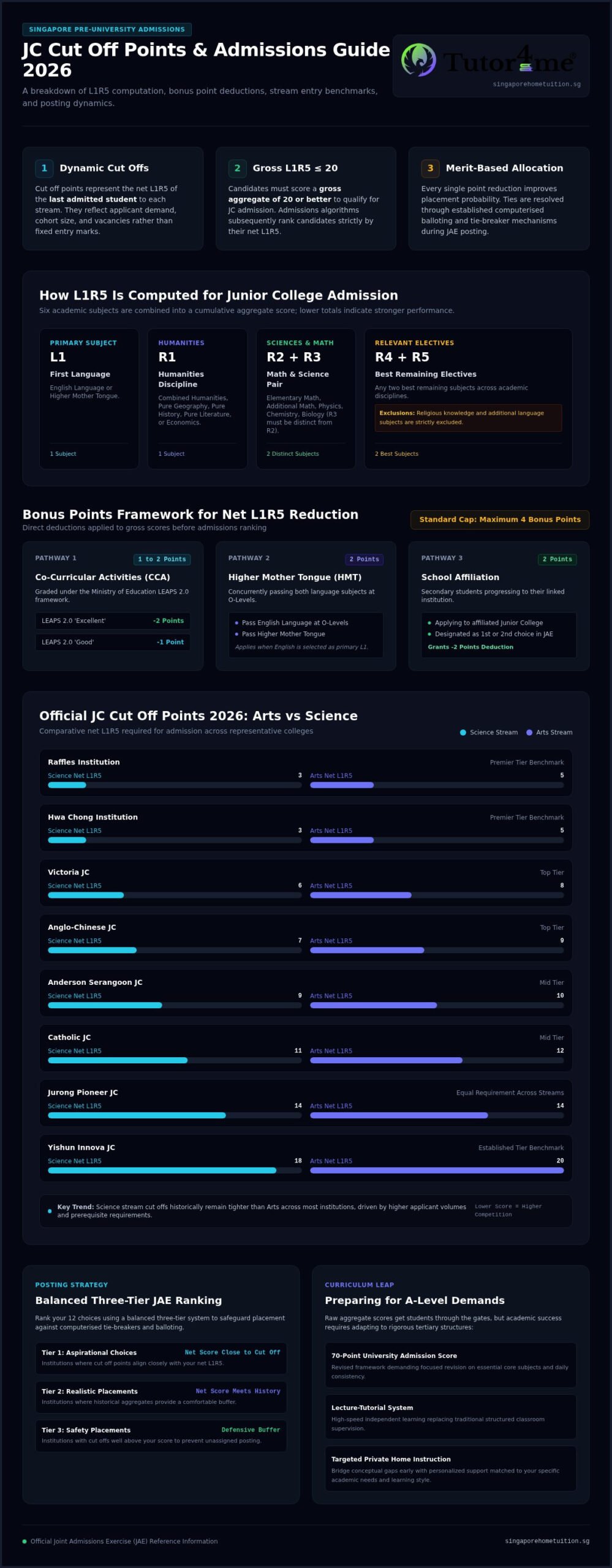
To qualify for junior college admission, candidates must attain a gross L1R5 score of 20 or better. While your gross score establishes baseline eligibility, admissions algorithms rank students strictly using their net L1R5. Central to Singapore’s Junior College System is merit-based allocation, where every single point reduction directly improves placement probability.
How L1R5 Is Computed for Junior College Admission
The L1R5 scoring system sums numerical grades across six key subjects, where lower aggregates indicate stronger performance. Your score calculation follows a structured framework:
- L1 (First Language): English Language or Higher Mother Tongue.
- R1 (Humanities): Combined Humanities, Pure Geography, Pure History, Pure Literature, or Economics.
- R2 (Mathematics/Science): Elementary Mathematics, Additional Mathematics, Physics, Chemistry, or Biology.
- R3 (Mathematics/Science): A second science or mathematics discipline not used in R2.
- R4 and R5 (Relevant Electives): Any two best remaining subjects, excluding religious knowledge and additional language subjects.
Choosing your strongest combination allows you to present the lowest possible aggregate score to the admissions system.
Maximizing Bonus Points for Net Aggregate Reduction
Net aggregate scores determine final posting priority, making bonus point deductions a decisive factor in competitive tiers. Eligible deductions lower your gross score through distinct pathways:
- Co-Curricular Activities (CCA): Attaining an ‘Excellent’ grade under the LEAPS 2.0 framework provides two bonus points, while a ‘Good’ grade provides one point.
- Higher Mother Tongue: Passing both English and Higher Mother Tongue at the O-Levels yields a two-point deduction when English is selected as the primary L1 subject.
- School Affiliation: Secondary students applying to an affiliated junior college qualify for two bonus points when selecting that institution as their first or second choice.
The standard Ministry of Education framework caps these deductions at a maximum of four bonus points for general applicants. Planning around official jc cut off points 2026 requires calculating your net score accurately under this four-point limit.
Indicative JC Cut Off Points: Arts and Science Streams
Entry standards vary noticeably depending on your choice of track. Science stream cut offs historically remain tighter than Arts across most institutions, driven by higher overall applicant volumes and university prerequisite requirements. Consulting the Official JAE Guide ensures you reference confirmed benchmarks during your decision-making process.
The table below summarizes the official jc cut off points 2026 across representative institutions, showing the net L1R5 required for both academic tracks.
| Junior College | Arts (Net L1R5) | Science (Net L1R5) |
|---|---|---|
| Raffles Institution | 5 | 3 |
| Hwa Chong Institution | 5 | 3 |
| Victoria JC | 8 | 6 |
| Anglo-Chinese JC | 9 | 7 |
| Anderson Serangoon JC | 10 | 9 |
| Catholic JC | 12 | 11 |
| Jurong Pioneer JC | 14 | 14 |
| Yishun Innova JC | 20 | 18 |
Top-Tier Junior Colleges: Score Ranges and Benchmarks
Premier institutions demand net scores between 3 and 7 points. Competition for these placements remains intense because Integrated Programme (IP) students advance directly into JC1 without taking the O-Levels. This structure leaves a limited quota of vacancies for JAE applicants at colleges like Raffles and Hwa Chong, keeping Science stream requirements pegged strictly at 3 net points.
Mid-Tier and Established Junior Colleges Across Singapore
Institutions operating within the 8 to 14 net aggregate bracket, such as Anderson Serangoon JC and Catholic JC, offer established academic tracks alongside modern campus resources. For students who prefer extra pacing before sitting for their national examinations, Millennia Institute provides an alternative three-year centralized pre-university track with an entry cut off of 20 points under the L1R4 system.
Securing a spot in a competitive college is only the opening step. If you want structured support to manage challenging subject combinations early, connecting with a top home tutor Singapore students count on will help you build solid conceptual foundations before lectures begin.
Strategic JAE Choice Submission: Securing Your Placement
Scoring well is only half the battle; how you rank your choices determines where you spend the next two years. The admissions algorithm assigns places strictly by merit, evaluating each student’s selections sequentially. To make informed decisions, you must understand how JAE posting works behind the scenes when demand exceeds vacancies.
Structuring the 12 Options on Your JAE Form
Distribute your 12 choices across three distinct tiers to balance ambition with security:
- Aspirational Choices (Choices 1 to 2): Target competitive schools where your net aggregate matches the historical cut off point exactly.
- Realistic Choices (Choices 3 to 8): Select colleges where your net score is one to two points better than the previous entry benchmark.
- Safety Choices (Choices 9 to 12): Pick reliable institutions where your score comfortably clears previous thresholds by three or more points, ensuring you aren’t assigned to an unselected school.
Understanding JAE Computer Posting and Tie-Breakers
Meeting the benchmark doesn’t guarantee a seat if a college runs out of capacity. When multiple applicants with identical net aggregates compete for the final vacancies, the computerized system applies specific tie-breakers:
- Citizenship Priority: Singapore Citizens take precedence over Permanent Residents, who rank ahead of International Students.
- Gross L1R5 Comparison: If citizenship status is identical, the system favors the candidate with the superior raw score before bonus deductions.
- Computer Balloting: If candidates tie across both criteria, the system conducts an automated ballot.
Because of this mechanic, matching the jc cut off points 2026 closely still carries a minor balloting risk for borderline applicants.
Appeal Procedures and Joint Admissions Transfers
If you don’t receive your preferred placement, you can lodge an appeal during the official post-results window. You must still report to your posted institution on the scheduled reporting date while awaiting appeal outcomes.
Junior colleges cannot accept appeals from applicants whose net aggregate fails to meet their published cut off score. Transfers depend entirely on vacated places after student withdrawals, making a well-hedged initial application your most reliable route to a desirable placement.
The Academic Jump: Preparing for A-Level Curriculum Demands
Entering your posted college marks the start of a steep learning curve. While qualifying through the jc cut off points 2026 confirms your baseline ability, the shift from secondary school spoon-feeding to the independent lecture-tutorial structure catches many fresh JC1 students off guard. Mass lectures deliver dense theoretical frameworks at rapid speeds, leaving individual problem-solving and application tasks entirely for tutorial discussions.
Subject syllabuses at the H2 level demand advanced cognitive skills. Instead of direct recall and standard templates, questions require sharp evaluation, cross-topic synthesis, and nuanced application. With barely nine months between your February orientation and the critical JC1 Promotional Examinations, unaddressed learning gaps snowball quickly into severe academic deficits across heavy disciplines.
Mastering Demanding Science and Mathematics Syllabuses
Higher mathematics transitions abruptly into rigorous abstract reasoning and complex multi-step calculus. Concurrently, experimental sciences require both precise theoretical analysis and high-stakes laboratory execution. In chemistry, organic reaction mechanisms and chemical energetics demand profound conceptual clarity rather than rote memorization. Securing professional guidance through targeted chemistry tuition helps you build systematic exam techniques early, protecting your grades before mid-year blocks begin.
Tackling Humanities and Language Rigor in Junior College
Pre-university humanities subjects evaluate structural arguments, evidence integration, and mature critical perspectives under intense time constraints:
- General Paper (GP): Compulsory for all pre-university students, GP tests your global awareness, philosophical insight, and discursive essay precision far beyond O-Level English standards.
- H2 Economics: Introducing entirely new analytical paradigms, this subject requires mastering market failure models, macroeconomic trade-offs, and data-driven case studies.
Transitioning into a completely unfamiliar academic field often presents early hurdles. Arranging specialized instruction through experienced economics home tuition provides the structured framework needed to master essay outlines and extract high-scoring case study evaluations.
Success under the updated 70-point scoring framework hinges on consistent weekly mastery. Connect with a dedicated home tutor at singaporehometuition.sg to get personalized academic support tailored to your pace.
Targeted Private Home Instruction: Ensuring JC Success
Qualifying via the competitive jc cut off points 2026 places you among academically capable peers, but lecture halls seating hundreds rarely accommodate individual questions. Mass instruction moves forward on an inflexible schedule, regardless of whether you fully grasped the derivation or thesis argument. Private home instruction resolves this constraint by shifting focus entirely to your personal learning style, ensuring challenging tutorial sheets don’t turn into lingering misconceptions.
Working alongside an experienced educator transforms how you manage complex content. Rather than passively listening to generic explanations, one-to-one sessions emphasize active problem-solving, structured step-by-step reasoning, and targeted exam technique. University graduates and seasoned school teachers provide real-time feedback on your working steps, instilling the study discipline necessary to meet rigorous A-Level standards.
The Advantages of 1-to-1 Private Home Tutoring
Personalized home tutoring offers targeted academic advantages that help students adapt quickly to junior college life:
- Travel Efficiency: Junior college schedules feature extended timetables, intense CCA commitments, and evening project meetings. Scheduling lessons directly at home eliminates tiring cross-island commutes, preserving vital study and rest hours.
- Customized Lesson Pacing: Tutors adapt explanations to your exact pace. You can spend an entire session deconstructing difficult calculus proofs or refining economics evaluation paragraphs without peer distraction.
- Steady Confidence Building: Regular, individualized review identifies foundational gaps before they trigger panic during major milestones like the mid-year block tests or JC1 Promotional Examinations.
Rapid Educator Matching with Singapore Home Tuition
Singapore Home Tuition functions as a trusted home tuition agency connecting students across Singapore with a global pool of experts, MOE educators, and university graduates. Every tutor profile undergoes rigorous qualification checks to verify relevant subject expertise and proven track records in pre-university preparation.
Parents benefit from a seamless arrangement featuring zero agency fees and completely transparent lesson billing, paying only for the sessions actually conducted. Through an efficient rapid matching workflow, you receive hand-picked educator profiles suited to your specific academic needs within 24 hours. The service also includes instant reassignment support if the teaching approach requires adjustment. Take charge of your pre-university journey early by consulting a qualified top home tutor in Singapore today.
Secure Your Academic Success in Junior College
Securing a coveted placement through the competitive jc cut off points 2026 marks an impressive milestone, but your pre-university journey is just beginning. Ranking your choices strategically protects your placement against tight tie-breakers, while adapting early to demanding H2 subjects ensures you thrive under the revised 70-point scoring system.
Staying ahead of the rapid lecture-tutorial pace requires consistent effort from week one. Don’t let initial test hurdles turn into lasting learning gaps. With zero agency fees for parents, verified educators with proven track records across Singapore, and instant reassignment support, bridging the academic transition has never been simpler. Hand-picked tutor profiles arrive within 24 hours, giving you tailored one-to-one guidance right when you need it most.
Find an experienced A-Level home tutor to guide your JC transition today and build a confident, clear pathway toward your university goals.
Frequently Asked Questions
How are JC cut off points determined each year in Singapore?
Cut off points aren’t pre-set by individual schools or the Ministry of Education. Instead, they reflect the net L1R5 score of the final candidate posted to that specific stream during the annual exercise. Published jc cut off points 2026 fluctuate based on three key factors: overall cohort examination performance, the volume of applicants choosing that institution, and the total vacancies available after admitting Integrated Programme cohorts.
Can I enter a Junior College if my net L1R5 matches the cut off point exactly?
Matching the cut off point does not guarantee entry. When applicant numbers exceed available slots at a given score, admissions tie-breakers decide the outcome. Singapore Citizens receive priority over Permanent Residents and international applicants. If citizenship status is identical, students with better gross L1R5 scores secure the seats. When all academic metrics tie, computerized balloting determines final postings, meaning borderline scores carry an inherent balloting risk.
What happens if my O-Level aggregate does not meet any of my 12 JAE choices?
If your net score fails to secure a spot across your 12 choices, the system posts you to an institution with remaining vacancies, provided you meet its minimum entry requirements. This placement depends on available capacity rather than geographical convenience. To prevent receiving an unintended placement, always reserve your lower choices for safe institutions where your net aggregate comfortably beats historical cut offs by several points.
What is the difference between H1 and H2 subjects in Junior College?
H1 and H2 subjects differ in curriculum depth, workload, and academic weight. H2 subjects cover broader theoretical concepts and carry 20 points toward the 70-point University Admission Score framework. H1 subjects feature roughly half the content volume and carry a 10-point weight, operating primarily as contrasting subjects or foundational disciplines like General Paper. Most students take three H2 content subjects alongside compulsory H1 requirements.
Can I appeal to a Junior College if my net score is higher than their cut off point?
You cannot successfully appeal if your net L1R5 score is higher than the school’s published entry point. Ministry of Education posting regulations strictly prohibit junior colleges from admitting appeal applicants who missed the official jc cut off points 2026 for that intake. Appeals are strictly reserved for students who met or beat the cutoff score but missed out during tie-breaking, or those with documented medical grounds.
How many bonus points can I use to lower my L1R5 score for JAE?
Most candidates can deduct a maximum of four bonus points from their gross aggregate. You can earn up to two points for CCA achievements under LEAPS 2.0, two points for passes in Higher Mother Tongue alongside English, and two points for designated secondary school affiliations. While certain specialized language elective programs allow deductions up to six points, the standard cap for general pre-university admissions remains four.
Why do students struggle academically during their first year in Junior College?
Students struggle because pre-university academics require independent learning rather than guided secondary instruction. Fast-paced lectures deliver large amounts of theoretical content quickly, expecting learners to solve advanced questions independently before tutorials. When students spend excessive time adjusting to high-demand H2 syllabuses alongside heavy co-curricular schedules, unaddressed conceptual gaps accumulate rapidly, leading to widespread underperformance during initial block tests and promotional examinations.