
For many students, the wait for national exam results feels longer than the years spent preparing for them. You’ve likely spent your break balancing a sense of relief with the growing anticipation of what your certificate will hold. Identifying the o level results release date 2026 is the first step in regaining control over your academic future. Based on official MOE patterns, the results are tentatively scheduled for release between Wednesday, 13 January 2027, and Friday, 15 January 2027.
It’s understandable to feel anxious about meeting specific cut-off points or mastering the complex L1R5 and L1R4 scoring systems. The high-stakes nature of the five-day Joint Admissions Exercise window requires a calm, organized approach to ensure you secure a spot in your preferred institution. This guide provides a reliable roadmap to help you manage the results day with confidence. We’ll walk you through the aggregate score calculations, explain the JAE application process, and outline the various pathways available to the 2026 cohort.
Key Takeaways
- Identify the tentative o level results release date 2026 and the typical timing for official announcements to ensure you are prepared for the mid-January window.
- Understand the essential documents you’ll receive on results day, including your result slip and the critical Form A containing your unique JAE PIN.
- Learn how to accurately calculate your L1R5 and L1R4 aggregate scores to determine your eligibility for Junior Colleges, Polytechnics, or the Millennia Institute.
- Master the strategic ranking of your 12 JAE choices to maximize your chances of admission into your preferred post-secondary institution.
- Discover how early academic intervention can ease the transition into the rigorous curriculum of JC or IB tracks after your results are released.
Official 2026 O-Level Results Release Date: What to Expect
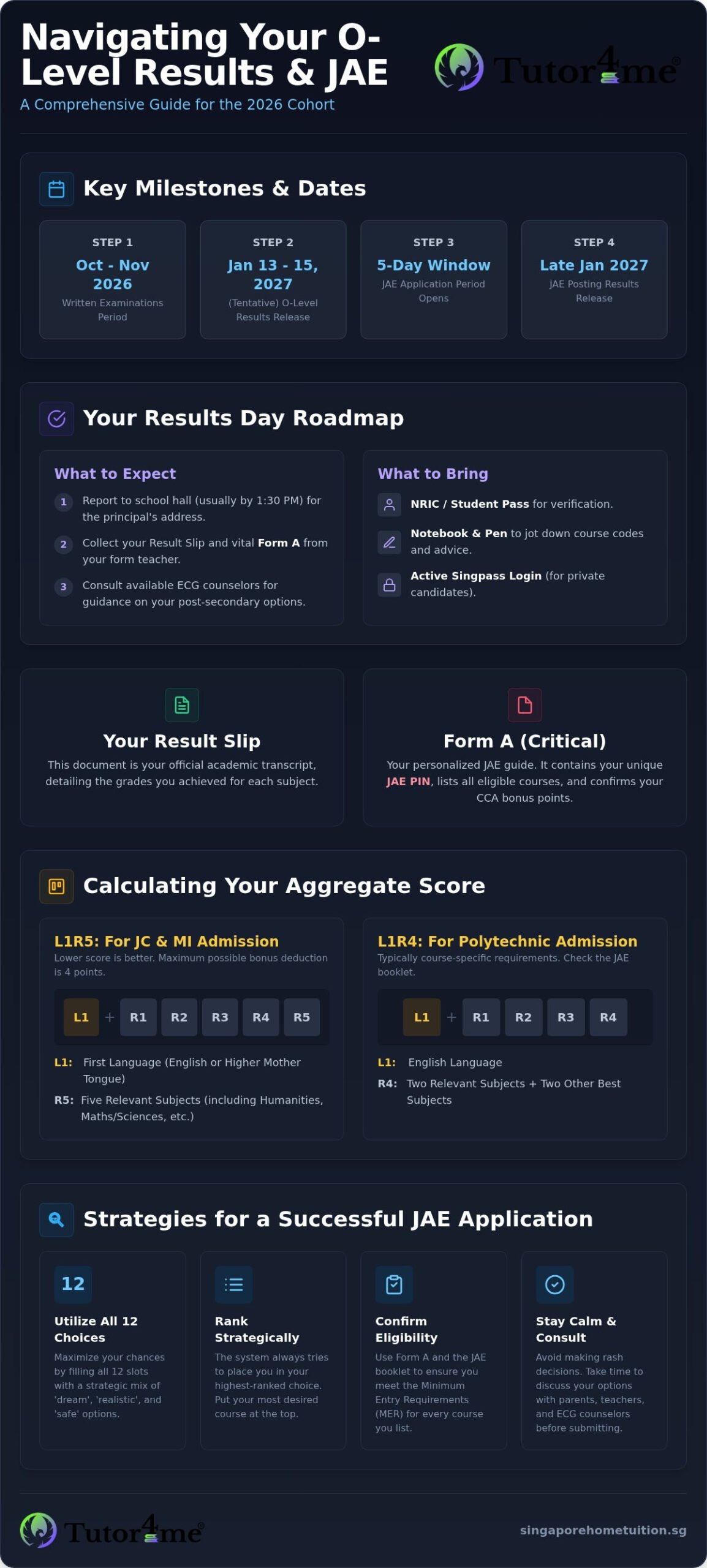
The Singapore-Cambridge GCE Ordinary Level examination is a defining moment for students across the island. Knowing the timeline helps reduce the stress that naturally builds up during the year-end holidays. Based on official projections, the o level results release date 2026 is tentatively scheduled between Wednesday, 13 January 2027, and Friday, 15 January 2027. This window aligns with the Ministry of Education’s long-standing tradition of announcing results in the second week of the new year.
Historical data shows that results typically drop on a Monday or Tuesday, usually around 2:00 PM SGT. School candidates should return to their secondary schools to collect their result slips. This isn’t just a formality; it’s when you receive Form A. This document is arguably the most important paper you’ll handle on results day. It contains your unique JAE PIN, which is essential for submitting your choices in the Joint Admissions Exercise portal. Private candidates can expect their results via post, though most prefer the convenience of viewing them online through the SEAB portal using Singpass.
Key Timeline for 2026 Candidates
The journey moves quickly once the results are out. You should keep these milestones on your radar to ensure you don’t miss any critical deadlines:
- October to November 2026: Completion of the main written examination period.
- Mid-January 2027: The official o level results release date 2026 arrives, triggering the immediate start of the five-day JAE window.
- Late January 2027: Release of posting results for Junior Colleges, Polytechnics, and the Millennia Institute.
If You Are Unable to Collect Results in Person
If you’re a school candidate and can’t make it, you can appoint a proxy to collect your results and Form A. They’ll need an authorization letter and their NRIC for verification. While results are viewable on the SEAB Candidates Portal, the physical Form A is vital for the JAE. To prepare for the transition, many students engage a top home tutor in Singapore to bridge the academic gap between secondary and tertiary levels.
Step-by-Step Guide: What Happens on Results Day
The atmosphere on the o level results release date 2026 will be a mix of nervous energy and collective relief. Most schools require students to report to the main hall by 1:30 PM, shortly before the official release at 2:00 PM. The principal usually begins with an address, sharing the school’s overall performance and offering words of encouragement. While you can monitor the official MOE exam dates for any last-minute updates, the physical collection process remains the most reliable way to receive your data and begin your transition.
Once the address concludes, you’ll collect your result slip and Form A from your form teachers. It’s common to experience “results shock” if your grades differ from your expectations. Schools prepare for this by having Education and Career Guidance (ECG) counselors available for immediate consultation. The 24 hours following the release are critical. Instead of making impulsive decisions, use this time to talk to your teachers. They understand your academic history and can provide a balanced perspective on whether your ‘dream’ school is still a viable target based on your actual aggregate.
Essential Documents to Bring
Preparation begins before you leave the house. You’ll need your NRIC or Student Pass for identification. Without these, your school cannot verify your identity to release your results. If you’re a private candidate, ensure your Singpass login is active well before the o level results release date 2026. It’s also wise to bring a notebook. You’ll want to jot down specific course codes or advice given by counselors during your stay on campus.
Understanding Your Form A
Form A is a personalized document that lists every post-secondary course you’re eligible to apply for based on your results. It’s vital to check that your personal particulars and CCA bonus points are accurately reflected. The document also contains your unique JAE PIN. You’ll need this code to log into the JAE portal for your submission. If you’re feeling overwhelmed by the transition to a more rigorous curriculum, connecting with a top home tutor in Singapore can help you prepare for the academic demands of Junior College or Polytechnic life.
Calculating Your Scores: L1R5 vs. L1R4 Explained
Understanding your aggregate score is the most critical step once you’ve navigated the o level results release date 2026. While your result slip displays individual subject grades, your eligibility for post-secondary institutions depends on specific combinations of these results. The system distinguishes between your gross score and your net score. Your gross score is the raw total of your grades, while your net score includes deductions from bonus points. These calculations determine which pathways in the Joint Admissions Exercise (JAE) are open to you.
The ‘Bonus Points’ system is a vital component of the Singapore education landscape. You can earn up to 2 points for excellent Co-Curricular Activity (CCA) records under the LEAPS 2.0 framework. Students who pass Higher Mother Tongue Language (HMTL) and apply to Junior Colleges or the Millennia Institute can receive an additional 2-point deduction. Bonus points can reduce your net aggregate score by up to 4 points. This reduction often makes the difference when you’re applying to competitive institutions where every point matters.
L1R5 Breakdown for JC Aspirants
If you’re aiming for a Junior College, you’ll need to calculate your L1R5 score. This aggregate consists of your First Language (English or Higher Mother Tongue) and five relevant subjects. These five subjects must include at least one from the Humanities category and one from the Mathematics or Science category. To be eligible for JC, your L1R5 gross aggregate must not exceed 20 points. Most students find the jump to H2 subjects challenging, particularly in the sciences. Starting early with Chemistry Tuition Singapore can provide the necessary foundation for the rigorous A-Level or IB curriculum that follows the o level results release date 2026.
L1R4 and ELR2B2 for Poly Pathways
For those pursuing a diploma at a Polytechnic or a three-year pre-university course at the Millennia Institute, the L1R4 or ELR2B2 system is used. ELR2B2 stands for English Language, two Relevant subjects, and your two other Best subjects. The relevant subjects vary significantly depending on the course cluster. For example, Engineering and Science courses place heavy weight on Mathematics and Science grades, while Humanities and Business courses prioritize English and relevant Humanities. International students or private candidates often seek IGCSE Home Tuition to bridge specific subject gaps and ensure their grades meet these local polytechnic entry requirements.
Choosing Your Path: JC, Poly, or ITE?
Selecting the right post-secondary pathway is a strategic decision that begins the moment the o level results release date 2026 arrives. You’ll find yourself at a crossroads between several distinct educational models, each offering a different trajectory for your future. Junior Colleges (JC) provide a rigorous, two-year academic route that prepares students for the GCE A-Level or IB Diploma. Local polytechnics offer a three-year, industry-aligned diploma program for those who prefer specialized, hands-on training. For students seeking technical mastery, the Institute of Technical Education (ITE) provides an essential foundation for both the workforce and further diploma studies. Securing a top home tutor in Singapore can be instrumental in navigating these choices and preparing for the increased academic workload.
If you require a more paced approach to the A-Level curriculum, the Millennia Institute (MI) offers a unique three-year pre-university track. This extra year allows for a deeper consolidation of complex concepts, which is often beneficial for students who find the two-year JC pace too intense. Each pathway caters to different learning temperaments, and your choice should align with how you best process information and manage stress.
Comparing the Academic Rigor
The transition from secondary school to a Junior College is often described as a steep climb. The volume of content increases significantly, and the depth of analysis required is far greater than at the O-Levels. JCs are traditionally academic and exam-oriented, requiring a high degree of self-discipline. For instance, many JC students find social science subjects entirely new and challenging. Engaging economics home tuition singapore early can help you grasp fundamental concepts before your first set of common tests. In contrast, Polytechnic students face a modular system where every project, presentation, and mid-term quiz contributes to their final Grade Point Average (GPA).
The IB Alternative
The International Baccalaureate Diploma Programme (IBDP) is an increasingly popular alternative to the traditional A-Level track in Singapore. It emphasizes a holistic education, requiring students to complete a Theory of Knowledge course and an Extended Essay. While A-Levels are highly regarded for their subject depth, the IB is praised for developing critical research skills. Both are recognized by top-tier universities globally, but the IB’s continuous assessment model suits those who prefer not to have their entire grade determined by a single final exam sitting. If you choose this path, specialized IB home tuition Singapore can help you manage the diverse requirements of the program and maintain a competitive edge after the o level results release date 2026.
To ensure you make an informed choice during the short application window, consider matching with home tutors in Singapore who understand the specific demands of your chosen track.
The JAE Window: Strategies for a Successful Application
The Joint Admissions Exercise (JAE) is a high-stakes period that begins the moment the o level results release date 2026 is announced. You have exactly five calendar days to submit your choices through the online portal. Many students make the mistake of waiting until the final hours to finalize their entries. This is risky. System congestion or sudden indecision can lead to errors that are difficult to correct once the window closes. It’s better to treat the fourth day as your personal deadline to ensure a frictionless submission.
Cut-Off Points (COP) represent the net aggregate of the last student admitted to a course in the previous year. It’s vital to remember that these numbers fluctuate annually. A school’s COP might drop by a point if the year’s cohort performed exceptionally well or if the institution saw a surge in popularity. If you aren’t posted to your preferred choice, the appeal process remains an option. However, most schools only consider appeals from students who meet the current year’s COP. This makes your initial ranking strategy the most important factor in your success.
Strategic Choice Ranking
Your list of 12 choices should be a balanced mix of ambition and realism. We recommend placing your ‘reach’ or ‘dream’ schools in the first two slots. These are institutions where your net score is exactly at or perhaps one point above the previous year’s COP. The middle section should consist of schools where your score is safely within the historical range. Finally, always include two or three ‘safety’ schools where your score is significantly better than the COP. This prevents you from being randomly posted to an institution that doesn’t align with your goals. As you look toward this next chapter, knowing how to choose a tuition agency in Singapore can help you find the right support for your new subjects.
Preparing for the Leap to JC or Poly
The transition from secondary school to tertiary education involves a significant “transition gap.” The workload in JC 1 or the first year of Polytechnic is often double what students experienced in Secondary 4. This jump is notoriously difficult for subjects like H2 Mathematics, Economics, or specialized diploma modules. Leveraging 1-to-1 home tuition during the period following the o level results release date 2026 can give you a vital head start. Finding a top home tutor in Singapore allows you to bridge these academic gaps before the first semester begins. This proactive approach builds confidence and ensures you aren’t playing catch-up during the busy orientation period.
Navigating Your Next Academic Chapter with Confidence
The period following the o level results release date 2026 marks a significant transition in your educational journey. By understanding the tentative mid-January timeline and mastering the L1R5 or L1R4 calculation methods, you’ve already laid the groundwork for a successful Joint Admissions Exercise. Remember that strategic ranking is your best tool for securing a spot in your preferred Junior College or Polytechnic. Success during this window depends on balancing your aspirations with the reality of historical cut-off points.
While results day brings clarity, it also introduces a more demanding academic landscape. The jump to A-Levels or a specialized diploma is steep, requiring a shift in how you approach complex subjects. We specialize in providing the support necessary to bridge this gap through qualified MOE teachers and subject specialists. Our personalized 1-to-1 matching ensures you’re paired with a mentor who understands the specific rigors of your chosen track. With a proven track record in helping students transition from Secondary 4 to JC or Poly excellence, we’re here to help you maintain your momentum.
Secure a Head Start for JC or Poly with Singapore’s Top Home Tutors and step into your new campus with confidence. You’ve worked hard to reach this point, and the right support system will ensure your future success is well within reach.
Frequently Asked Questions
What time will the 2026 O-Level results be released exactly?
The results for the o level results release date 2026 cohort are typically announced at 2:00 PM SGT. While the Ministry of Education usually confirms the exact date a few days prior, historical patterns suggest a mid-January release. School candidates gather in their respective halls to receive physical slips, while private candidates can access their results online. It’s best to ensure your Singpass is active well before the afternoon release to avoid technical delays during the peak traffic period.
Can I collect my O-Level results if I am overseas?
You can view your results online through the SEAB Candidates Portal if you are abroad on the o level results release date 2026. However, you still need the physical Form A for JAE submissions. You should appoint a proxy, such as a parent or relative, to collect these documents from your school. They must present a formal letter of authorization and their NRIC. International students who cannot use Singpass will receive their results via post to their registered address.
What is the difference between net and raw L1R5 scores?
Your raw L1R5 score is the simple sum of your grades for English and five relevant subjects. Your net score is the final aggregate after deducting bonus points for Co-Curricular Activities (CCA) and Higher Mother Tongue. For instance, an A1 in CCA provides a 2-point deduction. Most Junior Colleges use the net score for admission, meaning a raw score of 12 could become a net score of 8 if you maximize your bonus point eligibility.
How many choices can I submit in the Joint Admissions Exercise (JAE)?
You are allowed to submit a maximum of 12 choices in your JAE application. These choices can include a mix of Junior Colleges, Polytechnics, the Millennia Institute, and ITE courses. It’s essential to rank these strategically rather than filling all slots with highly competitive schools. We recommend placing schools where your net score safely meets the previous year’s cut-off point in your middle and lower slots to ensure you receive a posting that aligns with your goals.
What happens if I fail English or Mathematics in my O-Levels?
Failing English or Mathematics significantly limits your tertiary options in Singapore. Most Junior Colleges require at least a C6 in both subjects, while Polytechnics have specific minimum entry requirements depending on the course cluster. If you don’t meet these benchmarks, you might consider retaking the subjects as a private candidate or exploring conditional admission. Early intervention with specialized O Level Home Tuition can help students strengthen these core pillars before the final national examinations take place.
Is it better to go to JC or Poly after O-Levels in 2027?
The choice between Junior College and Polytechnic depends on your preferred learning environment. JCs offer a two-year academic route leading to A-Levels or the IB Diploma, which is ideal for those who prefer theoretical depth and exam-based assessment. Polytechnics provide a three-year diploma with a focus on practical skills and industry exposure. Both pathways offer strong routes to local universities, provided you maintain a competitive GPA or rank point during your studies in the respective institutions.
How do I appeal my school posting after the JAE results are out?
You can submit an appeal directly to your preferred school’s website once the JAE posting results are released in late January. Appeals are generally only successful if your net aggregate score meets or exceeds the school’s cut-off point for that specific year. Schools prioritize students who missed the COP by a very small margin or have exceptional talents. If your appeal is unsuccessful, you must report to the school you were originally posted to during the exercise.
Can private candidates participate in the JAE?
Private candidates can participate in the JAE if they are Singapore Citizens or Permanent Residents who have sat for the GCE O-Level examinations. You will receive your results and Form A via post to your registered residential address. The application process is entirely online, requiring you to use the JAE PIN found in your Form A. It’s crucial to verify your eligibility for specific courses, as some Polytechnic programs have age or medical requirements for private applicants during the submission window.