
What if the traditional study methods your child is currently using aren’t enough to meet the new demands of the 2026 psle? With the complete removal of topics like “Speed” in Mathematics and a significant increase in the weightage of English Oral Communication, the landscape of primary school assessment is shifting toward conceptual mastery. You likely feel the pressure of keeping up with these changes while managing the anxiety that comes with such a high-stakes milestone. It’s a challenging balance to strike, especially when you’re trying to identify specific subject gaps before the national deadlines arrive.
We understand that your goal is to provide a stable, supportive environment for your child’s success. This guide offers a clear roadmap to help you manage the 2026 psle with professional precision and quiet confidence. You’ll find a detailed breakdown of the official SEAB timelines, an explanation of the latest syllabus updates, and expert strategies designed to transform confusion into an organized plan of action. We will cover everything from the April registration window to the final written papers in September, ensuring you have the peace of mind to focus on what matters most: your child’s growth and empowerment.
Key Takeaways
- Understand the critical dates for the 2026 psle, from the April registration period to the final written examinations in late September.
- Gain clarity on how the AL scoring system translates raw marks into achievement levels for more effective goal setting and secondary school planning.
- Recognize the latest syllabus changes in English and Mathematics that emphasize verbal communication and conceptual problem-solving over simple memorization.
- Follow a structured two-phase revision roadmap designed to identify subject-specific weak points and build exam-ready confidence early in the year.
- Explore how 1-to-1 home tuition provides the focused attention and immediate feedback your child needs to excel in a high-stakes environment.
Navigating the 2026 PSLE: Key Dates and Examination Timeline
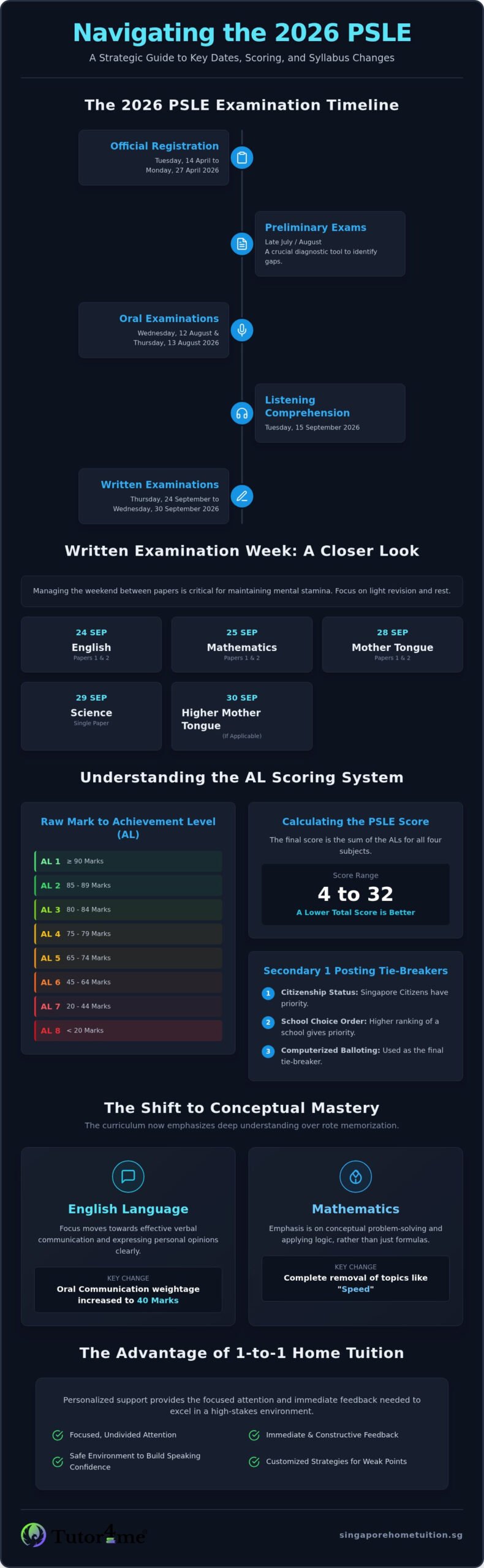
The Primary School Leaving Examination serves as the first significant milestone in a Singaporean student’s academic journey. It’s a rite of passage that marks the transition from foundational learning to specialized secondary education. For the 2026 psle cohort, the year follows a methodical four-term cycle. Term 1 is dedicated to syllabus completion and strengthening core concepts. Term 2 includes official registration, which is confirmed for Tuesday, 14 April to Monday, 27 April 2026. By Term 3, schools conduct Preliminary Examinations. These act as an essential diagnostic tool. They help identify subject-specific gaps before the national assessment begins. Schools typically schedule these in late July or August to mirror the actual exam environment. Analyzing these results helps you pivot your study strategy for the final stretch.
The 2026 PSLE Oral Examination Window
The oral component is often where students feel the most pressure. These exams are scheduled for Wednesday, 12 August and Thursday, 13 August 2026. This component tests verbal fluency through Reading Aloud and a Stimulus-Based Conversation. You’ll find that using the June school holidays and July for intensive practice makes a significant difference. Oral themes often revolve around daily life scenarios, community spirit, and technology. Your child should practice expressing personal opinions clearly and logically to satisfy the assessment criteria. Since the English oral weightage has risen to 40 marks, early mastery is vital. Many families use PSLE home tuition to provide the personalized feedback and safe environment needed to build speaking confidence.
Planning for the Written Examination Week
The written papers represent the final hurdle of the 2026 psle. The sequence starts on Thursday, 24 September and concludes on Wednesday, 30 September 2026. The typical schedule follows this order:
- 24 September: English Language Papers 1 and 2
- 25 September: Mathematics Papers 1 and 2
- 28 September: Mother Tongue Papers 1 and 2
- 29 September: Science
- 30 September: Higher Mother Tongue (if applicable)
Managing the weekend between papers is critical for maintaining mental stamina. Don’t use this time for heavy cramming. Instead, focus on light revision and adequate rest. Remember to prepare SEAB-approved calculators and dictionaries well in advance to avoid last-minute stress. The Listening Comprehension exam on Tuesday, 15 September 2026, acts as the final precursor to this intensive week. Organizing your child’s schedule around these dates provides a clear roadmap and establishes a sense of control over the process.
Understanding the PSLE Achievement Level (AL) Scoring System in 2026
The PSLE scoring system remains a point of significant focus for parents preparing for the 2026 psle. Unlike the previous T-score method, this system groups students into eight Achievement Levels (AL) based on their individual performance in each subject. Raw marks are converted into AL grades, where AL1 represents a score of 90 or above, and AL8 applies to scores below 20. Your child’s final result is the sum of these four subject scores, creating a range between 4 and 32. A lower total score indicates a higher overall achievement.
This shift aims to reduce fine differentiation between students. However, it places a higher premium on the Secondary 1 posting process. Since more students now share the same total score, tie-breakers determine school placement. Citizenship status is the primary consideration. If a tie remains, the choice order of schools becomes the deciding factor. This means your strategic ranking of schools is just as important as the grades themselves. If these two criteria don’t break the tie, computerized balloting is used. Understanding these nuances helps you manage expectations while building a realistic list of school choices.
AL Scores and Subject-Based Banding (SBB)
Results from the 2026 psle will directly influence how your child accesses subjects in secondary school. Under the Full Subject-Based Banding (SBB) rollout, students no longer follow rigid streams. Instead, they take subjects at G3, G2, or G1 levels. A strong performance in a specific subject, like an AL5 or better at the Standard level, often allows a student to take that subject at a more demanding G3 level. This flexibility rewards individual strengths and ensures students aren’t held back by a single weaker subject. Focusing on excellence in strength subjects can open doors to higher-level curriculum early in their secondary journey.
Foundation vs. Standard Level Subjects
Choosing between Standard and Foundation levels is a strategic decision usually made at the end of Primary 4 or 5. Foundation subjects are designed to support students who find specific areas, such as Mathematics or Mother Tongue, particularly challenging. For scoring purposes, Foundation grades are mapped to the AL system. An “A” in a Foundation subject is equivalent to an AL6, a “B” to an AL7, and a “C” to an AL8. While this mapping results in a higher score, it often provides a more manageable path for students to build confidence. If your child is struggling to maintain a passing grade at the Standard level, transitioning to Foundation can reduce academic stress. Finding a qualified PSLE home tuition specialist can help you evaluate your child’s current standing and make an informed choice between these levels.
Core Subject Breakdown: Key Focus Areas for English, Math, and Science
The 2026 psle marks a definitive shift toward higher-order thinking across all four core subjects. English Language assessment now places a premium on verbal communication. The Oral Communication component (Paper 4) has increased to 40 marks, reflecting a broader movement toward practical language application. In contrast, marks for Paper 1 and Paper 2 have been reduced to 50 and 90 respectively. Success in English now requires a balance between technical writing precision and the ability to articulate thoughts clearly during the stimulus-based conversation. Your child’s ability to engage with the examiner will be just as critical as their grammar and vocabulary scores.
Math Heuristics and Problem-Solving
Mathematics in the 2026 psle sees the full implementation of the revised primary syllabus. The most notable change is the complete removal of “Speed” as an examinable topic. Additionally, Paper 1 and Paper 2 now carry an equal weightage of 50 marks each. This equalization means your child cannot rely solely on the calculator-assisted Paper 2 to secure a high grade. Accuracy in the non-calculator Paper 1 is foundational for an AL1 or AL2 score. The exam increasingly focuses on pattern recognition, spatial visualization, and basic algebra. If your child struggles with these multi-step logic problems, specialized Primary 6 Math Tuition can help bridge these conceptual gaps through targeted heuristic training and methodical practice.
Science: Mastering the Application Questions
The Science paper has evolved to prioritize inquiry-based learning over simple keyword memorization. For the 2026 cohort, the “Cells” topic has been removed from the examinable content. Students must now master the CER (Claim, Evidence, Reasoning) framework to excel in open-ended questions. It’s no longer enough to identify a scientific fact; students must explain phenomena using specific evidence from the provided diagrams or scenarios. Key focus areas include:
- Diversity and Systems: Understanding complex biological and physical structures.
- Cycles and Interactions: Explaining how different environmental factors influence each other.
- Energy: Mastering the laws of conservation and energy forms.
Early exposure to these concepts through Chemistry Tuition Singapore can build a strong scientific foundation. These subject-specific results eventually feed into the official PSLE AL scoring system, making consistent performance across all modules essential for a favorable secondary school posting. Mother Tongue also remains a critical pillar. Composition writing now requires a deeper understanding of cultural context and a more sophisticated vocabulary to achieve the highest bands.
Strategic Preparation: Moving from Rote Learning to Conceptual Mastery
Success in the 2026 psle depends on a structured, four-phase approach that moves beyond mindless repetition. During Phase 1, which spans from January to May, focus entirely on foundation building. This is the time to identify subject gaps. If a child hasn’t mastered the basics of Ratio or Algebra by May, the more complex multi-step problems in Paper 2 will remain inaccessible. Phase 2, covering June and July, utilizes the mid-year holidays for topical revision. This is when students should begin the Ten-Year Series (TYS) papers to familiarize themselves with the standard of national examination questions.
As the calendar moves into Phase 3 during August and September, the focus shifts to timed mock exams. This phase is critical for building the mental stamina required for the actual examination week. It also coincides with the Oral and Listening Comprehension dates. Finally, Phase 4 in October is for the final polish. Instead of attempting new papers, students should review their accumulated notes and focus on mental preparation. This ensures they enter the exam hall with quiet confidence rather than last-minute anxiety.
Creating a Balanced Revision Timetable
A balanced revision timetable is essential to prevent burnout before the year ends. We recommend the Pomodoro method for P6 students. This technique involves 25 minutes of deep focus followed by a 5-minute rest. This rhythm maintains high levels of concentration without overtaxing the child’s attention span. You should prioritize weak subjects early in the week when energy levels are highest, but don’t neglect strengths entirely. Consistent, scheduled rest is a strategic necessity. It ensures your child remains sharp for the late September written papers.
The Power of the Error Log
The error log is a highly effective tool for diagnostic learning. Rather than simply marking a paper and moving on, students should record why they missed a mark. You should track whether the error was a conceptual misunderstanding, a careless calculation, or a lack of time. Reviewing these patterns is far more effective than completing dozens of additional practice papers. A dedicated home tutor can facilitate this diagnostic process. They pinpoint recurring errors that a student might overlook in a crowded classroom, allowing for targeted correction. If you want to ensure your child is fully prepared, consider engaging our specialized PSLE home tuition to create a personalized study roadmap.
Personalized Support: Why 1-to-1 PSLE Home Tuition Makes the Difference
The classroom environment is designed to deliver a standardized curriculum to a large group of students simultaneously. While this works for general instruction, it often lacks the capacity to address the nuanced learning gaps that emerge during the 2026 psle preparation year. A 1-to-1 home tuition setting removes the competition for a teacher’s attention. It allows for a customized pacing that matches your child’s specific learning speed. If they master a concept quickly, the tutor moves forward; if they struggle with a particular heuristic or scientific explanation, the session remains focused on that topic until clarity is achieved. This immediate feedback loop is essential for building the conceptual mastery required in the modern syllabus.
Beyond academic instruction, the emotional benefits of a dedicated tutor provide a significant advantage. The P6 year is often characterized by high-stakes pressure and rising anxiety. A professional tutor acts as a stable mentor who provides more than just academic answers. They offer a sense of empowerment by breaking down complex milestones into manageable steps. This partnership fosters a quiet confidence in students, helping them approach the exam hall with a clear mind. Whether you choose an MOE teacher with deep syllabus expertise or a full-time specialist known for personalized coaching, finding the right match is a vital pillar of support for your child’s success.
Targeted Intervention for P6 Milestones
Lessons must adapt as the academic year progresses through its various phases. During the first half of the year, the focus remains on foundation building and identifying blind spots in core subjects. As the August Oral Examination window approaches, a tutor can pivot to intensive verbal practice. They provide the stimulus-based conversation drills that are difficult to replicate in a large class setting. Following the oral dates, the focus shifts seamlessly to the written papers in September. Using PSLE Home Tuition Singapore ensures your child is matched with a specialist who understands these specific phase-based requirements and can adjust the curriculum accordingly.
The Convenience of Home and Online Learning
Time management is a critical factor during the final months of primary school. Between school supplementary classes and CCAs, every hour saved from traveling to a center is an hour gained for rest or targeted revision. Home-based learning provides a frictionless path forward, allowing for flexible scheduling that fits your family’s unique routine. Whether you prefer in-person sessions or the versatility of online tuition, this organized efficiency reduces the logistical burden on both parents and students. You can find your ideal PSLE tutor today to start building a personalized roadmap for the 2026 psle.
Preparing for a Successful 2026 PSLE Journey
Success in the 2026 psle requires more than just hard work; it demands a clear understanding of the shifting academic landscape. By aligning your child’s revision with official SEAB timelines and focusing on conceptual mastery in subjects like Mathematics and Science, you create a structured path toward excellence. We’ve explored how the AL scoring system prioritizes consistent performance and how strategic preparation phases can prevent burnout while addressing specific subject gaps early in the year.
Organizing this journey is simpler when you have a trusted partner. Our agency specializes in personalized 1-to-1 matching with MOE-trained educators and experienced specialists who provide the dedicated attention required for major national examinations. With islandwide coverage for convenient home-based learning, we’re a pillar of support trusted by parents across Singapore. Find a Dedicated PSLE Home Tutor for 2026 Success to ensure your child approaches their papers with clarity and empowerment. Every step taken today builds a strong foundation for their future achievements.
Frequently Asked Questions
When are the official 2026 PSLE exam dates released?
SEAB typically releases the final examination calendar by the first quarter of the year. However, confirmed dates for the 2026 psle include the registration window from 14 April to 27 April 2026. The oral examinations are scheduled for 12 and 13 August; while the written papers commence on 24 September. Parents should monitor the official SEAB website for any minor adjustments to these national schedules as the academic year progresses.
How is the 2026 PSLE score calculated under the AL system?
The AL system calculates scores by converting raw marks into eight Achievement Levels for each of the four subjects. AL1 is the highest band for scores of 90 and above; while AL8 is for scores below 20. Your child’s total score is the sum of these levels, ranging from 4 to 32. A lower total score indicates better performance and provides access to a wider range of secondary school options during the posting process.
Can my child use a calculator for all PSLE Math papers in 2026?
No, calculators are only permitted for Paper 2 of the Mathematics examination. Paper 1 is strictly a non-calculator component designed to test mental calculation and foundational speed. Both papers now carry an equal weightage of 50 marks each for the 2026 psle. It’s essential to ensure your child uses an SEAB-approved calculator model during their practice sessions and the actual Paper 2 examination to maintain compliance and avoid any last minute technical issues.
What is the difference between Standard and Foundation subjects in PSLE?
Standard subjects follow the full primary syllabus, while Foundation subjects have a reduced scope for students who require more support. In terms of scoring, Foundation grades are mapped to the AL system differently. For example, a Grade A in a Foundation subject is equivalent to an AL6. Choosing Foundation levels is a strategic decision that helps students build confidence and focus on core mastery rather than struggling with overly advanced content during their revision.
How does the tie-breaker work for Secondary 1 posting in 2026?
If students have the same PSLE score, tie-breakers are applied in a specific order. Citizenship status is the first criterion, prioritizing Singapore Citizens over Permanent Residents and International Students. If a tie remains, the choice order of schools listed in the S1 posting form becomes the deciding factor. Finally, computerized balloting is used as a last resort if all other criteria remain identical between the applicants for a specific school vacancy.
What happens if my child is sick during the 2026 PSLE Oral or Written exams?
If a student is unwell, they should not attend the examination. You must inform the school immediately and obtain a valid medical certificate from a qualified doctor. SEAB has established procedures for special consideration in such cases. They will use the student’s preliminary exam results and the performance of their cohort to derive a fair grade. It is important to prioritize your child’s health and follow the school’s official reporting protocols for national assessments.
Is 1-to-1 home tuition better than group tuition centers for PSLE prep?
1-to-1 home tuition offers a level of personalized attention that group centers often cannot match. In a private setting, the tutor focuses entirely on your child’s specific blind spots and adjusts the pacing to their needs. This is particularly effective for the 2026 psle, where conceptual mastery is prioritized over rote learning. At Singapore Home Tuition, we facilitate matches with MOE-trained educators who provide immediate feedback and customized study plans to ensure exam readiness.
How can I help my child manage stress during the PSLE year?
Managing stress requires a balance between academic rigor and emotional support. Encourage a consistent routine that includes scheduled rest and physical activity. Using techniques like the Pomodoro method helps maintain focus without causing burnout. Acting as a supportive partner rather than a source of pressure empowers your child. If you feel the academic workload is becoming overwhelming, engaging a professional home tutor can provide the structured guidance needed to build confidence and reduce overall exam anxiety.