
What if the secret to excelling in the 2026 PSLE isn’t found in more hours of study, but in a more precise approach to learning? For many students, the transition to the final year of primary school brings a daunting wave of complex heuristic questions and the added pressure of a revised syllabus. It’s common for children to feel overwhelmed by the fast pace of group classes where their specific doubts often remain unaddressed. You might notice your child struggling with time management during Paper 2 or losing marks to avoidable mistakes caused by exam anxiety.
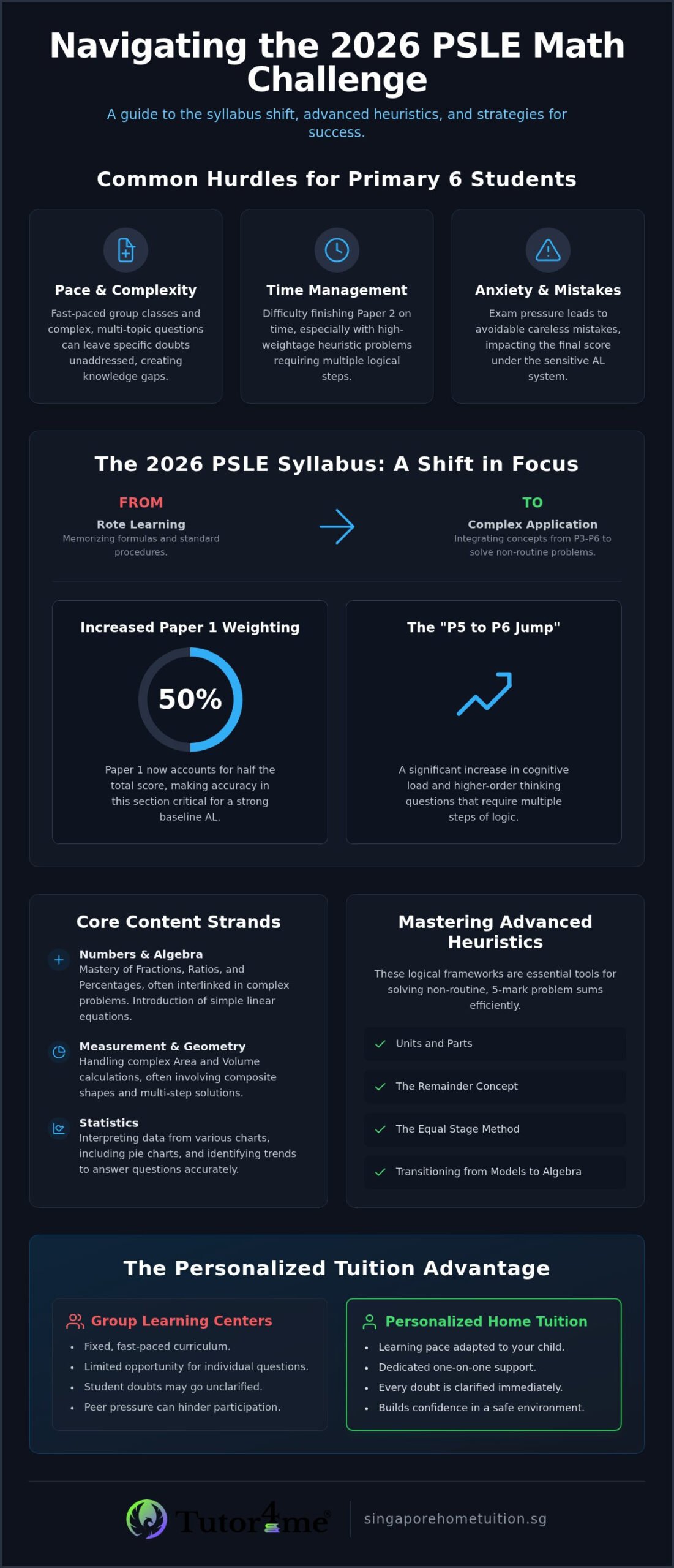
We recognize these challenges and believe that every student deserves a learning environment that adapts to their pace. Quality Primary 6 math tuition provides the dedicated, one-to-one support your child needs to bridge the gap between basic conceptual knowledge and high-level exam performance. This article explains how personalized instruction helps students master the 2026 syllabus changes, such as the increased 50% weighting of Paper 1 and the introduction of simple linear equations. You’ll discover how a tailored methodology builds the heuristic fluency and quiet confidence necessary to secure a significant jump in AL grades before the national exam.
Key Takeaways
- Understand how the 2026 PSLE syllabus shifts the focus from rote learning to the complex application of integrated concepts from Primary 3 through Primary 6.
- Learn to identify and master advanced heuristic strategies, such as Units and Parts and the Remainder Concept, to solve non-routine problem sums with confidence.
- Discover why personalized Primary 6 math tuition provides a more effective learning pace than group classes, ensuring every doubt is clarified before the national exam.
- Gain insights into strategic revision techniques that prioritize Paper 1 accuracy to secure a reliable baseline AL score and manage exam-day time constraints.
- Explore how professional tutor matching connects your child with MOE-trained teachers or specialists who align with their specific learning personality and academic goals.
Navigating the Primary 6 Math Syllabus: Why the PSLE Year is Different
The Primary 6 year represents a critical pivot in a student’s academic journey. It’s not simply a year for learning new topics; it’s a phase where every concept mastered from Primary 3 through Primary 5 must be integrated and applied with precision. The 2026 Primary School Leaving Examination (PSLE) marks a clear shift from basic content knowledge toward complex application. Students are no longer just “knowing” the formulas. They’re expected to identify which “tools” to use when faced with non-routine problems that blend multiple topics into a single question.
Success in this final year depends heavily on the groundwork laid previously. The foundation built in Primary 5 maths tuition serves as the essential springboard for P6 success. Without a firm grasp of P5 ratios and percentages, the advanced problem sums of P6 can become insurmountable. Under the Achievement Level (AL) scoring system, the margin for error is slim. A difference of just a few marks can shift a student from an AL1 to an AL2, making consistent performance across both Paper 1 and Paper 2 vital for securing a spot in a preferred secondary school.
The Core Content Strands in P6 Math
The P6 syllabus is organized into three main pillars that require different cognitive approaches. In Numbers and Algebra, students must achieve total mastery of fractions, ratios, and percentages. These topics are frequently interlinked in Paper 2 “killer” questions. Measurement and Geometry require students to handle complex area and volume calculations, often involving composite shapes. Statistics focuses on interpreting data from pie charts and identifying trends. Specialized primary 6 math tuition helps students recognize these patterns quickly, ensuring they don’t waste precious minutes during the exam trying to decipher the question’s intent.
The “P5 to P6 Jump” in Difficulty
Many parents notice a sudden dip in their child’s grades during the first term of Primary 6. This “jump” occurs because the cognitive load increases significantly. Paper 2 now introduces higher-order thinking questions that require multiple steps of logic before a student even picks up a calculator. This is where primary 6 math tuition becomes a stabilizing force. It provides a safe space for students to tackle these high-weightage questions without the pressure of a ticking clock. Early intervention with PSLE home tuition prevents the late-year burnout that often happens when students try to cram complex heuristics in the final months before September.
Mastering Advanced Heuristics and Problem-Solving Strategies
Heuristics are specialized tools for dismantling non-routine problem sums. While many students are comfortable with standard calculations, the 2026 PSLE demands a higher level of strategic thinking. Mastery in this area involves identifying specific patterns such as Units and Parts, the Remainder Concept, and the Equal Stage method. These aren’t just formulas to memorize; they’re logical frameworks that help a student navigate the complexity of Paper 2. Given the precision required by the new PSLE scoring system, where every raw mark can influence an Achievement Level grade, mastering these strategies is essential for academic stability.
A common pitfall for P6 students is an over-reliance on model drawing. While visual models are helpful in lower primary, they can become cumbersome and time-consuming for the most difficult 5-mark questions. At this level, students must learn to transition toward more efficient methods, such as ratio branching or algebraic representation. Beyond the calculation itself, developing a sense of “reasonableness” is crucial. A student who realizes that a calculated speed or quantity doesn’t fit the context of the question can self-correct before the invigilator calls for time. This level of critical thinking is a primary focus of high-quality primary 6 math tuition.
Common Heuristic Obstacles for P6 Students
The most frequent hurdle is the “identification gap.” Students often understand how to use a heuristic once told, but they struggle to decide which one to apply when facing a blank page. Misinterpreting subtle keywords like “of the remainder” versus “of the total” can change the entire context of a ratio problem, leading to a cascade of errors. Many children also get stuck in a “single-method” mindset, trying to force every problem into a model drawing even when a simpler unitary method would be more effective. If your child is facing these roadblocks, connecting with an experienced tutor can help them broaden their problem-solving toolkit.
How 1-to-1 Tuition Refines Problem-Solving Skills
Personalized primary 6 math tuition allows for a meticulous breakdown of “killer” questions at a pace that matches the student’s cognitive processing. In a group setting, a teacher might move to the next topic before a child has truly grasped the logic behind a step. 1-to-1 instruction ensures immediate correction of logical fallacies, preventing bad habits from taking root. Tutors can provide customized worksheets that target the specific heuristic types the student fears most, whether it’s “supposition” or “repeated identity.” This targeted practice builds the mental muscle memory needed to stay calm and analytical during the actual national exam.
Personalized Home Tuition vs. Learning Centers: Choosing the Best Fit
The decision between a bustling learning center and the focused environment of 1-to-1 home tuition often determines a student’s trajectory in the 2026 PSLE. While centers offer a structured curriculum, they frequently lack the flexibility to address individual misconceptions in real time. In a group of twelve, a student might hesitate to clarify a doubt about a complex heuristic, fearing peer judgment. This “shy student” syndrome can lead to cumulative knowledge gaps that become apparent only during major assessments. By contrast, primary 6 math tuition conducted in a 1-to-1 setting ensures that the tutor’s pacing aligns perfectly with the child’s learning speed.
This personalized approach is deeply rooted in Singapore’s Primary Mathematics Framework, which emphasizes the development of mathematical reasoning and problem-solving. When a tutor works exclusively with one child, they can implement pedagogical models more effectively, identifying exactly where the student’s visualization fails. Beyond academics, the mental health benefits of home-based learning are significant. Eliminating the commute between school and a center provides the student with essential rest hours, which are vital for maintaining focus during the high-pressure PSLE year.
The Advantages of 1-to-1 Home Tuition
In a private setting, 100% of the tutor’s attention is dedicated to the student’s specific academic gaps. There is no “average” student to cater to; the curriculum is the student. This level of focus allows for flexible scheduling that accommodates heavy CCA loads or late-day supplementary classes in school. Perhaps most importantly, home tuition creates a safe environment where a student feels comfortable making mistakes. This freedom to fail and learn without peer pressure is often the catalyst for the jump in confidence required to tackle the most challenging Paper 2 questions.
When is a Tuition Center the Wrong Choice?
A tuition center may not be the ideal fit if your child is already struggling to keep up with a fixed, fast-paced curriculum. Centers rarely pause for a single student, which can lead to increased anxiety and a sense of being left behind. Families also find that 1-to-1 home tuition offers a more unified solution for the household. For instance, while a P6 student prepares for Math, an older sibling might simultaneously receive Chemistry tuition at home, streamlining the family’s schedule. If travel time is cutting into your child’s limited revision or sleep hours, the convenience of a professional tutor coming to you becomes a strategic advantage for 2026 success.
Strategic Revision: Bridging the Gap Between Knowing and Doing
There is a significant difference between understanding a mathematical concept and performing under the ticking clock of an exam hall. Many students “know” how to solve a ratio problem in a relaxed setting but falter when the same problem appears in Paper 2. Strategic revision focuses on transforming passive knowledge into active performance. In the 2026 PSLE, where Paper 1 now accounts for 50% of the total marks, securing a baseline AL score depends on speed and accuracy in the MCQ and short-answer sections. By automating the response to standard questions, students can save their cognitive resources for the challenging “killer” sums that often decide the jump from AL2 to AL1.
Applied Fluency is the ability to solve familiar problems without hesitation to preserve mental energy for novel questions. When a student develops this “second nature” through consistent primary 6 math tuition, they reduce the risk of mental fatigue halfway through the paper. This emotional and mental stamina is just as important as the math itself. A child who feels in control of the paper is less likely to make the careless mistakes that stem from panic or exhaustion. If your child is struggling to translate their study efforts into results, arranging for a specialized PSLE home tutor can provide the structured guidance needed to build this vital exam stamina.
Paper 2 Time Management Tactics
Effective time management starts the moment the invigilator says “begin.” We teach students the “5-minute scan” technique, where they quickly browse the paper to identify and prioritize questions they are most confident in. This builds early momentum and secures “easy” marks first. Students must also learn to allocate specific time blocks: no more than two minutes for a 2-mark question and roughly eight to ten minutes for a complex 5-mark sum. Knowing when to “let go” of a particularly stubborn question is a sophisticated skill that prevents a single difficult problem from jeopardizing the rest of the paper.
The Role of Mock Papers and Error Analysis
Simply completing pile after pile of past-year papers is a low-yield strategy. True improvement comes from “deep diving” into mistakes rather than just marking them wrong. We encourage students to maintain an “Error Journal” to track recurring patterns in their work, such as misreading units or failing to transfer numbers correctly. During primary 6 math tuition sessions, a private tutor can simulate exam conditions at home, providing a realistic environment to practice these performance skills. This targeted analysis ensures that every mock paper completed serves as a stepping stone toward a higher AL grade, rather than just another repetitive exercise.
How Singapore Home Tuition Matches Your Child with the Ideal Math Specialist
Finding the right academic partner is the final piece of the PSLE puzzle. While previous sections explored the complexity of the 2026 syllabus and the need for heuristic mastery, these goals are only achievable with a tutor who understands your child’s specific learning profile. We provide access to a vast pool of qualified educators, ensuring that primary 6 math tuition is delivered by someone who isn’t just a subject expert, but a pedagogical match. Our islandwide coverage means the top home tutor in Singapore can reach your doorstep, regardless of your location.
Our commitment to excellence extends beyond the primary years. We maintain a diverse database of specialists capable of supporting students through various academic milestones, including IGCSE home tuition for older siblings. By aligning a tutor’s specific expertise with a child’s learning personality, we create a stable environment where academic growth feels natural rather than forced. This personalized matching process is what transforms a standard lesson into a transformative learning experience.
Tutor Profiles: MOE Teachers vs. Full-Time Tutors
We categorize our specialists into distinct tiers to help parents make an informed choice based on their needs. Current or ex-MOE teachers offer deep insight into marking schemes and the subtle shifts in the 2026 syllabus. They understand exactly what examiners look for in Paper 2. Full-time tutors often specialize in intensive exam preparation and have developed a library of heuristic shortcuts that help students solve problems faster. For students who need a confidence boost, university undergraduates serve as relatable mentors who can demystify complex topics through a peer-to-peer approach.
The Fast Matching Advantage
In the high-stakes PSLE year, time is a non-renewable resource. Waiting weeks for a tuition slot at a center is often not a viable option for families seeking immediate intervention. Our agency streamlines the search process, connecting you with a qualified Math specialist within a short timeframe. This efficiency allows your child to begin addressing their knowledge gaps immediately, ensuring they stay on track for their desired AL grade. Ready to secure your child’s AL1? Request a Primary 6 Math Tutor Today and give them the dedicated support they deserve for the 2026 national exams.
Securing Your Child’s Academic Future in 2026
The journey toward PSLE success requires more than just hard work; it demands a strategic approach to the revised 2026 Mathematics syllabus. We’ve explored how mastering advanced heuristics and refining time management for Paper 2 can transform a student’s performance. By choosing 1-to-1 Primary 6 math tuition, you provide your child with a tailored environment where complex concepts become clear, and exam anxiety is replaced by quiet confidence. This personalized attention ensures that no knowledge gap is left unaddressed before the national exam.
Singapore Home Tuition is dedicated to facilitating this critical connection. With our fast tutor matching service, we align your child with qualified MOE teachers or full-time specialists who have a proven track record in PSLE success. We understand the pressures of the final primary year and are here to offer the professional reliability you need for peace of mind. Taking the first step now allows for a steady, manageable revision pace that avoids the stress of last-minute cramming.
Find Your Ideal Primary 6 Math Tutor Now and empower your child to excel with the right support. We look forward to helping your family navigate this milestone with excellence and ease.
Frequently Asked Questions
Is Primary 6 Math tuition necessary if my child is already doing okay in school?
Primary 6 math tuition isn’t strictly mandatory for every child, but it’s often the difference between a good grade and an exceptional one. Under the current Achievement Level system, the margin for error is incredibly small. A tutor helps a student who is doing okay transition into the top tier by teaching them to handle non-routine questions that aren’t always covered in depth during standard school hours. This ensures they don’t lose marks on challenging Paper 2 sums.
How many hours of Math tuition per week is recommended for a P6 student?
Most students find that one or two sessions of 1.5 to 2 hours per week provide the right balance. During the high-pressure PSLE year, it’s important to avoid burnout while still maintaining a steady revision pace. A 2-hour session allows enough time for a tutor to explain a complex heuristic, practice several examples, and review previous mistakes without rushing. The frequency can be adjusted as the September written examination dates approach.
Can a private tutor help with both Paper 1 and Paper 2 strategies?
A qualified private tutor is essential for mastering the distinct demands of both papers. Paper 1 now accounts for 50% of the total marks in 2026, making speed and accuracy in multiple-choice questions vital. Meanwhile, Paper 2 requires deep logical reasoning for 5-mark problem sums. 1-to-1 tuition allows the tutor to split time effectively between these sections, ensuring the student builds the mental stamina needed to perform consistently across both papers on exam day.
What is the difference between an MOE teacher and a full-time tutor for PSLE Math?
The primary difference lies in their specific areas of expertise and classroom experience. MOE teachers possess direct knowledge of the latest marking rubrics and syllabus changes, offering a behind-the-scenes perspective on what examiners expect. Full-time tutors, on the other hand, often specialize in intensive exam-prep techniques and proprietary heuristic shortcuts. Both are highly effective, and the choice depends on whether your child needs curriculum-aligned stability or specialized problem-solving strategies.
How soon can we expect to see improvements in Math grades after starting tuition?
You can generally expect to see a noticeable improvement in confidence and technique within eight to twelve weeks of consistent 1-to-1 support. Significant jumps in AL grades often take slightly longer, typically appearing after two full terms of instruction. This timeline allows the student to internalize new problem-solving frameworks and apply them across various topics. Early intervention is key, as it provides the necessary lead time to correct deep-seated misconceptions before the final marking exercise.
Does Singapore Home Tuition provide 1-to-1 online Math tuition for P6?
Yes, we offer both personalized home-based learning and 1-to-1 online sessions to suit your family’s schedule. Online Primary 6 math tuition is an excellent option for busy students who want to eliminate travel time while still receiving high-quality, interactive instruction. Our tutors use digital tools to ensure that the sessions remain as effective as face-to-face meetings. This flexibility allows your child to receive expert guidance in a comfortable, stress-free environment that promotes better focus.
How much does Primary 6 Math tuition cost in Singapore for 2026?
Tuition rates in Singapore are influenced by the tutor’s background, such as whether they are an MOE teacher, a full-time specialist, or an experienced undergraduate. While we don’t set a single fixed price, we help parents find a match that fits their specific budget and academic requirements. It’s advisable to check current market standards for 2026, as rates reflect the high demand for specialized PSLE preparation and the tutor’s level of professional expertise.
Can the tutor help with other subjects like Science or English during the same session?
While some multi-disciplinary tutors can assist with multiple subjects, we generally recommend dedicated sessions for Mathematics to ensure total focus. P6 Math is highly conceptual and requires a deep dive into heuristics that can’t be rushed. If your child needs help in other areas, we can match you with specialists for English or Science to be held at different times. This structured approach prevents cognitive overload and ensures each subject receives the professional attention it requires.