
What if the difference between a B3 and an A1 isn’t more hours spent at a desk, but the specific way those hours are utilized? As the 2026 GCE O-Level examination period approaches, many parents worry that the jump from Lower Secondary to Upper Secondary rigour has left their child struggling. Engaging professional O Level Home Tuition often provides the necessary bridge, offering the personalized attention that a crowded classroom simply cannot match. It’s natural to feel concerned when the school’s pace doesn’t align with your child’s specific learning needs.
We’re here to ensure that the path to a first-choice Junior College or Polytechnic is clear and manageable. This guide will show you how 1-to-1 tuition transforms academic performance by targeting subject-based cognitive gaps and building lasting confidence. We’ll walk you through the strategic milestones for 2026, from the June Mother Tongue papers to the final written exams in November. You’ll discover how a tailored approach leads to A1 distinctions and a significantly more relaxed revision period for the entire family.
Key Takeaways
- Understand why personalized 1-to-1 instruction is more effective than group settings for managing the increased complexity of the 2026 MOE syllabus.
- Learn how to identify the most suitable tutor profile, whether an MOE teacher or a subject specialist, to match your child’s specific academic goals.
- Discover strategic methods for securing A1/A2 distinctions in rigorous subjects like Mathematics and Pure Sciences through targeted cognitive gap analysis.
- Explore a month-by-month revision timeline and learn when to engage O Level Home Tuition to ensure a stress-free lead-up to the national examinations.
- Find out how a professional matching service simplifies the vetting process by verifying tutor credentials and proven track records on your behalf.
The Evolving Landscape of O Level Preparation in 2026
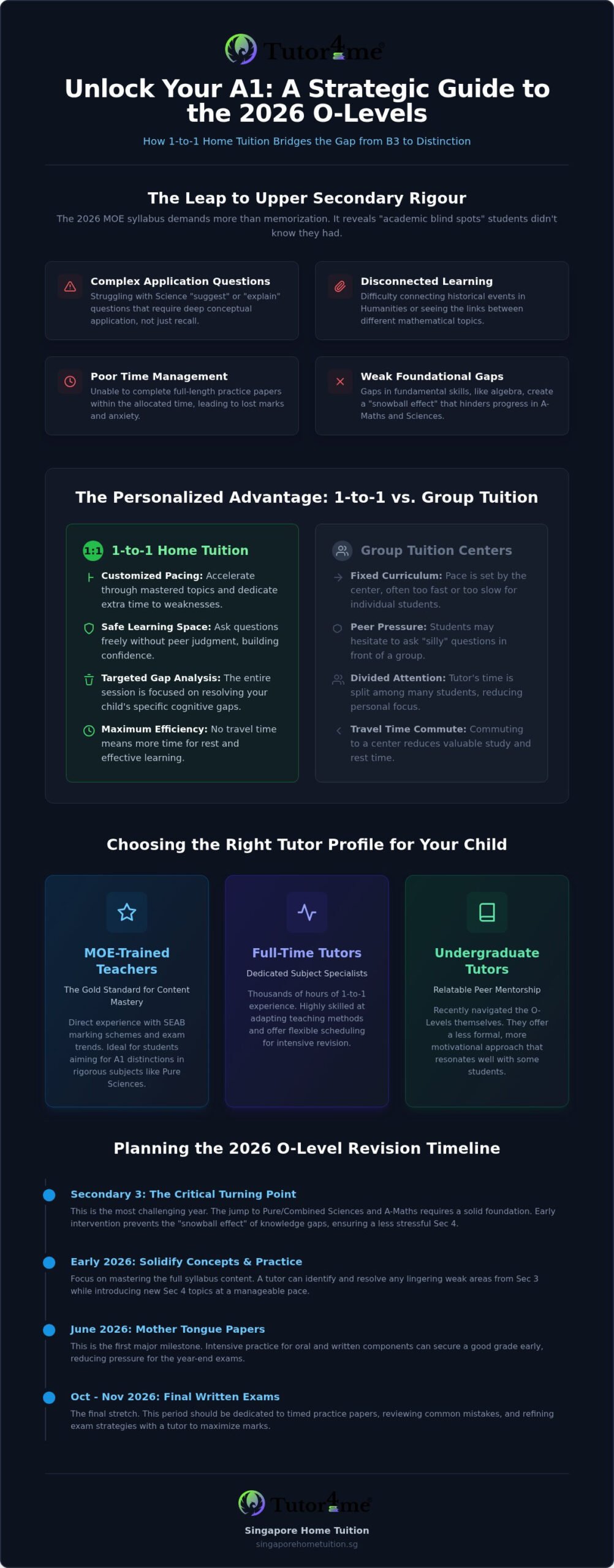
Preparing for the Singapore-Cambridge GCE Ordinary Level has changed significantly. In 2026, the MOE syllabus demands a higher level of conceptual application and data analysis. Students can’t simply memorize facts; they must demonstrate deep understanding across diverse contexts. This shift often reveals academic “blind spots” that weren’t apparent in Lower Secondary. Common issues include:
- Weakness in answering “suggest” or “explain” questions in Science papers.
- Difficulty connecting historical events or trends in Humanities.
- Poor time management during full-length practice papers.
- Gaps in algebraic foundations that hinder progress in Mathematics.
Engaging O Level Home Tuition addresses these gaps by providing a focused environment where a student’s specific weaknesses are the primary agenda. This personalized support does more than just improve grades; it restores student motivation. When a student sees they can master a difficult topic, their confidence grows, leading to a more proactive approach to their studies.
Home Tuition vs. Group Tuition Centers: A 2026 Comparison
While group centers provide a structured environment, they often lack the flexibility required for high-stakes preparation. 1-to-1 O Level Home Tuition allows for customized pacing. A tutor can accelerate through topics the student has already mastered and dedicate extra sessions to challenging chapters. This efficiency is vital for students balancing multiple subjects. Also, eliminating travel time helps maximize rest. A well-rested student is a more effective learner. Home settings create a safe space where students feel comfortable asking questions without the pressure of peer judgment. To ensure this environment is truly conducive to focus, it’s important to address any household issues like pests—you can read more about professional bedbug treatments if needed.
Early Intervention: Why Secondary 3 is the Critical Turning Point
Secondary 3 is often the most challenging year for students. The transition from general science to Pure or Combined Sciences introduces a steep learning curve. Similarly, the introduction of Additional Mathematics requires a strong foundation in algebraic manipulation. Without early intervention, small misunderstandings can quickly lead to a “snowball effect” that compromises performance in the final year. By the time Secondary 4 arrives, the volume of content becomes overwhelming. Engaging a top home tutor in Singapore during the Secondary 3 year ensures these foundations are solid, preventing the stress of last-minute cramming before national exams.
Choosing the Right Tutor Profile for Your Child’s O Level Needs
Selecting the right partner for O Level Home Tuition requires more than just scanning a resume. It’s about understanding how a tutor’s specific profile aligns with your child’s learning style and current academic standing. While some students need a mentor to simplify complex concepts, others require a specialist who knows the exact requirements of the GCE O-Level subjects they’ve chosen. Finding this balance is crucial for long-term success and peace of mind.
MOE-Trained Teachers: The Gold Standard for Content Mastery
Current and former MOE teachers possess direct experience with SEAB marking schemes and current examination trends. For students aiming for A1 distinctions, especially in rigorous areas like Chemistry tuition, these educators provide insights that go beyond the textbook. They understand common pitfalls and the precise phrasing required to secure full marks in structured questions. Their authority in the classroom translates into a result-oriented home environment that pushes students toward excellence.
Full-Time Tutors and Subject Specialists
These professionals have made tutoring their primary career, often accumulating thousands of hours of 1-to-1 instruction. Their high availability makes them ideal for students who need flexible scheduling or intensive crash courses during the school holidays. Because they work with students from diverse academic backgrounds, they’re highly skilled at adapting their teaching methods to suit different personality types. Many develop their own proprietary notes and practice sets that specifically target recent syllabus changes and cognitive gaps.
Undergraduate Tutors: Relatable Peer Mentorship
For students who feel intimidated by formal teachers, undergraduates offer a relatable peer mentorship. They’ve recently navigated the national examination system themselves and understand the modern pressures students face. They’re a cost-effective option for consistent weekly revision and homework help, ensuring that foundational gaps don’t widen as the year progresses. Their ability to build quick rapport helps students feel comfortable admitting when they don’t understand a concept, which is the first step toward improvement.
When you’re deciding on a profile, consider your child’s current grade and emotional needs. A student who is failing may benefit from the patience and relatability of an undergraduate, while a student stuck at a B3 might need an MOE teacher to push them toward an A1. Budgeting for tuition involves identifying where the most significant academic bottleneck exists. If you’re looking for a specific fit, you can find a suitable match through a professional agency that vets credentials and track records for you.
Mastering High-Stakes Subjects: Strategic Support for Distinctions
Securing distinctions in national exams requires a shift from passive learning to strategic mastery. Every subject group carries its own set of unique demands. While the sciences require precise application of theories, the humanities demand critical evaluation and synthesis of information. Utilizing O Level Home Tuition allows students to develop these specific cognitive skills in a controlled, one-to-one environment. Tutors focus on building exam muscle memory by deconstructing past-year papers and identifying the specific keywords that examiners look for in high-scoring scripts.
The Mathematics Challenge: E-Math vs. A-Math
Many students find it difficult to bridge the gap between understanding a mathematical concept and applying it accurately under timed conditions. Elementary Mathematics (E-Math) focuses on logical foundations and everyday applications. Additional Mathematics (A-Math) introduces abstract concepts like calculus and advanced trigonometry that require a significantly higher level of rigour. Consistent practice with a top home tutor is essential for A-Math. This personalized attention allows for the immediate correction of misconceptions before they become ingrained habits. For a detailed breakdown of how home-based learning compares to traditional centers, you can explore our resources on Maths Home Tuition Singapore.
Sciences and Humanities: Content Heavy vs. Skill Based
Subjects like Biology and History are notoriously content-heavy. They require students to organize and recall vast amounts of data. Effective tutors use mnemonics and concept mapping to make this information more manageable. In contrast, subjects like Physics or Social Studies are skill-based, focusing on the application of logic rather than just rote memorization. Developing a strong answering technique is particularly vital for Economics home tuition, where students must structure their responses to address multi-part prompts with precision.
Beyond theory, mastering the practical exam components is a critical part of the 2026 strategy. Practical exams account for a significant percentage of the final grade in Pure Sciences. O Level Home Tuition can include simulated sessions where students practice experimental planning and data analysis. These sessions ensure students remain calm and methodical during actual laboratory assessments. Language subjects also benefit from this strategic approach. Moving beyond basic literacy involves mastering the nuances of tone and purpose in situational writing, transforming a student’s academic profile from standard to distinction-ready.
Planning the 2026 O Level Revision Timeline
Success in the national examinations is rarely the result of last-minute cramming. It requires a disciplined schedule that accounts for both academic rigour and a student’s well-being. For many families, the journey begins long before the first paper is distributed. Establishing a clear roadmap helps students balance heavy CCA commitments with an increasing academic load. Engaging professional O Level Home Tuition provides the necessary structure to stay on track throughout the year, ensuring that no subject is neglected.
January to May: Foundation and Conceptual Clarity
The first five months of the year are the most effective time to address lingering Secondary 3 gaps. As students encounter more complex topics in Mathematics and Science, foundational weaknesses often become apparent. Use this period to set realistic grade targets for each subject and establish a consistent weekly tuition routine. Fixing conceptual errors during this phase prevents them from becoming insurmountable obstacles during the mid-year assessments. It’s about building a solid base before the pace of school revision accelerates.
June to August: Intensive Revision and Mock Exams
The June holidays represent a critical turning point in the academic calendar. With the 2026 GCE O-Level examination period beginning with Mother Tongue papers on June 2, students must shift their focus toward intensive revision. Many families utilize this break for “crash courses” in weaker subjects to boost confidence. This period should prioritize practicing under timed conditions to master time management. Use feedback from preliminary exams to refine answering techniques and address specific cognitive gaps identified by your top home tutor.
September to October: The Final Sprint
As the final written papers approach in October and November, the focus shifts to the Ten Year Series (TYS) and top school prelim papers. This “Final Sprint” is about building exam muscle memory and refining precision. Your tutor will help you review key formulas, case studies, and the essential keywords that examiners look for in high-scoring scripts. Mental preparation is just as important as content mastery. Managing exam anxiety with the support of a dedicated mentor ensures that the student remains calm and performs to their full potential. If you are ready to secure a tutor who can guide your child through this rigorous timeline, you can request a matching consultation today.
Securing the Ideal O Level Tutor with Singapore Home Tuition
Choosing the right educator is the final, critical step in executing a successful 2026 academic strategy. While the previous sections of this guide have outlined the academic requirements and timeline, the actual results depend on the quality of the student-tutor connection. We act as a professional facilitator, removing the burden of vetting from parents and ensuring a perfect fit from the very first lesson. Our goal is to provide a stable pillar of support in what is often a high-stakes environment for Singaporean families.
The process of engaging O Level Home Tuition through our agency is designed to be frictionless and efficient. Once a request is made, we utilize our extensive database to identify tutors who not only possess the required subject expertise but also align with the student’s specific learning pace and schedule. This methodical approach ensures that the transition into a new study routine is seamless, allowing the student to focus entirely on their revision goals. We maintain islandwide coverage across Singapore, ensuring that high-quality instruction is accessible regardless of your location.
Our Rigorous Tutor Verification Process
Trust is built on transparency and verified excellence. We take the responsibility of tutor selection seriously, performing comprehensive checks on every candidate before they’re recommended to a family. This involves a thorough review of academic transcripts to confirm subject mastery and verifying MOE registration status for our school-trained specialists. We also evaluate past student grade improvements and collect detailed feedback from parents who have previously engaged their services. Our commitment to quality is maintained through strict background checks and a rigorous vetting process that ensures only the most suitable educators join our network.
Tailored Learning Plans for Long-Term Excellence
Effective 1-to-1 instruction goes beyond simply following a syllabus. Our tutors are trained to identify and adapt to different learning styles, whether a student is a visual, auditory, or kinesthetic learner. By tailoring the delivery of complex concepts, we ensure that students remain engaged and empowered throughout their O-Level journey. Parents are kept informed through regular progress reports, which highlight milestones achieved and areas that require further focus. For a deeper look into how we support families, you can explore Private Home Tuition Singapore for Parents. This ongoing feedback loop ensures that the academic plan remains dynamic and responsive to the student’s evolving needs as the 2026 exams approach.
Empowering Your Child for the 2026 GCE O-Levels
Navigating the path to academic excellence requires a blend of early preparation, strategic timing, and the right mentorship. By identifying subject-based cognitive gaps in Secondary 3 and following a disciplined revision timeline, your child can approach the 2026 examinations with clarity and poise. Professional O Level Home Tuition provides the specialized support needed to transform a student’s potential into actual A1 distinctions.
Singapore Home Tuition remains a stable pillar for families seeking excellence. We offer access to MOE-trained tutors and provide a fast 24-hour tutor matching service that’s been trusted by thousands of Singaporean parents. Our methodical approach ensures that every student is paired with an educator who understands their unique learning style and the specific rigours of the current syllabus.
Take the first step toward a stress-free exam season today. Find Your Ideal O Level Home Tutor Today and give your child the tools they need to secure their first-choice tertiary institution. We’re dedicated to your success and ready to help you bridge the gap to academic distinction.
Frequently Asked Questions
How much does O Level home tuition cost in Singapore for 2026?
Factors like tutor experience and subject complexity determine the investment. Rates are generally tiered based on whether you engage an undergraduate, a full-time professional, or an MOE-trained teacher. Each category offers a different level of expertise and syllabus familiarity. We recommend discussing your specific academic goals and budget with us so we can provide a personalized recommendation that ensures your child receives the highest quality of instruction.
Is it better to have an MOE teacher or a full-time tutor for O Levels?
The choice between an MOE teacher and a full-time tutor depends on your child’s specific requirements. MOE teachers possess direct knowledge of current marking schemes and syllabus changes, which is invaluable for students aiming for top distinctions. Full-time tutors often provide more flexible scheduling and have extensive experience working with students across different school backgrounds. Both options offer high-quality O Level Home Tuition, but the right fit depends on your child’s learning pace.
How many hours of tuition per week is recommended for Sec 4 students?
Most Secondary 4 students find that 1.5 to 2 hours per subject each week provides the best balance. This duration allows the tutor to explain complex concepts thoroughly and still have time for guided practice with past-year papers. If a student is struggling with a specific subject, increasing the frequency during school holidays can help bridge gaps more quickly. It’s essential to maintain a sustainable schedule that avoids burnout before the final exams.
Can O Level home tuition help with Combined Science and Humanities?
Yes, specialized tutors are highly effective in helping students manage the broad scope of Combined Science and Humanities. These subjects require a mix of content memorization and specific answering techniques for structured questions. A dedicated tutor helps organize vast amounts of information into manageable summaries and mind maps. They also focus on the critical thinking skills needed to excel in Social Studies and elective Humanities, ensuring students don’t feel overwhelmed by the volume.
What happens if the matched tutor is not a good fit for my child?
If the initial tutor isn’t the right fit, our agency facilitates a replacement to ensure your child’s learning continues without interruption. We understand that a strong student-tutor rapport is essential for academic success. Our matching process is designed to be thorough, but we remain flexible if the pedagogical style doesn’t align with your child’s needs. We’ll work closely with you to identify a more suitable educator who can deliver the results you expect.
When is the best time to start O Level home tuition?
Starting early in Secondary 3 is the most strategic approach to O Level Home Tuition. This allows the student to master foundational concepts before the workload increases in the final year. For those already in Secondary 4, engaging a tutor by January is recommended to ensure there’s enough time to address academic blind spots before the mid-year assessments and the final national examination period begins in June.
Do your tutors provide their own O Level revision materials and notes?
Many of our subject specialists and MOE-trained tutors provide their own curated revision notes and practice materials. These resources are often designed to simplify complex topics and highlight the specific keywords required for the marking schemes. While school textbooks provide the necessary theory, these proprietary materials focus on exam application and high-yield topics. This supplemental support helps students build the muscle memory needed to tackle challenging questions with confidence during the actual exams.