

Scoring an AL1 in PSLE Mathematics is no longer a guaranteed predictor of success once a child encounters the abstract rigour of the Secondary 1 syllabus. Many parents are surprised when their children, who previously excelled with model drawing, suddenly struggle with the transition to formal algebra and complex geometry. You aren’t alone if you feel anxious about the 2026 SEC exam changes or the increased workload that comes with the new G1, G2, and G3 streaming system. It’s a significant leap that requires a fundamental shift in how a student thinks and solves problems.
This comprehensive guide is designed to give you peace of mind by explaining exactly what to expect during this academic transition. We’ll show you how to recognize early signs of struggle and explain why specialized 1-to-1 sec 1 math tuition can be the most effective way to provide personalized pacing. By the end of this article, you’ll have a clear understanding of the 2026 MOE syllabus and the practical steps needed to secure the right support for your child’s secondary school journey. We’ll explore the core topics, the shift toward conceptual application, and how to find a tutor who fits your child’s specific learning style.
Key Takeaways
- Understand why the shift from concrete model drawing to abstract algebraic reasoning causes many students to struggle during the Secondary 1 transition.
- Identify critical differences in the 2026 syllabus, including the introduction of negative integers and the move from PSLE heuristics to formal equations.
- Learn how to monitor your child’s first Weighted Assessment (WA1) results to identify early gaps in understanding before they become long-term hurdles.
- Use a structured approach to select the most suitable sec 1 math tuition by matching your child’s specific stream with the right tutor profile.
- Discover how personalized home tuition provides a safe space for students to clarify doubts and master complex topics at their own pace.
Understanding the “Secondary 1 Jump” in Mathematics
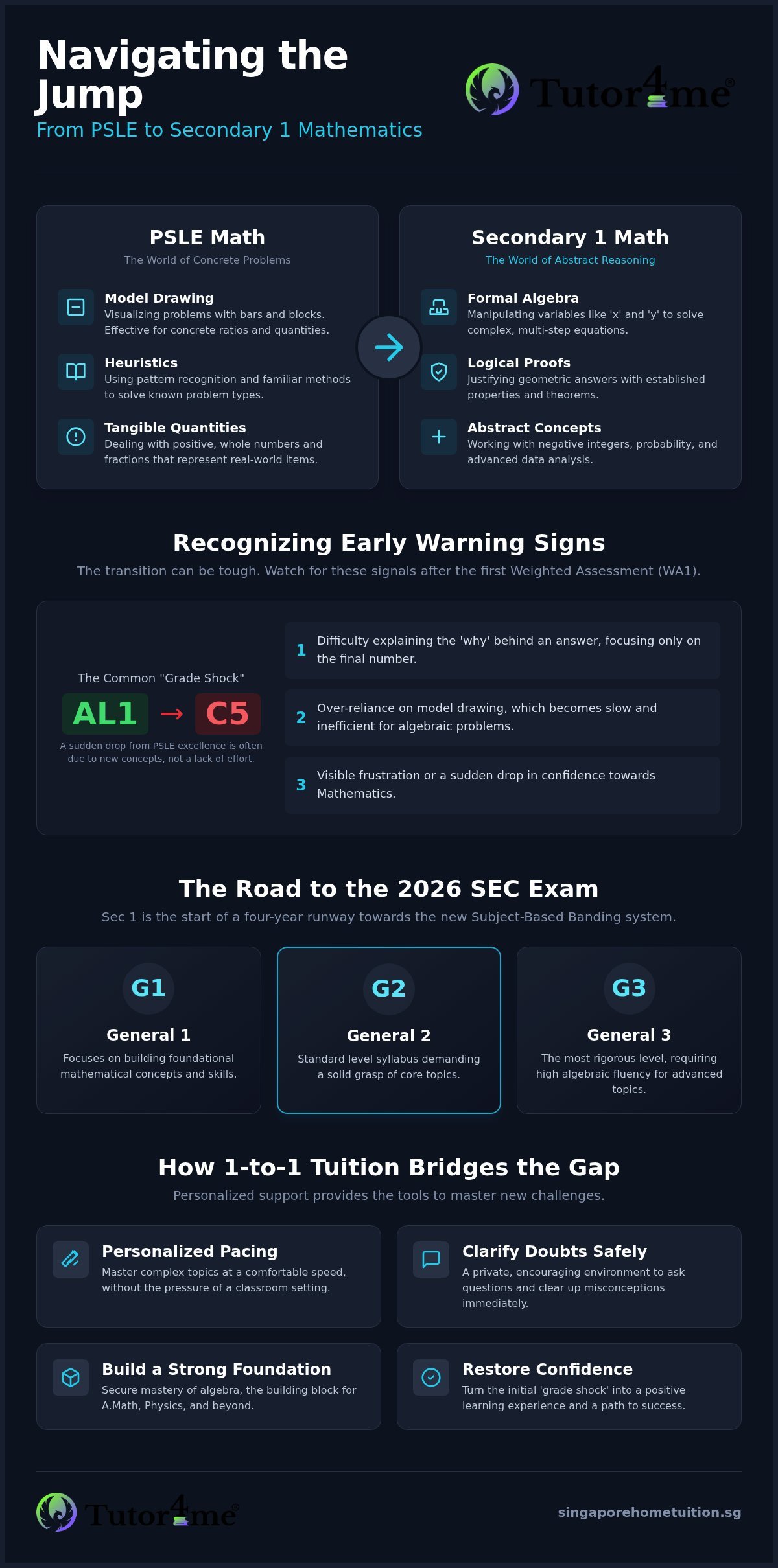
The transition from primary to secondary school is frequently described as a “jump” rather than a simple step. While the Singapore math curriculum at the primary level focuses heavily on concrete arithmetic and visual model drawing, Secondary 1 introduces abstract mathematical reasoning. Students move from solving for tangible quantities to manipulating variables and solving for “x”. This shift is compounded by a heavier academic workload. Longer school hours and new CCA commitments often leave students with less time for focused self-study, making the initial months of the year critical for setting the right pace.
Securing a strong foundation in these early stages is essential for long-term academic health. The concepts introduced now are not isolated; they are the building blocks for more advanced subjects. Without a clear grasp of Secondary 1 topics, students often find themselves struggling later with Additional Mathematics or Physics in upper secondary. This is where specialized sec 1 math tuition becomes a valuable asset. It provides the structured support and personalized attention needed to navigate the increased complexity before the workload becomes overwhelming and difficult to manage.
The Psychological Shift from Primary to Secondary
It is common for a student who excelled in PSLE Home Tuition to face a sudden “grade shock.” An AL1 student might receive a C5 on their first Weighted Assessment. This drop usually isn’t due to a lack of effort but a change in problem structure. Building resilience is vital. Effective sec 1 math tuition can help rebuild confidence by teaching students to justify their logic rather than just finding a “right answer.”
The 2026 SEC Exam: What Parents Need to Know
Starting in the 2026 academic year, the Singapore-Cambridge Secondary Education Certificate (SEC) replaces the O-Level and N-Level systems. Under Full Subject-Based Banding, students take Mathematics at G1, G2, or G3 levels based on their strengths. The G3 syllabus remains rigorous, demanding high algebraic fluency. Since the SEC is the eventual goal, Sec 1 is no longer a “honeymoon period.” It is the start of a four-year runway where consistent performance is necessary to maintain or upgrade subject levels.
Key Differences Between PSLE and Sec 1 Math Syllabuses
Transitioning from the Primary 6 curriculum to the official Sec 1 Math syllabus involves more than just encountering harder numbers. It requires a total shift in methodology. PSLE Math rewards students for using heuristics and model drawing to solve familiar problem types. In contrast, Secondary 1 Math demands logical proofs and the ability to handle abstract concepts that cannot be easily visualized. This change can be jarring for students who relied on rote memorization to succeed in primary school.
The most significant hurdle is the introduction of formal Algebra. Students move away from drawing rectangular blocks to represent quantities; instead, they must learn to define unknowns using variables like “x” and “y”. While models are effective for simple ratios, they become inefficient for complex equations involving multiple unknowns or fractional coefficients. Mastering this transition early is vital, as algebraic fluency is the foundation for almost every topic that follows in secondary school.
Other key differences include:
- Negative Numbers and Integers: Students must now deal with values below zero. Understanding that subtracting a negative is equivalent to adding can be counterintuitive and often leads to calculation errors.
- Geometry and Mensuration: Geometry moves beyond identifying shapes to requiring formal reasoning and multi-step calculations. Students must learn to justify their answers using geometric properties.
- Data Analysis and Probability: Statistical concepts become more sophisticated. Students learn to interpret different types of data sets and understand the mathematical basis of probability.
From Model Drawing to Algebraic Manipulation
The transition to algebraic expansion often leads to common errors, such as forgetting to distribute terms correctly within brackets. Many students struggle to “un-learn” the model method, which can slow them down during timed assessments. Engaging specialized sec 1 math tuition can help bridge this gap by providing targeted drills that replace old habits with efficient algebraic techniques. If your child is finding the shift difficult, finding a suitable home tutor can provide the one-to-one focus needed to master these abstract concepts.
New Topics Introduced in Secondary 1
Students will encounter prime factorization, HCF, and LCM at a much deeper level than in primary school. They also start exploring linear functions and coordinate geometry, which form the basis for all future graphing work. For those in the G3 stream, basic trigonometry is introduced, requiring a solid grasp of ratios and angles. Because these topics are entirely new, a student who misses the first few lessons may find it difficult to catch up without external sec 1 math tuition to reinforce the core principles.
How to Identify if Your Child Needs Sec 1 Math Tuition
Identifying the exact moment to seek academic support can be challenging for many parents. While it’s tempting to wait until the mid-year examinations, the fast-paced nature of the 2026 syllabus means foundational gaps can become permanent by then. Reviewing the first Weighted Assessment (WA1) results is a more proactive diagnostic tool. If your child’s score reflects a significant drop from their PSLE performance, it often indicates a struggle with the conceptual shift inherent in Mathematics education in Singapore. Beyond the marks, you should look for the “Confidence Gap.” A child who previously enjoyed Math but now avoids homework or expresses anxiety before lessons is likely hitting the “Algebra Wall.”
Diagnostic Signs for Parents
Watch for constant frustration during homework sessions, especially when algebraic terms are involved. If your child can solve a problem but cannot explain the logic back to you, they may be relying on rote memorization. This is a significant red flag in secondary school. The curriculum now requires students to justify their reasoning rather than just applying a formula. Another subtle sign is time management. If they’re failing to finish practice papers despite knowing the content, it suggests they haven’t mastered the fluency needed for the SEC-level rigor. Specialized sec 1 math tuition can help address these specific bottlenecks by focusing on technique and mental speed.
Struggling with basic variable substitution is a specific indicator that your child might require additional help. In primary school, unknowns were represented by boxes; in secondary school, they’re abstract symbols. If a student can’t visualize how these symbols interact, they’ll find every subsequent topic, from linear equations to coordinate geometry, increasingly difficult. Early intervention through sec 1 math tuition ensures these misconceptions are cleared before they become ingrained habits that are harder to correct later.
The Cost of “Waiting and Seeing”
The academic journey in secondary school is cumulative. Gaps in Secondary 1 Algebra almost inevitably lead to failure in Secondary 2 and 3. This has a direct impact on future choices, particularly regarding A Maths tuition eligibility. Most schools use Sec 2 performance to determine if a student can take Additional Mathematics, a subject critical for many JC and Poly pathways. By securing support early, you prevent a loss of academic interest and keep your child’s future options open.
Step-by-Step Guide: Choosing the Right Math Tutor in Singapore
Finding the right support for sec 1 math tuition requires a methodical approach. It isn’t just about finding someone who is good at numbers; it’s about identifying a specialist who understands the specific hurdles of the 2026 transition. Because the secondary school environment is more fast-paced than primary school, the matching process should be handled with organized efficiency to avoid wasting precious term time.
Follow these five steps to ensure a perfect fit for your child’s needs:
- Step 1: Identify the subject level. Determine if your child is in the G1, G2, or G3 stream. G3 Mathematics requires a much higher degree of algebraic fluency and abstract reasoning.
- Step 2: Choose the tutor profile. Decide whether an MOE teacher, a full-time tutor, or an undergraduate specialist best suits your budget and your child’s personality.
- Step 3: Verify syllabus knowledge. Ensure the tutor is fully conversant with the 2026 SEC syllabus changes and the move away from traditional O-Level structures.
- Step 4: Conduct a trial session. Use the first lesson to check for rapport. A good tutor should be able to simplify complex variables into manageable steps.
- Step 5: Establish milestones. Set clear goals for the first three months, such as improving Weighted Assessment results or finishing homework without frustration.
MOE Teachers vs. Full-Time Tutors: Which is Better?
Current or ex-MOE teachers are highly valued for their syllabus accuracy and understanding of marking rubrics. They know exactly how logic must be presented to secure full marks. Full-time tutors often offer more flexible scheduling, which is helpful given the unpredictable nature of CCA timings. They frequently act as relatable mentors, helping students manage the psychological stress of the Secondary 1 jump. Choosing between them depends on whether your child needs strict academic drilling or a more patient, encouraging guide.
Evaluating Tuition Agencies and Credentials
In the busy Singapore academic calendar, fast tutor matching is essential. You should verify a tutor’s academic background and their specific track record with lower secondary students. A reliable agency acts as a professional facilitator, vetting credentials so you don’t have to. Check out our guide on how to choose a tuition agency in Singapore to better understand what to look for in a service provider. Ensuring the agency understands the 2026 SEC requirements will save you significant time and effort.
Securing the right sec 1 math tuition early can prevent a small gap from becoming an unbridgeable chasm. If you’re ready to find a dedicated specialist for your child, request a qualified Sec 1 Math tutor today to begin the matching process.
Why Personalized 1-to-1 Home Tuition is the Best Fit for Sec 1
Secondary school life introduces a level of physical and mental exhaustion that most 13-year-olds haven’t experienced before. Between Co-Curricular Activities (CCAs) that often end late in the evening and the increased number of subjects, a student’s time is their most precious resource. 1-to-1 sec 1 math tuition at home addresses this by eliminating unnecessary travel. Instead of spending an hour commuting to a tuition center, your child can use that time for rest or other subjects. This efficiency is critical in maintaining a healthy academic balance during a high-stakes transition year.
Beyond time savings, the primary advantage is customized pacing. In a group setting, the teacher must follow a fixed schedule to cover the syllabus. If a student doesn’t grasp the fundamentals of linear equations in week three, the class still moves to week four. Home tuition allows a dedicated specialist to pause and spend extra time on specific hurdles like algebraic expansion. This targeted practice ensures that no foundational gaps are carried forward into the next term. It also provides a safe environment where students feel comfortable asking “silly” questions they might avoid in a crowded classroom.
Building a Strong Mathematical Foundation
Real-time identification of misconceptions is where 1-to-1 attention truly shines. A tutor can spot a student’s tendency to misapply a negative sign the moment it happens, preventing the error from becoming a habit. This personalized approach strengthens the bridge between the concrete methods taught in PSLE Home Tuition and the abstract expectations of secondary school. It isn’t just about passing the next test; it’s about preparing for the long-term goal of academic excellence in the O Level Home Tuition or SEC exam journey. By focusing on the specific exam format of your child’s school, a tutor ensures the practice is always relevant and effective.
The Role of a Tutor as an Academic Mentor
The transition to secondary school is as much a psychological journey as an academic one. A home tutor often serves as an academic mentor, providing the emotional support needed when a child feels overwhelmed by the “Secondary 1 Jump.” They teach essential study skills, such as how to organize math notes and use a scientific calculator effectively. By staying slightly ahead of the school’s syllabus, the tutor helps the student regain their classroom confidence. When a child already understands a concept before it’s taught in class, they’re more likely to participate and less likely to feel defeated by the subject. Choosing the right sec 1 math tuition isn’t just a remedial step; it’s a strategic investment in your child’s confidence.
Securing Your Child’s Mathematical Future in 2026
The transition to Secondary 1 is a pivotal moment that defines a student’s academic trajectory for the next four years. Success in the 2026 SEC syllabus requires more than just hard work; it demands a fundamental shift from concrete models to abstract algebraic reasoning. By recognizing the early warning signs of struggle and addressing them before they become ingrained habits, you provide your child with the stability they need to excel in a high-stakes environment. Personalized sec 1 math tuition ensures that this transition is handled with the care and specialized attention it deserves.
At Singapore Home Tuition, we act as a dedicated specialist to bridge the gap between primary foundations and secondary expectations. We provide a fast tutor matching service islandwide, giving you access to qualified MOE teachers and experienced full-time tutors who understand the nuances of the new curriculum. Our focus on 1-to-1 attention allows for customized pacing that group settings simply cannot offer. Find the perfect Sec 1 Math tutor today with Singapore Home Tuition and give your child the peace of mind to navigate their new academic journey with confidence. With the right support, the leap to secondary school becomes a manageable step toward excellence.
Frequently Asked Questions
Is Sec 1 Math much harder than Primary 6 Math?
Sec 1 Math is significantly more abstract than Primary 6 Math. While primary school focuses on concrete arithmetic and visual models, secondary school introduces variables and algebraic logic. This shift requires students to justify their reasoning rather than just finding a numerical answer. Many students find the introduction of negative numbers and linear equations particularly challenging. It’s a fundamental change in how they perceive mathematical relationships.
Should I wait for the first exam results before getting Sec 1 Math tuition?
Waiting for mid-year results often leaves foundational gaps that are difficult to bridge later. It’s better to monitor your child’s performance in early Weighted Assessments (WA1). If they struggle with basic variable substitution or algebraic expansion, starting sec 1 math tuition early prevents these issues from snowballing. Early intervention builds the confidence needed to handle the faster pace of the secondary school environment.
How many hours of math tuition does a Sec 1 student need per week?
Most students benefit from one session of 1.5 to 2 hours per week. This duration allows enough time to review school work, clarify new concepts, and complete practice problems without causing burnout. If a student has significant gaps from primary school, a temporary increase to two sessions might be necessary. The goal is to maintain a consistent rhythm that aligns with the school’s topical schedule.
Will the new 2026 SEC exam change what my child learns in Sec 1?
The 2026 SEC exam replaces the traditional O-Level and N-Level framework with a single certificate. While the core mathematical principles remain the same, the syllabus is now banded into G1, G2, and G3 levels. This change emphasizes conceptual understanding and real-world application over rote memorization. Your child will focus on topics tailored to their specific band, ensuring the curriculum matches their current learning pace and academic needs.
Can a tutor help my child transition from the Model Method to Algebra?
A qualified tutor is essential for helping students move away from the “Model Method.” In primary school, blocks represent quantities, but in secondary school, students must use variables like “x” and “y.” Tutors teach students how to translate word problems into formal equations. This transition is vital because models become inefficient for complex problems involving multiple unknowns or fractional coefficients found in the secondary syllabus.
What is the average rate for a Sec 1 Math home tutor in Singapore?
According to 2026 market data, rates vary based on the tutor’s experience level. Part-time or student tutors generally charge between S$30 and S$45 per hour. Full-time tutors typically command S$45 to S$55 per hour, while current or former MOE teachers range from S$60 to S$85 per hour. These rates reflect the specialized knowledge required to teach the lower secondary syllabus effectively.
Is online tuition as effective as home tuition for Sec 1 Math?
While online tuition offers convenience, 1-to-1 home tuition is often more effective for the Secondary 1 transition. Physical presence allows the tutor to monitor a student’s handwriting and step-by-step logic more closely. It’s easier to build the rapport and trust needed to ask “silly” questions in person. For a subject as abstract as Mathematics, the immediate feedback of a home setting is a significant advantage.
How do I know if my child is in G1, G2, or G3 Math?
Your child’s placement in G1, G2, or G3 Math is determined by their PSLE Achievement Level (AL) scores. Schools use these bands to provide a curriculum that matches each student’s aptitude. You can find this information in the school’s posting results or by checking your child’s timetable. If your child excels in sec 1 math tuition, they may have the opportunity to take Math at a higher level through Full Subject-Based Banding.