
A tutor with broad psychology knowledge may still not be the right fit for your current SUSS modules. Finding a private tutor for SUSS psychology modules means looking beyond the subject label. You need someone whose knowledge and teaching approach align with your course materials, assignment expectations and learning priorities, and who helps you build understanding you can apply independently.
Start with the modules you’re taking and the areas where you need support. This guide explains how to match a tutor’s subject expertise to psychology concepts, research methods or statistics, while considering your study goals and learning style. You’ll also find practical ways to assess explanations, guided practice and assignment support, and decide whether one-to-one home or online tuition suits your routine. A focused match can help you approach topics such as PSY107 or HBC201 with a study plan shaped around your needs, rather than relying on general explanations.
Key Takeaways
- Match tutoring to your current SUSS psychology modules, course materials and study priorities, rather than psychology as a broad subject.
- Assess a tutor’s relevant knowledge and teaching approach by how clearly they explain concepts and support your independent understanding.
- Identify whether you need help with concepts, research methods, academic writing or study planning, then agree on a practical way to track progress.
- Use initial lessons to assess the tutor’s clarity, pace, preparation and ability to encourage your participation.
- When seeking a private tutor for SUSS psychology modules, share your academic needs, preferred learning style, lesson format and scheduling preferences to guide a suitable match.
Why choose a private tutor for SUSS psychology modules?
Private tuition gives you individual academic support shaped around your current course needs. For a SUSS psychology student, that could mean reviewing a challenging concept, working through research methods, practising academic writing or planning independent study. You can focus each session on your current questions instead of following a general lesson plan designed for psychology as a broad subject.
Interest in psychology is a useful starting point, but it does not show whether a tutor can explain a particular course topic or help you work with your module materials. A private tutor for SUSS psychology modules should connect explanations and guided practice to the questions you bring. You can also read about educational psychology, which explores how people learn and how learning is shaped by cognitive, emotional and social factors.
When can one-to-one psychology tuition help?
One-to-one support may help if you’re stuck on a concept, unsure how to structure independent study or finding it difficult to connect ideas across your course materials. Bring a specific question to a session and work through it at a pace that suits your learning style. Tuition is not necessary for every student, but it can support your studies without promising a particular grade or outcome.
For example, ask a tutor to explain a difficult idea in simpler terms, then discuss how you might apply it to a new example. Explaining your reasoning gives you a chance to identify what you understand and what still needs attention.
What should a SUSS student expect from a tutor?
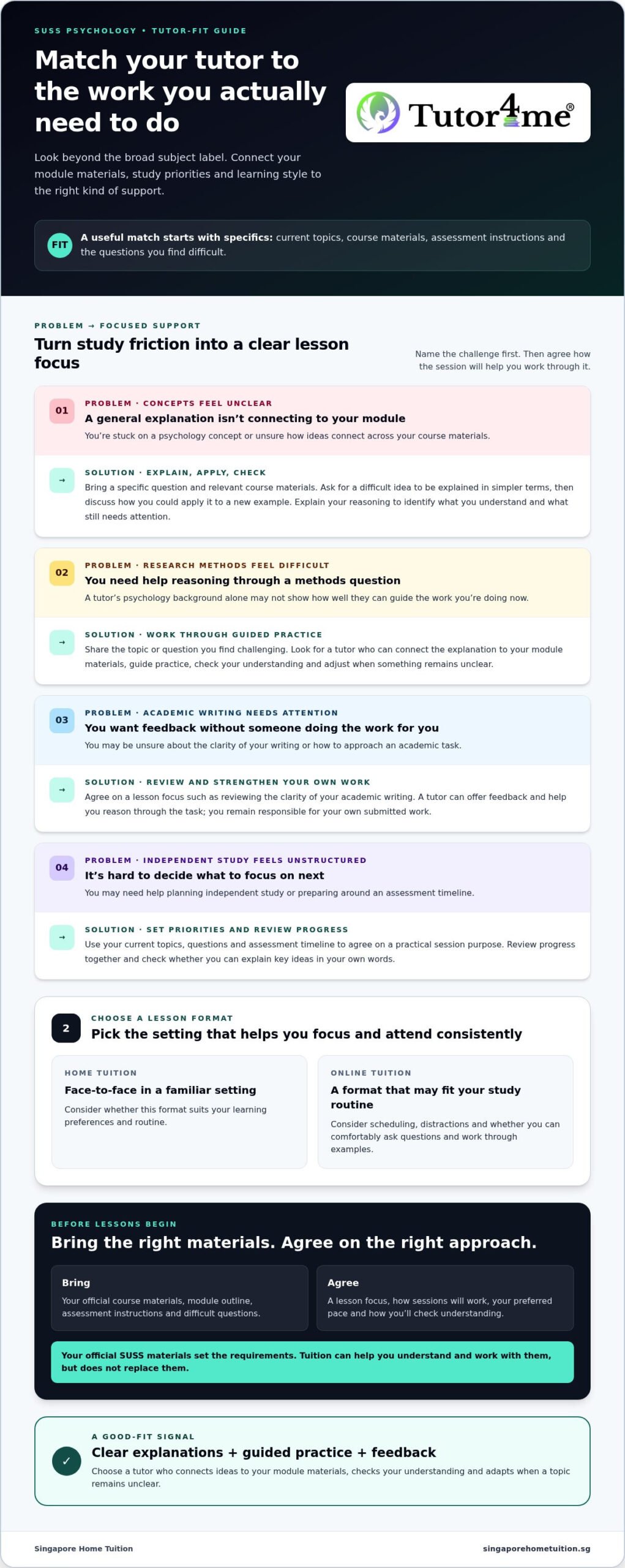
Expect clear explanations, guided practice and feedback that helps you check your understanding. A tutor can break a complex topic into manageable steps, discuss how to approach a research-method question or review the clarity of your own academic writing. The aim is to strengthen your ability to reason through the work, not to produce assessed work on your behalf.
Bring your current official course materials, module outline and assessment instructions to guide each session. These set the requirements for your module. Tuition can help you understand and work with them, but it does not replace them. Agree on a lesson focus, then use questions and practice to check whether you can explain the key ideas in your own words.
How to assess a tutor for your SUSS psychology modules
Start with what you’re studying now, not a broad label such as “psychology”. Gather your module outline, current topics, assessment timeline and the questions you find difficult. Then set your priorities: understanding a theory, interpreting research methods or organizing your study before an assessment, for example. This gives you a clearer basis for matching a tutor’s background and teaching approach to your academic needs.
Assess both subject knowledge and teaching. A tutor may know psychology concepts but still need to explain them in a way that makes sense to you. Look for someone who connects ideas to your module materials, checks your understanding and adjusts when a topic remains unclear. You want to build links between concepts, not just memorise terms without knowing how to apply them.
Match tutor expertise to module learning needs
Use your course materials to describe the topics you need help with, then compare those needs with a tutor’s relevant subject background and teaching experience. You don’t need to rely on a module name alone. A short list of concepts, readings or skills gives a clearer picture of the support you need. Tutor matching can take these details into account, along with the tutor’s ability to explain ideas clearly and respond to your questions.
Check communication and teaching approach
Before lessons begin, agree on how sessions will work. You might review your questions, discuss an explanation, try guided practice and get feedback on what you understood. Share your learning style and preferred pace so the tutor can adapt. Bring relevant materials, take part in the activities and review progress together. Clear expectations help keep lessons focused.
Choose a format that helps you concentrate and attend consistently. Home tuition may suit you if you prefer face-to-face learning in a familiar setting. Online tuition may fit more smoothly into your study routine. For either format, consider scheduling, distractions and whether you can comfortably ask questions and work through examples.
With personalized one-to-one tuition, your tutor can focus on your current topics rather than a generic psychology lesson. Singapore Home Tuition matches learners with educators based on their academic needs, and verifies tutor qualifications and ability. To explore tutor profiles and teaching fit, visit the home tutor matching service.
Which psychology study needs can a private tutor support?
First, identify the kind of help you need. Psychology study can involve understanding concepts, working through research methods, developing academic writing or organizing independent study. Each calls for a different focus, so agree on a clear purpose for the session and a way to check whether you understand the material.
A private tutor for SUSS psychology modules can guide practice and problem-solving, while you remain responsible for your own submitted work. Use your current official SUSS course materials to confirm module topics, assessment instructions and requirements. Check named modules, assessment types and course-specific details against those materials rather than relying on a general description of psychology.
Support with psychology concepts and research methods
If a concept feels unfamiliar, a tutor can break it into smaller parts, explain key terms and use examples to help you connect ideas. Research methods may also be a priority, depending on your current materials and study goals. A tutor can guide you through relevant course exercises and ask you to explain your reasoning. You complete the practice and build your own understanding.
| Learning need | Possible tutoring activity | Progress check |
|---|---|---|
| Concept clarification | Break down a difficult idea and discuss examples drawn from your course materials. | Explain the idea in your own words and apply it to a fresh example. |
| Research-method understanding | Work through relevant course exercises and talk through the reasoning behind each step. | Describe why you chose an approach and identify any parts that remain unclear. |
| Academic writing | Plan an argument, review a draft you wrote and discuss how to make your points clearer. | Check whether the revised structure communicates your ideas more clearly. |
| Study planning | Arrange topics into a practical schedule based on your priorities and assessment timeline. | Review completed study tasks and adjust the plan where needed. |
Improve academic writing and study organization
Writing support can focus on planning and reviewing your own work. A tutor might help you clarify a paragraph’s main point, improve the flow of an argument or spot where an explanation needs more support. Follow the citation style and format stated in your current course instructions. Check rather than assume which style or assessment format applies.
If keeping up with topics is your main challenge, use sessions to prioritize what to study and set a manageable schedule. Bring your course materials, decide what you want to work on and use your own explanations, practice and writing to check what you’ve understood. These are options to shape around your needs, not requirements for every student.
How to decide whether a tutor is the right fit
A suitable tutor should help you work towards clear study goals and feel comfortable asking questions. Assess the match through a simple cycle: set priorities, share relevant course materials, agree on what to cover and review how the sessions are working. This gives you practical evidence of the teaching fit without promising a particular academic result.
Set clear goals before lessons begin
Before the first session, note the topics you find difficult, the pace that helps you follow explanations and your immediate study priorities. Bring current course materials and prepare a few focused questions. You might want to understand a concept, practise explaining an idea or plan how to approach a topic. Agree on a simple way to check your learning after the session, such as summarising the main points in your own words.
Review the tutor match and adjust support
After the first lessons, consider whether explanations are clear, the pace suits your learning style and the tutor has prepared around the priorities you agreed on. Notice whether you’re actively working through ideas, rather than only listening. If a topic remains confusing, say so and agree on what to revisit or change in the next session.
Feedback keeps sessions relevant as your questions and study needs change. Discuss whether to spend more time on explanations, guided practice or planning. Review what you understand and what needs more attention. A single lesson is not a measure of your overall ability.
- Clarity: Can you explain the key idea after the tutor has covered it?
- Pace: Is there enough time to ask questions and think through examples?
- Preparation: Does the session reflect the materials and priorities you shared?
- Participation: Are you practising, explaining and making decisions yourself?
If the match remains unsuitable after you’ve discussed what needs to change, instant reassignment is available through Singapore Home Tuition. The aim is to find a tutor whose subject background and teaching approach better fit your academic needs. For a broader guide to tutor selection, read about choosing a suitable home tutor. To find a private tutor for SUSS psychology modules, share your study priorities and preferred lesson arrangement to guide a more tailored match.
Find a private tutor for SUSS psychology modules through personalized matching
A suitable tutor match starts with a clear picture of your current studies. Share the psychology topics you’re working on, the areas you find challenging and the kind of support you want. This helps guide the match towards an educator whose background and teaching approach relate to your academic needs. The right fit will depend on the student and the topics involved.
Consider the lesson arrangement as well as the subject focus. One-to-one tuition can take place at home or online, with the format shaped around your learning requirements. Think about which option helps you concentrate, ask questions and fit lessons into your schedule. Your preferred communication style and learning pace can also guide the match.
What information helps create a suitable tutor match?
Before requesting a private tutor for SUSS psychology modules, gather a few details to make your needs clear. You can share:
- Your current study priorities and the topics you want to work on.
- Relevant course materials or module information that explains your learning needs.
- Specific challenges, such as understanding concepts, approaching research methods or organizing independent study.
- Your preferred lesson format, scheduling preferences and communication style.
Specific details make tutor matching more focused. For example, asking for support with a particular topic gives a clearer direction than requesting general psychology tuition. Describe whether you learn best through careful explanations, discussion or guided practice. These preferences help shape the match around tutor background and session approach.
Take the next step with Singapore Home Tuition
Singapore Home Tuition provides one-to-one home and online tuition, with dedicated support through student matching. Share your academic needs and preferred arrangement so the matching process can focus on relevant tutor backgrounds and your learning requirements. Hand-picked tutor profiles are delivered to parents within 24 hours, and parents pay only for lessons conducted.
When you receive a profile, compare the tutor’s background and teaching approach with the priorities you shared. Discuss how sessions can address your current topics, then review the fit as lessons progress. To get started, request a tutor match and share what you need help with.
Choose support that fits your psychology studies
A suitable tutor match starts with your current SUSS psychology modules, study priorities and preferred way of learning. Look for support that helps you understand course concepts, work through relevant materials and strengthen independent study, rather than relying on general psychology knowledge alone.
A private tutor for SUSS psychology modules should be matched to your learning needs and able to explain ideas in a way that supports your understanding. Before lessons begin, share your current topics, questions and preferred format. Review the fit as you go, and speak up if the pace or focus needs to change.
Singapore Home Tuition provides hand-picked tutor profiles within 24 hours, with support from registration through student matching. Parents pay only for lessons conducted, and instant reassignment is available if a tutor match is unsuitable. Request a tutor match for your academic needs and share your study priorities. With a clear focus and suitable one-to-one support, you can approach your studies with greater confidence.
Frequently Asked Questions
Can a private tutor help with SUSS psychology modules?
Yes. One-to-one tuition can support your psychology studies, depending on the topics you’re covering and where you need help. A tutor can explain difficult concepts, guide practice with course materials or help you organize independent study. Share your current module information and priorities to keep sessions relevant. Use official SUSS materials for module requirements and assessment instructions. Tuition supports your studies but does not replace those materials.
How do I find a private tutor for SUSS psychology modules?
Outline your current topics, study priorities, learning challenges and preferred lesson format. These details guide a match based on your academic needs and a tutor’s relevant background and teaching approach. Singapore Home Tuition provides hand-picked tutor profiles within 24 hours and support through student matching. You can arrange one-to-one home or online tuition and discuss the focus you need for your studies.
What qualifications should a psychology tutor have?
Look for relevant psychology knowledge, suitable teaching experience and the ability to explain ideas clearly. The best fit depends on the topics you’re studying, so consider how the tutor’s background relates to your learning needs. Singapore Home Tuition verifies tutor qualifications and ability. You can also assess whether the tutor listens to your questions, explains their approach and encourages you to work through ideas independently.
Can a tutor help with psychology research methods and academic writing?
Yes. A tutor can guide you through research-method concepts or help you plan and review your own academic writing. For example, discuss how to structure an argument, clarify a concept or work through relevant course exercises. You remain responsible for your assessed work and submissions. Follow your current SUSS materials for assessment requirements, citation style and other course-specific instructions.
Is online tuition suitable for SUSS psychology students?
Online tuition can suit you if you can concentrate, ask questions and work through materials comfortably in that format. Consider your schedule, learning style and study environment when comparing online and home lessons. One-to-one online tuition can focus on your current learning requirements, while home tuition offers face-to-face support. Choose the arrangement that makes it practical for you to participate and review course topics consistently.
How can I tell whether a psychology tutor is the right fit?
After the initial lessons, consider whether explanations are clear, the pace suits you and sessions focus on the priorities you shared. Notice whether you’re actively asking questions and explaining ideas yourself, rather than only listening. Tell the tutor what is working and what needs adjustment, then agree on next steps. A suitable match should support your understanding and independent study without promising a particular grade or academic outcome.
Can I change tutors if the match is not suitable?
Yes. Instant reassignment is available through Singapore Home Tuition if the tutor match is unsuitable. Share what isn’t working, such as the teaching pace, communication or alignment with your study priorities, so the next match can better reflect your needs. Tutor support is available through student matching, and parents pay only for lessons conducted. Open feedback helps focus the reassignment on your academic needs.