
What if the clearest sign your child needs extra help isn’t one low mark, but a pattern in how they learn and feel about school? If you’re noticing signs my child needs a private tutor, a disappointing test result alone may not tell the whole story. A difficult topic, a busy school term or a temporary dip in confidence can affect performance, but ongoing struggles may call for more focused support.
It’s understandable to feel unsure about when to step in. You want to support your child without adding pressure or treating every setback as a lasting problem. Look for recurring difficulty understanding lessons, completing schoolwork independently or taking part in class. Changes in confidence and motivation can offer useful context too.
This checklist will help you spot patterns, consider whether they’re temporary or persistent, and identify what to discuss with your child and their school. It also explains how one-to-one home or online tuition can support a specific subject need when extra teaching is appropriate. The aim is to choose a practical next step that fits your child’s academic needs and learning style.
Key Takeaways
- Look for recurring signs my child needs a private tutor across academic progress, confidence and independent study, rather than relying on one low mark.
- Consider whether difficulties continue over time or may be linked to a temporary setback, such as illness, a transition or an unfamiliar topic.
- Identify whether your child needs help with a specific subject, problem-solving or guided practice, and set a practical learning goal.
- Talk with your child and review examples of challenging work before deciding what support may be appropriate.
- Learn how one-to-one tuition can be matched to your child’s academic needs, level and learning style.
What signs suggest my child may need a private tutor?
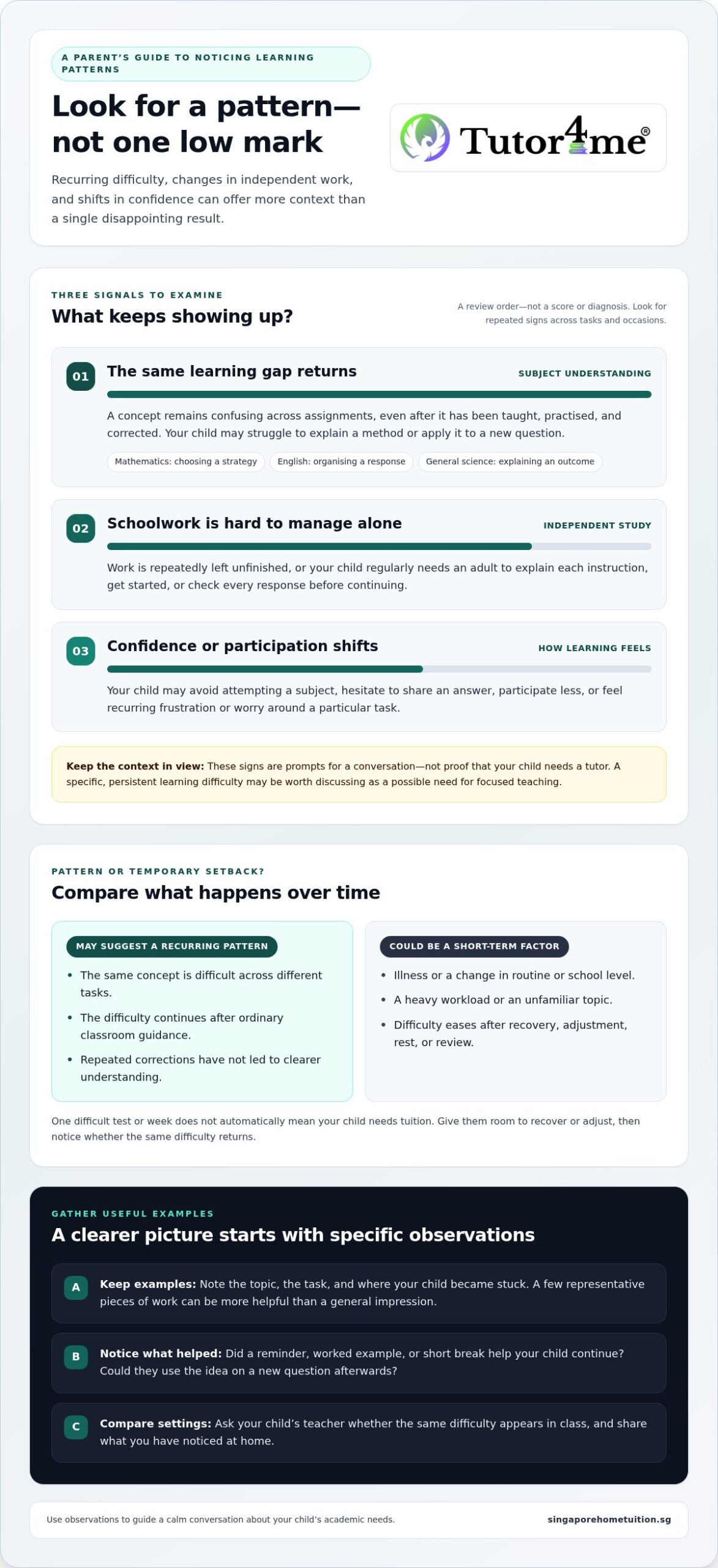
One low mark or a difficult week doesn’t automatically mean your child needs tuition. Look for patterns instead: does the same subject remain confusing? Is your child losing confidence or finding it hard to start and finish schoolwork without repeated help? These observations can guide a calm conversation, but they are not a diagnosis.
Personalised academic support may be worth considering when a specific learning difficulty keeps affecting your child’s understanding, confidence or ability to work independently. Start by identifying what is getting in the way and whether focused teaching could help. Tutoring involves individual instruction, which can give a student space to ask questions and work through areas of difficulty.
Academic signs: when the same learning gaps keep appearing
An occasional careless error is part of learning. A recurring gap is different: your child may struggle to apply a concept even after it has been taught, practised and corrected. Notice whether they can explain the method, rather than only arrive at an answer with help. If repeated corrections haven’t led to clearer understanding, take a closer look at the subject need.
- Academic progress: The same type of question causes difficulty across assignments, or your child can’t apply a familiar method to a new problem. In Mathematics, they might get stuck choosing a strategy; in English, organising ideas for a response; in general science, explaining why an outcome occurs.
- Work patterns: Classwork or homework is repeatedly left unfinished, particularly when it involves the challenging topic.
These examples don’t mean every child needs help in every subject. Focus on the area where you see a consistent obstacle, such as a particular Mathematics topic or difficulty understanding English comprehension questions.
Changes in confidence, participation, or study independence
Academic difficulty can also affect how your child approaches learning. A child who used to attempt familiar work may begin avoiding it, hesitate to ask questions or participate less. Some children need reassurance at first. A more persistent concern is being unable to begin or complete work without an adult guiding each step.
- Confidence and participation: Your child avoids attempting a subject, seems reluctant to share an answer or stays quiet despite having questions.
- Independent study: They regularly wait for an adult to explain each instruction, help them get started or check every response before they continue.
- Emotional response: Schoolwork brings recurring frustration or worry, especially around a particular subject or task.
Use these signs my child needs a private tutor as prompts to understand what your child is experiencing, not as a reason to jump to conclusions. Ask what feels difficult: the instructions, the topic, remembering a method or knowing how to begin? Their answer can help you distinguish a need for occasional encouragement from a subject-specific gap that may benefit from individual attention.
How can you tell a learning pattern from a temporary setback?
A recurring learning pattern appears across more than one task or occasion, rather than in a single disappointing result. For example, a child may find one Mathematics test unusually hard, then manage similar work after rest and review. A pattern is more likely if the same concept remains difficult across different assignments, even after ordinary classroom guidance.
Short-term circumstances can affect schoolwork too. Illness, a change in routine or school level, a heavy workload or an unfamiliar topic may temporarily affect concentration and performance. Give your child room to recover or adjust, then see whether the difficulty eases. The aim is to understand what is happening, not to label a temporary struggle as a lasting problem.
What to observe before deciding your child needs extra support
Look across different pieces of work and occasions. Compare how your child approaches a concept in classwork, homework and revision, while remembering that task difficulty can vary. Notice whether they can explain the idea in their own words after it has been taught and practised, or still need the same steps explained from the beginning.
- Keep examples: Note the topic, task and point where your child became stuck. A few representative examples are more useful than a general impression that schoolwork is “always difficult.”
- Record what helped: Did a reminder, worked example or short break help your child continue? Could they apply the idea to a new question afterwards?
- Notice when it happens: Check whether the difficulty is tied to one unfamiliar topic, follows a change or illness, or keeps returning across different tasks.
This record can help you assess the signs my child needs a private tutor without treating one mark as a verdict. It also gives you specific questions to raise with your child’s teacher.
When school feedback can add useful context
Arrange a calm conversation with your child’s teacher. Ask how your child is progressing, whether they participate and begin tasks in class, and whether the same difficulty appears during lessons. Share what you’ve noticed at home too. Differences between classroom and home observations can be informative, but neither account alone explains every cause.
Bring together a few examples from schoolwork, your child’s description of what feels hard and the teacher’s observations. If concerns persist, discuss suitable next steps with the school or an appropriate professional. Avoid trying to diagnose a learning condition yourself. The research on specific learning disabilities offers background on one area of learning difficulty, but it cannot determine what is causing an individual child’s challenges.
If the evidence points to a specific subject gap, one-to-one tuition may be a practical option alongside school guidance. Singapore Home Tuition provides personalised home and online tuition. Explore home tuition support when you’re ready to consider focused academic help.
Which difficulties can private tuition address, and which need another response?
Private tuition is most useful to consider when you can name an academic need: a particular subject topic, a skill that needs practice or a lesson concept your child has not yet grasped. One-to-one teaching can focus on that need and move at your child’s pace, with time to revisit explanations and practise applying them. It is one form of support, not an automatic answer to every school or wellbeing concern.
When one-to-one support may fit a subject-specific need
Consider tuition if your child repeatedly gets stuck on a specific topic, needs structured practice for an upcoming assessment or finds it difficult to organise revision for a subject. Set a clear goal suited to their level and immediate priorities, such as explaining a concept in their own words or choosing an appropriate method for a question. PSLE families can explore the PSLE home tuition guide for relevant support.
A focused lesson can help a learner work through a question step by step, identify where their understanding breaks down and practise a similar task with guidance. This is different from trying to address every subject or expecting tuition alone to raise grades. If you’re weighing the signs my child needs a private tutor, start by matching the support to a specific learning priority.
When tuition alone may not answer the concern
If schoolwork is accompanied by persistent distress, a broader change in wellbeing or difficulties that seem to extend beyond academic instruction, talk with your child and their school before deciding what support is appropriate. A tutor can provide subject teaching, but tuition isn’t a diagnosis, treatment or guaranteed route to better results. For background on learning disabilities, resources from the National Center for Learning Disabilities may help inform your questions, but they cannot assess your child.
Use this comparison to plan a practical next conversation. The observations are starting points, not conclusions.
| Concern | What you might observe | Reasonable next conversation |
|---|---|---|
| Subject-specific gap | Your child repeatedly struggles to apply a particular concept or skill. | Ask your child and teacher which part is unclear; consider focused subject support if the need is clear. |
| Need for guided practice | Your child understands an explanation but has trouble practising independently. | Discuss what kind of practice would build confidence and independence. |
| Unclear or broader concern | Distress persists, or the difficulty doesn’t seem limited to schoolwork. | Begin with your child and school; seek an appropriate professional’s guidance where needed. |
Once the concern is specific, you can consider whether one-to-one home or online tuition fits your child’s needs. Singapore Home Tuition offers subject-focused tuition as a possible next step. Explore subject-focused tuition support.
What should parents do after noticing signs their child needs a private tutor?
Noticing a concern doesn’t mean you need to decide immediately. Take a measured approach: understand your child’s experience, identify the academic need, review examples of the difficulty, then consider whether extra support fits. This keeps the next step focused on what your child needs rather than on one mark or a general wish to do better.
Use this sequence to organise your thoughts:
- Talk with your child. Ask which parts of schoolwork feel manageable and which feel confusing. Listen before suggesting a solution.
- Name the subject need. Narrow the concern to a subject, topic or skill, such as interpreting a question or applying a method.
- Review examples. Look at recent work and note where your child gets stuck, what they can do independently and what kind of guidance helps.
- Consider suitable support. If a specific academic need remains, discuss whether one-to-one tuition could address it alongside communication with the school.
How to talk with your child about extra academic support
Choose a calm moment, not just after a difficult test or homework session. Open questions can help your child explain what’s going on: “Which part of this topic makes sense?” or “Where do you usually get stuck?” You could also ask whether examples, a different explanation or more practice would help them understand.
Present support as a way to learn, not as proof that your child has failed. Make space for their views. A child may be comfortable with the subject but unsure how to start, or may understand in class yet need more time to practise at home. Their answers can help you describe the need clearly to a teacher or tutor.
How to set a useful starting goal
Choose one realistic learning goal instead of expecting a tutor to improve every subject at once. For example, your child might aim to explain a science concept in their own words, organise a short English response or complete a familiar type of Mathematics question with less prompting. These goals are specific enough to review through examples of the child’s work.
Consider the tutor’s subject expertise, the student’s level and their learning style. Some learners benefit from seeing a worked example before trying a question; others need time to talk through their reasoning. A suitable teaching approach should respond to the need you’ve identified, rather than rely on a one-size-fits-all plan. Review progress periodically with your child, using their understanding and independence as well as completed work to guide any adjustments.
If you’re ready to explore one-to-one support, find a tutor matched to your child’s academic needs.
How can a well-matched private tutor support your child’s next step?
A tutor match should begin with a clear picture of what your child needs help learning. The relevant subject and academic level matter, as does your child’s learning style: do they need concepts explained in smaller steps, guided practice or time to ask questions without feeling rushed? A thoughtful match can make one-to-one home or online tuition more focused, though no single tutor or format suits every student.
What a tutor match should respond to
Share the specific topic or skill your child finds difficult, along with their level and a practical learning goal. For example, a student may need support with a Maths topic, English writing or a science concept. This gives the tutor useful context to shape lessons around the student’s academic needs rather than follow a broad, one-size-fits-all plan.
Singapore Home Tuition connects families with MOE teachers, experienced full-time tutors and university graduates. We deliver tutor profiles to parents within 24 hours and provide support through the matching process.
A practical next step for families considering tuition
Before exploring a match, summarise the subject, the difficulty you’ve observed and the kind of help your child responds to. You might note that they understand a worked example but struggle to try a similar question alone. This keeps early lessons directed towards a real learning priority and gives you and your child something specific to review over time.
For help considering subject fit, browse the Maths and subject tuition options. As you consider the signs my child needs a private tutor, treat matching as a practical step, not a promise of results. Discuss whether the proposed subject expertise and teaching approach make sense for your child, then review how the support is working through their questions, practice and growing independence.
If you’ve identified a specific learning need and would like to explore one-to-one support, find a suitable private tutor for your child.
Make the next step fit your child
Your child’s learning needs can change as they practise, gain confidence and encounter new topics. Treat support as a conversation you can review, not a fixed judgement about your child’s ability. The signs my child needs a private tutor are most useful when they help you describe a specific challenge and agree on a realistic next step with your child.
If you’re still weighing your options, start with the learning goal you’ve identified. Consider whether individual guidance could help your child approach that subject with greater understanding and independence. A well-matched tutor can focus lessons on the needs and learning style you’ve discussed, while you stay involved in reviewing whether the support feels appropriate.
Explore one-to-one home and online tuition support when you’re ready to take that step. With a clear goal and your child’s perspective at the centre, you can move forward thoughtfully and help them feel supported in their learning.
Frequently Asked Questions
How many signs should I notice before considering a private tutor?
There isn’t a fixed number of signs my child needs a private tutor. Give more weight to a difficulty that keeps appearing than to how many concerns you can list. For example, note whether your child repeatedly gets stuck at the same point in a subject, even after trying different assignments. A short record of what happens and what helps can make your next discussion with your child or teacher more useful.
Is one poor test result a sign that my child needs a tutor?
Not by itself. A single result may reflect an unfamiliar format, a rushed day or a topic your child hadn’t fully practised yet. Look at the marked paper alongside classwork and later attempts: can your child understand the corrections and answer a similar question afterwards? If the same underlying skill remains difficult across different tasks, discuss the pattern with your child before deciding whether extra teaching could help.
Can a private tutor help if my child understands lessons but struggles with homework?
Possibly. Your child may follow a teacher’s explanation but need practice recalling a method or applying it without prompts. Check where homework stalls: reading the question, choosing a strategy, organising a written answer or checking completed work. A tutor can focus on practising that subject skill with guidance. If the obstacle is mainly time, fatigue or an unclear homework routine, adjusting the routine may be a more suitable first step.
What should I do if my child refuses extra academic support?
Start by listening, rather than insisting that tuition is the answer. Ask what worries them: feeling singled out, losing time for other activities or not wanting to revisit a difficult subject. Acknowledge the concern and explain that support is meant to make learning easier to approach, not to judge ability. You could agree to discuss one subject or try a small, time-limited change in study support before making a larger decision.
Can online tuition suit a child who needs individual academic support?
It can suit some children, depending on their learning style and how they engage with lessons through a screen. Consider whether your child can stay focused online, follow explanations and ask questions comfortably. Pay attention to how they respond to the format and whether they can take part in the lesson. For a child who benefits from fewer screen distractions or hands-on interaction, home tuition may feel more suitable.
Should I speak with my child’s teacher before arranging a private tutor?
Speaking with the teacher can give you useful classroom context, though it doesn’t have to delay support for a clear subject need. Ask for a specific example of what the teacher has noticed, such as how your child approaches a particular type of task or responds to feedback. Share what you see at home too. Comparing observations can help you decide whether the concern is limited to one setting or appears in different learning situations.
Can a child who is doing well still benefit from a private tutor?
Yes, if there’s a clear purpose, such as exploring a subject in greater depth or working towards a personal learning goal. Doing well doesn’t automatically mean tuition is needed, just as strong marks don’t rule out a targeted interest or challenge. Ask your child what they’d like to learn and consider whether extra guidance fits their schedule and motivation. Keep the goal enriching and manageable, rather than adding lessons solely to maintain performance.