

Key Takeaways
| ✓ Oral Examinations are held on 12 and 13 August 2026. ✓ Mother Tongue and English Listening Comprehension fall on 15 September 2026. ✓ Written Papers run from 24 to 30 September 2026. ✓ English, Mathematics, Science and Mother Tongue are tested across the written window. ✓ Start structured revision at least 4–6 months before the first paper. ✓ A qualified one-to-one home tutor can fast-track weak topics and exam technique. |
Understanding the 2026 PSLE Examination
The Primary School Leaving Examination (PSLE) 2026 is a defining milestone for every Primary 6 student in Singapore. Knowing the exact exam dates, planning a focused revision schedule and securing the right academic support at home can make all the difference between average and outstanding results. This guide brings you the official 2026 PSLE timetable, a month-by-month preparation roadmap and proven study techniques — paired with our one-to-one home tuition programme designed specifically for PSLE success.
At Singapore Home Tuition, we match your child with experienced, MOE-aligned tutors who teach exclusively in a one-to-one setting at the comfort of your home. Whether your child needs to strengthen weak topics, build confidence for oral examinations or sharpen exam techniques for the written papers, our PSLE specialists are ready to help.
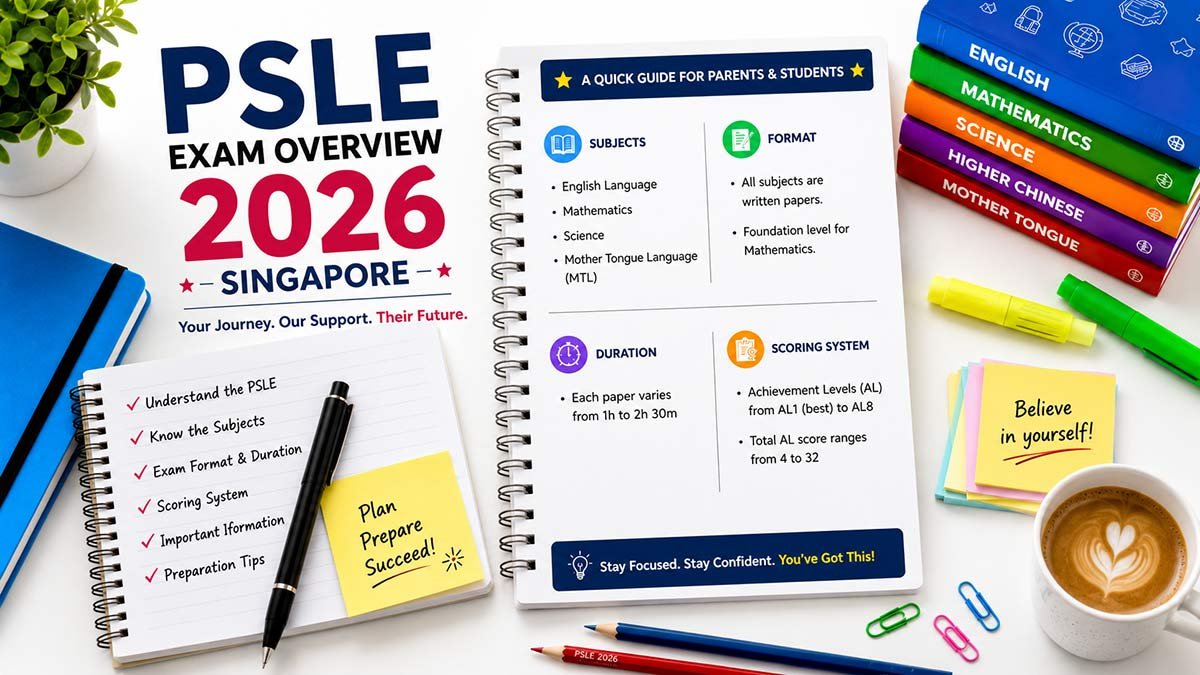
PSLE 2026 essentials — textbooks, planner and stationery laid out for revision.
Official PSLE 2026 Examination Timetable
Below is the full 2026 PSLE examination timetable covering all subjects and language papers. The schedule is organised by date to help families and tutors plan revision sessions, rest days and last-minute reviews efficiently. Kindly refer to the official MOE website for the latest announcements regarding national examinations and key academic dates.
Date | Start | End | Subject Name | Exam Type | Duration |
Wed, 12 Aug 2026 | 08:00 | 13:30 | English Language | Oral | — |
Wed, 12 Aug 2026 | 08:00 | 13:30 | Foundation English Language | Oral | — |
Wed, 12 Aug 2026 | 08:00 | 13:30 | Chinese Language | Oral | — |
Wed, 12 Aug 2026 | 08:00 | 13:30 | Malay Language | Oral | — |
Wed, 12 Aug 2026 | 08:00 | 13:30 | Tamil Language | Oral | — |
Thu, 13 Aug 2026 | 08:00 | 13:30 | English Language | Oral | — |
Thu, 13 Aug 2026 | 08:00 | 13:30 | Chinese Language | Oral | — |
Thu, 13 Aug 2026 | 08:00 | 13:30 | Malay Language | Oral | — |
Thu, 13 Aug 2026 | 08:00 | 13:30 | Tamil Language | Oral | — |
Thu, 13 Aug 2026 | 08:00 | 13:30 | Foundation Chinese / Malay / Tamil | Oral | — |
Thu, 13 Aug 2026 | 08:00 | 13:30 | Bengali / Gujarati / Hindi / Panjabi / Urdu | Oral | — |
Thu, 13 Aug 2026 | 08:00 | 13:30 | Foundation Bengali / Gujarati / Hindi / Panjabi / Urdu | Oral | — |
Tue, 15 Sep 2026 | 09:00 | 09:35 | Chinese / Malay / Tamil Language | LC | 00:35 |
Tue, 15 Sep 2026 | 09:00 | 09:40 | Foundation Chinese / Malay / Tamil | LC | 00:40 |
Tue, 15 Sep 2026 | 09:00 | 09:30 | Bengali / Gujarati / Hindi / Panjabi / Urdu | LC | 00:30 |
Tue, 15 Sep 2026 | 09:00 | 09:30 | Foundation Bengali / Gujarati / Hindi / Panjabi / Urdu | LC | 00:30 |
Tue, 15 Sep 2026 | 11:15 | 11:50 | English Language | LC | 00:35 |
Tue, 15 Sep 2026 | 11:15 | 11:50 | Foundation English Language | LC | 00:35 |
Thu, 24 Sep 2026 | 08:15 | 09:25 | English Language | Written | 01:10 |
Thu, 24 Sep 2026 | 10:30 | 12:20 | English Language | Written | 01:50 |
Thu, 24 Sep 2026 | 08:15 | 09:25 | Foundation English Language | Written | 01:10 |
Thu, 24 Sep 2026 | 10:30 | 11:30 | Foundation English Language | Written | 01:00 |
Fri, 25 Sep 2026 | 08:15 | 09:25 | Mathematics | Written | 01:10 |
Fri, 25 Sep 2026 | 10:30 | 11:50 | Mathematics | Written | 01:20 |
Fri, 25 Sep 2026 | 08:15 | 09:15 | Foundation Mathematics | Written | 01:00 |
Fri, 25 Sep 2026 | 10:30 | 11:15 | Foundation Mathematics | Written | 00:45 |
Mon, 28 Sep 2026 | 08:15 | 09:05 | Chinese / Malay / Tamil | Written | 00:50 |
Mon, 28 Sep 2026 | 08:15 | 09:05 | Bengali / Gujarati / Hindi / Panjabi / Urdu | Written | 00:50 |
Mon, 28 Sep 2026 | 10:15 | 11:55 | Chinese / Malay / Tamil | Written | 01:40 |
Mon, 28 Sep 2026 | 10:15 | 11:55 | Bengali / Gujarati / Hindi / Panjabi / Urdu | Written | 01:40 |
Mon, 28 Sep 2026 | 08:15 | 08:55 | Foundation Chinese / Malay / Tamil | Written | 00:40 |
Tue, 29 Sep 2026 | 08:15 | 10:00 | Science | Written | 01:45 |
Tue, 29 Sep 2026 | 08:15 | 09:30 | Foundation Science | Written | 01:15 |
Wed, 30 Sep 2026 | 08:15 | 09:05 | Higher Chinese / Malay / Tamil | Written | 00:50 |
Wed, 30 Sep 2026 | 10:15 | 11:35 | Higher Chinese / Malay / Tamil | Written | 01:20 |
Month-by-Month PSLE 2026 Revision Roadmap
A well-paced revision plan is far more effective than last-minute cramming. Use the following month-by-month roadmap as a flexible guide — adjust the intensity to your child’s needs, school commitments and rest requirements.
June — Identify the Gaps
Use the June school holidays to take stock of where your child stands. Gather two or three recently marked practice papers and review them together. A simple highlighter exercise — yellow for conceptual gaps, pink for careless mistakes and blue for timing issues — gives a clear, visual picture of which areas need the most attention. June is also the right time to establish a consistent weekly study routine with protected rest periods.
July — Master the Oral Examinations
With oral exams on 12 and 13 August, July is the critical preparation window. Short daily sessions of 15 to 20 minutes are far more effective than long, occasional sessions. Focus on reading aloud with clear pronunciation, expression and pace, and on giving reasoned, well-structured responses to stimulus-based conversations. Use materials provided by your child’s school as these are calibrated to the expected standard.
August — Build Exam Stamina
Once the oral examinations are completed, attention shifts to full-paper, timed practice. Work through complete papers under exam conditions rather than topical exercises alone. After every paper, the review matters as much as the attempt — apply the highlighter exercise again to ensure your child is learning from each mistake.
September — Sharpen and Stay Calm
In the final two weeks, reduce the volume of new content and focus on refining exam techniques, time management and answer presentation. Prioritise quality sleep, balanced meals and short outdoor breaks. Confidence comes from familiarity and rest, not from rushing through endless new papers.

Personalised one-to-one PSLE home tuition with an experienced Singapore Home Tuition tutor.
Study Techniques That Genuinely Work
Educational research consistently shows that two techniques deliver the strongest results for long-term retention: practice testing and spaced practice. In contrast, rereading notes and highlighting feel productive but have limited effect on real exam performance.
- Practice Testing — Active retrieval of information through quizzes and past-year papers strengthens memory far more than passive review.
- Spaced Practice — Short, regular study sessions over weeks beat long, last-minute cramming. Revisit each topic three to four times across spaced intervals.
- Interleaving — Mix different topics or subjects within a study session to build flexibility in applying concepts.
- Self-Explanation — Encourage your child to explain a worked solution aloud. If they cannot explain it, they have not truly understood it.
English Language
Strong reading habits, daily writing practice and clear oral expression are the foundations of a strong PSLE English score. Focus on situational writing structure, composition planning, comprehension inference questions and grammar editing. Practise oral reading aloud and stimulus-based conversation regularly with a tutor or parent.
Mathematics
Mastery of heuristics — model drawing, working backwards, guess-and-check and units-and-parts — is critical for Paper 2 problem sums. Build accuracy in Paper 1 through daily mental sums and arithmetic drills. Always review wrong answers using the highlighter method to separate conceptual gaps from careless errors.
Science
PSLE Science rewards precise scientific language and structured answers. Focus on keyword application, cause-and-effect explanations and experimental analysis. Build a personalised concept map for each theme — Diversity, Cycles, Systems, Interactions and Energy — and revisit it weekly.
Mother Tongue Languages
Consistent daily exposure through reading, listening and conversation builds fluency. Use school-provided oral materials and engage in short, daily conversations to strengthen pronunciation and vocabulary. Composition practice should focus on plot structure, descriptive vocabulary and clear handwriting.
Why Parents Choose Singapore Home Tuition for PSLESingapore Home Tuition is a trusted one-to-one home tuition agency dedicated to helping Primary 6 students achieve their best possible PSLE results. Every lesson is conducted in the comfort and safety of your home, with a tutor matched specifically to your child’s learning style, current level and target secondary school.
- 100% one-to-one home tuition — no group classes, no shared attention
- MOE-aligned curriculum coverage across English, Mathematics, Science, Chinese, Malay and Tamil
- Carefully screened tutors: MOE teachers, full-time tutors and top undergraduates
- Flexible scheduling that fits around school, CCAs and family commitments
- Free tutor matching service — parents pay no agency fees
- Replacement guarantee if the first tutor is not the right fit