
You may understand the theory in lectures but still struggle to apply it to assignment questions or exam-style problems. An NTU engineering module tutor can help you work through those gaps when their subject knowledge and teaching approach fit the topics you are studying.
A useful match depends on more than a general engineering background. Consider the tutor’s knowledge of your priority topics, such as engineering mathematics, mechanics of materials or fluid mechanics, how they explain difficult ideas, and whether lesson times fit your university schedule. The tutor should also understand your academic needs and adapt lessons to your learning style.
This guide explains how to assess subject fit, teaching approach and lesson format, then prepare for focused sessions and review your progress. Singapore Home Tuition provides one-to-one home and online tuition for university students, matches students with suitable educators, verifies tutor qualifications and ability, and delivers tutor profiles within 24 hours. Support is available throughout student matching.
Key Takeaways
- Identify whether you need help with concepts, problem-solving or working through questions at the pace of your module.
- Choose an NTU engineering module tutor whose subject background fits the specific topics you want to study.
- Compare home tuition, online tuition and independent study based on interaction, convenience and access to materials.
- Bring relevant module materials, list your questions and prioritise difficult topics before each lesson.
- Share your module topics, learning gaps and preferred format to guide a suitable tutor match.
When Can an NTU Engineering Module Tutor Make a Difference?
One-to-one tuition can help when you know which parts of a module are causing difficulty. Engineering courses often combine theory, calculations and practical applications, but your main challenge may be limited to one of those areas. A tutor can help you revisit a concept, practise problem-solving or work through a method you have not yet mastered.
Tutoring should support your learning, not replace independent study or involve someone completing assignments for you. The aim is to understand the reasoning behind a solution and build the skills to apply it yourself. As a foundation, you can read more about what tutoring is and how it provides individual academic support.
Which engineering topics might need focused support?
Depending on your module, you might need help with calculus, circuit theory, thermodynamics or programming. These are examples, not a checklist for every engineering course. Review your current module outline, lecture materials and assessment details to identify which subjects and methods your lessons should focus on.
Look back through lecture notes, tutorial questions and marked work to pinpoint where you get stuck. Are you unsure about a principle, a calculation step or how to apply a method to an unfamiliar problem? Write down a specific example for each difficulty. That gives you and your tutor a practical starting point.
When is one-to-one module tutoring useful?
Individual lessons give you time to raise specific questions and work at a pace that suits your understanding. If a core concept is unclear, a tutor can explain it another way and check which part still needs attention. If you understand the theory but struggle to use it, focus lesson time on applying a method to practice problems and explaining each step.
Set a clear focus for each session. You might first clarify a concept, then attempt a related problem yourself with guidance. One-to-one tuition is most productive when you take part, review the material between lessons and use feedback to guide further practice. It can support your learning, but it cannot guarantee a particular grade.
How to Evaluate an NTU Engineering Module Tutor’s Subject Fit
Start with the module topics you need help with, rather than a broad label such as “engineering.” Identify the concepts or methods causing difficulty, then compare them with the tutor’s relevant subject background and ability to explain foundational ideas clearly. A tutor may be well suited to one topic area without being the right fit for every engineering subject.
What subject expertise should the student look for?
Review your current module outline and note the specific areas where you need support. NTU’s College of Engineering includes different engineering disciplines, so the knowledge needed for one module may differ from another. Share relevant module details, lecture notes or selected tutorial questions when discussing your learning goals. These examples help define the support you are looking for.
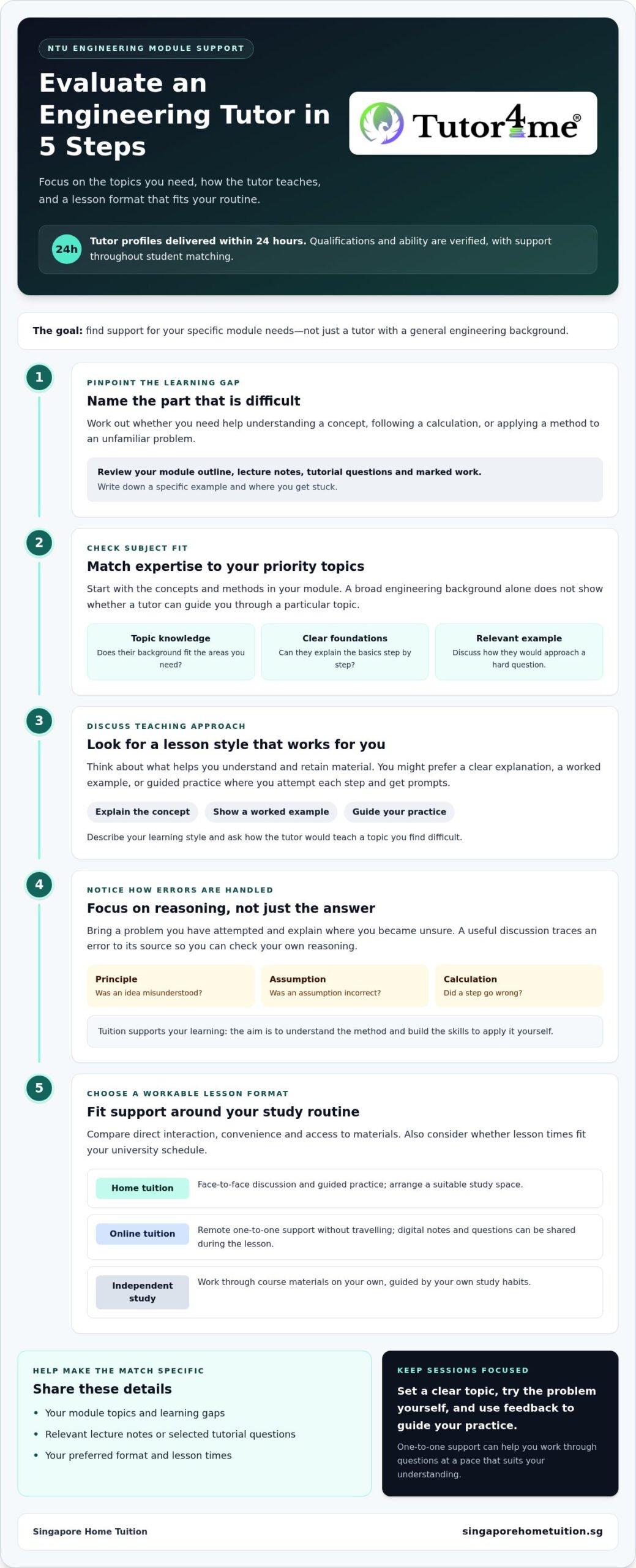
Look for a clear connection between the tutor’s subject background and your priority topics. A broad engineering qualification or interest alone does not show how well someone can guide you through a particular concept. Consider whether the tutor can explain the fundamentals in clear steps, then connect them to the methods used in your module. Ask how they would approach one of the questions you find difficult.
How can teaching approach fit the student’s learning style?
Think about what helps you understand and retain material. You might benefit from a clear explanation, a worked example or guided practice where you attempt each step and receive prompts. Describe your learning style and ask how the tutor would approach a topic you find difficult. A useful discussion should give you a clear picture of the proposed lesson, rather than rely on general claims about teaching.
You can also discuss how the tutor helps students diagnose errors. Do they trace a mistake back to a misunderstood principle, an incorrect assumption or a calculation step? Learning to identify the source of an error can help you check your own reasoning instead of simply following a demonstrated solution. Bring a problem you have attempted and explain where you became unsure.
Use these points to describe your academic needs when arranging one-to-one support. For broader guidance on top home tutor matching, consider how subject fit, teaching approach and your preferences work together. A focused match can make lesson time more useful, while your own practice remains an essential part of learning.
Compare Tutoring Formats and Support for NTU Engineering Modules
The right format depends on your academic needs, study environment and routine. One-to-one home tuition and online tuition provide direct interaction with a tutor. Independent study lets you work through course materials on your own. Compare how each option supports your concentration, questions and regular study habits.
| Format | Interaction | Convenience and materials | May suit you if… |
|---|---|---|---|
| One-to-one home tuition | Face-to-face discussion and guided practice with a tutor. | Study at home; access to physical or digital materials depends on what you use in lessons. | You prefer in-person explanations and can arrange a suitable study space. |
| Online tuition | Remote one-to-one discussion and support. | Study without travelling; digital notes and questions can be shared during the lesson. | You’re comfortable learning online and want support from home. |
| Independent study | You work through questions and notes on your own. | Choose when and where to study; use your existing course materials and resources. | You can set your own study plan and need time for individual practice. |
Home tuition or online tuition: which may suit the student?
Home tuition gives you face-to-face support in a home setting. Online tuition provides remote one-to-one support, so you can study without travelling. Consider where you concentrate best, whether you prefer discussing equations or diagrams face to face, and how you will access the notes and questions needed for a lesson. Choose the format that makes focused, regular learning practical for you.
How does tutoring differ from self-study tools?
A tutor can respond to your questions, adjust an explanation and guide you through a problem as you work. Self-study tools and independent revision let you practise at your own pace, but they do not provide the same direct exchange. Both can support your learning. Tutoring should complement NTU lectures, official course materials and your own revision, not replace them.
Before arranging lessons, consider questions to ask a potential tutor, such as how they structure practice or work through errors. For broader guidance on finding one-to-one support, explore top home tutor matching and consider which format best fits your learning preferences.
Prepare for NTU Engineering Module Tuition and Track Progress
A focused lesson starts with a clear picture of what you are studying and where you are getting stuck. Before meeting an NTU engineering module tutor, gather relevant materials and choose a specific goal. You do not need to prepare every topic at once. A short, prioritised list helps you use lesson time well.
What should a student bring to the first lesson?
Use this simple preparation plan:
- Gather relevant materials. Bring the current module outline, lecture notes and selected tutorial questions or marked work. Use materials you are permitted to share, and do not reproduce or distribute restricted course content.
- List your questions. Note the steps or ideas that feel unclear. Point to where you lose track of a derivation or explain why you are unsure which method to choose.
- Prioritise difficult topics. Choose the areas that are blocking your understanding or are relevant to upcoming coursework. Review current official module information if you are unsure which topics or assessments to prioritise.
- Agree on a lesson focus. Decide whether you need a concept explained, a worked example discussed or guided problem-solving practice. Adjust the focus as you identify your learning gaps.
How can the student tell whether the support is helping?
Look for evidence of understanding, not a promised grade change. After a lesson, explain the key idea in your own words, then attempt a similar problem without copying the tutor’s steps. Can you identify the relevant principle, choose a method and check your reasoning? If not, note the step where you need more guidance.
Keep a brief record after each session: what feels clearer, what still needs work and what you want to ask next. This helps you and your tutor adjust priorities when a topic proves difficult or your coursework changes what needs attention. Progress can be uneven, so use your attempts and explanations to guide the next lesson instead of expecting every gap to close at once.
Prepare your module topics and learning questions to explore one-to-one tuition. Share your academic needs for tutor matching.
Find a Suitable NTU Engineering Module Tutor Through Personalised Matching
A useful match starts with specific information, not just a request for general engineering help. Tell us your module or subject area, the topics you find difficult and the support you want. Share your preferred tuition format too. These details help guide matching towards a tutor whose subject background and teaching approach suit your academic needs.
What information helps shape a suitable tutor match?
Before requesting an NTU engineering module tutor, prepare a brief summary of:
- Subject area and module topics: Name the engineering discipline and concepts you want to focus on.
- Learning gaps: Explain whether you need help understanding theory, applying methods or practising problem-solving.
- Learning preferences: Say whether you find worked examples, step-by-step explanations or guided practice most useful.
- Materials and format: Note which current module materials can help explain your needs, and whether you prefer one-to-one tuition at home or online.
Specific details give the matching process a clearer direction. For example, describe the topic you are studying and where your reasoning gets stuck, rather than saying only that an engineering module feels difficult. Selected notes or questions can help clarify the lesson focus. Follow any restrictions on course materials.
What support is available after tutor matching?
Singapore Home Tuition supports students from tutor matching through lesson arrangements. Tutor qualifications and ability are verified, and hand-picked tutor profiles are delivered to parents within 24 hours. Use the profile details to assess subject background and teaching fit against your learning needs.
If the existing match is unsuitable, instant reassignment is available. Explain what is not working, such as a mismatch in subject focus or teaching approach, so the next matching step can take your feedback into account. For broader guidance, read about top home tutor matching.
Start by outlining your module topics, learning gaps and preferred format. Share your academic needs to explore a suitable tutor match.
Take the Next Step Towards Focused Module Support
Choosing an NTU engineering module tutor starts with identifying the topics you need help with, then comparing subject background, teaching approach and lesson format. Bring specific questions and current module materials to your lessons. Afterwards, check whether you can explain the concepts and attempt similar problems independently. Tutoring can support your learning, while your own practice remains essential.
Singapore Home Tuition has more than 1,000 tutors in its database, verifies tutor qualifications and ability, and delivers hand-picked tutor profiles within 24 hours. Dedicated support is available, including instant reassignment if the existing match is unsuitable.
Share your module topics, learning gaps and preferred format to get started with one-to-one home or online tuition. Share your academic needs and find a suitable tutor. A clear lesson focus can help you work through challenging coursework one step at a time.
Frequently Asked Questions
How do I find an NTU engineering module tutor?
Identify your engineering subject area, the module topics you find difficult and the kind of support you want. Share these details, your preferred tuition format and relevant study materials to guide the tutor match. Singapore Home Tuition verifies tutor qualifications and ability, and delivers hand-picked tutor profiles within 24 hours. Review the profiles for a fit with your subject needs and learning preferences.
Can a private tutor help with NTU engineering modules?
Yes. One-to-one tuition can focus on concepts or problem-solving steps you need to practise. You can ask for help understanding a principle, then work through a similar question with guidance. Tutoring complements your lectures, official module materials and independent revision. Check your current module outline and assessment details so lesson priorities reflect what you are studying.
What should I look for in an engineering module tutor?
Look for relevant subject knowledge, clear explanations and a teaching approach that suits how you learn. A broad engineering background alone does not show a tutor’s fit for every module. Share a topic or question you find difficult and discuss how the tutor would explain it or guide you through an unfamiliar problem. Tutor qualifications and ability verification can also help you assess a match.
Is online tuition suitable for NTU engineering students?
Online tuition can suit you if you are comfortable discussing concepts remotely and working with digital notes, diagrams or questions during a lesson. It provides one-to-one support without travel, while home tuition offers face-to-face interaction. Consider where you concentrate best and which format helps you participate actively. Your preference and study routine can help guide the choice.
How can I prepare for an engineering tuition lesson?
Bring the current module outline, lecture notes and a few relevant tutorial questions or marked attempts. List the exact steps or ideas that are unclear, then choose the topics you most want to address. Agree on a lesson focus, such as clarifying a concept or practising problem-solving. Share only materials you are permitted to use, and avoid reproducing or distributing restricted course content.
Can I change tutors if the match is not suitable?
Yes. Instant reassignment is available if the existing tutor match is unsuitable. Explain what is not working, such as a mismatch in subject focus, communication or teaching approach, so your feedback can guide the next matching step. Dedicated support is available during student matching. A tutor change gives you a way to seek a better fit for your learning needs.