
What if more worksheets aren’t the best way to prepare your child for a maths competition? Effective math olympiad training for primary school is less about repeating familiar questions and more about spotting patterns, explaining reasoning and trying a fresh approach when the answer isn’t obvious.
If you’re unsure what preparation involves, you’re not alone. It can be difficult to tell the difference between useful problem-solving practice and extra work that adds pressure. You may also want your child to explore challenging questions without losing confidence in everyday school maths.
This guide explains the skills and habits competition-style mathematics can develop, and how to choose practice that fits your child’s interests, level and schedule. You’ll find ways to keep preparation balanced, check what to know about a competition, and decide whether tailored explanations or feedback from a one-to-one maths tutor could help. If you consider tuition, ask about the tutor’s experience with non-routine problems and competition preparation. Not every maths tutor offers olympiad training. The aim is steady progress, confidence and curiosity, not simply a larger stack of worksheets.
Key Takeaways
- Think of math olympiad training for primary school as guided work on unfamiliar questions, alongside regular maths learning.
- Help your child build a repeatable approach: understand the question, explore a method, explain the reasoning and review the result.
- Choose self-study, group practice or one-to-one tuition based on the feedback, pace and motivation your child needs.
- Begin with questions suited to your child’s current understanding, then set a routine that leaves room for schoolwork, rest and other interests.
- Before choosing a tutor, ask about their approach, rapport with your child and experience guiding primary students through non-routine maths problems.
What does math olympiad training for primary school involve?
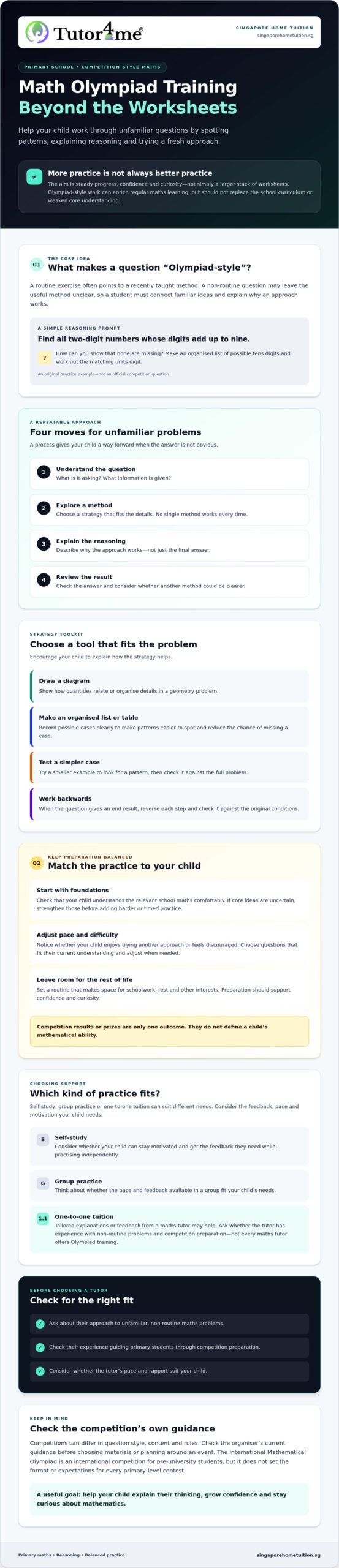
Math olympiad training for primary school is guided practice in applying familiar mathematical ideas to unfamiliar, non-routine questions. The aim is to help a child identify useful information, choose a strategy and explain why it works. This practice can enrich regular maths learning, but it shouldn’t replace the school curriculum or weaken understanding of core concepts.
Preparation depends on a child’s interests, confidence and current foundations, as well as the particular competition they may enter. Competitions can differ in question style, content and rules. Before choosing materials or planning around an event, check the organiser’s current guidance for its requirements. For wider context, the International Mathematical Olympiad (IMO) is an international competition for pre-university students, but it isn’t a guide to the format or expectations of every primary-level contest.
How is olympiad-style problem-solving different from routine practice?
Routine exercises often ask students to apply a method they’ve just learned. An olympiad-style question may not make the useful method obvious. A student needs to connect known ideas, try a representation such as a list or diagram, and check whether their reasoning covers every possibility. The explanation matters, not just the final answer.
For example, ask your child to find all two-digit numbers whose digits add up to nine, then explain how they know none are missing. They might list possible tens digits and work out the matching units digit for each. This original practice example isn’t an official competition question. It shows how systematic thinking can turn a simple idea into a clear reasoning task.
Is competition preparation suitable for every primary student?
There’s no single readiness test. Curiosity and a willingness to explore a question can matter as much as speed or advanced techniques. Start by checking whether your child understands the relevant school maths comfortably. If core ideas are still uncertain, strengthen those first rather than adding harder or timed practice.
Watch how your child responds. Do they enjoy trying a second approach, or do challenging questions leave them discouraged? Adjust the difficulty and pace accordingly. A competition result or prize is only one outcome; it doesn’t define a child’s mathematical ability. Preparation should support confidence and interest, with room to pause or change direction if it stops feeling constructive.
How do primary students build stronger mathematical reasoning?
Strong reasoning develops through a process a child can repeat, not by memorising a shortcut for every question. During math olympiad training for primary school, encourage your child to pause and ask: What is the question asking? What information do I have? Which approach could help? Can I explain why it works? Then review the result and consider whether another method would be clearer.
This sequence gives students a way forward when a question feels unfamiliar. It also helps you identify where support is needed: understanding the wording, choosing a strategy, carrying it out or checking the answer. A correct answer is useful, but the reasoning behind it helps a child tackle new problems independently.
Which problem-solving strategies can primary students practise?
Choose a strategy that suits the information in the question. No single method works every time.
- Draw a diagram to show how quantities relate, or to organise details in a geometry problem.
- Make an organised list or table when a question has several possible cases. A clear record makes patterns easier to spot and reduces the chance of missing a case.
- Test a simpler case if the original question feels complicated. A smaller example may reveal a useful pattern, which the student can then check against the full problem.
- Work backwards when the question gives an end result and asks how it was reached. Reverse each step carefully, checking that it matches the original conditions.
Ask your child to talk through the choice: “Why did you draw that?” or “How does this table help?” These questions encourage explanation without taking over the problem. The Math Olympiads for Elementary and Middle Schools (MOEMS) site can also give families a reference point for exploring an elementary-level maths competition.
How should students learn from a difficult question?
Give your child time to make a first attempt before offering a hint or worked solution. If they get stuck, ask which part is clear and where their reasoning stopped. A small prompt, such as suggesting a diagram or asking them to try a simpler case, can help them continue without removing the challenge.
After reviewing a solution, have your child explain the key step in their own words. Return to a similar question later without showing the earlier working. If they can choose and explain a method independently, they’re beginning to apply the idea rather than copy a procedure. If they need more individual explanation, you can explore PSLE home tuition for support with primary maths foundations and feedback.
Self-study, group practice, or one-to-one tuition: which fits?
The best practice format depends on how your child learns, works through difficulty and responds to feedback. Self-study offers independence and flexibility. Group practice, where available, can let students compare different approaches. One-to-one tuition allows explanations and pace to be adjusted to the learner. None is a guaranteed shortcut. The aim is to find support that builds understanding without adding unnecessary pressure.
Use these questions to compare the options:
- Feedback: Can your child spot an error alone, or would timely guidance help them see where their reasoning shifted?
- Pace: Does the student like to spend time exploring, or need help breaking a challenging question into manageable steps?
- Motivation: Does working independently hold their interest, or do they benefit from discussing ideas with others?
- Explanation: Can your child explain why a method works, not just record an answer?
For a reference on teaching reasoning to younger learners, the Education Endowment Foundation describes an approach designed to develop pupils’ understanding of logical principles. Consider what kind of guidance your child needs to make progress with unfamiliar questions, rather than choosing a format based on the label alone.
When can independent practice be enough?
When might a one-to-one tutor be useful?
Individual support may help if the same misunderstanding keeps appearing despite thoughtful practice, or if your child needs clearer explanations before they can continue independently. Ask how a tutor would adapt explanations to your child’s learning style, and request specific examples of guiding primary students through non-routine maths questions. If competition preparation is a priority, confirm relevant experience directly. One-to-one maths tuition can provide tailored feedback, but it doesn’t replace the student’s own effort or guarantee competition results.
Group practice may be a good fit if your child gains motivation from hearing how others approach a question, though access and format will vary. Choose the arrangement that helps your child think, explain and learn from mistakes while keeping regular school maths and wellbeing in view.
How can parents plan olympiad practice without adding pressure?
Start with a short set of varied questions that reflects what your child currently understands, rather than choosing material based only on their school year. Notice which ideas they can use confidently and where they need support. This first check is for planning, not grading. It helps you set a suitable level before adding more challenging or timed practice.
Build practice around your child’s schoolwork, rest and other interests. A routine is useful only if it remains manageable and your child is willing to take part. Adjust the challenge gradually. If practice leads to ongoing distress, frequent conflict or a drop in confidence, pause and reconsider the workload. You can return to it later or seek guidance from a teacher or tutor.
What should a simple weekly practice routine include?
Choose a small number of questions with varied demands instead of assigning a large stack. Leave space for your child to try each problem, explain their thinking, correct any errors and reflect on what they might try next time. The aim is thoughtful engagement, not completing as many questions as possible.
Keep the schedule flexible. If the week is busy, reduce or skip a session rather than squeezing practice into time needed for rest or other commitments. Check in regularly: is your child still curious, or does the routine feel like another test? Use their response to decide whether to maintain, adjust or pause the plan.
How can parents check progress without focusing only on scores?
Look beyond correct answers. Can your child describe a strategy in their own words? Are they more willing to try an unfamiliar question, or better able to notice where an approach stopped working? Keep a brief note of recurring difficulties and examples of more independent reasoning. These signs can reveal progress even when a question is still answered incorrectly.
Use school mathematics understanding and wellbeing as part of the picture. If competition practice is making core learning feel unsettled, return to foundational concepts before increasing the difficulty. A calm conversation can help you understand what feels engaging and what feels too demanding. Your child’s confidence and interest matter alongside their performance.
If your child needs more support with primary maths, explore PSLE home tuition and discuss their current learning needs and the kind of guidance that may suit them.
How can the right tutor support primary olympiad preparation?
A suitable tutor match involves more than strong maths knowledge. Consider three parts separately: whether the tutor understands primary mathematics, how they teach unfamiliar problems, and whether your child feels comfortable asking questions and making mistakes. For math olympiad training for primary school, subject expertise alone doesn’t confirm competition-preparation experience, so ask about it directly.
Before lessons begin, agree on what you want the support to achieve. You might focus on strengthening foundations, practising non-routine questions or helping your child explain their reasoning. Discuss a manageable workload, how feedback will be given and how you’ll review progress. Keep school learning and your child’s wellbeing in view. If you’re also considering broader examination preparation, see the PSLE home tuition guide.
What should parents ask before choosing a maths tutor?
Ask how the tutor would identify gaps and adjust questions to your child’s current understanding. Request specific examples of how they guide primary students through non-routine maths problems, including what they do when a student gets stuck. Confirm any relevant competition-preparation experience rather than assuming it from a general maths background. You can also discuss your child’s interests, learning style, schedule and preferred lesson format, such as home or online tuition.
Notice how the tutor responds to your child’s questions. A helpful approach should make room for the student to think and explain, rather than rushing to demonstrate a solution. Rapport matters because a child is more likely to share confusion when they feel heard and supported.
How can a tuition agency help with the tutor match?
A tuition agency can help match a student with an educator based on their academic needs, subject and preferred learning format. Singapore Home Tuition provides personalized one-to-one home and online tuition, and its pool includes MOE teachers, experienced full-time tutors and university undergraduates. When discussing a match, explain that your child needs support with non-routine primary maths problems and ask whether a potential tutor has relevant competition-preparation experience. That experience should be confirmed directly rather than assumed from general maths expertise.
Use an initial conversation to confirm the tutor’s teaching approach, experience with primary-level problem-solving and willingness to agree on clear goals and feedback. If the fit doesn’t seem right, raise your concerns with the agency. A careful match can make individual tuition a useful source of tailored explanations, but it isn’t a shortcut or a guarantee of competition results.
Explore PSLE tuition support if you’re considering one-to-one help with your child’s primary maths learning.
Build a confident next step for your child
Helpful math olympiad training for primary school develops more than competition technique. It gives your child practice approaching unfamiliar questions, explaining a method and learning from mistakes. Start with suitable questions, protect time for schoolwork and rest, and adjust the pace to your child’s interest and confidence.
If you’re considering a tutor, look for a match across subject knowledge, teaching approach and rapport. Ask about experience guiding primary students through non-routine maths problems, and agree on goals and feedback before lessons begin. Competition-specific experience should be confirmed rather than assumed.
Singapore Home Tuition offers personalized one-to-one tuition at home or online, with tutors matched to students’ academic needs. Its educators include MOE teachers, experienced full-time tutors and university undergraduates. Discuss your child’s primary maths foundations and ask about a tutor’s experience with non-routine problems before deciding whether the match is suitable.
Find a suitable maths tutor for your child if tailored explanations and feedback may help. Keep curiosity at the centre, and let steady reasoning practice support your child’s confidence in mathematics.
Frequently Asked Questions
What is math olympiad training for primary school?
Math olympiad training for primary school is guided practice in solving unfamiliar, non-routine maths questions. Students learn to identify useful information, choose a strategy, explain their reasoning and review their answers. It can enrich a child’s mathematical learning, but it shouldn’t replace regular schoolwork or foundational practice. The focus is on developing flexible problem-solving habits, not simply completing large numbers of worksheets or memorising competition tricks.
At what age can a child start math olympiad training?
There’s no single age at which every child should start. Begin with questions that match your child’s current understanding and interest, rather than assuming they’re ready because of their school year. A secure grasp of relevant maths foundations can make challenging practice more manageable. If you’re considering a specific competition, check its organiser’s current eligibility rules, as age or primary-level requirements can vary between events.
How can I help my child prepare for a math olympiad at home?
Choose a few questions at a suitable level and give your child time to try them independently. Ask them to explain their approach, then review any errors together without rushing to show a solution. Diagrams, organised lists or simpler examples may help, depending on the problem. Keep practice manageable and protect time for schoolwork, rest and other interests. If your child becomes persistently distressed, pause and reconsider the routine.
Does math olympiad training help with school mathematics?
It can give students extra practice in reasoning, explaining methods and approaching unfamiliar questions, which may complement school mathematics. The benefit depends on the child’s foundations and how the practice is used. Olympiad preparation shouldn’t displace learning required for school or PSLE. If core concepts are uncertain, strengthen those first. Treat competition practice as enrichment, not as a promise of higher school marks or a replacement for curriculum learning.
Should primary students use a tutor for math olympiad preparation?
A tutor isn’t necessary for every primary student, but one-to-one support may help when a child repeatedly struggles with the same ideas or needs tailored explanations and feedback. Ask how the tutor teaches non-routine questions and whether they have relevant competition-preparation experience. Don’t assume that experience from a general maths background. Agree on suitable goals and workload, and check that your child feels comfortable asking questions and working through mistakes.
How often should a primary student practise math olympiad questions?
There isn’t one practice frequency that suits every child. Start with a manageable routine that fits around schoolwork, rest and other activities. A small set of questions with time to attempt, discuss and review them may be more useful than frequent drills without reflection. Adjust the routine based on your child’s engagement, confidence and understanding. If practice starts causing ongoing stress, reduce it or take a break.
Are math olympiad questions part of the PSLE?
Math Olympiads are separate competitions, not a named component of the PSLE. PSLE Mathematics assesses primary maths learning, including students’ ability to apply mathematical understanding to questions. Olympiad problems may use non-routine approaches or extend beyond familiar school exercises, so preparation for one shouldn’t be treated as PSLE preparation by itself. For current PSLE expectations, check the relevant official guidance and keep your child’s school learning as the priority.