
What if the best preparation from a private tutor for GEP selection test isn’t more test drilling, but stronger reasoning habits? It’s understandable to want clear guidance when the process is changing and your child’s needs are individual.
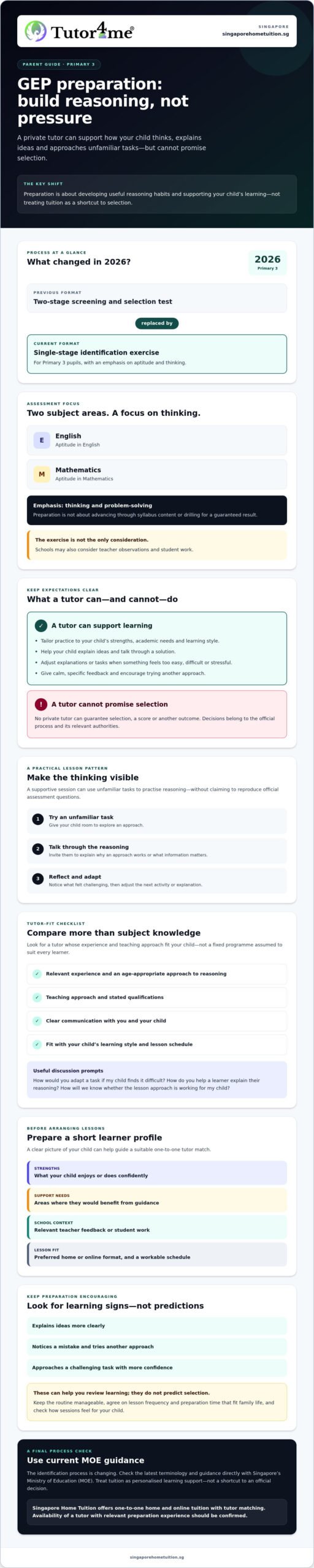
In 2026, the old two-stage GEP screening and selection test has been replaced by a single-stage identification exercise for Primary 3 pupils. The exercise assesses aptitude in English and Mathematics, with an emphasis on thinking and problem-solving rather than advanced syllabus knowledge. Schools may also consider teacher observations and student work, so preparation shouldn’t be treated as a shortcut to selection.
This guide explains what responsible tuition can involve and how to assess a tutor’s relevant experience, teaching approach and fit with your child’s learning style. You’ll find practical questions to ask, ways to keep preparation encouraging rather than pressurised, and how to request a suitable tutor match for one-to-one home or online tuition.
Key Takeaways
- Check whether a private tutor for GEP selection test preparation has relevant experience and can explain an age-appropriate approach to reasoning and problem-solving.
- Use tuition to support your child’s academic needs and learning style, not as a promise of selection or a reason for excessive test drilling.
- Compare tutors by teaching approach, stated qualifications, communication and schedule fit before choosing a match.
- Prepare a short learner profile with your child’s strengths, areas for support, relevant school feedback, preferred lesson format and schedule.
- Singapore Home Tuition offers one-to-one home and online tuition with tutor matching. Ask whether a tutor with relevant preparation experience is available.
What should parents know before hiring a private tutor for the GEP selection test?
If you’re unsure what preparation involves, how to judge a tutor’s fit or what tuition can realistically achieve, start by separating academic support from selection outcomes. A private tutor can work with your child individually, identify areas to develop and help build useful learning habits. They can’t decide whether your child is selected.
Preparation support means guided practice that helps a child develop reasoning, explain ideas clearly and approach unfamiliar tasks with confidence. It is not a promise of selection or any particular result.
The programme and identification process are changing, so check the latest terminology and guidance directly with Singapore’s Ministry of Education (MOE) before arranging lessons. The Gifted Education Programme (Singapore) page offers background on the programme’s history, but it shouldn’t replace current MOE information when you’re checking what applies to your child.
What does preparation for the GEP selection test involve?
Useful preparation can focus on how your child thinks, explains an answer and responds when a task is unfamiliar. For example, a tutor might ask your child to talk through a solution, explain why one approach works or consider another way to solve a problem. Afterward, the tutor can ask what felt easy or challenging and adjust the next activity accordingly. These are broad learning activities, not claims about specific official question formats.
A suitable tutor should first learn about your child’s strengths, academic needs and learning style. They can then agree on lesson priorities with you, rather than starting with a fixed programme or assuming every child needs the same practice. Ask how the tutor will adapt explanations and tasks if your child finds an activity too easy, difficult or stressful. For instance, a tutor might break a difficult problem into smaller steps, or invite your child to explain a solution in a different way.
Does private tutoring guarantee selection?
No. A private tutor for GEP selection test preparation cannot guarantee selection, a score or another outcome. A tutor provides teaching support; decisions belong to the official process and its relevant authorities. Be cautious of claims that promise a particular result or present intensive drilling as a sure route to selection.
Instead, look for a manageable routine that supports your child’s confidence and curiosity. Agree on lesson frequency and preparation time in a way that fits family life, and check in with your child about how the sessions feel. Progress can include explaining ideas more clearly, noticing a mistake and trying another approach, or attempting a challenging task with greater confidence. These signs can be useful for reviewing learning, but they don’t predict selection.
Before choosing a tutor, confirm their relevant experience and ask how they would tailor lessons to your child. Keep MOE guidance as your source for current process details, and treat tuition as personalised learning support, not a shortcut to an official decision.
What can a private tutor contribute to GEP selection preparation?
One-to-one tuition can give your child space to think aloud, ask questions and receive feedback at their own pace. The value lies in how the tutor responds to the learner, not in repeating a fixed set of drills. Lessons can work on reasoning and problem-solving through unfamiliar tasks without claiming to reproduce official assessment questions.
A tutor can tailor practice, explain ideas in different ways and help a learner reflect on their thinking. These contributions support learning, but they don’t determine selection outcomes.
How can one-to-one support respond to a child’s needs?
Start with a conversation about your child’s strengths, areas where they need support and what they hope to gain from lessons. A tutor can use that picture to set priorities, then adjust the focus as they observe how your child approaches a task. For example, they might encourage a learner to explain a solution step by step, ask what information in a problem matters most, or revisit a concept if the reasoning is unclear.
Feedback should be specific and calm. Rather than simply marking an answer right or wrong, a tutor can ask what the child noticed, where they felt uncertain and what they might try next. This helps your child recognise gaps and practise explaining their thinking without turning every lesson into a high-pressure test. You can also agree on a simple way to review lessons, such as asking which task your child found most interesting and what they would like to practise again.
One-to-one home or online tuition may suit your family, depending on your preference and tutor availability. Ask how the tutor will keep you informed about lesson priorities and your child’s engagement.
Which tutor backgrounds may be relevant?
MOE teachers, experienced full-time tutors and university undergraduates can each bring different experience. A tutor’s background alone doesn’t prove they have relevant preparation experience or a particular teaching approach. Ask about their work with the child’s age group, their experience teaching English or Mathematics, and how they would guide a learner through a challenging task. The official goals of the GEP can also help you consider whether a tutor’s approach supports learning beyond rehearsing answers.
Ask for a practical example of how the tutor would respond if a child got stuck. Listen for a process that gives the learner time to think, checks what they understand and offers a useful next step, rather than immediately supplying the answer. Check the tutor’s stated qualifications and experience, and ask how lessons could change as your child’s needs become clearer.
When considering a private tutor for GEP selection test preparation, focus on the match between your child and the tutor’s teaching approach. A useful next step is to compare tutor profiles against your child’s needs, preferred lesson format and the experience you want to discuss.
How should you compare private tutors for the GEP selection test?
Compare tutors against your child’s needs, not just a title or a claim of specialist preparation. The Ministry of Education’s official Gifted Education Programme information is the better reference for programme details. Use tutor discussions to assess teaching fit, and ask the tuition agency how its matching service considers your requirements.
Use this checklist to compare profiles consistently:
- Relevant experience: Ask about teaching children of a similar age and supporting reasoning or problem-solving. Request examples the tutor can explain, and check stated qualifications rather than assuming a particular background proves GEP preparation expertise.
- Teaching approach: Ask how the tutor would introduce an age-appropriate task, check understanding and respond if your child gets stuck. Clear explanations and room for the child to think aloud are useful signs.
- Communication: Find out how the tutor will share lesson priorities, progress and concerns with you. Agree on how often you’ll review whether the approach is working for your child.
- Schedule and format: Check that the proposed timing and home or online lesson format suit your family and your child’s routine.
Individual tuition gives one tutor the chance to focus on one learner’s questions and pace. A centre-based programme may offer a group setting. Neither format suits every child, so consider where your child feels comfortable participating and what kind of attention they need. Compare the actual teaching approach and format rather than assuming one is automatically better.
Which questions should parents ask a potential tutor?
Ask how the tutor would learn about your child’s academic needs before planning lessons. Invite them to describe relevant experience and give an example of how they teach a challenging idea to a child of this age. You might also ask, “What would you do if my child couldn’t explain how they reached an answer?” and “How would you tell me if the lesson plan needs to change?” Specific answers make it easier to compare tutors fairly.
How can you assess a good child-tutor match?
Notice whether the tutor listens to your child, explains ideas clearly and welcomes questions. After an early lesson, ask your child what felt helpful or uncomfortable. Their response is one part of your decision, alongside the tutor’s experience, communication and practical fit. It is not evidence of a future selection result.
A private tutor for GEP selection test preparation should be able to explain how their approach fits your child, without promising a particular outcome. Use the same criteria for each profile, then choose the tutor whose teaching, communication and schedule best match your family’s needs.
What should you prepare before requesting a GEP tutor match?
A clear tutor brief helps a home tuition agency understand your child’s academic needs and suggest profiles to consider. You don’t need to predict selection or provide a long report. Focus on what your child finds engaging, where support may help and what your family can manage.
What information belongs in a tutor request?
Use this checklist to prepare the key details before requesting a private tutor for GEP selection test preparation:
- Describe the learner: Share your child’s primary level, strengths and areas where they would welcome support. Relevant school feedback can give context, but it doesn’t predict selection.
- Explain learning preferences: Note how your child likes to learn, such as working through examples, talking through ideas or having time to think before answering. If you’re unsure, describe what you’ve noticed during homework or other learning activities.
- State the lesson format: Indicate whether you prefer one-to-one home tuition or online tuition. The options available will depend on family preference and tutor availability.
- Give realistic availability: Share suitable days or time windows and any scheduling limits. You don’t need to include unnecessary personal details.
- Ask about relevant experience: Ask whether a tutor with relevant preparation experience is available, and what qualifications and teaching experience you can discuss before proceeding.
Before lessons begin, agree how the tutor will share lesson priorities and any concerns with you. Set a practical time to review how the arrangement is working, rather than expecting every lesson to produce an immediate result. A short review can cover whether your child understands the explanations, feels comfortable asking questions and is working on the goals you agreed.
How should parents review early lessons?
After the initial lessons, ask your child whether the explanations made sense and whether they felt comfortable asking questions. Discuss the agreed learning goals with the tutor, and check that lesson communication is clear. These conversations help you assess fit and make adjustments if needed.
If the match doesn’t feel suitable, contact the agency to explain what is not working and ask what options are available. Clarify the next steps rather than assuming a replacement or a particular timeline. If you’re planning broader support for later primary-level learning, see this guide to PSLE home tuition.
Ready to describe your child’s needs and preferred lesson format? Share your tutor request and ask whether a suitable tutor is available for this preparation.
How can Singapore Home Tuition help you find a suitable private tutor?
Once you’ve identified your child’s academic needs, preferred lesson format and schedule, a tutor-matching service can help you look for profiles that fit those requirements. Singapore Home Tuition provides one-to-one home and online tuition and matches students with educators such as MOE teachers, experienced full-time tutors and university undergraduates. Share the kind of experience you’re looking for, then review whether a proposed tutor’s background and teaching approach suit your child.
What support can families ask about?
When discussing a possible match, ask what relevant preparation experience the tutor has and what qualifications and teaching experience they can describe. A profile can help you start that conversation, but it is still important to check how the tutor would approach lessons for your child. Ask how the matching process considers your child’s learning style, academic needs and preferred format.
A suitable tutor should be able to explain how they would approach lessons and communicate with you about priorities or concerns. Ask what you can expect to discuss as lessons progress, and how the tutor would adjust if your child finds the work too difficult, too easy or stressful. A profile is a proposal to consider, not a promise of selection or a particular academic result.
Singapore Home Tuition offers personalized one-to-one tuition at home or online across academic levels and subjects. When you enquire, describe the support you want and ask whether an appropriate tutor is available for your child’s needs and schedule.
What is the next step for parents?
Prepare a short brief before you enquire. Include your child’s level, strengths, areas where support may help, preferred lesson format and realistic schedule. Share relevant school feedback if it helps explain your child’s learning needs, but treat it as context rather than a prediction of selection.
Before accepting a profile, discuss the tutor’s relevant experience and confirm availability for your preferred arrangement. If no suitable tutor is available, ask about your options rather than assuming a match can be made. You can also clarify how progress updates and parent communication will work once lessons begin.
For a private tutor for GEP selection test preparation, the next step is a clear conversation about fit, not a promise of results. Request a suitable tutor match by sharing your child’s needs and preferences, then review any proposed profile at your own pace.
Choose preparation that fits your child
A suitable private tutor for GEP selection test preparation should support your child’s reasoning, confidence and learning needs, not promise a particular result. Compare tutors by relevant experience, teaching approach, communication and fit with your child’s schedule and preferred lesson format. Keep preparation manageable, and check current programme information with the Ministry of Education.
Singapore Home Tuition provides personalized one-to-one home and online tuition and matches students with educators from a diverse pool. Ask whether a tutor with relevant preparation experience is available, and review the proposed tutor’s background and approach against your family’s needs.
When you’re ready, request a suitable tutor match and share your child’s academic needs, preferred format and schedule. A thoughtful match can make preparation feel clearer and more supportive. With realistic expectations and the right guidance, your child can focus on learning with confidence.
Frequently Asked Questions
Can a private tutor guarantee that my child will be selected for the GEP?
No. A tutor can help your child practise reasoning, explain ideas clearly and approach unfamiliar tasks with greater confidence, but can’t guarantee selection or a particular result. In 2026, the former two-stage GEP selection test has been replaced by a single-stage identification exercise for Primary 3 pupils. Check the Ministry of Education’s latest guidance, as official identification decisions are separate from tuition.
What should I look for in a private tutor for the GEP selection test?
A suitable private tutor for GEP selection test preparation should have relevant, clearly described experience with your child’s age group and be able to explain how they teach reasoning and problem-solving. Ask how they’ll identify your child’s academic needs, adapt lessons and keep you informed. Discuss stated qualifications, and notice whether your child understands the explanations and feels comfortable asking questions. Avoid tutors who promise selection or a specific result.
Is one-to-one tuition better than a tuition centre for GEP preparation?
Neither format is best for every child. One-to-one tuition gives a tutor room to adapt explanations and lesson pace to one learner, while a centre programme offers a group setting. Consider where your child feels comfortable participating, the teaching approach offered and what fits your family’s schedule. Compare the actual lesson structure, tutor experience and student fit rather than assuming the format alone determines preparation quality.
How do I know whether my child needs a private tutor for GEP preparation?
Your child may benefit from a private tutor if they would value individual support with explaining their thinking, working through unfamiliar problems or building confidence in English or Mathematics. First consider whether these needs can be met through current school support and whether extra lessons would feel manageable. Tuition is optional, not a requirement for identification, and a child’s interest or school feedback can’t predict selection.
What should I tell an agency when requesting a GEP tutor?
Share your child’s primary level, strengths, areas where they need support, learning style, preferred lesson format and realistic availability. Relevant school feedback can help a tutor understand the learner, but it shouldn’t be treated as a prediction of selection. Ask whether a tutor with relevant preparation experience is available, what experience and qualifications you can discuss, and how lesson progress or concerns will be shared with you.
How quickly can Singapore Home Tuition provide tutor profiles?
Ask Singapore Home Tuition about the expected timing for a tutor match, as availability depends on your child’s requirements and the tutors who are suitable. When a profile is proposed, review the tutor’s stated qualifications and experience, ask about relevant teaching background, and confirm that the tutor’s schedule and home or online format suit your family.
What if the tutor is not a good fit for my child?
If the tutor isn’t a good fit, contact the agency and explain what isn’t working, such as unclear explanations, communication issues or a schedule mismatch. Ask what options are available and whether another suitable tutor can be considered. A change in tutor can address fit, but it doesn’t guarantee selection or academic outcomes.