
Many parents believe the PSLE journey begins in Primary 6, but the reality is that the foundation for a high Achievement Level is firmly established a year earlier. The transition from Primary 4 to Primary 5 often brings a sharp decline in results as students encounter complex multi-step word problems and unfamiliar heuristics for the first time. If your child is struggling with this sudden jump in difficulty, you aren’t alone; many families find that primary 5 maths tuition is the essential bridge needed to navigate this significant academic shift. It’s the pivotal point where foundational learning meets the rigorous demands of the national examination standards.
We understand the stress of seeing your child lose confidence when their usual study methods no longer yield the same high scores. It’s frustrating to watch them grapple with abstract concepts that seem far removed from the basics they mastered previously. This guide will show you how personalized support can transform these challenges into strengths by focusing on conceptual mastery and proven problem-solving techniques. We’ll look at how the updated 2026 syllabus changes, including the removal of ‘Speed’, place a higher premium on topics like Ratio and Fractions. You’ll discover how a proactive approach today ensures a much smoother, more confident path to the 2026 PSLE.
Key Takeaways
- Recognize that Primary 5 is the pivotal year for building PSLE foundations, as the curriculum shifts toward complex, multi-step heuristics.
- See how targeted primary 5 maths tuition helps students navigate the updated 2026 syllabus, focusing on mastery of Ratio and Percentage.
- Evaluate the benefits of personalized 1-to-1 home tuition for providing the immediate feedback and customized pace needed for advanced topics.
- Implement a structured approach to identifying whether academic struggles stem from deep-seated conceptual gaps or simple procedural errors.
- Benefit from a professional matching process that aligns your child with subject specialists and MOE teachers for optimal learning outcomes.
Understanding the Primary 5 Math Jump in 2026
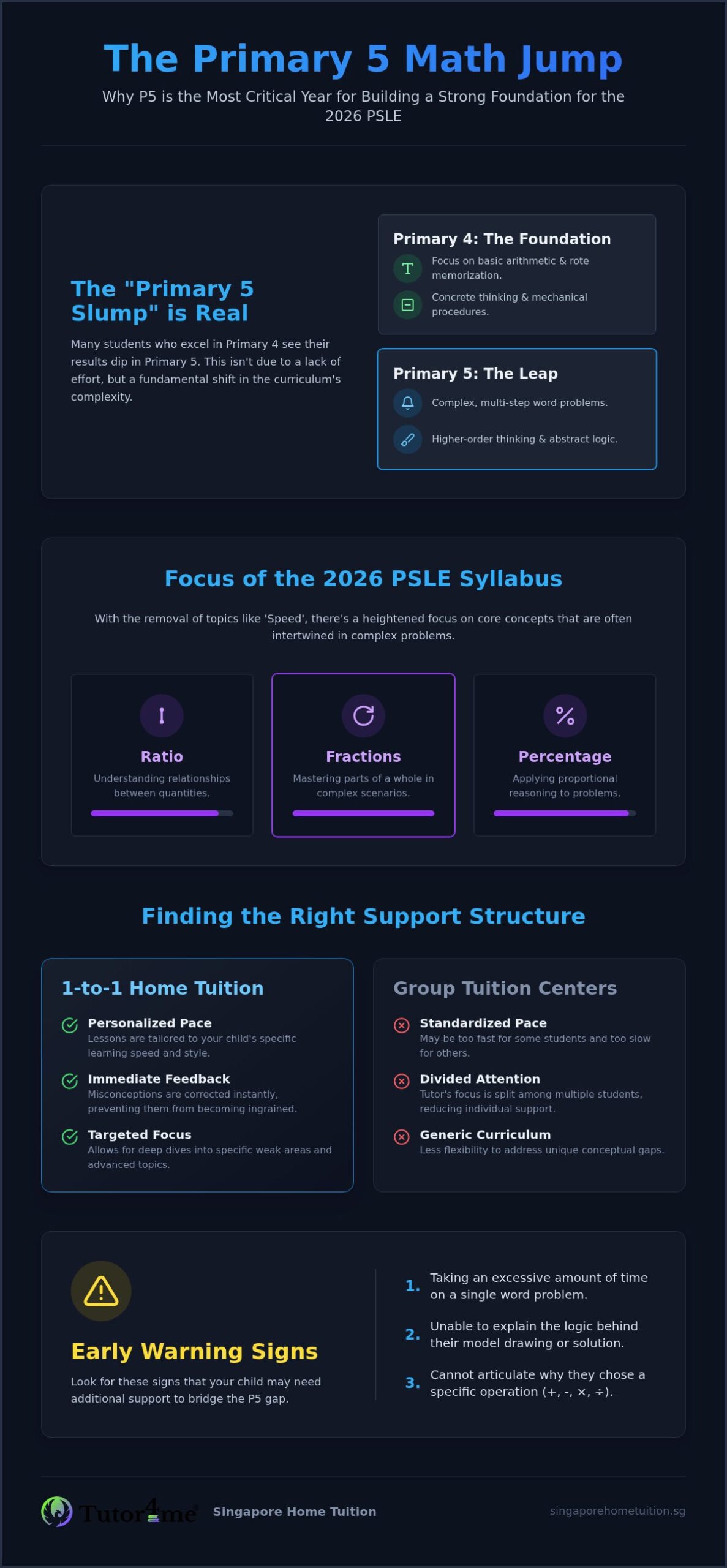
The “Primary 5 Slump” is a well-documented phenomenon in Singaporean schools. Many students who comfortably scored in the top Achievement Levels during Primary 4 see their results dip noticeably in their first P5 semester. This drop isn’t usually due to a lack of effort. Instead, it’s a direct result of the curriculum’s sudden shift from basic arithmetic to complex, multi-step problem sums that require higher-order thinking and sophisticated logic.
This period coincides with a significant stage of cognitive development. Students must transition from concrete thinking to abstract conceptualization. Without proper guidance, the leap to visualizing complex ratios or percentage changes can feel overwhelming. At this level, students move from “how to calculate” to “how to solve.” Primary 5 introduces the bulk of the content tested in the Primary School Leaving Examination (PSLE). Because the P6 year is often consumed by revision and intensive practice, P5 is actually the most critical window for mastering new concepts. Engaging professional primary 5 maths tuition early can help bridge this gap before the student’s confidence is affected.
The Transition from Lower to Upper Primary
Lower primary mathematics focuses on rote memorization and mechanical procedures. In contrast, Upper Primary requires analytical reasoning. The weightage of Paper 2, where calculators are allowed but questions are significantly more complex, increases. This shift tests a child’s ability to identify patterns and apply heuristics. Early warning signs that a child needs additional support include taking an excessive amount of time on a single word problem or being unable to explain the logic behind their model drawing. If they can’t articulate why they chose a specific operation, they likely haven’t mastered the underlying concept.
Why 2026 Students Face Unique Challenges
Students sitting for the national exams in 2026 are working within a fully implemented updated MOE syllabus. With the removal of topics like ‘Speed’ from the primary level, there’s a heightened focus on Ratio, Fractions, and Percentage. These topics are often intertwined in a single question, requiring a high degree of mental flexibility. Early intervention through primary 5 maths tuition provides a supportive environment where these misunderstood concepts are addressed immediately. Building this academic foundation alongside mental resilience is essential. It prevents the “snowball effect” where small gaps in P5 become insurmountable hurdles during the high-stakes P6 year.
Navigating the Complexities of the MOE P5 Mathematics Syllabus
The MOE Primary 5 Mathematics syllabus introduces a level of complexity that demands more than basic calculation. Topics like Ratio, Percentage, and Rate now form the backbone of the Upper Primary curriculum. These subjects require students to understand relationships between quantities rather than just performing isolated operations. For instance, advanced number work involves a deeper understanding of factors and multiples, which serve as the building blocks for simplifying fractions and solving complex word problems. Geometry also takes a significant step forward; students must master the area of triangles and the intricate properties of angles within polygons to succeed in Paper 2.
When children struggle with these abstract concepts, implementing Evidence-based strategies for math intervention can help clarify the logic behind the numbers. Primary 5 is the year where decimals and fractions are integrated into real-world contexts, such as calculating volume or measuring mass. This transition requires a high level of precision and a shift in how students approach their daily assignments. If you’re looking for a tutor who specializes in these specific P5 challenges, you can find a qualified math specialist to support your child’s journey.
Mastering Heuristics and Problem-Solving Strategies
Heuristics are tools for logical deduction in math that allow students to break down seemingly impossible questions into manageable steps. Common P5 heuristics include model drawing, working backwards, and the “units and parts” method. These are particularly vital for Paper 2, where “Non-Routine” problems test a student’s ability to apply known concepts to novel situations. Developing these skills early through primary 5 maths tuition ensures that students don’t just memorize steps but actually understand the problem-solving process. This mastery is what separates students who can solve standard textbook questions from those who can tackle the challenging “killer questions” seen in recent national exams.
Building Accuracy in Fractions and Percentages
Fractions, decimals, and percentages aren’t separate entities; they’re different ways of expressing the same proportional values. A student who understands this conceptual link can move fluidly between formats, which is essential for solving real-world problems like calculating GST or finding the final price after a discount. Accuracy is often the deciding factor between Achievement Levels. To reduce careless mistakes, students should adopt systematic checking methods, such as re-reading the final question to ensure their answer matches the required units. Dedicated primary 5 maths tuition provides the structured environment needed to practice these checking habits until they become second nature.
Comparing 1-to-1 Home Tuition vs. Group Centers for P5 Success
While group tuition centers provide a structured environment, they often follow a rigid syllabus that moves forward regardless of whether every student has mastered the topic. In a 1-to-1 setting, the lesson pace is dictated entirely by the child’s comprehension level. This immediate feedback loop is essential for primary 5 maths tuition, where a single misunderstanding in a multi-step problem can derail an entire solution. If a student struggles with the concept of “Remainder Value” in fractions, the tutor can pause and provide alternative explanations until the concept clicks before moving to more advanced heuristics.
Another significant advantage is the elimination of travel time. Commuting to a physical center can consume several hours each week; time that is better spent on rest or targeted revision. Lessons in a home setting are also customized based on your child’s school-specific weighted assessments. This means the tutor focuses on the exact topics and question formats favored by your child’s school, providing a more relevant and efficient preparation than a generic center-based curriculum that tries to cater to students from various institutions simultaneously.
Personalized Attention for Heuristic Mastery
Private tutors excel at identifying specific logic gaps that are frequently overlooked in a classroom of twenty students. For instance, a child might be proficient in basic calculations but fail to identify the correct heuristic for a “Difference Unchanged” problem. A specialist can tailor their teaching style to match the child’s unique learning profile, whether they are a visual learner who needs detailed models or an analytical thinker who prefers symbolic representation. This one-on-one rapport builds a safe environment for students to ask questions they might find “embarrassing” in front of their peers, ensuring no doubt goes unaddressed.
Flexibility and Convenience for Busy Families
Primary 5 marks the start of more intensive CCA commitments and leadership responsibilities. Balancing these with academics requires a high degree of flexibility that group centers simply cannot offer. 1-to-1 tuition allows you to schedule sessions around school events, remedial classes, and family obligations. You have the choice between physical home visits or interactive online tuition, both of which remove the friction of a weekly commute. Finding the top home tutor Singapore has to offer ensures that your child receives expert guidance while maintaining a manageable and productive daily routine during this high-stakes year.
Key Strategies to Overcome the P5 Math Slump
Overcoming the academic dip in Primary 5 requires a systematic approach that goes beyond simply completing more worksheets. The first step is to identify the root cause of the struggle. You must determine if your child is facing a deep conceptual gap or if their lower scores are primarily the result of careless mistakes. Often, what looks like a Primary 5 issue is actually a shaky foundation in Primary 3 or Primary 4 concepts that has finally been exposed by the more rigorous curriculum. Strengthening these basics is essential before moving to advanced topics.
Once the foundation is secure, students should be introduced to varied heuristic types through gradual exposure. Starting with simpler versions of a problem before moving to complex, multi-step variations prevents the student from feeling overwhelmed. Consistent practice with top school past-year papers is the final stage of preparation. This exposure helps them adapt to the standard of questioning expected in national exams and familiarizes them with different phrasing styles used across various schools.
Developing a Disciplined Revision Routine
Consistency is the key to long-term memory retention. A daily 30-minute practice session is far more effective than a single, exhausting four-hour block on the weekend. This routine keeps mathematical concepts fresh and builds the mental stamina required for long examinations. We recommend maintaining an error log to track recurring mistakes. By categorizing errors into “conceptual,” “calculation,” or “misreading,” students can visualize their progress and focus their primary 5 maths tuition sessions on specific areas of weakness. Balancing topical revision with full-length mock papers ensures they are prepared for both individual chapters and the cumulative syllabus.
Enhancing Exam Techniques and Time Management
Mastering the content is only half the battle; the other half is effective exam strategy. Paper 1 demands quick mental calculation to preserve time for the more demanding questions in Paper 2. Students should learn to allocate their time strictly based on the weightage of the marks. The 1-mark-per-minute rule suggests that a student should spend no more than one minute for every mark a question is worth to ensure the entire paper is completed within the time limit. Applying this rule helps prevent the common mistake of spending ten minutes on a two-mark question at the expense of the high-weightage problem sums at the end of the paper.
If you’re looking for a structured way to apply these techniques, our team can help you find a dedicated PSLE home tutor who specializes in turning these strategies into measurable results.
Finding Your Ideal Primary 5 Math Tutor with Singapore Home Tuition
Selecting the right educator is a decision that impacts more than just grades; it shapes a child’s relationship with the subject. At Singapore Home Tuition, we act as a professional facilitator to remove the stress of this search, allowing parents to focus on supporting their child emotionally. Our agency employs a rigorous matching process that connects you with MOE-trained teachers, full-time tutors, and subject specialists who understand the specific demands of the 2026 syllabus. This personalized approach ensures your child isn’t just another face in a crowded classroom. Instead, they receive the dedicated attention necessary to master the heuristics discussed earlier, with a curriculum that adapts to their specific pace.
We recognize that every student has a unique personality and academic baseline. Some children require a firm, structured approach to stay focused, while others thrive with a more encouraging, patient guide who can build their confidence. By tailoring our selection to fit your child’s specific needs, we create a productive learning environment where they feel empowered to tackle difficult problem sums. Our islandwide coverage ensures that high-quality primary 5 maths tuition is accessible from the comfort of your own home, providing a stable pillar of support during this high-stakes academic year.
Why Choose Singapore Home Tuition?
Our expertise in the local educational landscape allows us to stay ahead of curriculum shifts and assessment frameworks. We don’t just provide a list of names; we match you with specialists who have a proven track record in primary 5 maths tuition and understand how to navigate the “P5 slump.” Time is of the essence when academic gaps begin to appear, which is why we offer a fast and efficient tutor matching service. This allows your child to start lessons immediately, preventing small misunderstandings from snowballing into larger issues. For comprehensive support, you can explore our PSLE Home Tuition Singapore services to find the perfect match for your family’s requirements.
Getting Started: Your Journey to Academic Excellence
Starting the process is straightforward and designed to be frictionless for busy parents. Simply submit a request detailing your child’s current performance, learning style, and preferred schedule. We’ll then provide a curated selection of top home tutors in Singapore who meet your criteria. During the first lesson, you’ll have the opportunity to evaluate the tutor’s credentials and teaching style to ensure a perfect fit. It’s a chance to see how they connect with your child and explain difficult concepts. Securing your child’s foundation today is the most effective way to ensure they are ready for the challenges of 2026. Don’t wait until the P6 year to address foundational gaps; take the first step toward academic excellence now.
Securing Your Child’s Academic Path for 2026
The transition into Upper Primary is a challenging period that requires a fundamental shift in both mindset and study habits. By addressing the “P5 Slump” early, you ensure that your child doesn’t just survive the curriculum but masters the complex heuristics required for the national exams. Focusing on analytical thinking and consistent, disciplined practice transforms academic anxiety into quiet confidence. Choosing personalized primary 5 maths tuition allows for a tailored approach that group environments simply cannot match, providing the immediate feedback necessary to bridge conceptual gaps before they widen.
Singapore Home Tuition acts as a professional facilitator, trusted by thousands of parents across the island. We provide specialized matching for the PSLE foundation years, giving you access to experienced MOE teachers and subject experts who understand the local landscape. Our dedicated team removes the stress of the search, allowing you to focus on your child’s growth. Find the perfect Primary 5 Maths tutor for your child today and establish a stable pillar for their future success. With the right support, the journey toward 2026 becomes a path of empowerment and excellence.
Frequently Asked Questions
Is Primary 5 Math really much harder than Primary 4?
Yes, the transition to Primary 5 marks a substantial increase in difficulty compared to Primary 4. Students move from simple calculation to complex multi-step word problems that require analytical reasoning. This “P5 jump” is often where grades dip as the syllabus introduces advanced heuristics. Engaging in primary 5 maths tuition early helps students adapt to these new demands by building the logical framework needed for Upper Primary success.
How many hours of tuition does a P5 student typically need?
Most Primary 5 students benefit from 1.5 to 2 hours of tuition once or twice a week. The exact duration depends on the child’s current mastery of foundational concepts and their ability to keep up with the school’s pace. A consistent weekly schedule ensures that new topics are reinforced immediately, preventing the accumulation of misunderstood concepts as the syllabus progresses toward more challenging heuristics in the second semester.
Can my child still catch up if they failed their P5 mid-year exams?
It’s entirely possible for a student to catch up even after a poor mid-year performance. Primary 5 is designed as a foundation-building year, providing a window to identify and fix conceptual gaps before the high-stakes Primary 6 year begins. Personalized support focuses on rebuilding confidence and strengthening basic arithmetic skills. This targeted intervention allows students to stabilize their grades and approach the end-of-year examinations with a much stronger academic footing.
What are the most common heuristic types taught in P5 Math?
The most common heuristics taught at this level include model drawing, the “units and parts” method, and working backwards. Students also learn to use the “supposition” method and “internal transfer” strategies for complex ratio and percentage questions. Mastering these tools is essential for solving Paper 2 questions. Specialized primary 5 maths tuition provides the structured practice needed to recognize which heuristic applies to a specific problem sum, a skill vital for the national exams.
Should I hire an MOE teacher or a full-time tutor for P5 Math?
The choice depends on your child’s specific requirements and your family’s budget. MOE-trained teachers possess deep familiarity with the latest assessment frameworks and marking schemes. On the other hand, experienced full-time tutors often offer greater scheduling flexibility and a wealth of practical experience in 1-to-1 environments. Both types of educators can provide high-quality guidance; we help you evaluate credentials to find the perfect fit for your child’s learning style.
Does Singapore Home Tuition provide materials or follow the school textbook?
Our tutors typically align their lessons with the school’s current textbook to ensure consistency with the MOE syllabus. However, they also provide supplementary materials, such as top school past-year papers and curated heuristic worksheets, to broaden the student’s exposure. This dual approach ensures the child masters the school’s curriculum while gaining the competitive edge needed for national standards. Tutors customize these resources based on the student’s specific academic gaps identified during lessons.
How soon can we expect to see improvement in P5 Math grades?
While every child learns at a different pace, most parents see a noticeable improvement in conceptual understanding within three to six months. Initial progress often appears as increased confidence and a better grasp of homework assignments. Significant grade improvements usually follow as the student masters exam techniques and reduces careless mistakes. Consistent tuition provides the steady reinforcement required to turn these early gains into sustained academic excellence by the year-end exams.
What is the difference between P5 Math tuition and PSLE prep?
Primary 5 tuition focuses primarily on content mastery and the introduction of new, complex topics like Ratio and Percentage. In contrast, PSLE preparation, which intensifies in Primary 6, shifts the focus toward comprehensive revision, time management, and advanced exam strategies. P5 is the year to build the “muscles” of mathematical logic, while the P6 year is about refining those skills to perform under the pressure of a national examination.