
The secret to thriving in a JC tuition in Singapore in 2026 isn’t just about how many hours you study; it’s about how strategically you manage the new 70-point University Admission Score system. You likely feel the weight of meeting competitive L1R5 cut-off points while worrying about the steep academic curve that separates O-Levels from H2 Chemistry or Economics. It’s common to feel a sense of uncertainty when faced with complex decisions regarding H1, H2, and H3 subject combinations that will ultimately define your university options.
This guide provides the expert insights you need to handle this transition with professional confidence. You’ll gain a clear understanding of the current Junior College landscape, from decoding the latest MOE grading shifts to selecting a school that aligns with your personal strengths. We’ll outline a practical framework for choosing your subjects and explain how to secure the right academic support early, ensuring you stay ahead of the rigorous A-Level pace. By the end of this article, you’ll have a reliable roadmap to turn academic pressure into a manageable path toward excellence.
Key Takeaways
- Understand the differences between the 2-year JC track and the 3-year MI programme to select the most suitable pre-university pathway.
- Develop a framework for choosing a jc in singapore that considers both L1R5 cut-off points and the specific school culture that’ll support your goals.
- Prepare for the academic jump by mastering the H1, H2, and H3 subject framework and the shift to application-based learning.
- Learn how to manage a rigorous daily schedule of lectures and tutorials while balancing high-commitment extracurricular activities.
- Identify the benefits of early intervention and personalized tuition so you don’t struggle with challenging H2 subjects.
Understanding the Junior College Landscape in Singapore (2026)
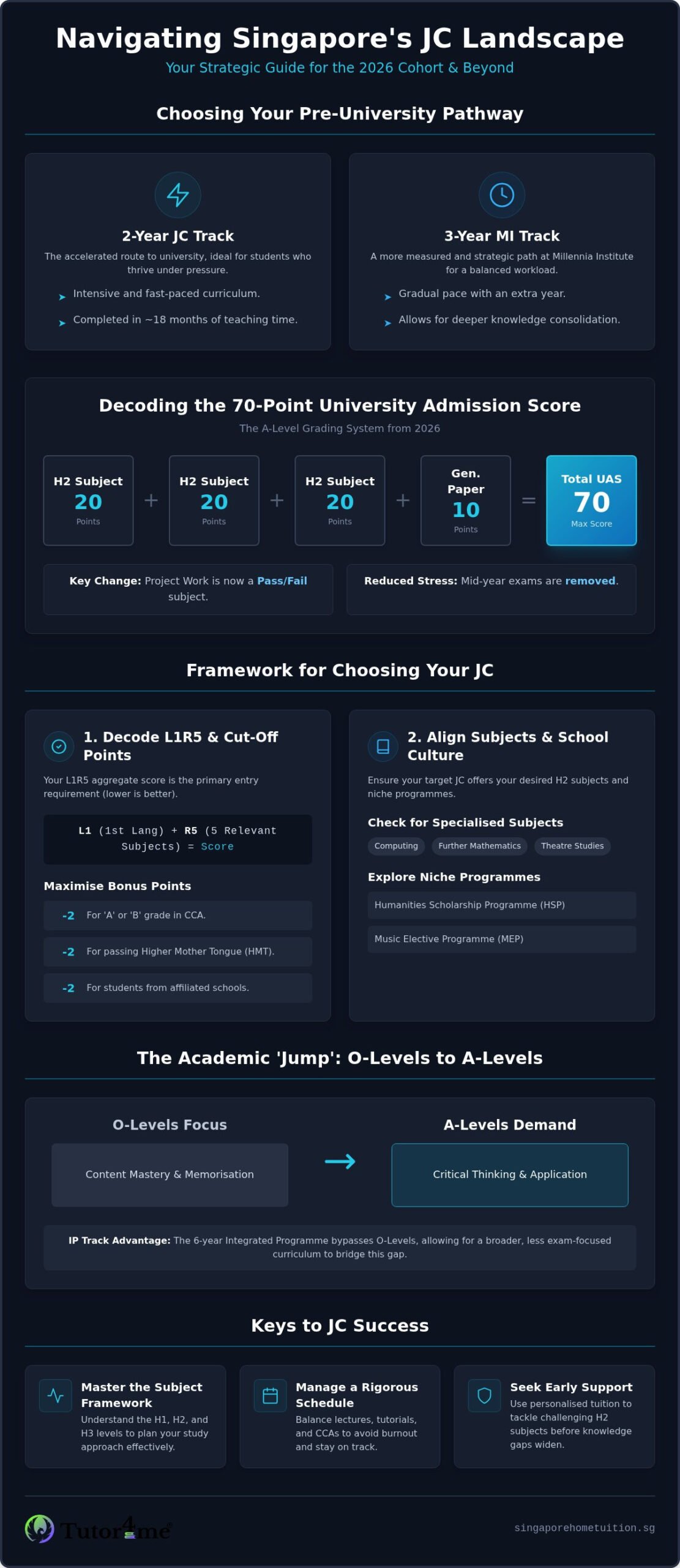
A Junior College (Singapore) serves as the primary pre-university pathway for students aiming for local or international degree programmes. Choosing a jc home tuition in singapore is a significant milestone that requires careful planning. For most students, a jc in singapore represents a critical bridge between secondary school and the autonomy of university life. The curriculum culminates in the Singapore-Cambridge GCE A-Level, a qualification recognized globally for its academic depth. For the 2026 cohort and beyond, the University Admission Score (UAS) is calculated out of 70 rank points, focusing on your three best H2 subjects and General Paper. This shift reflects a move toward a more holistic academic experience where Project Work is pass/fail and mid-year exams are removed to reduce testing pressure.
2-Year JC vs. 3-Year Pre-U: Which Path Suits You?
The majority of students opt for the two-year JC track, but it’s not the only route. You should consider your learning pace and workload capacity before deciding. Here are the primary differences between the pathways:
- 2-Year JC Track: Intensive and fast-paced, requiring students to master a broad syllabus in approximately 18 months of actual teaching time.
- 3-Year MI Track: A more gradual pace at the Millennia Institute, offering an extra year to consolidate subject knowledge and manage the A-Level workload.
While the two-year track gets you to university sooner, the three-year option can be a strategic choice for students who want to avoid burnout. Your choice here directly impacts your university admission timeline, so it’s vital to assess your learning style early.
The Integrated Programme (IP) Advantage and JAE Realities
The Integrated Programme (IP) track is a seamless six-year journey toward the A-Levels. Students in this track skip the O-Level examinations, moving directly from secondary school into their affiliated JC. This allows for a broader, more holistic education without the pressure of a national exam at the four-year mark. In contrast, the Joint Admissions Exercise (JAE) remains the gateway for O-Level students. It’s a merit-based system where cut-off points are determined by the L1R5 aggregate score. Competition for top-tier JCs via JAE is often fierce, and the transition requires a significant jump in critical thinking. If you’re struggling to bridge the gap between O-Level results and JC expectations, finding a top home tutor in Singapore can provide the personalized support needed to manage this transition effectively.
How to Choose the Best JC for Your Academic Goals
Selecting the right jc in singapore is a multi-faceted decision that goes beyond school rankings. You should aim for an environment where your learning style and academic interests are well-supported. Start by consulting the official list of Junior Colleges to understand the various academic tracks and niche programmes available nationwide. Your choice will ultimately influence your university prospects and the quality of your pre-university experience.
Decoding L1R5 and Cut-Off Points (COP)
The primary hurdle for entry is the L1R5 aggregate score. This is calculated by summing the grades of your first language and five relevant content subjects. A lower score indicates higher academic performance. For the 2026 intake, top-tier schools such as Raffles Institution and Hwa Chong Institution have maintained a competitive COP of 4 for the Science stream and 5 for the Arts stream. You can strategically lower your net aggregate score by utilizing bonus points:
- CCA Excellence: Attaining an ‘A’ or ‘B’ in your secondary school CCA can deduct 2 points.
- Higher Mother Tongue: Passing HMT at the O-Levels provides an additional 2-point deduction.
- Affiliation: Some schools offer a 2-point deduction for students from affiliated secondary schools.
Subject Combinations and School Specialisations
It’s vital to check if a specific jc tuition singapore offers your desired H2 subject combination. While most schools provide standard Science and Arts streams, specialized subjects like Computing, Further Mathematics, or Theatre Studies are only available at select institutions. You should also consider schools with specific elective programmes, such as the Humanities Scholarship and Programme (HSP) or the Music Elective Programme (MEP), if you have a strong interest in those areas.
While school location is a practical factor for daily travel, it shouldn’t be the sole reason for your choice. The academic culture and the strength of the teaching departments are far more influential on your A-Level results. If you find the transition to challenging new subjects daunting, seeking Economics home tuition in Singapore can provide a stable foundation before the curriculum pace accelerates. Balancing your academic load with a meaningful Co-Curricular Activity (CCA) is also essential, as university admissions increasingly look for a holistic profile alongside raw academic scores.
The Academic ‘Jump’: Transitioning from O-Levels to A-Levels
Entering a jc in singapore often brings a sudden realization that the study methods used for O-Levels are no longer sufficient. The transition is marked by a shift from rote memorization to high-level critical thinking and complex application. You’ll find that the sheer volume of content increases significantly, but it’s the depth of understanding required that creates the most pressure. Many students experience a noticeable ‘grade dip’ in their first year. It’s common for high achievers to receive their first ‘S’ or ‘U’ grade during early assessments as they adjust to new marking rubrics, but don’t let this initial shock discourage you.
Success at the A-Levels requires a different mental approach. You must learn to synthesize information across different topics rather than treating them as isolated chapters. This academic jump is most apparent in subjects like Project Work (PW), which is a pass or fail requirement from 2024 onwards. While the grading has changed and no longer contributes to your rank points, the demand for collaborative research and oral presentation skills remains a cornerstone of the JC experience. Managing these varied demands requires a high level of self-discipline and organized efficiency.
Mastering the H1, H2, and H3 Subject System
The curriculum is structured around Academic Units (AU), designed to provide both breadth and depth in your education. Most students take three H2 content subjects and one H1 content subject, alongside compulsory subjects like General Paper and Mother Tongue. The difference in rigour is stark. For instance, while O-Level Chemistry focuses on foundational concepts, Chemistry tuition Singapore specialists often note that H2 Chemistry demands a far more sophisticated understanding of reaction mechanisms and molecular geometry. If you demonstrate exceptional aptitude in a particular field, you might be invited to take an H3 subject in your second year. These are university-level modules that allow you to pursue a distinction for your academic portfolio.
The Critical Role of General Paper (GP)
General Paper is often cited as the most challenging subject for new students at a jc in singapore. Unlike secondary school English, GP requires you to possess a deep awareness of global affairs and the ability to construct nuanced, mature arguments. You’re no longer just writing a story; you’re engaging in a logical debate on topics ranging from ethics to technology. Developing this argumentative flair takes time and consistent practice. For those struggling to find their voice in essays, Mastering A Level General Paper Tuition provides a structured way to build the critical thinking skills necessary for A-Level success. Mastering GP early is essential, as it remains a compulsory component of the 70-point University Admission Score.
Managing the Rigorous JC Schedule and Student Life
Entering a jc in singapore means adapting to a schedule that often mirrors a professional working day. Classes can start as early as 7:30 AM and may end late in the evening on days dedicated to Co-Curricular Activities (CCAs). This intensity requires a fundamental shift in how you view your time. It’s no longer just about finishing homework; it’s about managing a continuous flow of lectures, tutorials, and self-directed study. The two-year journey is a sprint that demands both physical stamina and mental resilience to avoid burnout before the final examinations.
The Lecture-Tutorial System: A University Preview
The academic structure in a jc in singapore is specifically designed to prepare you for the autonomy of university life. Lectures are large-scale sessions where teachers deliver core content at a rapid pace. You’ll need to develop effective note-taking strategies to capture key concepts without losing focus. Tutorials are smaller, interactive classes where you apply what you’ve learned to specific problems. To benefit from these sessions, you must complete your tutorial sheets before attending class. Arriving unprepared often results in a wasted hour, as the discussion moves quickly through the solutions. Staying productive during independent study blocks is equally vital. Use these gaps to consolidate your notes or visit the library for quiet revision rather than treating them as purely social breaks.
Balancing Holistic Development and Grades
While academic excellence is the primary goal, CCAs play a critical role in your holistic development. Leadership positions or representation in sports and arts can significantly enhance your university application portfolio; for student councils or committees looking to strengthen their group dynamics, TeamLabs provides facilitated activities that help build the strong connections required for effective peer leadership. However, high-commitment CCAs can consume 10 to 15 hours a week, often leaving you exhausted by nightfall. Student leaders and athletes must employ strict time management techniques, such as using digital planners or time-blocking their weekends for deep work. You should prioritize sleep and consistent revision over last-minute cramming to balance your mental and physical health. If the pressure becomes overwhelming, don’t hesitate to leverage school resources. Most colleges provide professional counsellors, peer support networks, and scheduled teacher consultations to help you navigate academic or emotional hurdles.
If you find the pace of lectures is exceeding your ability to keep up, matching with a top home tutor in Singapore can provide the targeted academic support necessary to manage your workload efficiently.
The accelerated pace of a jc in singapore means that a single week of missed concepts can snowball into a significant academic deficit. Identifying early warning signs is crucial for maintaining your trajectory toward a successful A-Level result. These signs often manifest as a consistent inability to follow lecture progressions or a growing backlog of incomplete tutorial sheets. If you find yourself repeatedly scoring in the ‘S’ or ‘U’ range during topical tests, it’s a clear indicator that the foundational concepts require immediate reinforcement before the next term begins.
Personalized 1-to-1 home tuition offers a strategic advantage by providing a focused environment where you can address specific misunderstandings without the distractions of a large classroom. This format allows for immediate feedback; a luxury often missing in the lecture-tutorial system where teachers must cater to dozens of students at once. Utilizing the June and December holidays for intensive revision is another effective strategy. These breaks provide a rare opportunity to consolidate the past semester’s content and bridge any knowledge gaps before the curriculum advances further.
Targeted Support for Difficult Subjects
Certain subjects present a much steeper learning curve than others. For many students in the Science stream, H2 Chemistry tuition is a top priority because the syllabus requires a sophisticated grasp of abstract molecular structures and complex reaction kinetics. Similarly, Economics home tuition is highly sought after since most students are encountering the subject for the first time in Junior College. A private tutor can break down complex economic models and essay structures into manageable steps, ensuring you develop the analytical skills required for high-level evaluation in your jc in singapore.
The Singapore Home Tuition Advantage
Finding the right academic partner is about more than just subject knowledge; it’s about suitability and professional standards. A personalized matching process ensures you’re paired with qualified MOE teachers or experienced subject specialists who understand your specific learning style and the rigour of the A-Level syllabus. Home-based learning also offers the practical benefit of saving precious commuting time, allowing you to dedicate those extra hours to much-needed rest or self-study. Secure your academic future today by finding the top home tutor in Singapore to guide you through this high-stakes educational journey.
Securing Your Path to A-Level Excellence
Entering a jc in singapore is a significant commitment that requires a clear strategy from day one. You’ve learned how to navigate the 2026 admission landscape and the critical importance of selecting subjects that align with your strengths. Success isn’t just about hard work; it’s about mastering the shift toward high-level critical thinking and managing a demanding schedule with professional efficiency. By identifying academic gaps early and utilizing the right resources, you can turn the pressure of the A-Level curriculum into a rewarding journey toward university admission.
Singapore Home Tuition has been a trusted partner for parents for over a decade, providing peace of mind in this high-stakes environment. We offer specialized support for difficult H2 Mathematics, Sciences, and Humanities subjects through expert matching with MOE-trained JC tutors. Our personalized approach ensures every student is paired with a specialist who understands their unique learning style and the specific rigours of the current syllabus. Start your JC journey with the right support—request a tutor now!
You have the potential to excel in this new chapter. With the right guidance and consistent effort, you’ll reach your academic goals with confidence.
Frequently Asked Questions
What is the difference between JC and Polytechnic in Singapore?
Junior College (JC) provides a broad-based academic education culminating in the A-Levels, whereas Polytechnic offers specialized diploma courses focused on industry skills. While a JC student spends two years preparing for a single set of national examinations, Polytechnic students undergo three years of continuous assessment and internships. Choosing a JC is typically the faster route to university, while Polytechnic is ideal for those who prefer hands-on learning and specific career preparation.
How is the L1R5 cut-off point calculated for JC admission?
L1R5 is calculated by summing the grade points of your first language and five relevant content subjects. To enter a jc in singapore, your subjects must include at least one Humanities and one Science or Mathematics. You can deduct up to 4 bonus points from your raw score for CCA excellence and passing Higher Mother Tongue. A lower aggregate score is necessary to meet the competitive cut-off points of top-tier institutions.
Can I change my subject combination after starting JC?
You can usually request a change within the first two weeks of the first term, provided you meet the prerequisites and there are vacancies. Most colleges allow a ‘cooling-off’ period after orientation for students to finalize their combinations. However, approval is not guaranteed and depends on the school’s scheduling constraints. It’s vital to decide early, as switching subjects later makes it very difficult to catch up on intensive lecture content.
Is it possible to enter a JC if I missed the cut-off point by one mark?
Admission is strictly merit-based, meaning you’re unlikely to be posted to a school if your net aggregate score exceeds the cut-off point. If you miss the mark, you can submit an appeal directly to the Junior College after the posting results are released. Success in appeals is rare and typically reserved for students with exceptional achievements in areas like sports or performing arts that meet the school’s specific needs.
What are H3 subjects and should I take them?
H3 subjects are advanced modules that provide university-level depth in a specific area, offered only to students who excel in their H2 subjects. You should consider taking an H3 if you have a genuine passion for the field and can handle the additional workload. While H3 grades don’t affect your rank points, they serve as a powerful differentiator for competitive university scholarships or high-demand courses like Medicine and Law.
How many CCAs can I join in Junior College?
Most students join one core CCA to maintain a manageable balance between their academic and social lives. While some schools allow you to join a second interest group, the rigorous schedule of a jc in singapore often makes this difficult. It’s better to commit deeply to one activity where you can pursue leadership roles. This approach strengthens your university portfolio without compromising the time needed for your intensive H2 subject revision. To document these formative years and celebrate your milestones with teammates, you can discover PhotoNow for a professional self-photo session that captures your student life in a private setting.
You must meet the minimum Mother Tongue (MT) requirement to be eligible for local university admission. If you fail H1 MT, you’ll need to re-take the exam or pass the MT ‘B’ syllabus. Students who achieved a pass in Higher Mother Tongue at the O-Levels are exempted from this requirement. Meeting this benchmark early is important so you can focus entirely on your core A-Level subjects in your second year.
How do I choose between the Science and Arts stream in JC?
Base your decision on your university goals and the subjects where you have the highest aptitude. The Science stream is generally required for degrees in Medicine, Engineering, and Architecture. Conversely, the Arts stream is excellent preparation for Social Sciences, Law, and the Humanities. Look at your O-Level grades to identify your strengths, as the increased difficulty of H2 subjects requires a solid foundation to avoid a significant grade dip.