

Imagine the look on your child’s face when they encounter their first set of complex heuristic word problems in Primary 5. The confidence they maintained throughout lower primary often falters as the 2026 curriculum introduces a significant jump in logical complexity and abstract thinking. It’s a stressful moment for many families, especially when parents find that the MOE methods used today are vastly different from the ones they learned years ago. This is why many families turn to primary 5 maths tuition to provide a stable bridge during this challenging academic transition.
We recognize that a sudden dip in grades is rarely about a lack of effort; it’s often about a gap in specialized strategy. This article explains how targeted, 1-to-1 support helps students master the advanced heuristics required for the updated syllabus. You’ll learn how to address the specific requirements of the P5 curriculum while restoring your child’s academic self-esteem. We will outline the path toward securing a robust foundation for the 2027 PSLE, helping your child approach every math paper with quiet confidence and clarity.
Key Takeaways
- Understand the specific reasons why student performance often dips during the transition to Upper Primary mathematics.
- Discover how specialized primary 5 maths tuition helps students transition from simple arithmetic to advanced PSLE heuristics.
- Identify the “Transfer of Information” hurdle and other common challenges that prevent students from solving complex word problems.
- Learn the essential strategies for mastering the Model Method and other critical pillars of the 2026 syllabus.
- Explore how personalized 1-to-1 matching with experienced educators can restore a child’s confidence and academic foundation.
The Transition to Primary 5 Mathematics: Understanding the 2026 Jump
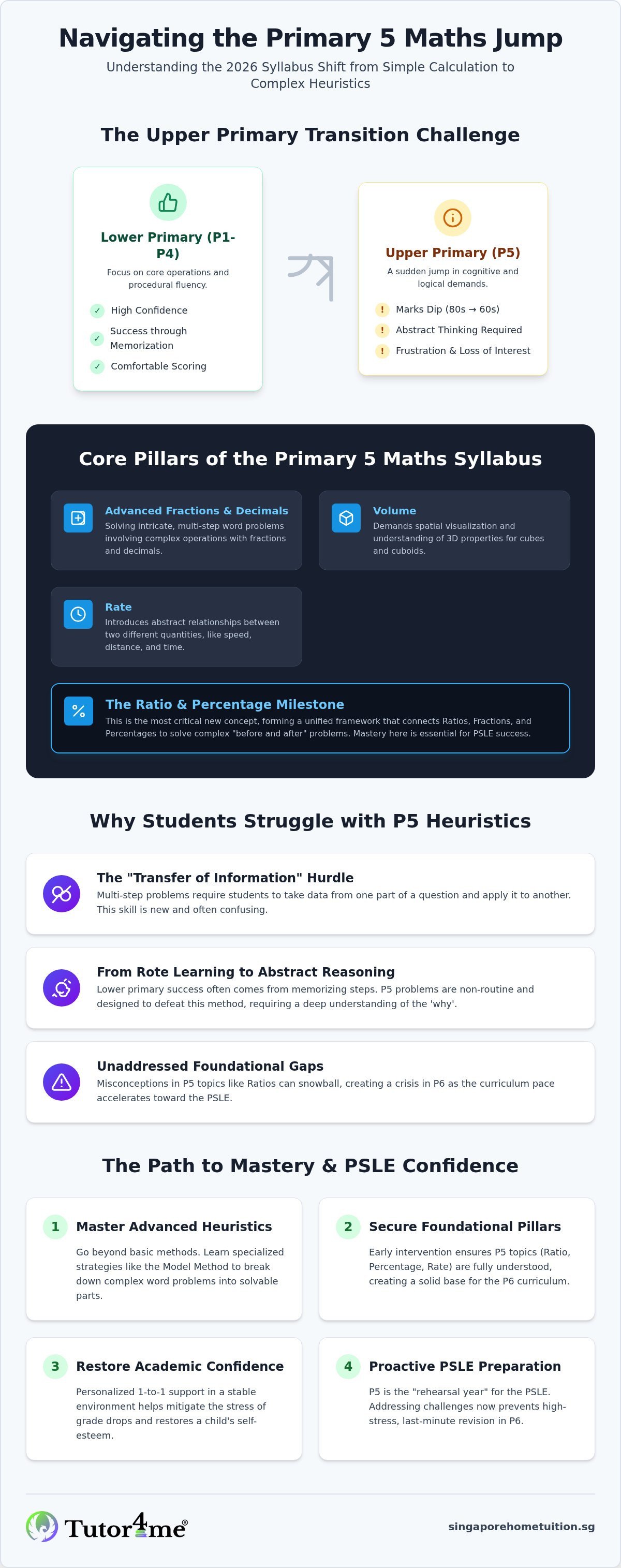
Primary 5 is often cited by parents and educators as the most difficult year in a child’s primary school journey. In 2026, this transition is particularly significant as the curriculum demands a higher level of cognitive flexibility. While Primary 4 focuses on core operations and basic problem-solving, Primary 5 introduces a sudden increase in syllabus depth and breadth. Many students who were comfortably scoring in the high 80s find their marks dipping into the 60s during the first semester of Upper Primary. This “jump” occurs because the exam format shifts from testing accuracy in calculation to testing the ability to apply logic in unfamiliar, multi-step contexts.
The psychological impact of this grade drop can be profound. For an 11-year-old, seeing a sudden decline in academic results often leads to frustration and a loss of interest in the subject. Engaging in primary 5 maths tuition early can help mitigate this stress by providing a stable environment to bridge these new conceptual gaps. It’s about providing the right support before a lack of confidence becomes a permanent hurdle to their learning progress.
From Calculation to Heuristics
The core of the challenge lies in the shift from procedural fluency to heuristic application. In the lower primary years, students often succeed through rote memorization of steps. However, the Singapore math methodology is designed to move students from concrete understanding to abstract reasoning. P5 problem sums are multi-step and require “Transfer of Information,” which is the ability to take data from one part of a question and apply it to another. Rote learning fails here because questions are designed to be non-routine. Students must understand why a certain model works rather than just how to draw it, making primary 5 maths tuition Singapore a valuable tool for developing this deep conceptual clarity.
Setting the Foundation for PSLE 2027
This academic year serves as the “rehearsal year” for the national exams. The topics introduced now, such as Ratio, Percentage, and Rate, form the bulk of the PSLE Paper 2. Identifying learning gaps during this year is critical. If a child enters Primary 6 with unaddressed misconceptions in P5 topics, they’ll likely face a crisis as the pace of school lessons accelerates. Early intervention through PSLE Home Tuition ensures that these foundational blocks are secure before the final sprint begins. This proactive approach prevents the need for intensive, high-stress revision later on and gives students the peace of mind they need to excel.
Core Pillars of the Primary 5 Maths Syllabus in Singapore
The academic expectations for students in 2026 are clearly defined in the Core Pillars of the Primary 5 Maths Syllabus. This curriculum represents a shift from basic computation to the application of mathematical concepts in complex scenarios. Students are expected to master advanced operations with fractions and decimals, moving beyond simple addition or subtraction to solve intricate word problems that require multiple steps. Mastery of these topics is essential, as they provide the numerical foundation for almost every other topic in the Upper Primary years.
New concepts like Volume and Rate also enter the curriculum, demanding a mix of spatial and logical visualization. Volume requires students to understand the three-dimensional properties of cubes and cuboids, while Rate introduces the relationship between two different quantities, such as time and distance. These topics often prove challenging because they require students to mentally manipulate shapes or conceptualize abstract movement. For many parents, explaining these nuances at home becomes difficult, which is why specialized primary 5 maths tuition can be a practical solution to ensure these concepts are correctly understood from the start.
The Ratio and Percentage Milestone
Ratio is arguably the most critical new concept introduced in Primary 5. It serves as a bridge between fractions and percentages, forming a unified framework for solving complex “before and after” word problems. A common misconception students face is treating ratios as absolute values rather than relationships between parts. Experienced tutors help students see the connection between these three topics, teaching them how to convert a ratio into a fraction or a percentage to simplify a problem. When a student can fluently move between these representations, they unlock the ability to solve higher-order thinking questions that appear in the latter half of Paper 2.
Geometry and Spatial Awareness
Geometry in Primary 5 moves toward the properties of triangles and quadrilaterals, including parallelograms, rhombuses, and trapeziums. Students must learn to identify and solve for unknown angles using established geometric rules. The complexity increases significantly when students are asked to find the area of shaded regions within composite figures. This requires a high degree of spatial awareness to “see” hidden shapes or subtract smaller areas from larger ones. Dedicated educators often use physical visual aids and digital drawing tools to help students decompose these complex figures into manageable parts. If your child is struggling to visualize these problems, finding a top home tutor in Singapore can provide the personalized guidance they need to master these spatial challenges.
Building a strong grasp of these pillars now ensures that your child doesn’t feel overwhelmed when they reach the final PSLE year. If you find that the school pace is too fast for your child to absorb these core topics, consider seeking a personalized matching service to find an educator who fits your child’s specific learning style.
Common Challenges: Why Students Struggle with P5 Math Heuristics
Many students find that their previous study habits no longer yield the same results in Upper Primary. The most common hurdle is the “Transfer of Information” in word problems. Unlike Primary 4, where questions are direct, P5 problem sums are often long and filled with distractors. Students must filter out irrelevant data and identify the core relationship between variables. Without a systematic approach, it’s easy to misinterpret the question entirely. This is where primary 5 maths tuition provides a significant advantage by teaching students how to annotate and deconstruct these lengthy narratives.
Another challenge is the misapplication of heuristic methods. Many students default to Model Drawing for every question, even when a Unitary Method or the “Guess and Check” alternative would be more efficient. This often leads to time management issues during weighted assessments. When a student spends ten minutes on a single four-mark question, they lose the opportunity to complete the rest of the paper. Developing a “toolbox” of Effective Strategies to Master Primary 5 Math is essential for navigating these high-pressure exam environments.
Careless mistakes also tend to spike during this year. Since questions involve more steps, a single calculation error in the early stages cascades through the entire problem. Students often lack the habit of “working backwards” to verify their answers. A dedicated specialist can instill these systematic checking habits, ensuring that marks aren’t lost to avoidable slips. It’s not just about knowing the math; it’s about managing the precision required for the 2026 syllabus.
The Problem with Problem Sums
P5 introduces specific scenarios like “Before-and-After” and “Equal Stage” problems. These require students to track changes in quantities over time. For instance, if two people spend different amounts of money and end up with equal sums, the student must identify what remains constant. Identifying the “constant total” or “constant difference” is a skill that requires repetitive, guided practice. 1-to-1 primary 5 maths tuition allows an educator to walk through these scenarios at the student’s own pace, ensuring the logic is sound before moving to the next complexity level.
Overcoming Math Anxiety
It’s common for students to develop a fixed mindset after receiving their first few failing grades in P5. They might begin to believe they aren’t capable of mastering the subject. This anxiety creates a mental block that makes learning even harder. A supportive tutor acts as a bridge, breaking down complex concepts into small wins that restore a child’s confidence. The goal of tuition should be to reduce the family’s stress, providing a professional facilitator who handles the academic heavy lifting while parents provide emotional support.
Effective Strategies to Master Primary 5 Math Concepts
Success in Upper Primary is rarely the result of talent alone. It’s the product of a methodical approach that prioritizes understanding over speed. To help your child regain their footing in 2026, follow these five strategic steps.
- Step 1: Strengthen the Foundation. Before tackling P5 heuristics, ensure that Primary 3 and 4 topics are fully mastered. Gaps in basic fraction operations or long division often manifest as “heuristic errors” when the real issue is foundational.
- Step 2: Master Visual Logic. Use the Model Method to turn wordy problems into clear diagrams.
- Step 3: Maintain a Mistakes Log. Have your child record every incorrect answer in a dedicated notebook. Categorizing these as “conceptual,” “careless,” or “time-related” helps identify exactly where they need the most support.
- Step 4: Prioritize Consistency. Fifteen minutes of focused problem-solving every day is more effective than a grueling four-hour session on the weekend. This habit builds “math stamina” and reduces exam anxiety.
- Step 5: Seek Expert Guidance. If the gap feels too wide to bridge alone, professional PSLE Home Tuition provides the targeted intervention needed to correct misconceptions before they become permanent.
Mastering the Model Method
The bar model is the most powerful tool in a student’s arsenal. It allows them to visualize the relationship between different quantities, making it easier to identify which part of the problem is missing. As students become more proficient, they naturally begin to transition from these pictorial representations to algebraic-style thinking. This progression is vital for a smooth entry into Secondary 1 mathematics. The Model Method serves as a vital bridge from concrete visualization to abstract logical reasoning. Our primary 5 maths tuition focus often centers on this transition, ensuring students don’t just draw models, but understand the logic behind them.
Active Revision Techniques
Passive reading of textbooks is rarely effective for math. Instead, use the “Teach-Back” method. Ask your child to explain a solution to you or their tutor as if they were the teacher. If they can explain the “why” behind a step, they truly understand the concept. Additionally, practicing with past-year papers from top schools familiarizes them with the standard of difficulty they will face. It’s also helpful to plan your revision milestones around the PSLE Exam Dates 2026 to ensure your child is peak-ready when it matters most.
Implementing these strategies can transform a child’s relationship with mathematics from one of frustration to one of mastery. If you need a specialist to help implement these techniques, you can find an experienced PSLE tutor through our personalized matching service today.
Personalized 1-to-1 Tuition: The Singapore Home Tuition Advantage
Group tuition centers often operate on a fixed schedule, moving to the next chapter regardless of whether every student has mastered the current one. In the high-stakes environment of Primary 5, this rigid pace can leave some children behind, especially when they encounter a specific hurdle like Ratio or Percentage. Personalized primary 5 maths tuition solves this by aligning the teaching speed with the student’s actual progress. This bespoke approach ensures that no heuristic gap remains unaddressed as the child moves toward the 2027 PSLE.
Choosing the right educator is a critical step in this process. Our pool of qualified educators includes MOE teachers with deep syllabus knowledge, dedicated full-time tutors, and relatable undergraduates who have recently excelled in the same system. Whether your child needs a rigorous academic specialist or a supportive mentor, our matching service focuses on finding the perfect fit for your family’s specific needs. This flexibility extends to the format as well, with options for islandwide home visits or convenient online sessions that fit seamlessly into a busy primary school schedule.
Matching the Right Tutor to Your Child
A student’s academic performance is often tied to their emotional connection with their teacher. If a child feels intimidated, they won’t ask the questions necessary to clear their doubts. We prioritize finding a top home tutor in Singapore who matches your child’s personality and learning style. By filtering for subject specialists who understand the 2026 curriculum, we ensure that the tutor acts as both an instructor and a mentor throughout the two-year PSLE journey. This relationship builds the trust required for a student to tackle difficult heuristics without fear of failure.
Home vs. Center: Why 1-to-1 is Superior for P5
The transition to Upper Primary brings a heavier workload and longer school hours. Eliminating the commute to a tuition center gives your child more time for rest and self-study, which are essential for maintaining mental clarity. In a 1-to-1 setting, the student receives immediate feedback on every problem sum they solve. This prevents the reinforcement of wrong concepts that often happens in large groups where the teacher can’t check every student’s working. Most importantly, the home environment provides a safe, pressure-free space where students feel comfortable admitting when they don’t understand a concept. This leads to genuine breakthroughs in understanding that are often missed in a crowded classroom.
Investing in 1-to-1 primary 5 maths tuition isn’t just about immediate grade improvement; it’s about providing a stable pillar of support during a high-stakes transition. By matching your child with a dedicated specialist, you give them the tools to navigate the 2026 syllabus with quiet confidence and the resilience needed for future academic success.
Securing Your Child’s Mathematical Future for 2027
Primary 5 is a transformative year that sets the stage for success in the upcoming PSLE. By identifying gaps in heuristic application early and mastering the core pillars of the updated 2026 syllabus, your child can avoid the stress often associated with the Upper Primary transition. A systematic approach, combined with visual logic and active revision, transforms complex academic challenges into manageable milestones.
Specialized primary 5 maths tuition provides the individual focus required to bridge these conceptual gaps while restoring a student’s self-esteem. Our agency offers islandwide coverage across Singapore and a diverse pool of qualified MOE and full-time tutors. We’re dedicated to a fast matching process, often connecting families with a subject specialist within 24 hours to ensure your child’s learning journey remains on track without interruption.
Find the Perfect Primary 5 Math Tutor Today and give your child the support they need to approach their exams with quiet confidence and clarity.
Frequently Asked Questions
Why do Primary 5 Math grades often drop compared to Primary 4?
Grades often decline because the syllabus shifts from basic calculation to higher order heuristic application. Primary 5 introduces complex word problems that require multi-step logic and the ability to interpret long narratives. This cognitive jump, combined with more abstract topics like Ratio and Percentage, often catches students off guard after the more straightforward Primary 4 curriculum.
How many hours of Primary 5 Maths tuition are recommended per week?
Most students benefit from one or two sessions of 1.5 to 2 hours per week. This duration allows enough time to review school work while introducing new heuristic strategies without causing mental fatigue. The exact frequency depends on your child’s current foundation and their ability to keep up with the fast paced 2026 school syllabus milestones.
Is 1-to-1 home tuition more effective than group tuition for P5 Math?
1-to-1 home tuition is generally more effective for P5 because it offers a customized learning pace. In a group setting, a teacher cannot pause for one student who is struggling with a specific concept like composite area. Personalized sessions allow the tutor to address individual gaps immediately, ensuring that wrong concepts aren’t reinforced through repetitive incorrect practice.
Can a Primary 5 tutor help my child with the new MOE heuristics?
Yes, qualified primary 5 maths tuition specialists are specifically trained in the latest MOE pedagogical shifts. They focus on teaching students how to identify “Before-and-After” or “Equal Stage” scenarios within word problems. By breaking down the Model Method and other visual strategies, a tutor helps your child move from rote memorization to genuine logical reasoning.
What is the average rate for a Primary 5 Math tutor in Singapore in 2026?
Rates for a Primary 5 Math tutor in Singapore vary based on the educator’s qualifications and experience. While undergraduate tutors offer a more accessible entry point, full-time tutors and MOE trained teachers command different rates due to their specialized expertise in the national curriculum. We recommend checking current market ranges for home tutors to find a professional that fits your family’s budget and academic goals.
How do I know if my child needs Primary 5 Maths tuition or just more practice?
If your child understands the concepts but makes occasional slips, they likely need more practice. However, if they are consistently unable to start word problems or feel overwhelmed by the 2026 curriculum jump, professional primary 5 maths tuition is advisable. Look for signs of frustration or a significant dip in weighted assessment scores as clear indicators that conceptual support is needed.
Does Singapore Home Tuition provide materials for P5 Math lessons?
Our tutors typically bring their own specialized resources, including past year top school papers and heuristic worksheets. They also work with the child’s school materials to ensure alignment with what is being taught in the classroom. This dual approach helps the student master their current school work while gaining exposure to more challenging exam style questions.
What happens if the matched tutor is not a good fit for my child?
We prioritize finding the perfect match, but we understand that personality fit is essential for effective learning. If you feel the matched tutor is not suitable after the first lesson, you can request a change through our agency. We’ll facilitate a new match quickly to ensure your child’s academic progress remains a top priority without any long term disruption.