

What if the secret to securing an A* in the IGCSE isn’t just about how many hours your child spends studying, but how well they decode the specific "command words" used by their exam board? For many families in Singapore, the transition from lower secondary to the IGCSE presents a steep learning curve. You might find yourself balancing the nuances of Cambridge versus Edexcel while helping your child manage an increasingly heavy subject load. It’s a high-stakes environment, and it’s natural to feel some anxiety about making the right choices for their academic future.
We understand these pressures and are here to provide a stable pillar of support. This complete 2026 guide clarifies the IGCSE structure and illustrates how personalized IGCSE Home tuition Singapore can transform academic struggle into quiet confidence. You’ll discover a strategic roadmap for subject selection and revision, along with insights into finding a qualified private tutor who can offer the 1-to-1 mentorship your child needs to excel. By focusing on tailored exam techniques and a deep understanding of marking schemes, we help students navigate their path to success with clarity and purpose.
Key Takeaways
- Understand the strategic advantages of the IGCSE curriculum as a globally recognized precursor to the IB Diploma and A-Level pathways.
- Learn how to select the optimal mix of core and extended subjects to align with future university entry requirements.
- Identify proven revision strategies, such as the Active Recall method, to effectively manage the increased syllabus depth and coursework demands.
- Explore how specialized igcse tuition singapore provides targeted 1-to-1 support for the specific marking schemes of Cambridge and Pearson Edexcel.
- Establish a clear 12-month roadmap to navigate examination registration deadlines and peak revision periods with confidence.
Table of Contents
What is IGCSE and Why is it Growing in Popularity in Singapore?
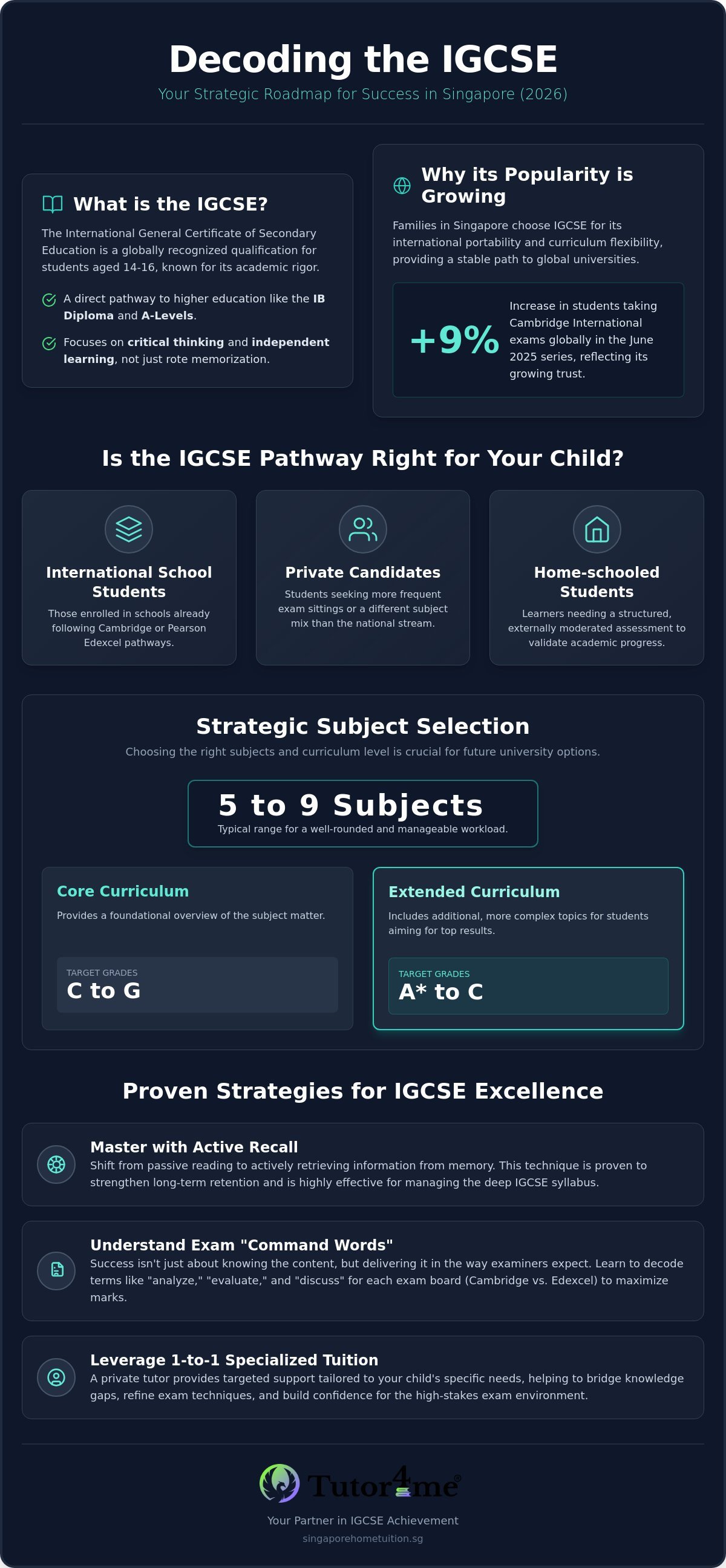
The International General Certificate of Secondary Education (IGCSE) serves as a global benchmark for academic excellence for students aged 14 to 16. While the local GCE O-Level has long been the standard in Singapore, many families are now turning toward the IGCSE for its international portability and flexible curriculum. It isn’t merely an alternative; it’s a rigorous framework designed to prepare students for the next stage of their education, whether that’s the IB Diploma or A-Levels.
Singaporean parents often value the curriculum’s ability to provide broad international exposure. Unlike the more rigid structure of local examinations, the IGCSE allows students to tailor their subject choices to their specific strengths and future career aspirations. This flexibility is particularly useful as the Ministry of Education transitions the O-Level to the new Singapore-Cambridge Secondary Education Certificate (SEC) from 2027. For many, the IGCSE remains a stable, proven path that is recognized by every major university across the globe.
Recognition and Global Opportunities
The IGCSE is often described as the "gold standard" of international qualifications. It is accepted by top-tier universities worldwide and is also recognized by local polytechnics in Singapore for admission into diploma courses. In the June 2025 exam series, there was a 9% increase in students taking Cambridge International exams globally, reflecting its growing stature. The curriculum moves beyond rote memorization; it prioritizes independent learning and critical thinking. These are the exact skills required for success in higher education. By engaging with IGCSE tuition Singapore, students can bridge the gap between understanding content and applying it in the high-pressure environment of international assessments.
Who Should Take the IGCSE in Singapore?
This pathway is ideal for several groups of learners in the local landscape:
International School Students: Those enrolled in schools following the Cambridge or Pearson Edexcel pathways.
Private Candidates: Local or international students seeking a qualification that offers more frequent exam sittings and a different subject mix than the national stream.
Home-schooled Students: Learners who require a structured, externally moderated assessment to validate their academic progress.
For these students, finding specialized igcse tuition singapore is often the key to mastering the diverse subject requirements and achieving the grades necessary for their chosen pre-university programs. The personalized attention helps students navigate the jump from lower secondary to the more demanding IGCSE syllabus with confidence.
Navigating Subject Choices and Examination Boards
Choosing the right subjects is more than just an academic exercise; it’s a strategic decision that shapes a student’s future university options. In Singapore’s competitive environment, students typically select between 5 and 9 subjects. This range provides enough breadth for a well-rounded profile while ensuring the workload remains manageable. A primary consideration is the choice between the Core and Extended curriculum levels. The Core syllabus provides a foundational overview for those targeting grades C through G. Conversely, the Extended curriculum includes additional, more complex topics designed for students aiming for the A* to C range. Understanding this distinction early is vital, as it sets the ceiling for a student’s potential results.
Language requirements also demand careful thought. Students must often choose between First Language English and English as a Second Language (ESL). While First Language English is the standard for those seeking entry into competitive UK or US universities, ESL can be a practical alternative for students who excel in other areas but need a different pace for language acquisition. Engaging with IGCSE tuition singapore allows for a personalized assessment of which track will yield the best final grade aggregate. It’s often better to secure a high grade in a slightly less demanding paper than to struggle with a syllabus that doesn’t match the student’s current proficiency.
Cambridge (CIE) vs. Pearson Edexcel
Determining which examination board is more suitable requires an understanding of their distinct assessment styles. The Official Cambridge IGCSE Programme is the most prevalent board in Singapore’s international schools. It typically utilizes a linear format where all assessments take place at the end of the two-year course. Pearson Edexcel is another high-quality option, sometimes preferred for its straightforward question structures in subjects like Mathematics. While both provide a rigorous qualification, the choice usually rests on the school’s curriculum or the student’s preference for specific paper formats. Using **IGCSE tuition **can help students become familiar with the unique marking criteria of their specific board, which is often the key to mastering complex exam techniques.
Strategic Subject Selection
A competitive profile for 2026 requires a balance of Sciences, Humanities, and Mathematics. It’s essential to plan these choices as early as Year 9 or Grade 8. For example, a student interested in Medicine will likely need to take Chemistry and Biology at the Extended level. However, don’t ignore the humanities; subjects like Geography or Economics develop critical writing skills that are vital for the IB Diploma. The difficulty of a subject should be weighed against the student’s interest and aptitude. If a student is struggling with the jump in syllabus depth, a specialized IGCSE home tutor can provide the targeted support needed to bridge knowledge gaps before they become overwhelming. Early planning ensures that the student remains on track for their desired university pathway without unnecessary stress.
Common Challenges for IGCSE Students in Singapore
The transition from lower secondary to the IGCSE syllabus is often steeper than students anticipate. While earlier years focus on general concepts, the IGCSE demands a level of subject-specific precision that can be overwhelming. This is particularly true for private candidates moving from the local MOE stream to the international curriculum. The shift requires a fundamental change in how students process information. Instead of relying on the structures they’ve known, they must adapt to a system that prizes the application of knowledge over the mere repetition of it.
Coursework and Internal Assessment (IA) components also add a layer of complexity. These aren’t just homework assignments; they’re moderated pieces of work that contribute significantly to the final grade. Managing these alongside a full subject load requires a high degree of discipline. Many students find that their previous study habits don’t translate well to this new environment, leading to a sense of being perpetually behind. This is where 1-to-1 igcse tuition singapore becomes a vital resource, providing the structure and accountability needed to stay on track.
The Content Volume Gap
In subjects like Biology and History, the sheer volume of content is a common hurdle. Students aren’t just learning facts; they’re expected to synthesize information across multiple units. Rote memorization often fails here because the IGCSE framework is built on critical thinking. Application-based questions require students to use theoretical knowledge to solve unfamiliar, real-world scenarios rather than simply reciting memorized facts. This is where many struggle, as the answer isn’t found directly in the textbook but in the student’s ability to analyze provided data.
Decoding "command words" is another essential skill. When an examiner asks a student to "evaluate," they aren’t looking for a simple description. They want a balanced argument with a supported conclusion. Misinterpreting these instructions is a primary reason why even well-prepared students lose marks. Specialized igcse tuition singapore helps students bridge this gap by focusing on past-paper analysis and the specific requirements of the marking scheme.
Time Management and Exam Anxiety
Managing a rigorous two-year study plan while maintaining commitments to co-curricular activities requires exceptional organizational skills. The IGCSE represents the first major external public examination for many students, and the psychological impact can be significant. In Singapore’s competitive environment, the pressure to perform is constant. Building resilience is a gradual process. It involves consistent, low-stakes testing to normalize the exam experience and reduce the fear of the final paper.
With the Cambridge October/November 2026 normal stage deadline set for August 8, 2026, students must begin their preparation early. A personalized approach reduces anxiety by providing a clear path forward, ensuring that every study session is purposeful and productive. By addressing specific subject gaps in a supportive environment, students can regain their confidence and focus on achieving their target grades.
Effective Strategies for IGCSE Exam Preparation
Success in the IGCSE isn’t an accident; it’s the result of a deliberate, 12-month revision roadmap. Students should begin their journey by mapping out their entire syllabus at least a year before the 2026 exams. This prevents the common pitfall of last-minute cramming, which is rarely effective for application-based subjects. A core component of this strategy is the "Active Recall" method. Instead of re-reading notes, students should use flashcards or practice questions to force their brains to retrieve information. This strengthens memory pathways and ensures that content is readily available under exam pressure.
Marking schemes are often underutilized. Rather than using them as a simple answer key, students should treat them as a primary study tool. They reveal the specific keywords and phrases that examiners are trained to look for. By studying these schemes, students learn how to structure their responses to maximize marks. Combined with timed mock exams, this approach builds "exam stamina." Sitting for a full-length paper in a quiet environment helps students manage their time and reduces the likelihood of panic on the actual day. Engaging with IGCSE tuition Singapore provides the necessary oversight to ensure these practice sessions are rigorous and reflective of actual exam conditions.
Mastering Past Year Papers
When practicing with past papers, it’s generally advisable to go back five years. However, students must be aware of the 2026 syllabus changes to avoid practicing outdated topics. Analyzing examiner reports is equally important. These documents highlight common mistakes made by previous cohorts, such as failing to show working in Math or mislabeling diagrams in Biology. Identifying recurring patterns in question types allows students to predict the likely format of their own papers and prepare accordingly. It’s about working smarter by focusing on the areas where examiners most frequently test deep understanding.
Coursework and Practical Skills
For Science subjects, mastering the practical component is essential. Whether taking the actual lab-based exam or the "Alternative to Practical" paper, students must understand experimental design and data interpretation. In Humanities and Creative Arts, managing coursework deadlines is a major source of stress. A qualified IGCSE home tutor can help students break down these large projects into manageable tasks, ensuring that Internal Assessments contribute positively to the final grade. Consistent school assessments serve as a useful predictor of performance, allowing for early intervention if grades begin to slip. By securing high marks in coursework, students can enter the final exam hall with a significant portion of their grade already secured.
How Private 1-to-1 Tuition Ensures IGCSE Success
In a traditional classroom or group tuition center, the pace of learning is often dictated by the average student. This setting can leave high achievers feeling unchallenged and struggling students falling further behind. Private 1-to-1 **igcse tuition **provides a dedicated space where the curriculum is tailored entirely to the individual. This personalized attention allows tutors to identify and close specific subject knowledge gaps that might be overlooked in a larger group. When a student receives undivided focus, they can ask questions freely and explore complex topics without the pressure of keeping up with peers.
The flexibility of 1-to-1 support extends to the curriculum pace. Some subjects, such as Physics or Additional Mathematics, contain threshold concepts that are foundational for the entire syllabus. If a student misses a core principle in electromagnetism or calculus, future units become increasingly difficult to grasp. A private tutor allows the student to spend multiple sessions on a single challenging topic if necessary. This ensures mastery before moving forward. By focusing on the specific marking rubrics of your child’s chosen exam board, a specialist tutor can turn a predicted grade B into a confident A*.
The Advantages of Home and Online Learning
International school students in Singapore often manage packed schedules involving long school hours and various co-curricular activities. Home and online tuition options eliminate the need for travel, allowing for more rest and focused study time. This creates a comfortable, distraction-free environment that is essential for deep learning. With islandwide coverage, families can access top-tier educators regardless of their residential location. Online sessions provide an added layer of flexibility, making it easier to fit lessons into busy schedules or even during school holidays. This stable, supportive environment helps students build the stamina required for the two-year IGCSE journey.
Matching Your Child with the Right Specialist
An experienced IGCSE tutor is significantly more effective than a generalist. Specialists stay updated on the latest syllabus changes and examiner reports, providing insights that go beyond the textbook. The role of a tuition agency is to act as a professional facilitator, vetting credentials and teaching styles to ensure a perfect match for your child’s personality and academic needs. This matching process is vital for subjects that require oral exams or presentations, as 1-to-1 mentoring builds the necessary confidence and communication skills. Engaging in IGCSE tuition in Singapore ensures that the matching process is handled with professional care. For parents also considering the local education pathway, our guide on O Level Home Tuition provides a comprehensive look at preparing for the national examinations.
Preparing for IGCSE Excellence in 2026
Navigating the IGCSE journey requires a blend of strategic planning and disciplined execution. Success depends on more than just effort; it’s about selecting the right subject mix and mastering the specific command words required by examiners. We’ve explored how active recall and a deep understanding of marking schemes can transform standard study habits into high-performance outcomes. While the jump in syllabus depth is significant, it doesn’t have to be an overwhelming hurdle for your child.
Choosing a specialized Home Tuition Agency Singapore provides the personalized 1-to-1 attention needed to master complex subjects at a customized pace. We facilitate connections with experienced MOE and international school tutors who understand the nuances of the 2026 curriculum. Our islandwide service offers a fast matching process within 24 hours, ensuring your child receives support exactly when they need it most. With the right guidance and a structured roadmap, your child can approach their examinations with quiet confidence and achieve their full potential. Find the perfect IGCSE tutor for your child today.
Frequently Asked Questions
What is the difference between IGCSE and O-Levels in Singapore?
The primary difference lies in the curriculum’s scope and international portability. IGCSE is a globally recognized qualification designed for an international audience, whereas the Singapore-Cambridge O-Level is tailored to the local national stream. IGCSE offers more frequent examination sittings and a wider variety of subject choices, making it a flexible precursor to the IB Diploma or A-Levels.
How many subjects should my child take for IGCSE?
Most students in Singapore typically take between 5 and 9 subjects. A common recommendation is to sit for at least 7 subjects to maintain a competitive profile for pre-university admissions. This allows for a balanced selection across sciences, humanities, and languages while ensuring the workload remains manageable for thorough revision.
Can my child take IGCSE as a private candidate in Singapore?
Yes, students can register as private candidates through the British Council in Singapore. This is a popular route for home-schooled learners or those looking for an alternative to the local secondary system. It’s vital to stay informed about registration deadlines, such as the August 8, 2026, normal stage deadline for the Cambridge October/November series.
Is IGCSE tuition necessary if my child is already in an international school?
While international schools provide a strong foundation, IGCSE tuition singapore helps students master the specific exam techniques and marking schemes that classrooms might not cover in depth. Personalized support is particularly beneficial for bridging the content gap in more rigorous subjects. It ensures that students can confidently apply their knowledge to the complex, application-based questions found in final papers.
What are the best subject combinations for a future in medicine or engineering?
Students aiming for medicine should prioritize Biology and Chemistry at the Extended level. For those interested in engineering, a strong focus on Physics and Mathematics, including Additional Mathematics, is essential. Adding a humanities subject like Economics or Geography provides the well-rounded academic profile that competitive universities look for during the selection process.
When is the best time to start IGCSE tuition?
The most effective time to begin is at the start of the two-year IGCSE cycle, usually in Year 10 or Grade 9. Starting early allows students to build a solid understanding of core concepts at a comfortable pace. This proactive approach prevents the need for last-minute cramming and builds the necessary confidence as the 2026 examination dates approach.
How much does IGCSE home tuition cost in Singapore?
The investment for home tuition depends on the tutor’s background and level of expertise. Rates are generally influenced by whether the tutor is an MOE-trained teacher, a full-time professional, or a subject specialist. Because it is tailored to the individual, the final cost also reflects the frequency of sessions and the complexity of the subjects being covered.
What is the difference between IGCSE Core and Extended papers?
Core papers cover the foundational syllabus and are intended for students aiming for grades C through G. Extended papers include more advanced topics and are designed for those targeting the A* to C range. Choosing the Extended curriculum is often necessary for students who plan to pursue the subject at a higher level in the IB Diploma or A-Levels.