
What if the best tutor match isn’t the one with the highest rate? Comparing private home tutor rates singapore can be confusing when tutors have different backgrounds and students need support at different academic levels. A rate table alone won’t show which tutor is right for your child.
A more useful comparison starts with your child’s academic needs: the subject and level, the topics they find challenging, and the learning style that helps them engage. This guide explains what can affect rates and how to compare tutor experience and lesson arrangements without relying on a single figure.
You’ll also learn how to consider MOE teachers, experienced full-time tutors, university graduates and subject specialists for Primary, Secondary, Junior College and other learning needs. Before lessons begin, agree on the subject focus, learning goals, schedule and payment arrangements. Sharing these details when requesting a match helps identify relevant tutor profiles and set clear expectations.
Key Takeaways
- Private home tutor rates singapore can vary with the assignment, so one figure won’t apply to every learner.
- Compare tutor backgrounds, subject expertise, level familiarity, schedule and lesson mode to judge fit, not just the rate.
- A higher rate does not automatically mean a tutor is better suited to your child’s needs.
- Before requesting a match, prepare the student’s subject, level, learning priorities and preferred schedule.
- Clear requirements help focus the matching process on tutors whose experience relates to the assignment.
What Shapes Private Home Tutor Rates in Singapore?
Rate comparisons can be misleading when tutor backgrounds, student levels and lesson requirements differ. Private home tutor rates singapore depend on the assignment rather than one universal standard. The subject, academic level, tutor’s relevant experience and lesson arrangement can all affect the rate.
In short, rates reflect the student’s level and subject, the tutor’s relevant background, and the format and focus of lessons. When comparing profiles, start with what your child needs to learn, then consider how the tutor’s experience and approach fit those needs.
Why do private home tutor rates vary by student level?
Learning requirements change from Preschool through University. A younger learner may need help building foundational skills, while Primary and Secondary students study a wider range of subject content. Junior College and University tuition can require closer alignment with advanced topics and course expectations. The Education in Singapore overview provides context for these different stages.
Exam preparation also affects the teaching focus. PSLE, O-Level, A-Level, IB and IGCSE are distinct academic contexts, with different subject demands and assessment expectations. A tutor supporting PSLE preparation may focus on core understanding and exam practice, while an A-Level or IB assignment may call for more specialised subject knowledge. The student’s level and exam pathway help define the scope of instruction.
How does tutor background affect the rate?
Tutor profiles may include MOE teachers, experienced full-time tutors, university graduates and subject specialists. These backgrounds can indicate different areas of experience, but a title alone won’t show whether a tutor suits your child. Look for a connection between the tutor’s experience and the subject, level and learning priorities involved.
A subject specialist may suit a learner who needs focused help in a particular area. A university graduate may be a relevant option when their subject knowledge aligns with the assignment. An experienced full-time tutor or MOE teacher may bring other useful teaching experience. No category is automatically the right choice for every learner.
The lesson arrangement matters too. One-to-one home tuition and online lessons may call for different ways to present material and keep a student engaged. Consider which format suits the learner’s needs and how they participate, rather than assuming one is always better.
Compare these details together:
- Subject: Is the tutor’s knowledge relevant to the specific subject?
- Academic level: Does their experience relate to the learner’s current stage?
- Teaching background: Does their experience align with the support your child needs?
- Lesson arrangement: Does the format suit the learner’s learning style and schedule?
This approach is more useful than treating a rate table as a final answer. A suitable match starts with the academic needs behind the assignment.
Which Factors Should You Compare Beyond the Rate?
A useful comparison looks beyond the lowest quote. Private home tutor rates singapore may differ, but suitability depends on how well a tutor’s experience and teaching approach align with your child’s requirements. Compare profiles against the actual assignment instead of treating one qualification or lesson format as an automatic advantage.
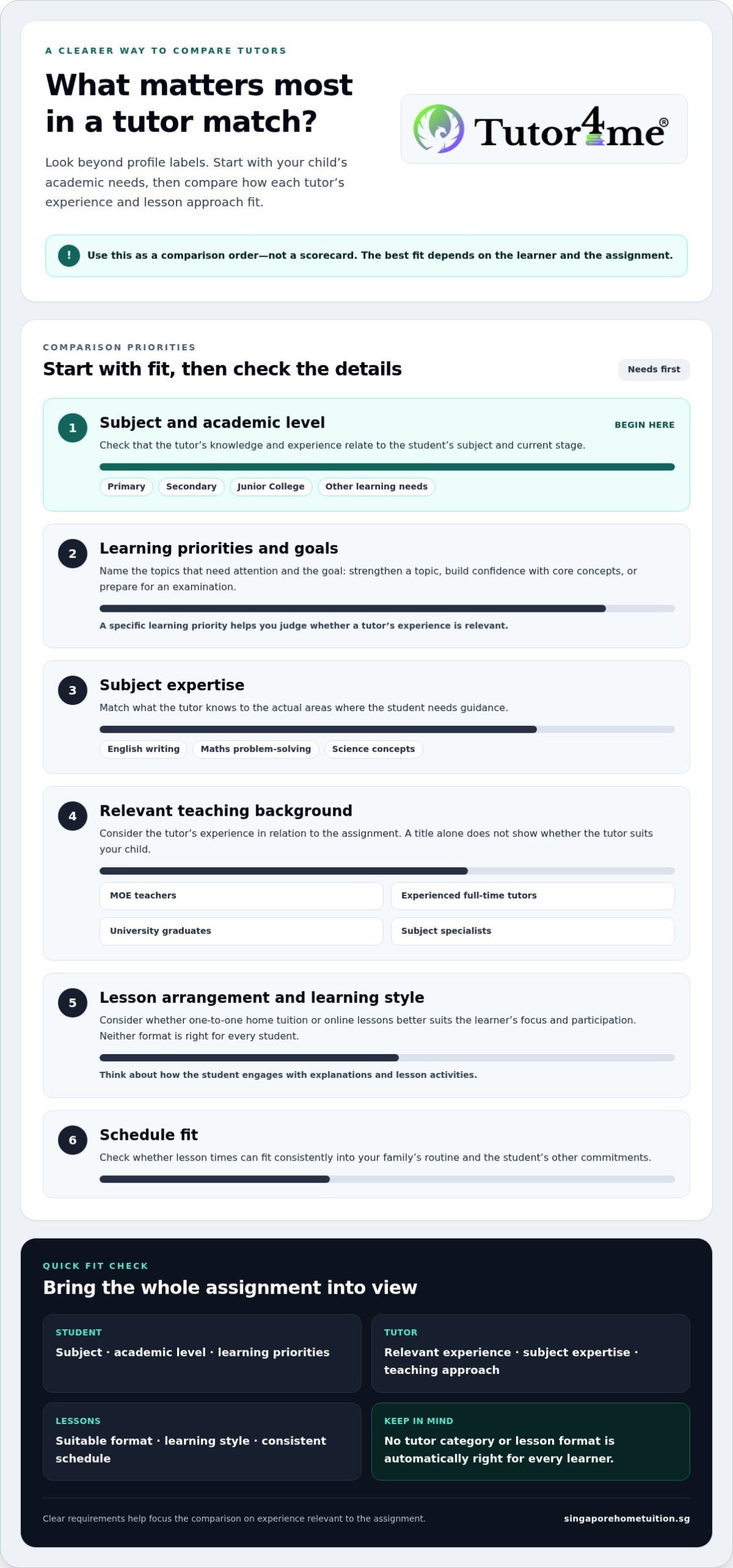
A suitable match depends on your child’s academic needs and how well the tutor’s experience, expertise and teaching approach fit them. Use these criteria when reviewing profiles:
- Tutor background: Consider whether the tutor is an MOE teacher, experienced full-time tutor, university graduate or subject specialist. Look for experience relevant to the student’s current needs.
- Subject expertise: Match the tutor’s knowledge to the subject and the areas where the student needs guidance, such as English writing, Maths problem-solving or science concepts.
- Level familiarity: Consider experience with the student’s academic stage and learning goals.
- Schedule: Identify lesson times that can fit consistently into your family’s routine and the student’s other commitments.
- Lesson mode: Decide whether one-to-one home tuition or online lessons better suits the learner’s focus and participation. Both formats are available, and neither is right for every student.
How should subject and academic level guide your comparison?
Start with the subject the student is taking, then identify the goal: strengthening a particular topic, building confidence with core concepts or preparing for an examination. The tutor’s subject expertise is most relevant when it connects to that priority. For exam support, consider familiarity with the learner’s curriculum and assessment context, whether PSLE, O-Level, A-Level, IB or IGCSE.
For primary-level support, the PSLE Home Tuition Singapore guide can help you think through the learning needs at that stage. The Ministry of Education Singapore also outlines the local education system, giving families context for a student’s level and pathway.
Consider subject and level together. A tutor may know a subject well, but you’ll also want to assess whether their experience suits the student’s current stage and learning goals.
What should you look for in a tutor profile?
Review qualifications, teaching background and experience with the student’s level as separate details. Then consider the learner’s learning style: do they benefit from step-by-step explanations, guided practice or discussion? If problem-solving is a priority, look for a tutor who can help the student work through questions and understand the reasoning behind each step.
Singapore Home Tuition verifies tutor qualifications and ability before matching. Share your child’s subject, level and learning priorities so the team can focus on relevant profiles. If your family is seeking primary-level exam support, explore PSLE home tuition options.
Are Higher Private Home Tutor Rates Always Better?
No. A higher rate doesn’t automatically mean a better student-tutor fit. It may reflect a tutor’s background or the demands of the assignment, but neither tells you by itself whether the tutor’s subject knowledge and teaching experience match your child’s needs.
Use profile details to understand what a tutor may bring to lessons, then decide whether those strengths suit the learner. The comparison below describes possible strengths and fit, not guaranteed academic outcomes.
| Tutor background | Possible strengths to consider | May suit a learner who |
|---|---|---|
| MOE teacher | School teaching experience that may be relevant to structured curriculum support. | Needs guidance connected to school topics or a defined syllabus. |
| Experienced full-time tutor | Dedicated tutoring experience and focused subject instruction. | Benefits from regular, targeted support in a subject area. |
| University graduate | Knowledge linked to their area of study. | Needs support in a subject that aligns with the tutor’s academic background. |
| Subject specialist | Focused knowledge in a particular subject. | Has specific subject goals or needs help with a particular area. |
These are starting points, not rankings. A tutor’s experience with the student’s subject and academic level is more informative than a broad label alone. When comparing private home tutor rates singapore, consider what each profile brings to the assignment instead of assuming a higher rate signals a closer fit.
When might an MOE teacher or experienced full-time tutor suit?
An MOE teacher’s school teaching experience may be relevant if your child needs structured support with curriculum topics. An experienced full-time tutor may suit a learner seeking focused subject instruction or ongoing guidance through challenging material. For either profile, consider experience with the student’s level and learning priorities. Neither background guarantees grades or exam results, and neither is the right fit for every learner.
When might a university graduate or subject specialist suit?
A university graduate or subject specialist may be worth considering when their subject knowledge aligns with the learner’s academic needs. Compare that knowledge with the student’s current level and goals, and consider the tutor’s relevant teaching experience. For secondary-level support, focus on how closely the tutor’s experience matches the learner’s subject and examination context, rather than relying on a category label alone.
Before deciding, identify the support your child needs most. Is the priority understanding class topics, strengthening a particular subject or practising problem-solving? A clear answer helps you assess whether a tutor’s background relates to the student’s learning priorities.
How Can You Plan for Private Home Tuition Before Requesting a Match?
A clear request helps a home tuition agency focus on tutor profiles that fit your child, rather than relying on broad labels or a single rate comparison. Before requesting a match, describe the learner’s academic needs and the practical arrangements your family can support.
Use this preparation process:
- Start with current needs. Note the subject and level, then identify what your child finds challenging or wants to strengthen.
- Set learning priorities. Describe the main goal, such as revisiting class topics, building subject confidence or practising problem-solving.
- Describe learning style. Share whether your child responds well to step-by-step explanations, guided practice or discussion, and where they need extra support.
- Choose a lesson mode. Decide whether home lessons or online tuition is a better fit for your family and learner.
- Set a workable schedule. Identify suitable lesson times and regular commitments that affect availability.
These details connect the learner’s needs with a tutor’s subject background, level familiarity and teaching experience. They also give the matching process practical boundaries, making it easier to compare profiles against your requirements. Clear priorities help you weigh private home tutor rates singapore alongside the relevance of a tutor’s experience.
What information helps a tutor match?
Summarise the student’s academic level, subject, learning priorities and preferred lesson arrangement. Be specific about areas needing support, such as fractions in Primary Maths, essay writing in English or a challenging topic in Secondary Science. Include a short description of the learner’s learning style. This gives the home tuition agency useful context for identifying tutor profiles that align with the assignment.
What should families clarify before lessons begin?
Before lessons start, agree on a suitable schedule, learning goals, communication expectations and subject focus. Review the hand-picked tutor profiles and select a tutor whose background fits your child’s needs. For broader context on one-to-one home tuition in Singapore, families can also refer to a parent guide when planning their approach.
Confirming these details gives the family and tutor shared expectations. Singapore Home Tuition offers zero agency fees, and parents pay only for lessons conducted. This keeps the payment arrangement clear while you focus on selecting a suitable match.
Ready to share your child’s academic needs and find a suitable tutor profile? Request a tutor match with the subject, level, learning priorities and preferred schedule.
How Singapore Home Tuition Matches Families With Suitable Tutors
After comparing tutor profiles, choose an option that fits the learner and your family’s practical needs. Singapore Home Tuition uses the requirements you share to guide the matching process, helping you focus on the details that matter instead of making a decision based on a profile label alone.
What happens after you share your academic needs?
Share the student’s subject, academic level and family requirements so the team can shortlist relevant tutor profiles. You can also explain the main learning priority and preferred lesson arrangement. A student seeking help with one topic may need a different focus from one looking for ongoing support across a subject. This context helps make the profile options relevant to the assignment.
Review the profiles against your priorities. Consider which tutor’s experience aligns best with the subject and level, and whether the proposed arrangement suits the learner. You make the final selection, with the aim of finding an option that fits your child’s needs and your family’s routine.
How does support continue after tutor matching?
Dedicated tutor support is available from registration through student matching. If the existing match is unsuitable, instant reassignment is available. When discussing a change, explain what isn’t working for the learner, such as the lesson focus or fit with their needs. Specific feedback helps guide the search for another suitable match.
For a specialised curriculum such as IB, state that as part of your request. Naming the curriculum distinguishes the assignment from general subject support and keeps the matching focus on what the student is studying.
Your child’s needs may become clearer as lessons progress. Keep learning priorities and practical expectations in view as you assess whether the match remains suitable. Share your requirements with Singapore Home Tuition to request a tutor match tailored to your family.
Take the Next Step With Confidence
Choosing support for your child is a chance to shape learning around what helps them engage and make progress. Treat private home tutor rates singapore as one consideration, then assess whether the tutor’s subject experience, communication approach and schedule make sense for your family.
Before lessons begin, involve your child in setting a clear, manageable goal. They might aim to ask questions more confidently, strengthen a topic or feel more prepared for a subject’s demands. Agreeing on what to work towards gives your family and tutor a shared starting point, with room to adjust the focus as the learner’s needs become clearer.
You don’t need every detail settled before taking the first step. Share what you know about your child’s needs and preferred arrangements, then use the matching process to consider suitable profiles. Start your child’s tutor matching request and take a positive step towards support that fits their learning journey.
Frequently Asked Questions
How much do private home tutor rates in Singapore vary by academic level?
Rates can differ by level, subject and assignment, so a single figure won’t apply to every learner. To compare profiles, consider the student’s syllabus, subject focus and learning goals. A learner reviewing one topic has a different lesson focus from one preparing across an examination syllabus. Defining that scope helps you assess tutor profiles against the work involved.
Do MOE teachers charge more than other private home tutors?
There isn’t one rule that applies to every tutor. An MOE teacher’s background may suit a student who needs structured curriculum guidance, while another tutor may be a closer fit for a particular subject or learning preference. Compare the tutor’s experience with the learner’s level and goals, and consider the support the student responds to. A professional title alone doesn’t show how suitable the teaching approach will be.
Are online private tutors different from home tutors in their rates?
The lesson format alone doesn’t determine a rate. Consider how the student learns best and what the subject requires. A learner working through written Maths problems may prefer a format where they can comfortably share and review their working, while another student may engage well in an online discussion. Assess lesson mode, tutor experience and learner preference together instead of assuming one format is always a better fit.
Does a higher private tutor rate mean better results?
No rate can guarantee academic results. Before lessons begin, agree on a practical learning goal, such as explaining a challenging concept in the student’s own words or completing practice questions with clear reasoning. Discuss how you’ll review that goal over time. This helps your family assess whether lessons address the learner’s needs without treating the tutor’s rate as a measure of progress.
Do parents pay agency fees for Singapore Home Tuition?
Singapore Home Tuition does not charge parents agency fees. As you plan, consider the lesson frequency, subject focus and schedule that fit your family’s routine. These details help clarify the tutoring arrangement before lessons begin. Keep the agreed lesson plan and payment terms easy to refer to, so everyone shares the same expectations.
How quickly can I receive private home tutor profiles?
Singapore Home Tuition delivers hand-picked tutor profiles within 24 hours. To help the team identify relevant options, include the student’s subject, academic level, preferred lesson mode and suitable schedule in your request. Add a specific learning priority too, such as strengthening essay structure or practising a challenging Science topic. Clear details help you assess whether each profile suits the learner’s requirements.
Can I request a tutor reassignment if the match is unsuitable?
Yes. If the match isn’t working for your child, explain what feels unsuitable, such as the subject focus, lesson approach or fit with the student’s learning style. Restate the learner’s priorities so the next steps can take those needs into account. Specific feedback helps clarify what would make a more appropriate tutor match.